This post contains affiliate links. We may earn a small commission when you buy through our links — at no extra cost to you.
The fastest way to sink a family game night is a rulebook longer than the game itself. I’ve watched kids lose the thread around rule three, and I’ve watched a 6-year-old try to fan cards the size of a placemat. What separates a game that gets pulled out weekly from one that dies in a drawer is rarely the theme. It’s whether a kid can hold their hand, learn the rules once, and finish a round before the pizza gets cold.
My team and I played 16 games over four months, with kids, grandparents, and a table that kept changing size. Two things mattered more than I expected: player count and pace. A game that caps at four is lovely until a cousin shows up, and half-hour rounds lose a 7-year-old every time. Card size, too — small hands and oversized cards mean you’re playing their hand for them.
The picks below run from slap-happy party games to quiet rummy-style ones, and each earned its place at a real table, not a rulebook.




Best for Mixed-Age Family Nights
SKYJO
Key Features
- Ages: 8 and up
- Players: 2 to 8
- Contents: 150 cards, notepad, manual
- Play time: About 30 minutes
The second hand is where SKYJO wins people over. There’s no board to reset and no complicated score to catch up on, so after one round the table just deals again, and the game’s hold on a family is set right there. We think it’s the best all-around kids’ card game here because the rules fit in a sentence: everyone builds a small layout of cards, swaps and flips them, and tries to finish with the lowest total.
The arithmetic is the part we watched closest. Two-digit numbers get added at the end of every round and the totals climb, so a six-year-old wants an adult with the scorepad while an eight-year-old starts doing it silently. That’s exactly why the game still has teeth on the tenth play. The box carries a notepad, a manual, and rules printed in English, German, French, Spanish, and Italian.
Player count is the other thing it has over most decks. Two to eight covers a two-kid after-school game, a four-person dinner table, and a full holiday crowd, and turns move fast enough that nobody sits watching for long. It also means the same deck grows with the family instead of being outgrown in a year.
Where it asks something of you: someone has to keep that running score honest, and if it’s you, you’re half-playing. A full game also runs about half an hour, so this is a game you start on purpose rather than squeeze in before bed.
Pros
- Two to eight players fits any family
- Rules taught in about a minute
- Scorekeeping doubles as addition practice
- Notepad and manual included
Cons
- Full game runs about half an hour
- Two-digit totals need an adult’s help
We think it’s the one to buy first: two to eight players, a minute of rules, and scorekeeping that quietly turns into math practice.
Best for Rummy-Loving Families
Five Crowns
Key Features
- Ages: 8 and up
- Players: 1 to 7
- Storage: Cardboard box
- Contents: Cards and rulebook
- Price: Budget
Count the suits in Five Crowns and something is off: spades, hearts, clubs, diamonds, and stars. That fifth suit is the whole personality of the game, turning a familiar rummy hand into something a kid has to look at twice before deciding what to keep.
The wild card changes from round to round, so the card hoarded two hands ago is suddenly ordinary and the child who was paying attention is ahead. We noticed that’s where the game grips: making books and runs is easy to explain, but tracking which rank is wild this time is genuine memory work, and a nine-year-old can be better at it than an adult who is half-listening. One to seven players takes it from a two-person after-school game to a full holiday table.
This is the pick for a family that already plays rummy and wants the sharper version, and for parents who want a game that keeps an eight- or nine-year-old thinking rather than reacting. A six-year-old will want a partner for the first few rounds while the wild card settles into their head.
Pros
- Fifth star suit freshens plain rummy
- Changing wild card keeps adults engaged
- One to seven players, small travel-ready box
Cons
- Deck and box feel light for repeat play
The upgrade we point rummy families toward — a fifth suit and a moving wild card keep older kids thinking between hands.
Best for First Card Game
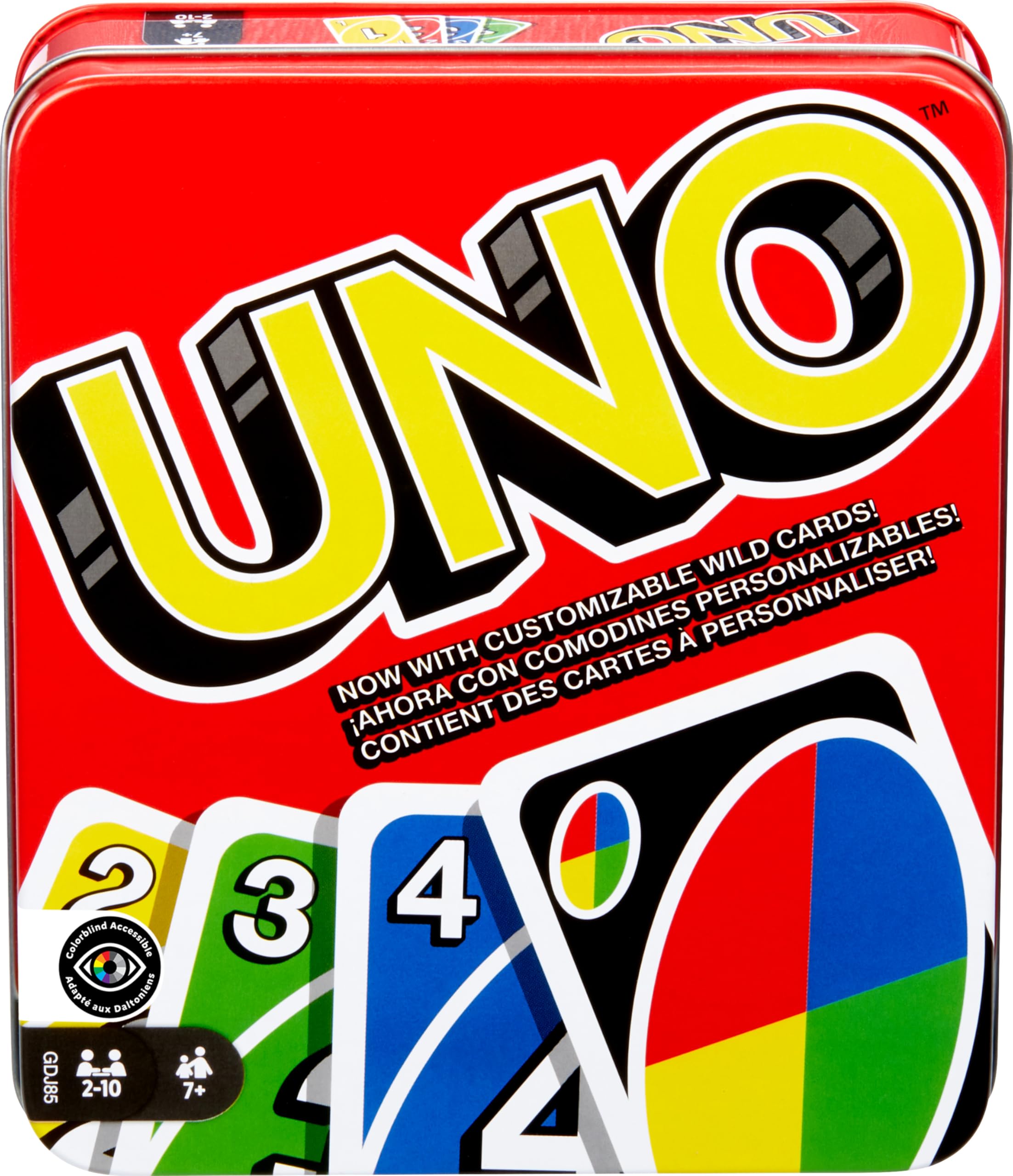
UNO
Key Features
- Ages: 7 and up
- Cards: 112 cards
- Players: 2 to 10
- Storage: Metal tin
- Price: Budget
The tin is the reason to buy this version rather than the one in a folding box. It snaps shut, swallows the whole 112-card deck, and comes out of the bottom of a backpack the way it went in. The deck adds three blank wild cards you can write house rules on and wipe clean, and every card carries a symbol for its color, so a color-blind player at the table isn’t guessing.
As a first card game, it’s still the easiest sell here: seven and up, two to ten players, no reading beyond numbers and colors, and rules most grown-ups already know — which matters more than it sounds when a grandparent sits down. Two things to know before you order. The cards run smaller than a classic UNO deck, and the tin is roomier than the deck needs, so it takes more bag space than it should.
Pros
- Metal tin outlasts the usual cardboard box
- Color symbols on every card
- Three blank wilds for house rules
Cons
- Cards run smaller than a classic deck
- Tin takes more bag space than the deck needs
Our budget pick: the game most kids already know, in a tin that outlasts the cardboard box it normally comes in.
Best for Loud Group Play
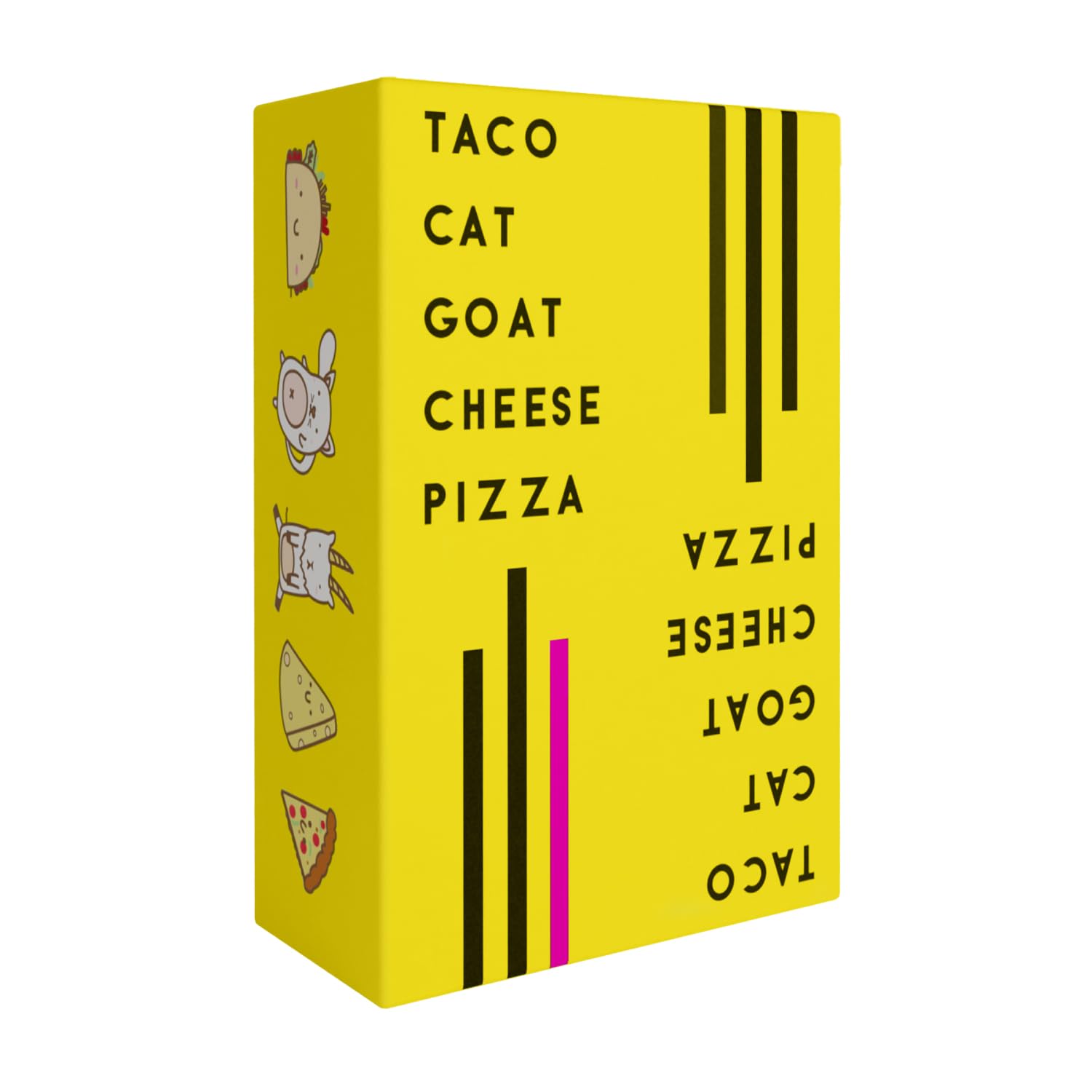
Taco Cat Goat Cheese Pizza
Key Features
- Ages: 8 and up
- Players: 2 to 8
- Play time: 10 minutes
- Price: Budget
One round in, the table is chanting — taco, cat, goat, cheese, pizza, one word per card flipped — and the moment a spoken word matches the picture, every hand lands on the pile at once. There is no strategy and no quiet. There is a lot of laughing.
Two to eight players, ten minutes a round, and a rule set you can teach in under two minutes. The action cards break the chant at exactly the right moment and give all that shouting somewhere new to go, and the box is small and light enough to disappear into a tote bag on the way to a restaurant.
It’s also a contact sport. The pile takes a beating because everyone reaches for the same square inch, and we set a house rule the first night: taps only, nails trimmed, and nobody diving across the table at a younger kid’s hand.
It’s the funniest game in this guide and the one that gets requested again the same evening. It is not, however, a restaurant-whisper game, and it’s a poor fit for a child who minds being slapped or losing a hand in front of everybody.
Pros
- Ten-minute rounds you can teach in two
- Small, light box that travels
- Action cards keep rounds from repeating
Cons
- Cards soften at the corners from grabbing
- Too loud and physical for some tables
The funniest ten minutes here, and the one we hand over when a table needs noise, jokes, and no strategy at all.
Best for Kids Who Scheme
Monopoly Deal
Key Features
- Ages: 8 and up
- Cards: 110 cards
- Players: 2 to 5
- Play time: 15 minutes
- Price: Budget
Monopoly Deal keeps the part of the board game kids actually care about — collecting property, charging rent, taking a set out from under someone — and puts it in 110 cards with no board, no banker, and no two-hour cleanup. A hand runs about fifteen minutes and ends the moment someone completes three property sets in different colors.
It’s the best strategy game here, and the reference cards are why: a child can check what an action card does without asking an adult, which keeps the turn moving and keeps them in charge of it. Two limits. Five players is the ceiling, so a big family has to split, and the stealing is the entire point, which a sore loser will feel.
Pros
- Fifteen-minute hands, not a whole evening
- Reference cards let kids run their own turns
- Real trading tension in card form
Cons
- Caps at five players
- Property stealing upsets sore losers
We recommend it for the kid who wants to scheme: real property trading, fifteen-minute hands, and reference cards that keep turns moving.
Best for Quick School-Night Rounds
Flip 7
Key Features
- Ages: 8 and up
- Cards: 94 cards
- Players: 3 or more
- Play time: 20 minutes
- Price: Budget
Flip 7 is a game about not getting greedy. Take a card; if that number is already in front of you, you bust out of the round. Stop in time and what you’re holding becomes points. The deck is stacked to make stopping hard — twelve 12s and eleven 11s at the top, working down from there — so the cards most likely to turn up are also the ones that hurt most when they repeat.
The action cards (Flip Three, Freeze, Second Chance, and the score modifiers) are what lift it above a coin flip, and they’re simple enough that a third grader reads one once and remembers it. Three or more players, twenty minutes, ninety-four cards, and a race to 200 points that a kid can score alone.
This is the one we reach for when there’s half an hour before bed and everyone wants a decision to make. The addition is real — your own row, then the round total — but it arrives as scorekeeping rather than homework. The catch is the headcount: with two kids at the table you need a third, so it’s a family-night game, not a pair game.
Pros
- Rounds end fast, so nobody waits
- Action cards add decisions beyond luck
Cons
- Needs three players at minimum
Our quick-round favorite — press your luck, dodge duplicates, and finish before the next thing on the schedule starts.
Best for Preschoolers and Beginners
Regal Games 6-Pack

Key Features
- Players: 2 to 6
- Card size: 4 inches by 2.75 inches
- Decks included: Six
- Price: Premium
Six decks come in this box — Old Maid, Go Fish, Crazy 8’s, Slap Jack, War, and Garbage Monsters — and there isn’t one among them that needs a rulebook opened first. Instructions come in each pack anyway, which matters if the last time you played War was decades ago.
The cards are the reason to pick this over a dollar-store version: four inches wide by 2.75 inches tall, enough for a four-year-old to fan and hold without a helper, with bold art that makes the matching in Go Fish and Old Maid readable at a glance.
It’s also the most expensive thing in this guide by a wide margin, and that’s the honest trade. If you want one game, buy one game. If you have three kids, a classroom, or a party-favor list to fill, six decks at once is the version that makes sense.
Where it earns its place is the bottom of the age range. This is the set we hand to a family whose youngest is still learning to hold cards, and it buys a couple of years before the rest of this list is ready. Once everyone is eight, they’ll want SKYJO or Flip 7 instead; the Regal box is the on-ramp, not the destination.
Pros
- Six classic games in one box
- Oversized cards suit small hands
- Instructions included in every deck
Cons
- Cards feel thin for the price
This is the set we hand to families with preschoolers: six classics, oversized cards, and instructions in every deck.
Best for Pre-Readers and Groups
Piles

Key Features
- Ages: 8 and up
- Players: 2 to 8
- Play time: 10 minutes
- Price: Midrange
There’s no text anywhere on the cards in Piles, only colors and numbers, and that’s the reason we keep it in the bag: it’s the one game here that puts a five-year-old and a grandparent on equal terms. Nobody reads a card, and nobody reads a rule mid-hand.
It plays like a free-for-all version of Speed. Two to eight players, ten minutes, everyone reacting at once, so there are no turns to wait through. The rule sheet is the weakest part of the package: setup means sorting matched sets for however many people are playing, and the instructions make that sound fussier than it is. One practice round with the cards face up teaches it faster than the paper does.
Where it shines for us is travel — cards only, pocket-sized, nothing to decode. It’s reflex rather than decisions, though, so a child who wants to out-think somebody will be bored inside ten minutes.
Pros
- No text, so pre-readers can play
- Two to eight players, no waiting for turns
Cons
- Setup sorting before each round
- Reflex-only play, no strategy
We keep it for mixed-age tables that can’t share a rulebook — no text, no turns to wait for, ten minutes from deal to rematch.
How We Tested the Best Card Games for Kids
We started with about 40 titles — classics, party games, newer imports — and cut anything that needed an app, an expansion, or more than five minutes of explanation before the first hand. That left 16 games, played over four months in the places they actually live: a kitchen table after school, a Sunday dinner with grandparents at one end, a two-hour drive, and a birthday party where half the kids had never seen the game before.
Setup was the first filter. We timed how long one adult took to shuffle and deal while a 7-year-old waited, and noted which games lost the table in that window. Then we taught each one out loud, once, without the box in hand, and watched who looked confused — that told us more about the printed age range than the box copy did.
Once play started, we watched for real decisions. Some games look strategic and turn out to be luck with extra steps; the ones that held up let a kid make a choice and then explain why. We noted who drifted off and at what minute, how long a round actually ran, and whether anyone asked to play again before the cards went back in the box.
Card quality got its own pass. We shuffled each deck 20 times and checked for bent corners, peeling edges, and ink that rubbed off on fingers. Every kid at the table dealt themselves a hand, fanned it, and pulled a card out — oversized cards are charming until small hands can’t manage them. Value came down to the deck, the rules card, and whether the box would survive a shelf.
How to Choose Card Games for Kids
The right deck for your family is the one whose rules your youngest player can hold in their head by the end of the first round — everything else is preference.
Check the Age, Then Check the Reading
The number on the box is a guess about reading and reasoning, not a promise. A game listed for eight and up usually assumes a child can hold a rule across a turn and compare or add numbers; seven and up often means nothing more than colors and pictures. Then look at what’s printed on the cards themselves. A deck with no text at all, like Piles, plays with four-year-olds and with a grandparent who left the reading glasses upstairs.
Count the Seats Before You Buy
Player count is where most purchases go wrong. Flip 7 needs three at the table, Monopoly Deal stops at five, and UNO takes ten, so a game with a three-player minimum is a wasted buy for two siblings on a rainy afternoon.
Then look at whether players take turns or act at once. A game where everyone reaches for the pile has no downtime; a rummy game with six players means five people watching one. For a wide age spread, the simultaneous games are usually the kinder choice.
Match the Length to the Evening
Read the time on the box as one round, not one sitting. A ten-minute round fits between dinner and bath; a game scored to 200 or 500 points is a half-hour commitment — fine on a Sunday, hopeless on a school night. The trap is buying the longer game for a short window and then house-ruling it into something nobody wants to finish.
Balance Luck Against Strategy
Mixed ages need enough luck that the youngest can win and enough decisions that the oldest stays awake. Pure reflex hands the advantage to whoever is quickest, which is rarely the six-year-old. Rummy-style and press-your-luck games split it better: Five Crowns rewards memory, Flip 7 rewards nerve, and in both a lucky hand can beat a careful one.
Look at What Survives a Backpack
A metal tin outlives a cardboard box by years, and a lid that stays shut is worth more than a theme. Card size cuts both ways: the oversized cards in the Regal set are easier for small hands, while a compact deck packs into a suitcase. If the game will travel, check the storage before you check the artwork.
Frequently Asked Questions
How do you teach a new card game to a kid who won’t sit through the rules?
Deal a practice hand with every card face up and play two rounds with the rules open on the table. Explain only the move in front of you, not the whole system, and skip scoring the first time. Most decks here click within a round or two; the ones with a moving wild card go faster with an adult playing as a partner for one night.
Do any of these work on a plane or in a car?
The deck-only games travel best. Piles, Taco Cat Goat Cheese Pizza, and Flip 7 need no more room than a tray table and have no board to set up. SKYJO and Five Crowns ask each player to spread out and sort cards, which is tight in a middle seat but fine at a restaurant or on a train. Anything scored on paper needs a flat surface, so save it for a table.
Will kids still play these after a month?
Short-round games last, because a rematch costs ten minutes rather than an evening. Rotate two or three decks instead of buying one heavy game, and let house rules grow — UNO’s blank wilds and Flip 7’s modifier cards invite it. What usually ends a game’s life in a house with kids isn’t boredom; it’s one missing card, so count the deck after a holiday.
Final Verdict
If you’re buying one deck this month, buy SKYJO. It handles two players or eight, explains itself in a minute, and slips arithmetic past kids who would rather not do arithmetic.
If your family already plays rummy, Five Crowns is the sharper game and the better long-term buy for kids eight and up. And if the youngest at your table is still learning to hold a fan of cards, start with the Regal six-pack and come back to the rest of this list in a year.
