This post contains affiliate links. We may earn a small commission when you buy through our links — at no extra cost to you.
By the third rainy day in a row, a ball pit stops being a novelty and becomes infrastructure — a soft place for a toddler to fall down on purpose, and a place to put them while you drink something hot. Cheap ones announce themselves fast: walls that slump when a kid leans in, seams that split by week two, a footprint that won’t fold down smaller than a couch cushion.
Most of what’s sold online is one of two things: a round pit with a foam core under a fabric cover, or a pop-up tent with mesh walls that springs open and collapses flat. Neither kind comes with balls — every pit we tested shipped empty — so budget for 100 to 200 balls on top of the price.
I’ve kept one of these in my living room for two years, and over the past three months we put 12 of them through daily use, including a foam pit that got jumped on and a pop-up tent that got folded and unfolded more times than I could count. Here’s what held up.


Best for Babies and Toddlers
SHJADE Foam Ball Pit
Key Features
- Cover: Removable and washable
- Unfolded size: 35.4 x 35.4 x 11.8 inches
- Foam thickness: 2 inches
- Recommended age: 12 months to 12 years
- Price: Midrange
At 11.8 inches tall with a two-inch foam rim, the SHJADE is the ball pool we point to first when a child is still finding their balance. The foam gives a wobbly sitter a soft edge, and the low wall lets a toddler crawl over the side instead of getting stuck behind a door flap.
The 35.4-inch round footprint fits a playroom or the end of a living room, and the zip-off cover is the detail we appreciate most: crumbs, spills, and the sticky film that balls pick up come off with the cover instead of becoming part of the furniture. The foam has enough give that a child who tips backward meets padding rather than a hard frame.
It arrives vacuum-packed, and the brand notes full round shape can take 2 days to 3 weeks. Unbox it early, use the hairdryer or pillow trick if you are impatient, and judge the pit after it has had time to relax. That wait is the cost of the softer build, and it is worth it if you are setting up before a birthday rather than on the morning of.
The 12-month-to-12-year age range is generous, but the real sweet spot is the baby-and-toddler years; once a child wants to stand up and hide, the taller Kiddzery is the better shape. For the first pit, this is the one we choose when comfort and cleanup matter more than room to stand.
Pros
- Soft two-inch foam rim
- Washable zip-off cover
- Low walls for easy entry
Cons
- Bottom insert can slide under balls
We recommend the SHJADE for babies and young toddlers because the foam rim is forgiving, the cover washes, and the low sides let them climb in without help.
Best for Older Toddlers
Kiddzery Pop-Up Ball Pit
Key Features
- Frame: Plastic
- Carry bag: Included
- Unfolded size: 39 x 39 x 39 inches
- Recommended age: 36 months to 10 years
- Price: Budget
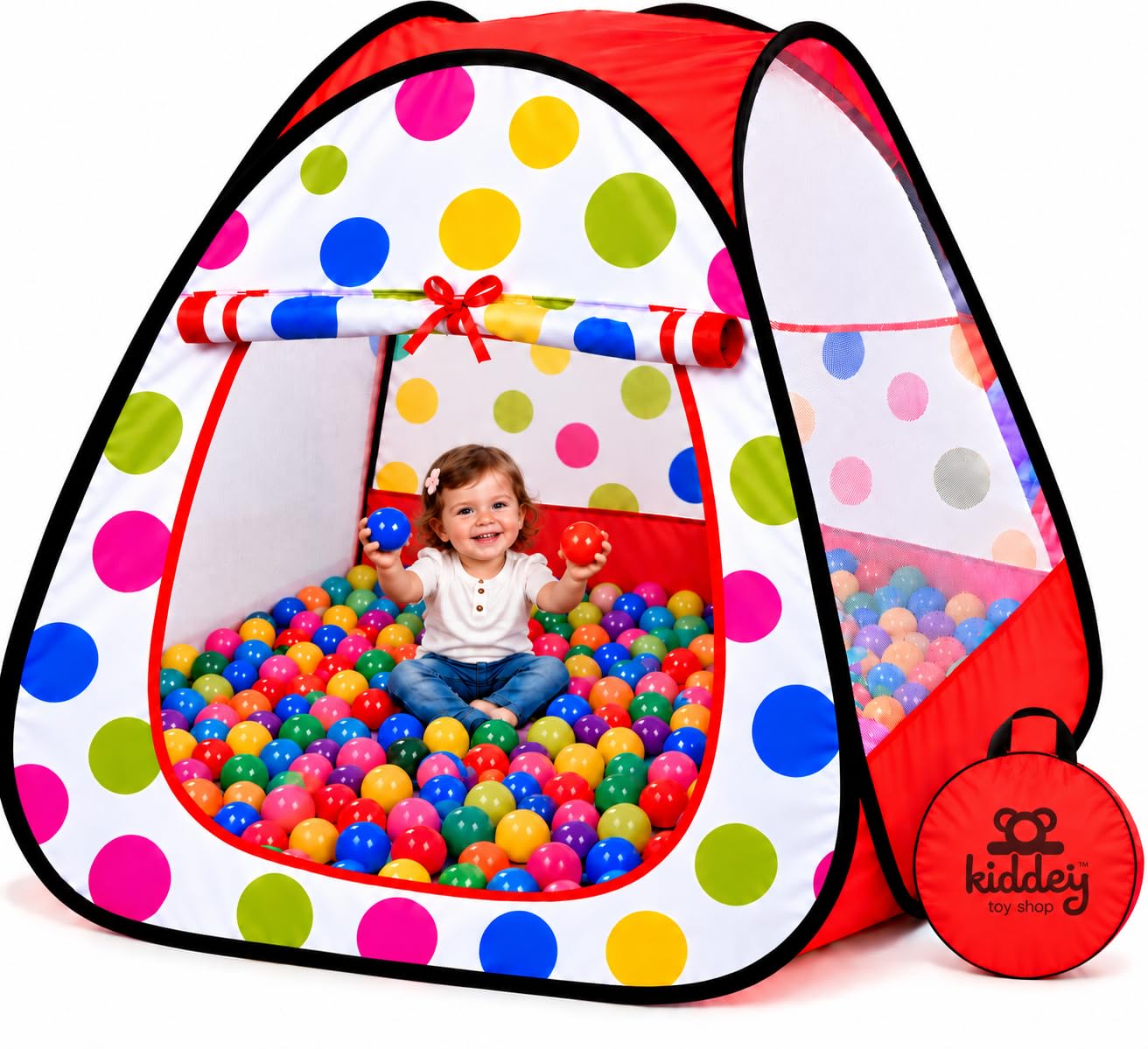
The Kiddzery starts at 36 months, and that age minimum is the most useful thing to know about it. This is not the soft landing spot for a new walker; it is a tall, enclosed play tent for a child who can work a door flap and wants a hideout.
At 39 inches square and 39 inches tall, it has more vertical room than the shallow pits, and we like that two preschoolers can sit inside without being folded into the walls. The pop-up frame is the quickest setup in this group, and the polyester walls wipe clean after snacks or a muddy afternoon.
Folding a pop-up back into a circle takes practice; open and close it once before you hand it over. The carry bag keeps it tidy between uses, and the 1.3-pound frame is light enough to hang on a hook in the garage.
This is the one we choose when the pit needs to do double duty as a reading nook or a fort. The trade-off is that it feels more like a tent than a padded baby space, so it rewards a child who is steady on their feet.
Pros
- Tall 39-inch play space
- Quick pop-up setup
- Wipe-clean polyester walls
Cons
- Door flap uses Velcro tabs
- Balls sold separately
We recommend the Kiddzery for preschoolers who want a playhouse they can stand inside, especially when it needs to move between rooms or into the yard.
Best for Budget Playrooms
Eocolz Pop-Up Ball Pit
Key Features
- Included: Basketball hoop and storage bag
- Unfolded size: 39.4 x 39.4 x 14.5 inches
- Recommended age: 6 months and up
- Suggested balls: 200 to 300
- Price: Budget
A small basketball hoop and a low price are the Eocolz’s whole pitch, and that combination is enough for a lot of playrooms. It is a shallow pop-up rather than a playhouse, so think of it as a place to sit, roll, and toss rather than a room to stand up in.
We like the 39.4-inch square footprint for two toddlers, and the 14.5-inch walls are low enough for a child to climb in without help. The hoop gives a target for older siblings, and the included storage bag makes the whole thing easy to move out of the living room when the day is done.
Opening is quick, and the listed 9.6-ounce weight makes it easy to carry, but a pop-up this size still needs two hands and a clear space to open. It is the budget pop-up we reach for when the hoop will actually get used.
The suggested fill is 200 to 300 balls, which is a useful number to have before you order; a sparse pit loses its appeal fast. Wipe the polyester with a damp cloth, let it dry fully, and the pit is ready for the next round.
Pros
- Basketball hoop adds target play
- Roomy 39.4-inch square footprint
- Lightweight with storage bag
Cons
- Can be stubborn to fold back
- Balls sold separately
We recommend the Eocolz when you want a roomy pop-up and a hoop without spending much, as long as you are patient with the fold-down.
Best for Color-Matched Playrooms
Zedachica Foam Ball Pit

Key Features
- Size: 35.43 inches
- Cover: Zippered and removable
- Balls included: No
- Recommended age: 12 months to 3 years
- Price: Premium
More money buys a softer color palette and a zip-off cover with the Zedachica, not a different basic shape from the SHJADE. Both are 35-inch foam rings with low walls and washable covers; the Zedachica’s case is finish, not function.
At 35.43 inches across and 11.81 inches high, it gives a toddler the same low, padded shape we like in the SHJADE. The cover unzips for cleaning, and the memory foam is soft but not so squishy that the wall collapses when a child leans on it. It is easy to move around the room, which matters if the pit lives in the middle of the floor.
Our verdict is that the Zedachica is the finish-first foam pick, not the default. The 12-month-to-3-year age range is shorter than the SHJADE’s, and the higher price buys color and finish more than extra function. If the color is what makes you keep the pit out instead of in a closet, that is worth something.
Pros
- Soft memory foam sides
- Zip-off washable cover
- Several color options
Cons
- Base foam insert can shift
We recommend the Zedachica when you want a foam pit with a color that suits the room and a cover that unzips; the SHJADE is the better value.
Best for Simple Portable Play
EocuSun Pop-Up Ball Pit

Key Features
- Frame: Alloy steel
- Storage bag: Included
- Unfolded size: 39.4 x 39.4 x 14.5 inches
- Recommended age: 6 months to 5 years
- Price: Budget
The EocuSun is the plainest pop-up in this group: no hoop, no playhouse theme, just a shallow square of polyester and a storage bag. That sounds like faint praise, but it is also the point; there is less to clean and no hoop to fight over.
At 39.4 inches square and 14.5 inches tall, it is the same shallow shape as the Eocolz and a good fit for two toddlers. We like it for a grandparent’s house or a second pit because it folds into a bag and is light enough to move from room to room. The 6-month-to-5-year range is broad, which makes it a useful hand-me-down.
Our take is that the EocuSun is a good low-cost second pit for calm play, not the one we choose for daily roughhousing. The soft walls are gentle for bumps, and the low height lets a toddler climb in without a door flap, but the shape is better for sitting and crawling than for climbing. If the pit will spend most of its life in a playroom and only come out for visits, that is a fair trade.
Pros
- Simple pop-up with storage bag
- Low walls easy for toddlers
- Fits two toddlers
Cons
- Steel supports can bend under rough play
We recommend the EocuSun as a simple, low-cost pop-up for calm toddlers, not for children who lean and climb on the walls.
How We Tested the Best Ball Pits
We started with the best-selling, most-reviewed pits on the major retailers, then cut anything with a pattern of split seams in the reviews, anything whose listed dimensions didn’t square with its stated ball capacity, and anything that came in only one size. That left 12 pits across both formats — foam-core rounds and pop-up tents — spanning footprints small enough for an apartment corner and wide enough for a finished basement. Testing ran three months, in a living room, a carpeted playroom, and a backyard with kids ranging from 1 to 4 years old.
Every pit got the lean test: I pressed my full weight on the rim, then sat a 30-pound toddler against the inside wall to see whether the whole thing rolled, tipped, or held. I checked seams, stitching, and fabric at day one, week two, and week eight, and washed every removable cover the way its tag instructed. Foam pits were judged on whether the core sprang back after a jumping session; tents were judged on whether the walls still stood square after a week of being climbed on.
Setup and pack-down were timed solo, then again with a baby on one hip, with the clock running until the pit was either standing or back in its carry bag. I measured the actual interior width and depth against the listing, then added balls in 50-count increments until a kid could sit inside without touching the floor — necessary, since not one pit arrived with balls included. Playability came down to watching: whether kids came back to it on day 10 as eagerly as day one, whether balls escaped through the mesh overnight, and how much of the room it still ate when empty. Last, we weighed price against the cost of filling it, because a cheap pit that needs 200 balls isn’t the cheaper option.
How to Choose a Ball Pit
Start with the child’s age and the floor space you can spare, then decide how much setup and cleanup you are willing to manage.
Match the design to the child’s stage
For a baby who is sitting or cruising, a foam ball pool is the more forgiving choice. The SHJADE’s two-inch foam rim gives a wobbly child a soft edge, and its 11.8-inch wall is low enough to crawl over. A pop-up play tent such as the Kiddzery is better once a child is 3 and wants to stand, hide, and move through a flap. Treat the age range as a starting point, not a guarantee; the Kiddzery’s 36-month minimum is the clearest boundary in this group.
Measure the footprint and wall height
A 35-inch round foam pit and a 39-inch square pop-up take up very different amounts of floor. The round pit tucks into a corner; the square tent needs a clear wall or a dedicated play area. Height changes the job too: an 11.8-inch foam wall is easy to step over, while a 39-inch play tent gives a preschooler room to stand. Leave a walkway around the pit so balls can be retrieved without moving furniture.
Plan for setup, folding, and foam recovery
Pop-up pits open in seconds, but folding them back into a flat circle and a bag is the skill nobody masters on the first try. If the pit will live in one room, that matters less; if it travels to grandparents or the yard, open and close it once before the child sees it. Foam pits arrive vacuum-packed, and the SHJADE may take 2 days to 3 weeks to reach full round shape. Unbox it early and let it relax before a birthday or holiday.
Check the cover, base, and cleaning routine
Foam pits live or die on their covers. A zip-off, washable cover is worth paying for because it handles spills, crumbs, and the sticky film that balls pick up. Also check the base: a separate foam insert can slide under a heavy layer of balls, and a smooth floor lets the whole pit skate. A low-pile rug or play mat helps it stay put and softens the thud when a child flops in.
Frequently Asked Questions
Do ball pits come with balls?
No. Every pit on this list is sold without balls. Eocolz suggests 200 to 300 for its size; for any pit, ball diameter changes the count, so buy a smaller batch first and add more if the floor looks sparse. Balls are a separate cost, and they are the main reason a budget pit does not stay budget.
Can I use a ball pit outside?
The pop-up designs are the outdoor-friendly ones; the Kiddzery and EocuSun use polyester walls over a frame and wipe clean. Keep a foam pit indoors, because the fabric cover and thick foam are harder to dry if they get damp. Bring any pop-up inside when the grass is wet or the sun is harsh.
Can a ball pit double as a playpen?
No. These are low, soft-sided play spaces, not secure enclosures, and none is meant for unsupervised containment or sleep. Use one while you are nearby, and keep it away from stairs, furniture edges, and anything a toddler can pull over. If you need a safe containment space, choose a dedicated play yard instead.
Final Verdict
For a baby or young toddler, the SHJADE is the one we recommend: the foam rim is forgiving, the cover comes off for washing, and the low sides let a child climb in without help. If your child is 3 or older and wants a playhouse, the Kiddzery is the better fit. The Eocolz is our budget pop-up pick when you want a hoop and can live with a fiddly fold.
