This post contains affiliate links. We may earn a small commission when you buy through our links — at no extra cost to you.
A piggy bank has one job, and it comes with a conflict baked in: the money goes in, and sooner or later someone has to get it back out. Ceramic banks look lovely on a nursery shelf until a 4-year-old carries one across a tile floor, and plenty of the plastic ones that survive the drop are so plain a kid never bonds with them.
I still have my first bank, a ceramic elephant my dad glued back together twice with the coins permanently inside. That’s the trap I wanted to avoid, so my team spent four months testing 16 banks with real families, watching which ones got hauled around by the ears and which sat ignored in a drawer.
Two things matter more than anything printed on the box: the coin slot, since a narrow one frustrates small hands and a wide one lets a kid shake everything back out, and how the bank opens, because a stopper underneath is worth more than a pretty glaze. If it’s headed to a birthday party, the safe bet is the one that survives the walk there.




Best for First Piggy Bank
PJDRLLC Unbreakable Plastic Piggy Bank
Key Features
- Colors: More than 10
- Material: Plastic
- Dimensions: 5.5"L x 4.7"W x 4.9"H
- Coin access: Twist-off bottom knob
- Price: Budget
Toddlers don’t save so much as carry money around, and this bank is built for that stage. The plastic is thick enough to feel solid instead of hollow, it takes a drop onto a kitchen floor without a crack, and the knob on the bottom twists off with a motion a 4-year-old can manage alone. That last part matters more than it sounds: a bank a child can open is a bank a child will use.
Size is the thing to check before you order. At about 5.5 inches long it looks smaller on a dresser than the listing photos suggest, and a kid picturing a giant pig may be disappointed. What it lacks in presence it makes up for in choice — more than ten colors, so two siblings can have identical banks in different shades, plus a sheet of gem stickers kids slap on before they’ve saved a penny.
The bottom plug is the one weak point. The small tabs on it can snap if a child yanks rather than twists, so work it with them the first few times and it stays whole. Beyond that, this is the bank we hand to a 3-year-old without a second thought, and it costs less than anything else in this guide.
Pros
- Thick plastic survives drops and daily handling
- Twist-off bottom a young child can work alone
- More than ten colors for siblings
- Gem stickers included for decorating
Cons
- Looks smaller in person than the photos imply
- Bottom plug tabs can snap if forced
Our default pick for a first bank: thick plastic that survives drops, a twist-off bottom small hands can work, and enough colors to keep siblings apart.
Best for Nursery Shelf
Pearhead Ceramic Piggy Bank
Key Features
- Weight: 1.7 lb
- Material: Ceramic
- Dimensions: 6.5"L x 5.55"W x 6.5"H
- Coin access: Removable rubber stopper
- Price: Budget
Pink with white polka dots, soft feet so it doesn’t scratch a dresser, and a rounded, classic pig shape. Sitting next to a lamp and a frame it looks like it belongs there rather than like a toy someone left behind, which is exactly what you want from a bank that arrives before the baby does.
What keeps it useful is the removable rubber stopper underneath. A sealed ceramic bank is a pretty object; this one can be opened, emptied, and filled again, and the 6.5-inch body holds more loose change than you’d guess from the outside. At 1.7 pounds it has real weight in the hand, and the ceramic reads as substantial rather than hollow.
In our book it stays on a dresser or a high shelf: a bank you lift down for a counting session, not one that rides in a backpack. That’s the trade — a keepsake first, a daily tool second — and worth it if the shelf is where the bank will live anyway.
Pros
- Polka-dot ceramic looks at home in a nursery
- Removable stopper makes it a working bank
- Soft feet protect furniture
- 1.7 pounds feels substantial in hand
Cons
- Ceramic chips, and paint flaws show up
A nursery-shelf bank that still works: we like the polka dots and soft feet for a shower gift, and the stopper means it isn’t just decoration.
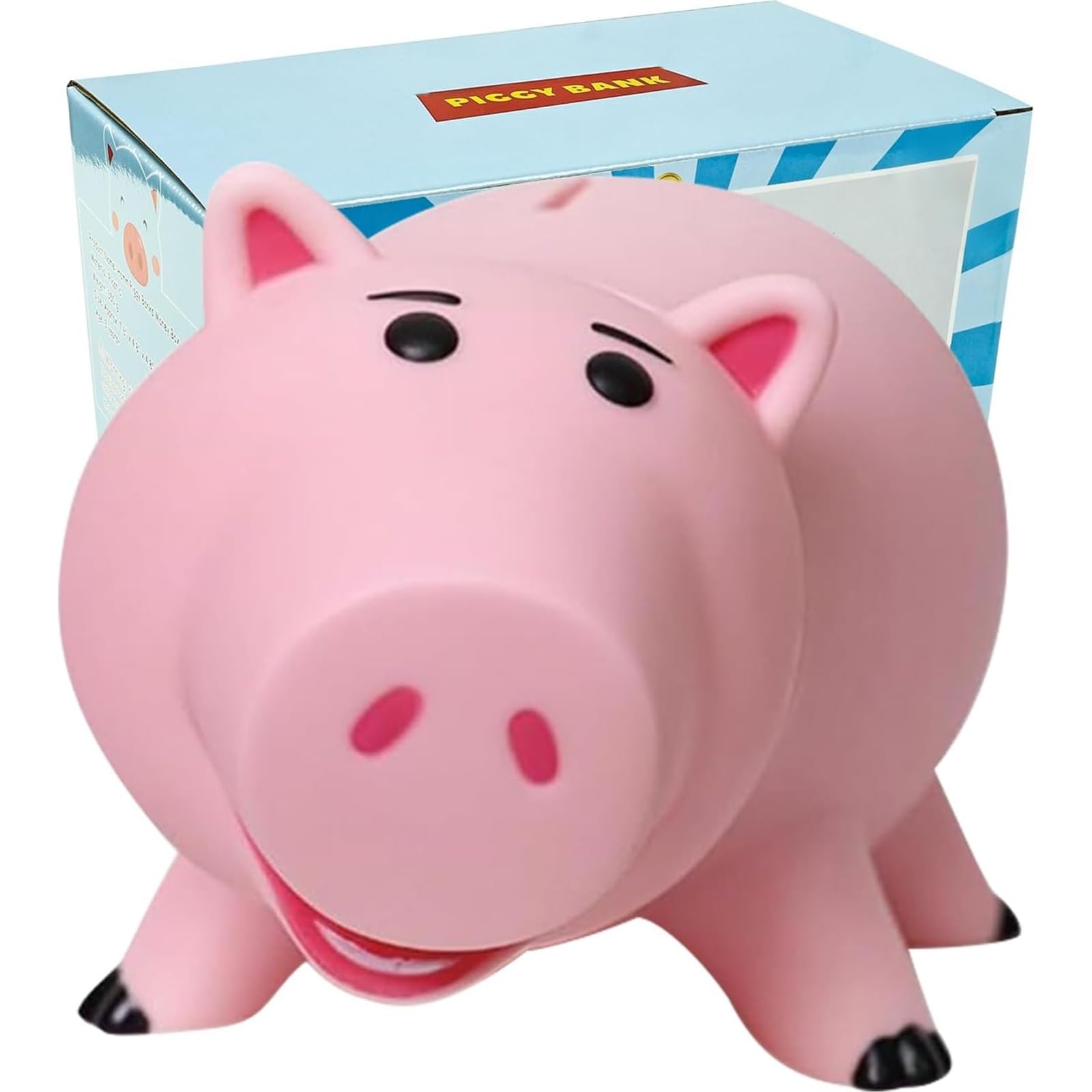
Best for Toy Story Fans
PHOCAS Hamm Piggy Bank
Key Features
- Weight: 8.8 oz
- Material: Hard plastic
- Dimensions: 7.6"L x 4.8"W x 4.8"H
- Coin access: Twist-out bottom stopper
- Price: Midrange
The likeness is the whole pitch, and it holds up — the snout, the shape, the faintly smug expression all read as Hamm rather than as a generic pig with a logo slapped on. That matters more than it sounds, because a character bank gets played with, and a bank that gets played with gets used.
It’s hard ABS plastic, 7.6 inches nose to tail and about 8.8 ounces, so a 4-year-old can carry it one-handed and the plastic has enough give that a drop onto tile doesn’t crack it. The bottom stopper twists out for emptying, and the interior takes folded bills alongside coins, which is more than most pig-shaped banks manage.
The head comes off for bigger deposits — handy for a birthday envelope — but the listing is upfront that it takes a little strength, so do that part yourself before you wrap it. After that, daily use is coins through the slot and a twist of the stopper, which is the right amount of machinery for a kid who mostly wants to play with the pig.
Pros
- Looks like Hamm, not a generic pig
- Hard plastic takes drops
- Holds bills as well as coins
- Removable head for larger deposits
Cons
- Smaller in person than the photos imply
- Small coins can hang up inside
For a Toy Story fan, this is the one we hand over: a hard-plastic Hamm that survives drops and takes bills as well as coins.
Best for Toddlers
H&W Squint Pig Money Bank
Key Features
- Weight: 12.3 oz
- Material: PVC vinyl
- Dimensions: 6"L x 8"W x 8"H
- Coin access: Twist-and-lock bottom plug
- Price: Midrange
The coin slot sits in the pig’s mouth, which sounds like a gimmick until you watch a toddler use it. There’s no narrow slit to line up — a 2-year-old holds a coin, aims at an open mouth, and drops it in. Feeding the pig becomes a game, and games get repeated, which is most of what a first bank needs to do.
The body is PVC vinyl, about 6 by 8 by 8 inches and 350 grams: light enough to carry, slightly soft to the touch, and tough in the way that matters. It takes a drop, a sit-on, or being dragged by a leg without cracking, and a twist-and-lock plug in the bottom empties it when the pig gets full.
We’re fond of the face, too. A squinting, cheerful pig reads as decor in a way most plastic banks don’t, which counts in the years between a nursery and a big-kid room. The honest caveat is the material: it’s PVC, and some families would rather not have vinyl in something a toddler handles daily. If that’s you, the plastic pig in our top pick is the closest substitute.
Pros
- Mouth slot a toddler can actually aim at
- Soft vinyl survives drops and sits
- Reads as decor rather than baby gear
Cons
- PVC body, which some families avoid
We like this best for a 2- or 3-year-old: a soft vinyl pig with a mouth slot small hands can aim at, and nothing to break.
Best for Teaching Money Basics
Moonjar Save Spend Share Tin Bank
Key Features
- Includes: Passbook
- Material: Tin with acrylic lids
- Dimensions: 5"L x 5"W x 5.25"H
- Compartments: Three: save, spend, share
- Price: Midrange
Three diamond-shaped tin canisters — Save, Spend, Share — held together by an acrylic band, each with a color-coded lid and a slot 1.5 inches long. Take the band off and they’re three separate banks a child can dump out, stack, and carry around the house. It looks unlike anything else here, and that’s part of why kids remember it.
What we like is where the split happens: at the moment of the deposit. A dollar doesn’t vanish into a pig, it gets divided on purpose, and the included passbook gives a kid somewhere to write down what went where. That’s a different exercise from dropping coins through a slot, and for a 5- to 8-year-old it’s the difference between a container and a habit.
It’s a handling object rather than a display piece: the band slides off, the canisters come apart, and a kid can line the three up like a shop counter. We like that about it, and it’s also why it suits a 5-year-old with a plan better than a toddler who will use the pieces as blocks.
Pros
- Three compartments split every deposit
- Passbook included for tracking deposits
- Lids lift off for easy dumping
- Diamond shape is easy for small hands
Cons
- Tin dents and bends with rough play
We reach for this when the goal is the lesson rather than the pig: three tins for saving, spending, and sharing, plus a passbook.
Best for Personalized Gift
Summidate Wooden Letter Piggy Bank
Key Features
- Height: 9 inches
- Material: Wood with acrylic panel
- Coin access: Screw-secured front panel
- Personalization: A–Z initials, sticker sheet
- Price: Midrange
Five or six tiny screws hold the acrylic front on, and that’s the first thing you notice when you pick this up. It’s also the reason the money stays put: no plug for a 3-year-old to pop, no lid to pry. For a bank that lives on a dresser and gets opened a couple of times a year, that’s the right trade.
The rest is a 9-inch wooden letter — A through Z, plus animal shapes — with a clear panel down the middle. Kids can see the level rise, which does more for a saving habit than any explanation of interest rates. A sheet of letter stickers comes in the box, so a name can go on the front or the back.
The wood is finished with mineral oil and beeswax rather than paint, and it stands on its own with some heft at 16 ounces. The top slot takes folded bills as well as coins, and it holds a lot before you need to think about opening it — which is good, because opening it is the one chore.
Where it earns its place here is as a gift with a name on it: a birth announcement, a first birthday, a christening. Buy it for that and it’s lovely. Buy it as the bank a child empties every week and the screws will send you back to a plastic pig within a month.
Pros
- Choose the child’s initial, A to Z
- Clear panel lets kids watch savings grow
- Wood and beeswax finish feel substantial
- Sticker sheet for adding a name
Cons
- Acrylic panel can arrive scratched or cracked
- Runs smaller than some buyers picture
Our gift pick: a wooden initial bank with a clear front, so a child watches the money rise — just know that opening it takes a screwdriver.
Best for Keepsake Gift
Child to Cherish Ceramic Piggy Bank

Key Features
- Finish: High-gloss
- Weight: 1 lb
- Material: Ceramic (dolomite)
- Dimensions: 8"L x 7"W x 7"H
- Price: Premium
Next to the Pearhead bank, this one is bigger in every direction — 8 inches tall against 6.5 — and heavier, at 454 grams. It’s dolomite ceramic with a high-gloss finish, and the painted detail is the reason to choose it: bright, layered, and good enough that it reads as a decorative object first and a bank second.
The interior is generous, too. Eight by seven by seven inches is more than most children will fill before they’re old enough to want a real account, and the size looks intentional on a dresser rather than crowding it. As a gift it makes an impression the moment the paper comes off, which is half of what a christening present is for.
The catch is the same one that comes with any ceramic bank, only sharper at this price: it’s beautiful and it’s breakable, and a child’s floor is not a forgiving place. As a shower or christening gift that a parent keeps out of reach, that trade makes sense — the finish is nicer than anything plastic in this guide. As a bank a 4-year-old carries around, it doesn’t.
Pros
- 8-inch body holds a great deal of change
- Glossy painted finish looks hand-decorated
- Reads as decor on a dresser
Cons
- Breakable if it lands on a hard floor
We call this the nursery-shelf showpiece: 8 inches tall, glossy, and heavy enough to feel like a keepsake — built for a dresser, not the playroom.
Best for Older Kids
Refasy Electronic ATM Piggy Bank

Key Features
- Type: Electronic ATM bank
- Access: Four-digit keypad code
- Dimensions: 5"L x 5"W x 7"H
- Age guidance: 3 years and up
- Price: Midrange
Feed a bill into the slot and the bank pulls it in, flashes, and plays a tune. That’s the appeal, and it works — there’s a separate spot for coins, and a kid who has been indifferent to a ceramic pig suddenly has opinions about saving. The first week with one of these is genuinely fun to watch.
The passcode is the second hook. A child sets a four-digit code and the door opens only for that code, which is exactly the kind of secrecy a 7-year-old finds thrilling. It runs on batteries you supply, and the voice prompts are loud — the bank announces itself every time a button is pressed — so think about where it’s going to live before you hand it over.
The keypad and the door are also where these go wrong. A bank that won’t recognize the code that was just set, or a door that sticks shut, stops being a savings toy and becomes a locked box. That’s the risk with any code bank, and it’s the one to weigh before you tuck a birthday envelope inside.
That’s why it’s a pick for a specific kid rather than a default: the fun is real, the roughly 5-by-5-by-7-inch body fits on a nightstand, and for a child who has outgrown a pig-shaped bank it’s a solid next step. Don’t load it with a month of allowance until you’ve lived with it for a week.
Pros
- Motorized feeder grabs bills and plays a tune
- Four-digit passcode a child sets
- Compact enough for a nightstand
Cons
- Keypad can reject a code just set
- Loud voice prompts on every button press
We recommend it for a kid who wants a code: the motorized feeder is genuinely fun, though you should expect to help when the keypad misbehaves.
How We Tested the Best Piggy Banks (With Some Very Honest Kids)
I started with every bank I could find, across ceramic, shatterproof plastic, wood, tin, and one electronic ATM, and ruled out anything with no way to reach the money short of a hammer. From there I filtered by size (big enough for a holiday haul of quarters, small enough for a nightstand), by material, and by price, since most of these are bought as a small gift rather than a splurge. That left 16 banks, which I handed out to families with kids between 2 and 10 and checked in on for four months.
The banks lived where banks actually live: nightstands, kitchen counters, the bottom of a backpack, next to the tooth-fairy pillow. Every couple of weeks I ran two checks. First the drop, from counter height onto hardwood and onto tile, followed by a hard look for cracks, chips, and popped-off stoppers. Then the payout: I fed each bank quarters until it stopped taking them, counted what fit, and timed how long a 4-year-old needed to get the coins back out. Some plugs came loose easily, some required an adult, and one keypad model locked a kid out with a code his parents had already forgotten.
Kids judged appearance and enjoyment better than I could. I asked each family which bank their child reached for unprompted after week one, and noted which finishes dulled or chipped once they’d been handled daily. Because so many of these get bought as gifts, I also checked how each one arrived, whether the box was presentable enough to hand over or needed wrapping, and whether the whole thing felt worth the money once the novelty wore off.
Four months in, the pattern was clear: the banks still in use were the ones a kid could open, fill, and carry without help. The pretty ones that needed a grown-up every time had migrated to a shelf.
How to Choose a Piggy Bank for a Kid
The right bank comes down to two questions: who is going to carry it, and who is going to open it.
Start With What Happens When It Hits the Floor
Most listings call this a money bank rather than a piggy bank, and the material line tells you more than the photos do. Plastic and vinyl bounce; ceramic, wood, and tin don’t. For a child under 5, whose bank gets carried, dropped, and occasionally sat on, we put plastic or vinyl first every time.
Ceramic has its place — a nursery shelf, a christening present — but it’s a display object that happens to hold coins, not something a toddler hauls around. Treat the word unbreakable with care, too: in a listing it usually means the bank won’t shatter, not that it won’t scratch, dent, or split at a seam.
Decide Who Opens It, and How Often
A twist-off stopper, a screw-secured panel, and a four-digit keypad are three different answers to the same question, and only one of them suits your kid. The stopper is right for a bank that gets emptied weekly: it’s fast, it needs no tools, and a 4-year-old can learn it. Screws make sense for a bank that’s really a keepsake, where money goes in and nobody opens it until the holidays.
Two traps. A stopper a child can’t work gets worked by force, and the little tabs on those plugs are the first thing to snap. A slot too narrow for a folded bill turns every dollar into a chore, so if paper money matters, look for a wide top slot or a removable top.
Match the Size to the Child, Not the Shelf
Medium and large mean almost nothing across listings — in this guide alone, banks described as large run from about 5 inches to 8. A 5-inch bank is a one-hand carry for a 6-year-old and a two-hand job for a 3-year-old. An 8-inch ceramic is furniture.
We like a first bank around 5 to 6 inches long: big enough that it takes months to fill, small enough that a preschooler can move it without help. If you’re buying for a dresser rather than a kid’s hands, size up — that’s where the 8-inch banks earn their space.
Choose a Bank, or a Money Lesson
A single-slot bank teaches one thing: put money in. A split bank — three tins, three lids, save, spend, share — teaches a decision, and the difference in what a child gets out of it is bigger than the difference in price. If the goal is a habit, look for compartments and something to write deposits down in.
If the goal is a gift a child keeps, go the other way: one handsome object with an initial on it outlasts a system nobody uses. Neither choice is wrong. Buying a lesson bank for a 3-year-old, or a display bank for a 9-year-old, is where the mismatch happens.
Frequently Asked Questions
What age should a child be to use a piggy bank?
The kids’ banks that list an age start at 3, and that’s a sensible line. Coins and small removable stoppers are choking hazards, so a bank with a plug stays a supervised object until then.
For a 1- or 2-year-old, buy it as a nursery keepsake and keep it out of reach. Hand over the coins once your child stops putting everything in their mouth.
How do you clean a piggy bank?
Empty it first, then wipe the outside with a damp cloth and a little mild dish soap, and dry it right away. Skip the dishwasher and don’t soak it — water sitting inside a ceramic or wooden bank is how you get a musty smell and lifted paint.
Sticker-covered plastic wipes clean with a fingertip and warm water. Avoid abrasive sponges on painted ceramic, which will dull the gloss.
Will a piggy bank hold paper bills?
Some do and some don’t, and the slot tells you. Hold a bill folded in half against the opening: if it won’t fit, you’re folding into quarters or lifting the stopper every time.
Wide top slots and banks with removable heads or front panels take bills flat. A narrow ceramic slot is a coin bank that can also accept a folded bill if you’re patient.
Final Verdict
For most families we recommend the PJDRLLC plastic bank. It’s the least expensive bank in this guide, it takes the way a preschooler treats things, and a child can open it without help — which is the whole job of a first bank.
If the bank is a gift, wrap the Summidate initial bank instead. If the point is teaching a habit rather than storing coins, start with the Moonjar’s three tins. Save the ceramic for a shelf.
