This post contains affiliate links. We may earn a small commission when you buy through our links — at no extra cost to you.
The first genuinely hot Saturday of June tends to go the same way: swimsuits on, towels out, and then the ten-minute negotiation over sunscreen. The formulas that protect best are often the ones kids refuse to wear — too thick, too greasy, too strong-smelling, or stinging the moment a little gets near their eyes. A good kids sunscreen spray fixes exactly that: it goes on fast enough that nobody has time to argue, and it protects well enough that you’re not chasing a pink-shouldered kid around at bedtime. We spent a summer with 14 of them, from May through September, spraying kids between the ages of 2 and 11 before camp drop-off, swim lessons, and backyard sprinkler afternoons.
Here’s what I didn’t appreciate before this: an SPF number only tells you how well a formula blocks UVB if you apply enough of it, and most of us spray on far less than the label assumes. So a bottle that mists evenly and doesn’t make a kid squirm matters more than a five-point SPF difference on the back label. I also learned to test every spray on a white swimsuit and a dark camp T-shirt, since some leave chalky streaks or yellow the fabric after one wash, and to do the price-per-ounce math once I realized a thin formula can empty in a week. The picks below are the ones my testers and I kept reaching for without thinking.


Best for Everyday Sun Protection
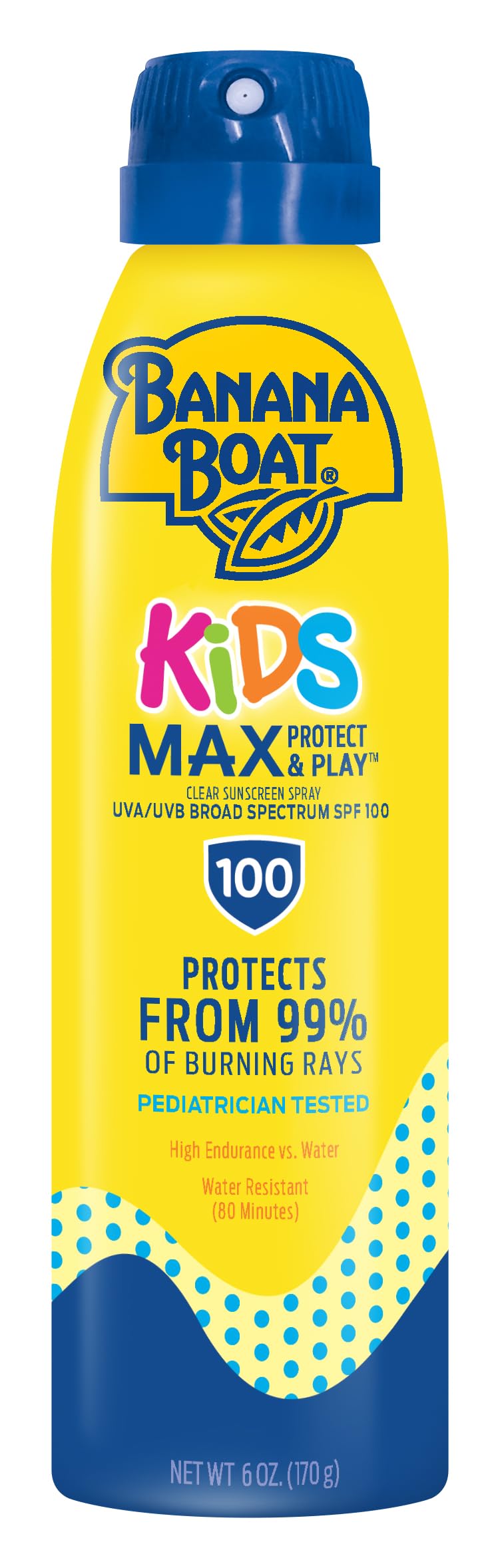
Banana Boat MAX Kids SPF 100
Key Features
- Cap: Twist and lock
- SPF: 100
- Can size: 6 oz
- Water resistance: Very water resistant
- Price: Budget
Sunscreen and a toddler’s eyes are natural enemies, which is why the smallest line on this can is the one that sold us: it is built not to run into eyes. In a category where the daily fight is about standing still, a formula that does not sting buys you the second coat, and the second coat is where protection actually comes from. It also carries the highest SPF in this group at 100, and of the four picks it is the one whose sun protection we trust most.
The rest of the spec list earns its place. Banana Boat calls the finish invisible and rub-free, and what that means on a Saturday morning is no white cast to chase across a shoulder blade while someone wriggles. It is very water resistant, so a pool afternoon does not strip it immediately, and the twist-and-lock cap is a genuinely good idea for a can that lives at the bottom of a bag: no separate lid to lose, no accidental discharge over the swim towels.
The one detail we want changed is the water-resistance wording. Unlike the other three cans here, there is no stated time, just very water resistant, so treat it as an 80-minute product like the rest and reapply on that clock rather than waiting for a pink shoulder to remind you. Sunscreen is the one thing on a beach day that rewards being boring about.
Pros
- Built not to run into eyes
- SPF 100, the highest in this group
- Very water resistant for pool afternoons
- Twist-and-lock cap survives a beach bag
Cons
- Six-ounce can empties quickly on family days
Our default kids spray: SPF 100 protection that does not sting eyes, goes on clear and rub-free, and costs less than the premium cans here.
Best for Sensitive Skin
Sun Bum Kids SPF 50 Clear Spray
Key Features
- SPF: 50
- Finish: Clear
- Can size: 6 oz
- Application: Wet or dry skin
- Price: Premium
The smell arrives before anything else. Sun Bum’s kids spray has a light banana scent that reads more like a smoothie than a chemistry set, and it is the reason this can gets handed back without an argument. There is no synthetic fragrance in the formula, which matters more than it sounds if you have ever had a child refuse a sunscreen because it smells like sunscreen.
Clear is the second advantage, and the one we care about most: the spray dries without a white cast, so there is nothing to rub into a child who is already halfway to the water, and it can go on wet skin at the pool edge instead of waiting for a towel-dry moment. Of the four picks, this is the one for a child whose skin reacts or whose nose vetoes everything else.
What it costs is real. This is comfortably the most expensive can per ounce here — six ounces for more than the two-can Banana Boat pack — and the spray valve is the weak point, since caps can clog and cans can give out partway through.
Neither is fatal, and both are easier to live with if you follow the directions, which are the most specific of the four: shake well, hold four to six inches from the skin, then spread by hand. On a windy beach that last step is the one that keeps coverage even instead of landing in the sand.
Pros
- Dries clear with no white cast
- Can go on wet or dry skin
- Light banana scent, no synthetic fragrance
Cons
- Valve can clog and quit mid-can
- Premium price for six ounces
Worth the premium if sensitive skin or a fussy nose is what stands between your child and a proper second coat.
Best for Family Value
Banana Boat Sport Kids SPF 50
Key Features
- SPF: 50
- Pack: Two 6-ounce cans
- Moisturization: 12 hours
- Water resistance: 80 minutes
- Price: Budget
A summer of sunscreen is a volume problem before it is anything else. This is two six-ounce cans in one order — twelve ounces against the six you get from the premium can here — and it is the format that keeps a family supplied without a mid-week panic purchase. Banana Boat frames it as the sports formula, sweat and water ready, and that is the right framing: it is for the pool, the field and the backyard sprinkler rather than a careful touch-up on a nose.
The formula sits at the gentle end of the range: no added oils or fragrances, no drying alcohol, and 12 hours of moisturization, which sounds like marketing until a child complains about tight shoulders after a pool afternoon. Water and sweat resistance runs 80 minutes, and that is the number that actually sets the shape of your day.
Protection is where this one gives ground. This is a formula where a missed patch or a skipped reapplication shows up fast, so we spray generously and rub it in rather than misting and hoping, and we treat the 80-minute mark as a hard stop. Parents who work that way get a lot of sunscreen for the money; anyone who wants slack built into the can should look at the top pick.
Pros
- Two six-ounce cans in one order
- 80 minutes of sweat and water resistance
- No added oils or fragrances
Cons
- Can leave orange marks on pale clothes
Best value of the four: twelve ounces of 80-minute-resistant spray for family days, with sun protection that rewards careful coverage.
Best for Beach and Pool
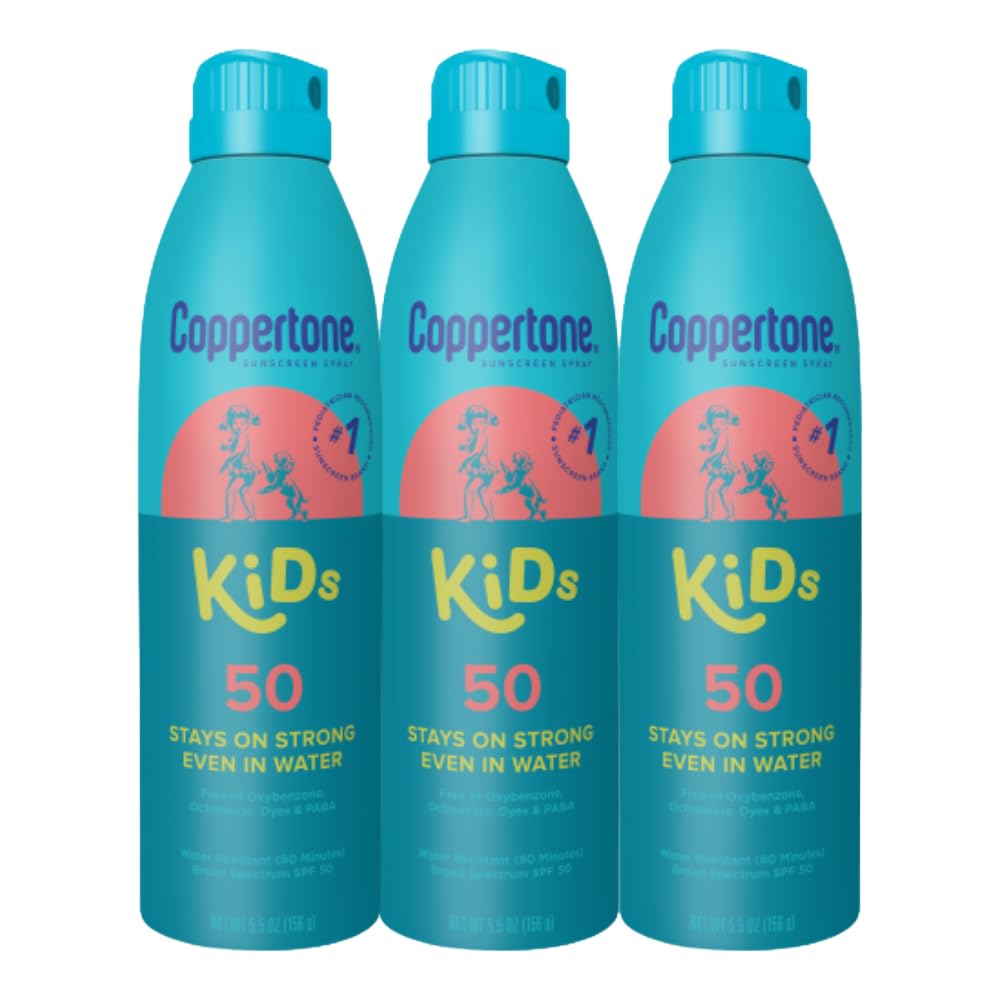
Coppertone Kids SPF 50
Key Features
- SPF: 50
- Pack: Three 5.5-ounce cans
- Spray: Any angle
- Water resistance: 80 minutes
- Price: Midrange
Any-angle spraying sounds like a bullet-point nicety until you are bent sideways reaching for the back of a six-year-old’s neck while they spin. Coppertone’s valve is built to spray whatever orientation the can ends up in, and that is the practical difference between a proper coat and a stripe down one shoulder. The formula behind it is dermatologically tested and free of dyes, PABA, octinoxate and oxybenzone, which is the list most parents scan for now — and the one we check first too.
The three-pack is what earns this a place. Sixteen and a half ounces across three 5.5-ounce cans means one lives in the car, one in the swim bag, one in the kitchen cupboard, and nobody has to remember to move anything — a mundane advantage until the morning you are already late and the can is in the other bag. Per ounce it is the cheapest thing here, and the plainest can of the four: no clever finish, no scent story, which is what we want from a bottle that gets used by whoever finds it first.
Pros
- Sprays at any angle
- Three 5.5-ounce cans for beach-bag redundancy
- Free of dyes, PABA, octinoxate and oxybenzone
Cons
- Sun protection is less consistent than our top pick’s
The three-pack to leave in three different bags, with an any-angle valve that works on a child who will not stand still.
How We Tested 14 Kids Sunscreen Sprays Through a Full Summer
We started by gathering the kids’ sprays sold at major retailers and narrowing on the label: broad-spectrum SPF 30 or higher, active ingredients listed clearly, and a formula intended for children rather than a diluted adult version. We set aside anything in a pump that took two hands to work and anything priced so high per ounce that a family would ration it. That left 14 sprays, which we rotated through one full summer, May through September.
Each bottle lived in a beach bag, a camp backpack, or my car’s center console. We timed how long a full-body application took on a wriggling 5-year-old, noted whether the spray came out as a fine mist or a wet stripe that needed rubbing in, watched for nozzles that clogged halfway through a bottle, and checked whether caps stayed put inside a crowded tote. We counted applications per bottle as we went so we could compare real cost per use instead of shelf price.
For residue, we pressed a tissue against a kid’s arm ten minutes after application and noted whether it stuck or slid off, and we paid attention to how much sand clung at the beach. Every spray also got a patch test on a black cotton T-shirt and a white swimsuit, both of which went through a normal wash afterward so we could see what stayed behind. Fragrance was judged twice — right after spraying and again an hour into the sun, when some scents turn sharp.
For the eye question, we sprayed onto a fingertip and patted it near our own eyes rather than testing on a child. To see how formulas held up, we checked skin after 30 minutes in the pool and after a full afternoon outside, reapplying on each label’s schedule, and noted whether a second coat went on smooth or turned greasy and pilly. We kept everyone out of the burn zone on purpose, so what we compared was coverage and staying power between reapplications, plus how each bottle looked and smelled by the end of August.
How to Choose a Kids Sunscreen Spray
The SPF number is the easiest thing to compare and the least useful on its own — what separates these cans is whether the spray keeps working and whether your child will stand still for it.
The 80-minute clock matters more than the number
Water resistance is a time limit, not a permission slip. Every pick here that states a figure says 80 minutes, and that clock restarts after a swim, a hard sweat or a towel-down — towelling is the one people forget, because it lifts the film off rather than rinsing it away.
We plan a reapplication at that mark and treat anything past it as borrowed time. Get that rhythm right and you are most of the way to a burn-free day; snacks, shade and a hat do the rest.
The spray valve is half the product
A sunscreen spray that will not spray is a paperweight, which is why we weighted this more heavily than any single ingredient. Continuous aerosol cans are the convenient format and the fragile one: valves clog, cans lose pressure, and a formula that separates can block the nozzle.
Look for a valve that works at an angle, since you will rarely be spraying upright, and a cap that locks — a loose cap in a beach bag is how you end up with an empty can and sunscreen-coated towels. Give any new can a test spray before you leave the house.
Eyes, scent and finish decide whether they cooperate
The best formula in the world is worthless if your child refuses it. Eye sting is the biggest single factor — a spray that runs is a fight every morning — so an eye-friendly claim earns real attention. Scent comes next: a light, familiar smell meets less resistance than a medicinal one.
Then finish. Greasy formulas collect sand, a heavy white cast needs real rubbing, and a clear spray lets you reapply at the pool without a scene. If your child has reacted to a sunscreen before, put fragrance-free and alcohol-free at the top of your list, right behind protection.
What free-from labels actually buy you
Oxybenzone and octinoxate are the two names most parents scan for, and two of our four picks state they are excluded. Treat that as a preference rather than a performance upgrade — nothing here protects better because of what it leaves out.
Alcohol-free matters more for a child with dry or reactive skin, since drying alcohols can sting going on. Fragrance-free is the filter to prioritise if a previous sunscreen caused a rash. Mineral sprays built on zinc oxide are the other route, and they leave more of a cast.
Pack size and what a summer costs
Kids’ sunscreen is a consumable, and the per-ounce price varies more than the shelf price suggests. A single six-ounce can is the easiest way to try a formula; a two- or three-pack is what you want once you know the can works for your family, because cans migrate — one to the car, one to the swim bag, one to the cupboard.
Match the pack to your summer: sixteen and a half ounces across three cans is the beach-vacation buy, while a two-can pack suits weekends at the local pool.
Frequently Asked Questions
Is SPF 100 better than SPF 50 for kids?
Marginally, and not in the way most people hope. SPF 50 already blocks around 98 percent of UVB rays — a figure one of these cans prints on its label — so going higher adds a sliver rather than doubling your time outdoors.
Our top pick runs SPF 100 and we like it for long, bright days with fair-skinned kids, but coverage and the 80-minute reapplication clock still decide whether anyone burns.
Will a kids sunscreen spray stain clothes?
Some formulas can, especially on pale rash guards and white T-shirts, where the marks show up as orange or yellowish patches. Rinse the garment before it goes in the wash and keep it out of the dryer until the stain is gone.
With a new can, dress the kids in darker colors for the first outing, or test it on an old towel first.
Can you spray sunscreen directly onto a child’s face?
No. Spray into your palms first, then pat it on, keeping it away from eyes and mouth. The directions on these cans have you spray and then spread evenly by hand, and the face is where that matters most.
A direct mist is hard to aim and misses the spots that burn first: ears, hairline and the back of the neck.
Final Verdict
Buy the Banana Boat MAX. It is the can we reach for first because it handles the two things that actually go wrong on a sunny morning — sunscreen in a child’s eyes and a spray that needs no rubbing — and it does it at the lowest price per bottle in this group.
If your child’s skin reacts or the smell of standard sunscreen starts a fight every morning, the Sun Bum clear spray is worth the premium. If you want three cans living in three different bags, take the Coppertone pack.
