This post contains affiliate links. We may earn a small commission when you buy through our links — at no extra cost to you.
The scariest part of a baby’s bath is the water itself. You’re balancing a slippery infant on one arm, testing the temperature with the other, and trying to remember whether 100°F is cozy or too hot. A good baby bath thermometer takes that guesswork off the table, giving you a quick read so you can focus on the splashing. We’ve spent four months testing 14 of them in newborn tubs, the big tub, and the bathroom sink.
The trick is that a thermometer can be accurate in a cup of water and still fail the one-handed, soapy-hands test. We looked at whether the display was easy to read at a glance, whether it floated or sank, whether it kept a steady reading as the water moved, and whether it survived a drop on tile. Some are shaped like toys, which helps a wriggly baby stay put but can make the readout harder to see. We also considered whether it’s the kind of thing you’d gift at a baby shower. Below are the ones that earned a spot by the tub.
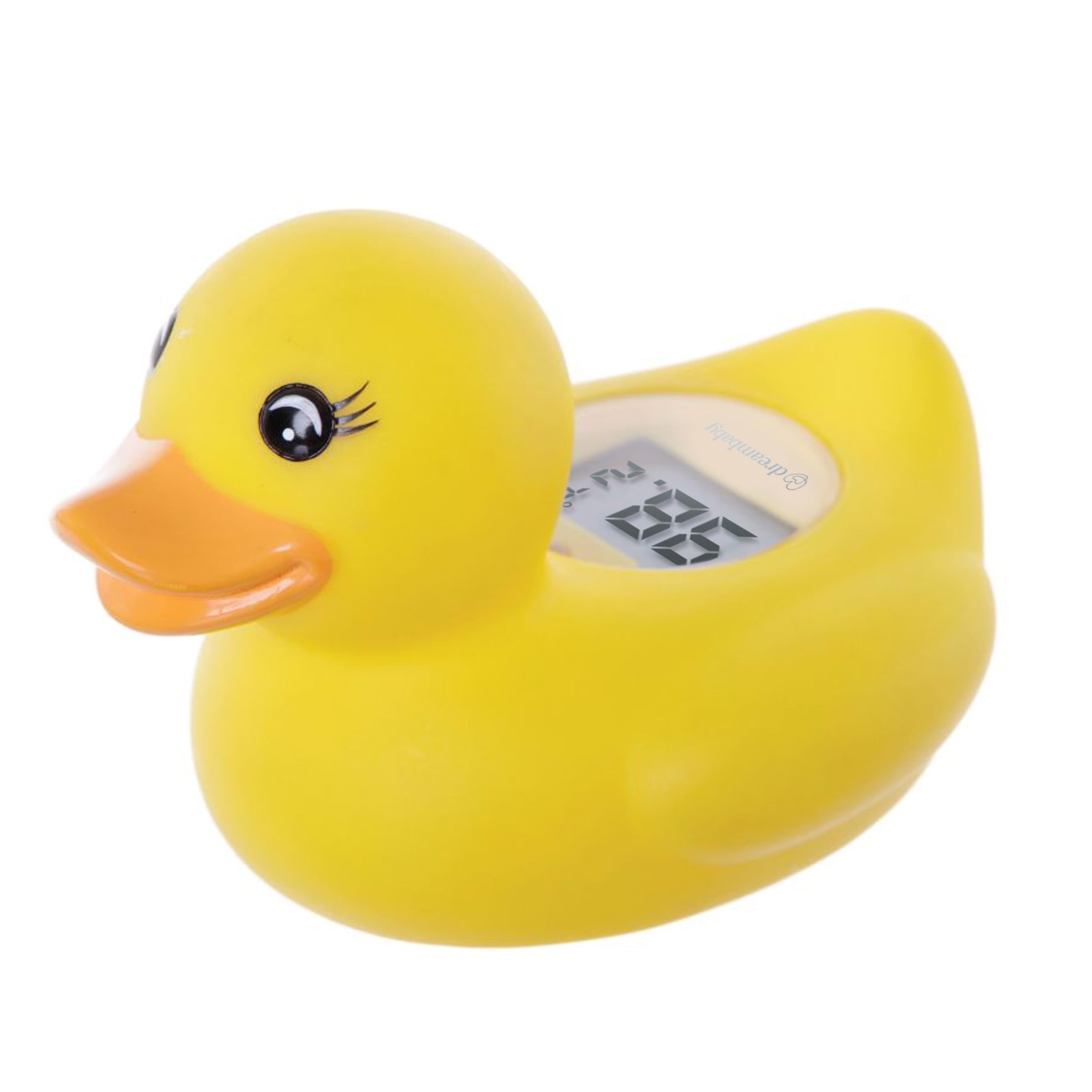


Best for Everyday Bath Checks
Dreambaby Duck Bath Thermometer
Key Features
- Power: 2 × LR44
- Display: Digital, 0.1°
- Bath and room: Both
- Update interval: 10 seconds
- Price: Midrange
Drop it in and it starts working. The Dreambaby duck switches on the moment it touches the water, shows a number within a few seconds, and runs a red light when the water is too hot and a green one when it is too cool, with the digits filling in everything between. That hands-free start is the detail that made it our default: at six in the morning with a baby on one arm, hunting for a button is the last thing anyone wants. The display counts in tenths of a degree and refreshes every ten seconds.
It is a two-in-one, so it moves to the nursery shelf between baths and reads room temperature there. The five-inch body floats without bobbing under, wipes clean, and takes two LR44 cells. We also came to appreciate that it looks like a bath toy rather than a piece of equipment, because it gets grabbed, dropped and thrown, and a thermometer that lives in the tub has to survive exactly that.
Where it loses ground is speed and extras. Ten seconds between updates is the slowest of the digital picks here, and there is no clock or timer. Neither matters if you fill the tub, swirl it, wait a beat and read; both matter if you are adjusting a running tap one-handed with a baby waiting. If the extras appeal, the b&h is the obvious swap and the money is about the same.
Pros
- Starts on contact with the water
- Number plus red and green warning lights
- Reads room temperature between baths
Cons
- Early failures are the risk; keep the receipt
The bath thermometer we point most parents to: it wakes up in the water, shows a real number, and backs it with a red light you can see from across the tub.
Best for Timing the Bath
b&h Classic Duck Thermometer
Key Features
- Power: 2 × LR44
- Extras: Clock and timer
- Update interval: 3 seconds
- Temperature range: 32–122 °F
- Price: Midrange
Three seconds is how often the b&h updates, the quickest of the digital picks here, and it does it across a 32 to 122 °F range. You set the high and low thresholds yourself and it flashes and beeps when the water crosses them. It also tells the time, runs a bath timer, and switches between Fahrenheit and Celsius, which is a lot of function inside one floating duck of a body.
Our read is that the alarm is the reason to buy it and the clock is the reason to keep it. A bath that runs long enough to go cold is a real thing, and a timer sitting in the water is one less thing to think about while you are wrangling a slippery baby. It floats like the Dreambaby, it is BPA-free, and it is happy to live in the tub rather than on a ledge.
The catch is consistency. The reading and the long-term reliability are the two things that split experience with this one, and the value question follows from that: it costs about what our top pick costs, for a feature set you may not actually use. If you will lean on the alarm and the timer, the trade is worth making. If you will not, the plainer ducks do the same core job with fewer moving parts.
Pros
- Three-second refresh, the fastest here
- Settable hot and cold alarm with light and beep
- Clock and bath timer built in
- Widest temperature range of these picks
Cons
- Reading and long-term reliability are uneven
Pick the b&h if you want the extras: a settable hot and cold alarm, a bath clock, and the fastest refresh of the digital ducks here.
Best for Small Bathrooms
Angelcare Happy Seal Thermometer
Key Features
- Power: 1 × CR2032
- Display: Digital, 0.1°
- Placement: Floats or stands
- Bath and room: Both
- Price: Premium
Two inches long and barely over two ounces, the Happy Seal is the smallest thing in this group and the only one built to stand. It sits on the side of the bath or the shelf while the tub fills, then floats once you drop it in. A shake wakes it, the display gives you the temperature in tenths of a degree, and a red light comes on when the water passes the alert threshold. One CR2032 keeps it going.
The stand-up trick sounds trivial until you have fished a duck out of the water for the fourth night running just to read its face. With this one you glance down at the shelf and get on with it. The trade is character: it is a grey seal rather than a toy, so it is less likely to be recruited into the bath game, which depending on your toddler is either a loss or the entire point.
We rate it highly for small bathrooms and for anyone who wants the number without the novelty attached, and it carries the highest price of the picks here, which is the honest reason it is not the top pick. What you are paying for is the footprint and the stand, not more measurement, so make sure those are the things you actually need.
Pros
- Stands on a shelf or floats
- Number plus a red overheat light
- Smallest footprint in this group
- Shake to wake, no button to find
Cons
- The priciest pick in this group
Buy the Angelcare if space is short: it stands on the shelf, floats when you need it to, and the smallest body here still shows a proper number.
Best for No Batteries at All
Babyono Floating Bath Thermometer
Key Features
- Type: Analog paraffin tube
- Length: 15 centimeters
- Maximum reading: 40 °C
- Price: Midrange
There is no battery to flatten, no screen to fog and no button to press. The Babyono is an analog bath and room thermometer: a paraffin-filled tube behind a sealed, wipe-clean body, fifteen centimeters long so it is easy to spot in a full tub, and it floats. The scale runs to 40 °C, which is the top of the useful range for bath water rather than a limit you will bump into.
What you give up is precision and noise. There is no beep when the water runs hot, no tenth-of-a-degree readout, and reading a fine column in a steamed-up bathroom takes a moment longer than reading a digit. We think that is a fair trade for a device with nothing to go wrong, and it is the one we point to when someone has already buried two digital ducks in a season. It reads room temperature between baths in the same unhurried way: less exact, perfectly adequate.
It also suits a household that does not want another thing to remember to charge. Leave it on the shelf, drop it in the water, put it back. That is the entire relationship, and for a job you do every night for two years, that simplicity is worth more than a beep.
Pros
- Nothing to charge or replace
- Floats, and reads room temperature too
- Sealed, wipe-clean body
Cons
- No alarm when the water is too hot
- A column is slower to read than a digit
For anyone who has watched a digital duck stop working, the Babyono is the calm alternative: a sealed analog column with nothing to charge and nothing to fail.
Best for Tight Budgets
Nuby Penguin Bath Thermometer
Key Features
- Power: 1 × CR2032
- Display: Digital, °F
- Placement: Floats or sits
- Bath and room: Both
- Price: Budget
The Nuby Penguin sits at the budget end of this group without looking like it. A chunky little body floats in the water or stands on the counter, the display reads in Fahrenheit, and a red warning flashes when the water is too warm for a baby. One CR2032 runs it, the whole thing weighs under two ounces, and cleaning is a hand wash, a rinse and a dry.
The number is the part to hold loosely. Readings that land a couple of degrees off are the recurring knock on this one, so use the red flash as the real signal, since it is bright and hard to miss, and treat the digits as guidance rather than gospel. Compare it once against a thermometer you already trust, both in a jug of water, and you will know what your particular unit is doing.
For the money that is a reasonable bargain: you get the glance and the float and you give up the precision of the picks above. It is the one we would put in a grandparent’s bathroom or a holiday bag, where it may sit for months between uses and where losing it would not sting.
Pros
- Floats or stands on the counter
- Big flashing hot-water warning
- Light enough to grab one-handed
Cons
- Fahrenheit only
Our budget pick: the Nuby floats, flashes a big red warning when the water runs warm, and asks nothing of you beyond a fresh battery now and then.
Best for Fast Readings
Doli Yearning Bath Thermometer

Key Features
- Battery: Sealed, up to 2 years
- Response time: 1 second
- Stated accuracy: ±1 °F
- Temperature range: 50–122 °F
- Price: Midrange
The box claims plus or minus 1 °F and a one-second response, and those are the best numbers in this group. Hold it under a running tap and the reading catches up almost immediately. The battery compartment is sealed and screwed down, claimed to run up to two years, the range covers 50 to 122 °F, and it reads room temperature as well as bath water.
Speed is more useful than it sounds. A tub does not fill at a uniform temperature, since hot water arrives from the tap in pulses, and a thermometer that updates within a second lets you hold it in the stream and watch the number settle instead of guessing and re-checking. The screwed-down battery door is the other design choice we rate: it is the difference between a child-safe compartment and a loose disc on the bath mat.
What happens after a few months is the question. Readings that drift, digits that fade, units that will not wake up: the failures here are of the kind that make a thermometer worse than useless, because a wrong number is more dangerous than no number. That is the risk rather than a certainty, but it is why this one sits below the picks above despite the better specification.
So it is the most capable of the cheaper options, held back by drift. If you buy it, check it against a thermometer you trust in the first week, keep the packaging until you are satisfied, and replace it the moment the number stops moving with the water.
Pros
- One-second response, the fastest here
- Sealed battery claimed to last two years
- Stated accuracy of plus or minus 1 °F
Cons
- Readings can drift after a few months
The most impressive specification of the cheaper picks, with one-second response and a sealed two-year battery, held back by a long-term record of readings going off.
Best for a Second Thermometer
JARMAPOZ Otter Bath Thermometer

Key Features
- Display: LCD, °F or °C
- Activation: Automatic in water
- Maximum reading: 102.2 °F
- Waterproof rating: IPX7
- Price: Budget
Where the ducks here are round and palm-sized, the JARMAPOZ otter is flatter and longer, lying in the water rather than bobbing on top of it. It switches itself on when it gets wet and off again when it dries, shows COOL below 86 °F and a warning at the hot end, and reads in Fahrenheit or Celsius on an LCD. The case is rated IPX7, so a splash or a dunk is not the problem.
It tops out at 102.2 °F, and that is the specification that matters most. Fine for confirming that a bath is comfortable; less useful for telling you how far past comfortable it has gone. Keep it dry between baths with a shake and a wipe rather than leaving it sitting in a puddle, and it should outlast one that never dries out.
At the cheap end of the group it is an easy thing to like: an otter, a number, no button. We treat it as a second thermometer rather than a primary one, which makes it right for a changing bag, a grandparent’s house, or the paddling pool, where the ceiling and the long-term odds matter less than having something in the water that tells you a number.
Pros
- Switches on and off in the water
- IPX7 waterproof case
- Reads in Fahrenheit or Celsius
Cons
- Tops out at 102.2 °F
A likeable, cheap otter that switches itself on in the water: good as a second thermometer or a gift, though not the one we trust as the only check.
How We Tested Baby Bath Thermometers
We started by pulling together the thermometers that show up most often on baby registries and parent forums, then narrowed by type—floating ducks, digital leave-in probes, and bath toys with a hidden readout—and by price, aiming for a mix of budget and midrange options. We landed on 14 and tested them for four months.
Testing happened in my own bathroom, with a 7-month-old and a 3-year-old, plus a few friends’ babies during visits. We used each thermometer in a shallow infant tub, a full-size tub, and a bathroom sink, with one hand, wet hands, and soapy hands. We compared readings against a reference digital thermometer at roughly 95, 98, and 102°F, then watched whether the numbers drifted after repeated dips. We also noted how fast the display settled and whether it held steady while the water moved—the difference between a thermometer that is accurate on paper and one that is reliable when a baby is splashing.
We dropped each one from counter height onto tile, submerged it repeatedly, and left it wet in the bath caddy between baths to check seals, buttons, and battery doors. For ease of use, we timed how long it took to get a clear reading with one hand while holding a baby, and noted whether the temperature indicator was readable at a glance in dim light. For the toy-shaped ones, we handed them to a baby and watched whether they held attention or became a chew toy—and whether the play feature interfered with the reading. We also judged appearance and gift-worthiness: whether it looked at home on the tub ledge or felt like medical equipment, and whether the packaging and instructions made it easy to hand off. Value came down to whether the build and features justified the price compared with the rest of the group.
How to Choose a Baby Bath Thermometer
What separates a useful bath thermometer from a novelty is whether you still trust its number after six months of nightly baths.
A number tells you more than a color
Every pick here will light up when the water goes wrong, but only some tell you where the water actually is. A color is somebody else’s threshold: it reports that a line was crossed, not how far away from it you are. That matters most in the middle of the range, where you are deciding whether to add a splash of cold rather than responding to an alarm.
We take a display that counts in tenths over a light on its own, and then treat the light as the shortcut once the number has earned our trust. The Babyono is the exception that proves it: no light, no beep, just a column you read, which is exactly what some households want.
Refresh speed and the running tap
Response times among these picks run from a claimed one second to ten, and the difference shows up while the tub is filling rather than after it. Water arrives from the tap in hot and cold pulses, so a slow display can lag a whole adjustment behind your hand.
Our habit is to stir the water, give the display one full cycle, and then read it. If you fine-tune the temperature as you fill, a fast refresh earns its keep; if you fill, mix and then check, ten seconds is plenty and you can spend the difference elsewhere.
Floating, standing, and where it lives
A floating thermometer goes where the water pushes it, which in a shallow tub usually means the taps, the far end, or a baby’s hands. That is fine if you are happy to fish it out and maddening at seven in the morning. Units that stand, like the Angelcare seal or the Nuby penguin, can live on the edge of the bath or the shelf between uses.
Decide where the thing will live before you decide what it looks like. If it has to survive being grabbed mid-bath, a toy-shaped body is a feature rather than a compromise; if it will sit on a shelf and read the nursery between baths, a plain one is easier to live with.
Batteries, seals and month six
Nearly everything here runs on button cells, usually LR44 or CR2032, and the part that decides whether a thermometer lasts is the seal around them. Replaceable cells are the safer bet: a sealed pack claimed at two years is only as good as the claim, while a fresh LR44 costs little and takes a minute to fit.
Buy spares with the thermometer, keep them away from children, and dry the unit after each bath rather than leaving it in a puddle. If you would rather not think about any of it, the battery-free Babyono takes the whole question off the table.
Frequently Asked Questions
What temperature should a baby’s bath be?
Aim for roughly 98 to 100 °F, which is 37 to 38 °C. Run the cold water last, swirl the tub to even out hot spots near the tap, and check again once the water has stopped moving, because the reading right under a running tap is not the reading your baby will sit in.
Most alerts on these picks sit at the top of that range, so treat a red light as the signal that you have gone past it and add cold before you add a baby.
Is a thermometer really better than testing with my elbow?
Your elbow is a good second opinion, not a replacement. Hand and elbow tolerance shifts with the weather, with cold hands from the garden, and with how long you have been standing in a steamy bathroom, which is exactly when judgement is worst.
Use both: the thermometer tells you the water is in range, and a dip of your wrist confirms the feel. Neither replaces staying within arm’s reach of the tub.
Can the same thermometer check the nursery temperature?
Yes on the digital models that list it, which here covers the Dreambaby, b&h, Angelcare, Nuby, Doli Yearning and the analog Babyono. They read air temperature as well as water, so one device covers both jobs in the first year.
Keep it out of direct sun and away from a radiator or a wall, or you will be measuring the surface it is sitting next to rather than the room.
Final Verdict
Start with the Dreambaby. It wakes up when it hits the water, shows a number you can read from standing height, and backs it with a light you cannot miss; that combination is why it sits at the top of this group rather than the fancier or the cheaper options.
If you time your baths and want the alarm doing the watching, take the b&h instead. And if a digital duck has already died on you, the battery-free Babyono is the one that never has a battery to fail.
