This post contains affiliate links. We may earn a small commission when you buy through our links — at no extra cost to you.
Toddler alarm clocks aren’t really about telling time — they’re about giving a small person a visual cue for when the day starts, and giving the rest of the house a little more sleep. The good ones are simple enough for a 3-year-old to read, dim enough to leave in a dark bedroom, and sturdy enough to survive being pressed, dropped, and dragged around. The wrong ones glow like a nightlight on full blast, blast an alarm loud enough to wake the whole floor, or depend on an app that disconnects at 2 a.m.
I tested a dozen of these over four months with toddlers in their own rooms — at bedtime, during nap, and at that brutal 5:45 a.m. wake-up — comparing how easy they were to set, how readable the color changes were, and whether the extras earned their keep. Appearance and color options matter more than you’d think in a nursery, but sleep-training usefulness and child-friendly controls are what separate a helpful clock from a novelty. The picks below are the ones I’d hand to a toddler without a demo.


Best for First Wake Clock
Little Teddi OK to Wake Clock
Key Features
- Size: 4.6"W x 5.5"H
- Power: Corded electric
- Sleep sounds: 4
- Night light colors: 5
- Price: Midrange
The shortlist for this job comes down to light, and the Little Teddi is the one here that lets you tune it properly. The light ring and the display dim separately, so the green wake cue stays readable from the bed while the room itself stays dark. In a small bedroom that is the difference between a clock that helps sleep and one that interrupts it, and it is the first thing we check now.
Setting it up is a single session at the kitchen table: choose the sleep color, the wake color and the two times, and the clock repeats them daily without being touched again. The face carries the message — asleep at night, awake in the morning — which is the part a two- or three-year-old responds to long before they can read a digital display. A nap mode doubles as quiet time once the afternoon sleep starts to go.
Around that core there are four sleep sounds, five night light colors, a child lock that needs a long press to release, and a memory battery that keeps your settings when the plug comes out. It takes up very little room on a nightstand at 4.6 by 5.5 inches, and the one-year warranty is standard for this group rather than generous.
Four sounds is the honest limit. If the white noise matters as much as the wake signal — some families run it all night — the Dreamegg carries a far bigger library, and the difference in choice is obvious the moment you scroll through it. For everyone else the work is done by the color change, and this clock does it without asking for a phone.
Pros
- Light ring and display dim separately
- Set once, then repeats every day
- Child lock protects the schedule
- Memory battery keeps settings through a power cut
Cons
- Only four sleep sounds built in
We recommend the Little Teddi to nearly every family: a color cue a toddler can read, a night light you can actually dim, and a price that keeps it the easy default.
Best for Character-Loving Kids
LittleHippo Mella Sleep Trainer
Key Features
- Size: 4.25"W x 4.5"H
- Power: Must stay plugged in
- Sleep sounds: 3
- Night light colors: 5
- Price: Premium
Mella is the clock for the child who won’t take a color’s word for it. The face sleeps and wakes on your schedule and the expression carries the rule in a way a bare light does not — which sounds like a gimmick until you have spent a week explaining a green lamp to a three-year-old who has decided the lamp is negotiable.
Its design is the most distinctive in this group, and it stops reading as a baby gadget on a shelf once your child is five or six: a round body in Arctic Blue with a digital face, small enough at 4.25 by 4.5 inches to sit almost anywhere. The training idea is old-fashioned in a good way, because the face carries the whole message and there is nothing for a toddler to decode.
The light is the part to plan around. It is strong enough that in a small room it reads more like a lamp than a night light, so give it a spot across from the bed rather than on the pillow side of the nightstand. That is a placement decision rather than a deal-breaker, but it is the reason a tiny bedroom with a light sleeper is the one case where we point elsewhere.
Pros
- Facial cues land with younger toddlers
- Doubles as a digital clock as kids grow
- Small 8-ounce body fits any nightstand
Cons
- Pricier than our top pick with fewer features
We think Mella is worth the premium for a child who obeys a face more readily than a color cue, and it keeps working as a real clock once they are older.
Best for App Control
Dreamegg Sound Machine & Wake Clock
Key Features
- Control: Wi-Fi app and on-device buttons
- Dimensions: 4.33 x 4.33 x 5.76 in
- Soothing sounds: 34
- Night light modes: 3, with 3 brightness levels
- Price: Midrange
App control is the reason to pick the Dreamegg, and it is the one clock here that can hold a different schedule for each day of the week. That matters more than it sounds: the moment school starts, Tuesday stops looking like Saturday, and a clock that cannot tell them apart wakes everybody up on the weekend. Pairing takes a few attempts and the screens are not the most logical, but a saved routine runs on the device.
The rest of the package is generous — 34 sounds across nature, ambient, white noise and melodies, three night light modes with three brightness levels each, and a body about 4.3 inches square and 5.8 tall that sits on a shelf without a fight. Buttons on the top and sides are another design detail we appreciate, because a volume change at 2 a.m. shouldn’t require finding your phone in the dark.
Where it falls behind the simpler picks is in the handover. A routine that lives in an app is a routine a babysitter cannot adjust, and the connection is the fragile part of the whole idea. Buy it if you like tuning sleep from bed and want a sound library that beats a dedicated noise machine; pass if the clock needs to work identically in every pair of hands.
Pros
- Different schedule for each day of the week
- 34 sounds across four categories
- Physical buttons back up the app
Cons
- App pairing and interface need patience
Our pick if you want the routine on your phone: 34 sounds, per-day schedules and a visible clock face, once you get past the app’s fussy setup.
Best for Cord-Free Nightstands
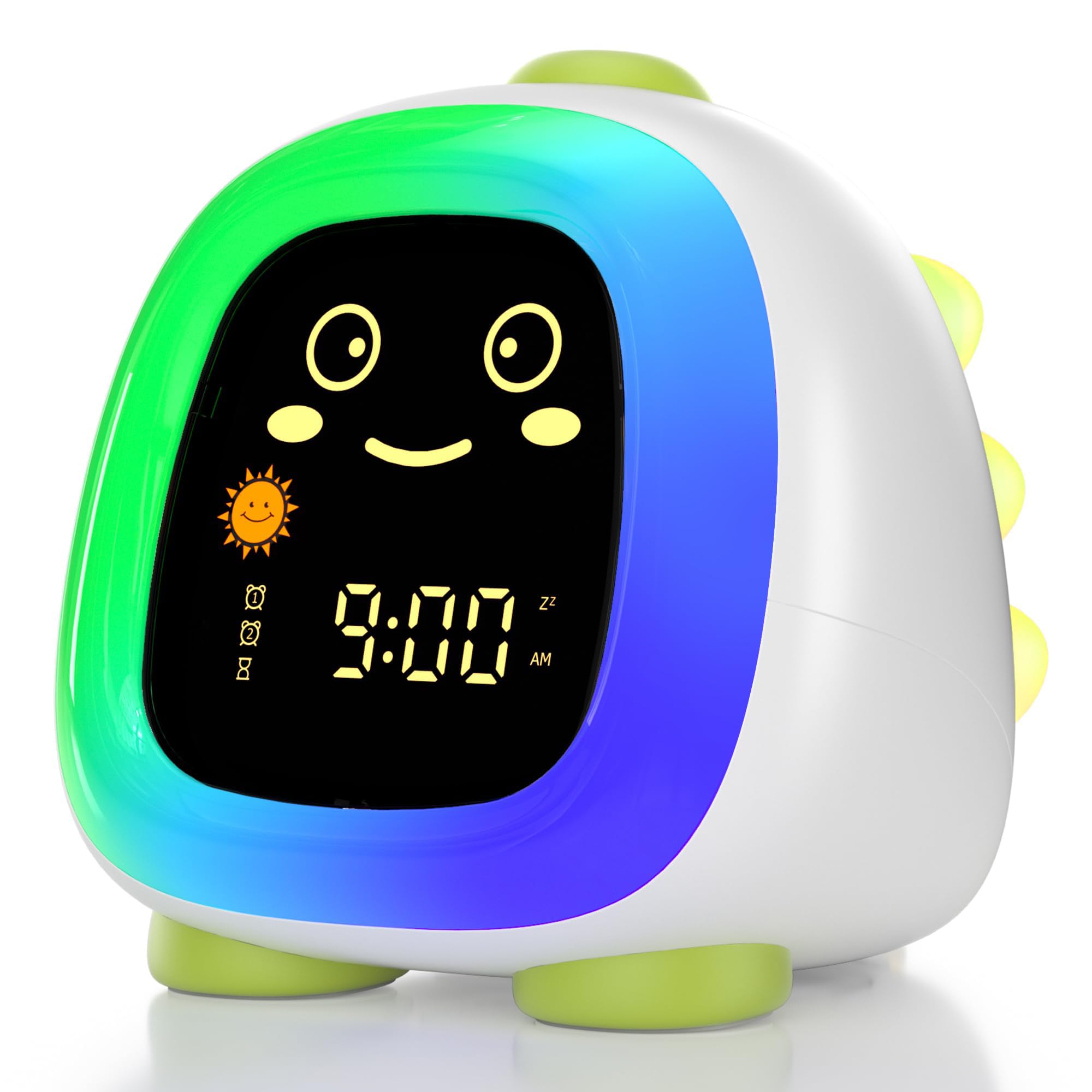
ANALOI Dinosaur Sleep Training Clock
Key Features
- Power: USB-C rechargeable
- Light options: 10
- Brightness levels: 3
- White noise and music tracks: 7
- Price: Budget
The dinosaur is the one clock here that isn’t tied to an outlet. It runs on a rechargeable battery and charges over USB-C, so it can sit on a shelf with no cable trailing down the wall, and it doesn’t go dark the moment someone trips over a cord. That sounds like a small thing until you are trying to find a free socket behind a dresser at nine at night.
For the money you get ten light options with three brightness levels, seven built-in sounds, a sun-and-moon display, and a 15, 30 or 60 minute countdown that runs the white noise while your child drops off and then stops. The countdown is the bit we use most in our own heads: it keeps the sound from becoming an all-night habit if you don’t want one.
There isn’t much to hold against it. The sun-and-moon cue is a gentler signal than a whole clock changing color, so it suits a child who has already got the idea more than one who is still learning it, and everything is set on the unit itself. What it is, though, is the clock we point at a travel bag, a grandparents’ spare room, or a first attempt at the whole idea — sturdy, simple, and the cheapest way in of the ones we recommend.
Pros
- Runs on a rechargeable battery, no cable needed
- Ten light options across three brightness levels
- 15/30/60-minute countdown for bedtime sound
Cons
We point parents to the dinosaur as a first clock or a travel one — rechargeable, cord-free and simple enough that nothing gets between your child and the green light.
Best for Dinosaur Fans
H-chin Dinosaur Kids Alarm Clock

Key Features
- Size: 5"W x 4.5"H
- Nap timer: 0-120 min
- Soothing sounds: 17
- Night light colors: 9
- Price: Midrange
A dinosaur head, eyes that open at the wake time, and a display big enough to read from the doorway — this one is unashamedly a toy that happens to teach time, and for a child who has rejected every other bedtime object, that framing is the whole point. Seventeen sounds is the widest library outside the app-controlled pick, and nine night light colors give a child something to choose at bedtime.
Programming is where it takes work. The button sequence is not obvious from the manual and this is the fiddliest clock of the group to set up — the sort of job you do once at the kitchen table with the instructions flat beside you, not at eight in the evening with a child watching. Get it right and the child lock keeps it right, which is more than most of these manage.
Once it is running, the dinosaur does the persuading a plain light cannot, and the display is large enough that a four-year-old can check it alone. That is the point at which a training clock stops being your job, and it is worth a fiddly hour with a manual to get there.
Pros
- 17 sounds, the widest library outside the app pick
- Child lock preserves the programmed times
- Large, readable clock face
Cons
- Must stay plugged in to run
We like the H-chin for dinosaur-obsessed kids: the big face and 17 sounds do real work, provided you program it yourself before handing it over.
Best for Simple Corded Setup
FiveHome Toddler Sleep Training Clock

Key Features
- Power: Corded electric
- Timers: 15/30/60 min
- Warranty: Lifetime
- Light colors: 10
- Price: Midrange
Plain is the pitch: ten light colors, three brightness levels on the warm white, buttons on both sides, and a footprint of about 5.7 by 4.8 inches. There are two alarms — a sleep time and a wake time — and that is the entire schedule. Nothing here needs explaining twice, which is exactly what some bedrooms want.
Two details lift it above filler. The memory function holds your times and settings through a power failure, so an outage doesn’t mean re-programming at bedtime, and the warranty runs longer than the one-year cover most of this group carries. For a clock that lives in a spare room and gets used a few nights a week, both of those matter more than another light color.
It is also the least flexible of the picks, with two alarms, a 15/30/60-minute timer rather than a proper nap setting, and no weekday programming. That is fine for a second bedroom, a clock at a grandparent’s house, or a child who just needs a red light and a green light and no menu to explore.
Pros
- Settings survive a power failure
- Warranty longer than the one-year standard here
- Simple side buttons and ten light colors
Cons
- Only two alarms, sleep and wake
We keep this one in mind for a spare room or a second child: simple buttons, settings that survive an outage, and a warranty longer than most here.
How We Tested Toddler Alarm Clocks
We started by gathering models sold specifically for toddler sleep training, then cut anything that required a phone for basic use, had controls too small for small fingers, or lacked a dimming option. That left 12 clocks, which we tested for four months in toddler bedrooms during nap time, bedtime, and early-morning wake-ups. We set each one ourselves, then handed it to a 2- to 4-year-old to see whether they could turn on the night light, change the color, or switch off the alarm without help.
At night, we watched how bright each display was in a fully dark room and whether it cast enough light to disturb a sleeping child; we also checked whether the lowest brightness was actually usable rather than just a token setting. For sleep training, we programmed wake times and noted whether the color change was obvious from a crib or bed and whether it stayed consistent after a power blip. We tested volume at the lowest and highest settings from the next room and checked whether the alarm could be silenced with one press.
Because several models rely on an app, we paired each one, set schedules from the phone, and then walked out of Bluetooth range to see what happened to the clock’s routine. We also let toddlers handle them: pressing buttons, dropping them on carpet, and carrying them between rooms. Appearance and color options got judged in daylight and in a dim nursery, and we compared what each clock included against what it cost to decide which extras were genuinely useful.
How to Choose a Toddler Alarm Clock
The clock doesn’t keep a child in bed — the cue does, so the useful question isn’t which one looks best on a shelf but which signal your toddler will read correctly at six in the morning with one eye open.
Start with the cue, not the clock
Most of these work the same way: a color for stay in bed, a color for get up. Some add a face that sleeps and wakes, and a couple use a sun and moon icon. They all succeed or fail on whether your child understands the signal, so choose the one that matches the language already in your house. If you already say green means go, a green light is the shortest path.
A two-step red-to-green is easier for a young toddler than a three-stage sunrise, because the wait has one clear ending. Introduce the rule a week before you expect it to work, and talk about it in the morning rather than at bedtime.
The dimmer matters more than the display
Here’s the trap. The light has to be bright enough to read from the far side of the room at 6 a.m. and dim enough not to keep a light sleeper awake at 10 p.m., and those two requirements fight each other. Look for separate control of the night light and the digits, because plenty of clocks dim the display beautifully and leave the light ring fixed.
In a small bedroom, treat adjustable brightness as the deciding feature and work down from there. Placement helps too: across from the bed rather than beside a pillow. The Little Teddi is the one we point to for getting this right.
Buttons or an app?
An app-controlled clock lets you build a separate schedule for every day of the week and change it without walking into the room. That is genuinely useful once school starts and Saturday stops looking like Tuesday. The cost is that the routine then lives on your phone, which a babysitter or a grandparent doesn’t have.
A clock with buttons on the unit is dumber and more portable in every sense. Whichever you choose, check for a child lock: a curious four-year-old can undo a carefully set schedule in about nine seconds.
Decide how much sound you need
Three or four sleep sounds is plenty if the clock’s main job is the wake signal. Seventeen or thirty-four is a different product, closer to a dedicated white-noise machine. If you already run a sound machine in the nursery, don’t pay twice — a clock with a couple of options and a timer covers the gap.
If you’re replacing both, an all-in-one keeps the nightstand tidier and gives you one fewer thing to plug in. Check whether the sound runs all night or only on a countdown; a 60-minute timer is a bedtime helper, not a noise machine.
Power, placement, and the cord
Almost every clock here runs from a wall adapter, and the batteries inside hold settings rather than running the light. So budget for an outlet near the nightstand, and route the cord behind furniture and out of reach — a loose cable beside a toddler’s bed is the one genuine safety consideration in this category.
If there’s no outlet where you want the clock, a rechargeable model is the exception rather than the rule. Wherever it ends up, the face should be visible from the pillow without your child having to sit up to check it.
Frequently Asked Questions
What age can a toddler start using an OK-to-wake clock?
Most children get the idea somewhere between two and three, and it clicks reliably by three or four. Before that, the clock is mostly a night light with a friendly face. If your child is under two, the clock can’t do the work a consistent routine does.
Introduce the color rule first — green means you can get up — and expect a week or two of reminders before it becomes habit. Start with the wake signal only; adding a bedtime color on day one is usually one rule too many.
What happens to the clock if the power goes out?
The light and the sound stop, because these run from the wall. A memory battery or a memory function keeps your programmed times, and a few models keep the clock itself, so check that line on the listing if outages are common where you live.
After any outage, glance at the time display before bed. A clock that is an hour off will wake the whole house at the wrong moment, and that is the failure most likely to send a training clock to a drawer.
Can one clock handle two children?
Only if they share a schedule. Every clock here holds one sleep time and one wake time, with a couple adding a second alarm or different settings by day of the week — which helps with school terms, not with a two-year-old and a five-year-old who need different mornings.
Siblings close in age usually do fine with a single green light. Two children on different schedules need two clocks, and a second cheap one for the younger child is a better buy than one expensive clock everyone argues about.
Final Verdict
Start with the Little Teddi. It does the one thing a toddler clock has to do — shows a clear, readable you-can-get-up-now — and the separate dimming for the light ring and the display is what keeps it from turning into a lamp in a small room.
If your child needs a character rather than a color, Mella is worth the premium. If you want the schedule on your phone with a full sound library behind it, take the Dreamegg.
