This post contains affiliate links. We may earn a small commission when you buy through our links — at no extra cost to you.
The saddest thing in a backyard is a soccer ball gone soft by the fence — still glossy, still round, and completely unkickable. I’ve watched it happen in a single weekend, and I’ve watched a kid lose interest in a ball that was simply the wrong size for their feet. What you’re actually buying is air retention, seams that survive a driveway, and a size that matches your child’s age. My team and I spent the past four months kicking, squeezing, and re-inflating 14 kids soccer balls to find the ones still bouncy when the season ends.
Here’s what nobody tells you at checkout: the number on a kids’ ball is the size, and it’s matched to age, not height. Handing a 6-year-old a size 5 is the quickest way to make soccer feel like work, and the ball your kid thinks looks cool gets picked up far more often than a sensible one. The picks below cover all three youth sizes and a spread of budgets, from a first rec season to the ball that replaces the one lost in the bushes.


Best for Ages 8-12
GoSports Classic Soccer Ball
Key Features
- Size: Size 4
- Cover: Synthetic leather
- Bladder: Butyl
- Included: Ball pump
- Price: Budget
The pump is the detail that decides it. It comes in the box with the ball, the needle stores inside the handle so there is nothing loose to lose in a gift bag, and it turns a flat parcel into something kickable on the spot. For a present bought the night before a party, that is worth more than any panel count.
Size 4 puts it in the hands of the eight-to-twelve crowd, and this is the ball we point most families toward. Synthetic leather over a butyl bladder is the standard recipe for a recreational ball, and what separates this one is that the wear stays cosmetic: scuffed, dirty, still round, still firm, where cheaper balls here were splitting seams. It plays like a firm training ball rather than a match ball, which suits a kid learning to strike through the middle of it. It is also the least expensive ball in this roundup, which is the last reason to choose it rather than the first.
Inflate it before you wrap it. Not every ball arrives airtight, and a week of use inside the return window will tell you whether yours is one of the soft ones — far better than finding out on a birthday morning.
Pros
- Pump and needle included, needle stored in the handle
- Most convincing durability of any ball here
- True size 4 for ages 8 to 12
- The lowest-priced ball in this roundup
Cons
- Six-month warranty, half the length of Wilson’s
We think this is the ball most families should buy: a true size 4 that arrives with its own pump and the best durability record in this roundup.
Best for First Real Ball
WILSON Traditional Soccer Ball
Key Features
- Size: Size 3
- Cover: Synthetic leather
- Bladder: Butyl rubber
- Warranty: 1 year limited
- Price: Midrange
Black-and-white pentagons, silver accents, a machine-sewn cover: this is the ball a child draws when you say soccer ball, and the familiarity does real work on a nervous five-year-old. It is the size 3 we hand a beginner who wants their ball to look like the ones on television.
Size 3 fits roughly the five-to-eight window, and the butyl rubber bladder is the same air-retention design the pricier balls here use, so pressure is not the weak point. The cover is soft rather than tacky, which makes for a gentle first touch and a ball that will not sting a bare shin in the garden.
Durability is the open question, and it is the one to think about before you buy. On grass, at a weekly practice, this ball holds together and the scuffs are cosmetic. On asphalt it is a different story: the cover abrades and the seams are the first thing to go, so if your kid’s after-school kicking happens on a driveway, plan on replacing it or choose the GoSports instead. The one-year limited warranty is the longest in this roundup, and for a first real ball that lives on grass it is our pick.
Pros
- Classic black-and-white look children recognize
- Butyl rubber bladder holds shape between games
- One-year limited warranty, longest in this roundup
Cons
- Recreational build, not a match-grade ball
Our pick for a first real ball: a classic size 3 that looks the part and carries the longest warranty here.
Best for Preschool Beginners
hahaland Glitter Unicorn Soccer Ball
Key Features
- Size: Size 3
- Weight: 11 oz
- Diameter: 7.5 inches
- Included: Hand pump and mesh bag
- Price: Budget
Where the Wilson is the ball a coach hands out, this is the one a four-year-old points at. The glitter finish catches the light across a lawn, which is either the entire point or an immediate no, depending on the child in question.
It arrives flat with a hand pump and a mesh carry bag, so it is a complete gift: nothing else to buy and nothing to hunt for on the morning of a party. At eleven ounces it is light enough for small legs to dribble without the ball getting away from them, and the soft-touch cover is kind to bare shins in a way a stitched ball is not.
The size is where to be careful. The listed diameter is 7.5 inches, and some come in under that; if your child is joining a team, buy a regulation size 3 and treat this as the backyard ball instead.
Judged as a toy rather than as equipment, it is the best of these for a reluctant beginner — light enough to control, soft enough to boot around indoors, and decorated in a way that makes a four-year-old want to take it outside. That is not a small thing when the alternative is another afternoon on the sofa.
Pros
- Glitter finish that gets a reluctant child outside
- Hand pump and mesh carry bag included
- Light eleven-ounce ball for small legs
Cons
- Included hand pump feels flimsy
The one we hand a reluctant beginner: a glitter finish, a pump and a carry bag make it a complete first-ball gift.
Best for Teen Practice
adidas Tango Street Soccer Ball
Key Features
- Size: Size 5
- Cover: TPU
- Bladder: Butyl
- Construction: Machine-stitched
- Price: Premium
The surface is the surprise: a soft, faintly tacky TPU that grips the foot through a pass instead of skidding off it. We noticed it in the first few kicks, and it is the reason this is the size 5 we hand a teenager before a plain practice ball.
It is a size 5, so it belongs at the twelve-and-up end of this search — the kid who has stopped outgrowing a ball every spring and has started caring what badge is on it. Machine-stitched TPU over a butyl bladder is a sensible recipe, and the bright graphics stay easy to track against a busy background on a grey afternoon.
Inflation is where it can disappoint: a small number arrive that will not hold air from the first fill. Inflate it the day it lands and check it again a week later while a return is still easy, and the risk is handled. Ours came up and stayed up, and the touch is what keeps it in the bag rather than in the shed.
Pros
- Soft tacky TPU cover gives a clean first touch
- Butyl bladder keeps its shape
- Bright graphics easy to pick out on the field
Cons
- Ships flat with no pump in the box
A size 5 we hand a teenager with confidence: the soft TPU cover gives a genuinely clean first touch.
Best for Indoor Play
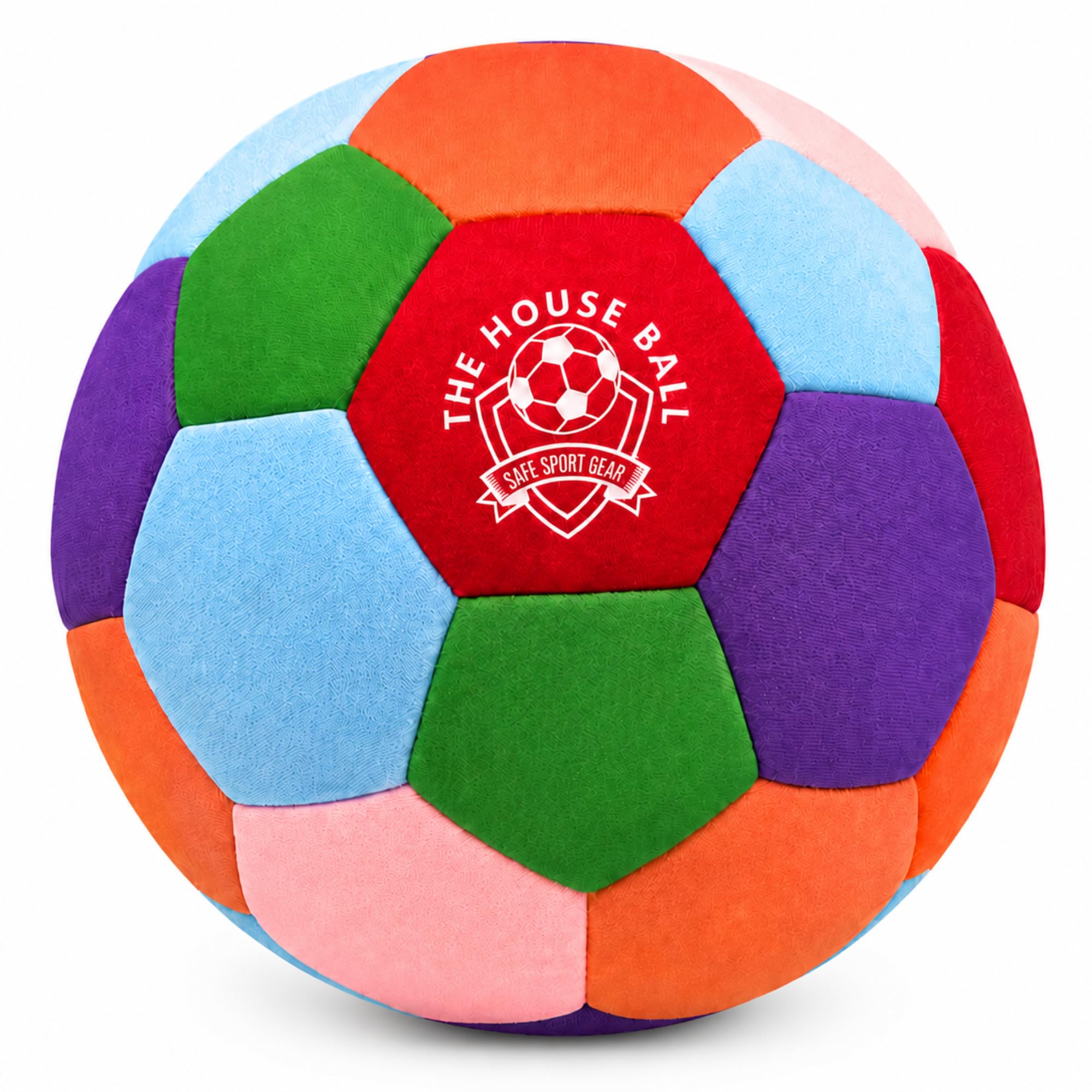
The House Ball Indoor Soccer Ball
Key Features
- Size: Size 4
- Cover: Foam-cushioned
- Weight: 8 oz
- Diameter: 8 inches
- Price: Premium
A hallway, a wet Saturday, a nine-year-old with energy to burn: that is the situation this ball was designed for. The foam layer under the cover takes the sting out of a mis-hit and keeps scuffs off the paint, which is the whole argument for owning one.
We keep it as a second ball rather than an only ball. It is a genuine size 4 with realistic weight, so close control and juggling work transfer when the kid goes back outside, but the softness that makes it safe in a living room also takes the pace off a real shot. For technical work in a small space, nothing else here comes close.
The one thing to watch is teeth. The same soft cover that makes it safe against a skirting board is the reason a dog can open it up in an afternoon, so in a house with a chewer this ball lives in a cupboard rather than on the floor.
Pros
- Foam layer takes the sting out of a mis-hit
- Safe for walls, furniture and hallways
- Realistic size 4 for indoor skill work
Cons
- Goes soft faster than an outdoor ball
The only ball here we kick down a hallway: soft enough for a living room, real enough to sharpen close control.
Best for Night Games
FlashCatch Light-Up Soccer Ball

Key Features
- Cover: Molded rubber
- Batteries: Spares included
- Play time: Up to 30 hours
- Price: Premium
November practices end in the dark, and that is the case for this ball: the LEDs fire on contact and switch themselves off when play stops, so a kid can keep going in the garden after the streetlights come on without leaving anything running. The light triggers on any touch rather than only a proper kick, so a ball rolling across the patio still glows.
It is molded rubber rather than stitched, so the touch is firmer and more plasticky than a leather-covered ball. Nobody is going to confuse it with a match ball, and at dusk that is not why you are buying it — the bright shell and the glow do the work, and the whole thing feels like a toy that happens to be shaped like a size 5.
Spare batteries come in the box and the listed runtime is up to thirty hours a set, so the novelty outlasts the first evening. That is a more thoughtful package than most novelty balls manage.
Pros
- Lights on every touch and switches off by itself
- Spare batteries included
- Up to thirty hours of light per set
Cons
- Arrives flat with no pump included
- Firmer, more plastic feel than a stitched ball
This is the one we bring out after the clocks change: a light-up ball that turns a dark garden into somewhere worth practicing.
Best for Toddler Gift
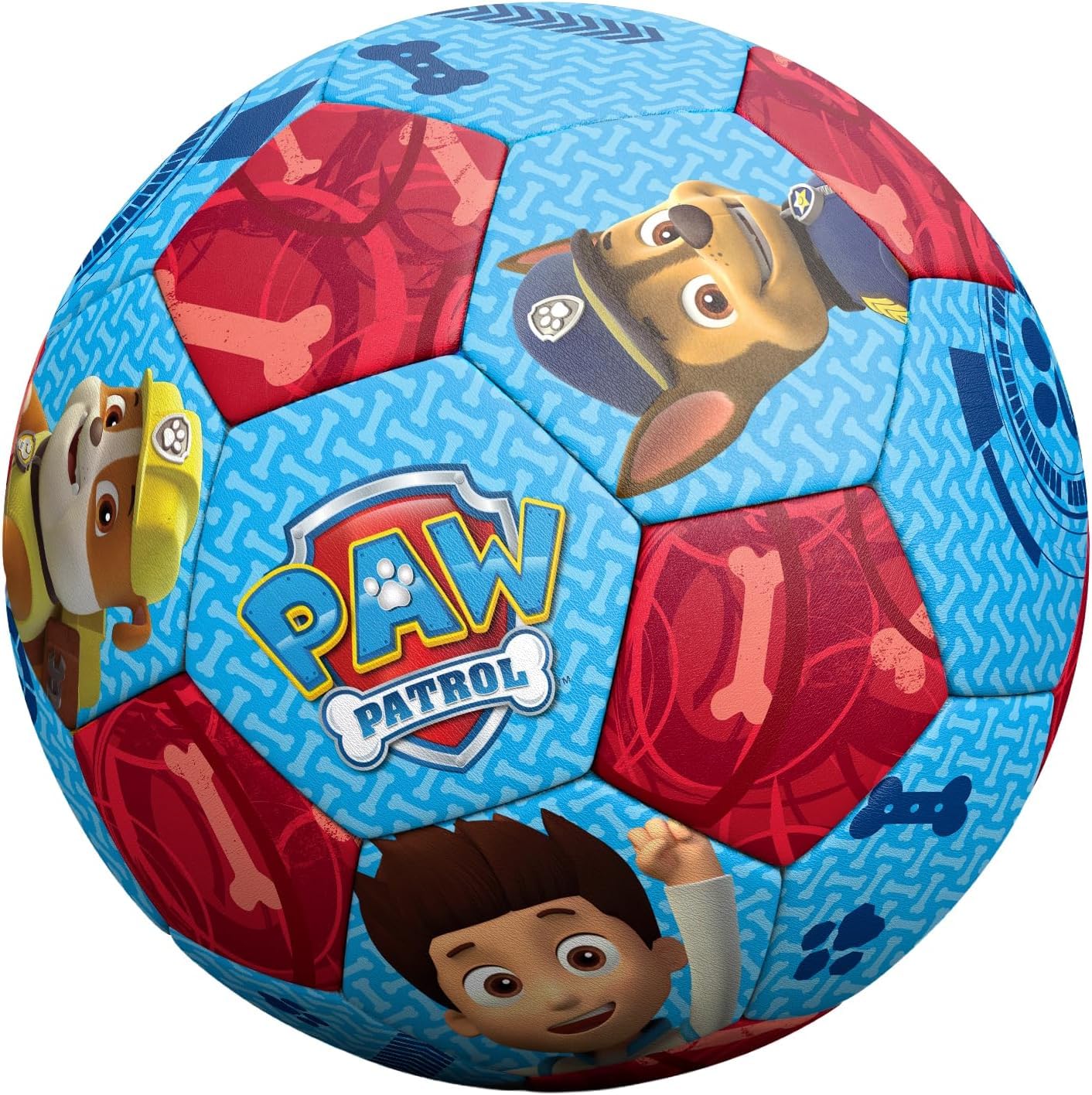
Hedstrom PAW Patrol Soccer Ball
Key Features
- Cover: PVC
- Diameter: 7 inches
- Warranty: 90 days
- Age range: 3 years and up
- Price: Budget
Chase and Marshall on a seven-inch PVC ball is not subtle marketing, and for a three-year-old it works: the characters are the reason the ball gets picked up at all.
As equipment it is a toy — soft PVC over a rubber bladder, seamless, and a touch over seven ounces, which is about right for a toddler’s leg speed. The softness also means an indoor kick is unlikely to take out a lamp, and the three-and-up rating matches the size rather than flattering it.
It ships deflated with no pump in the box, so buy one at the same time or the birthday moment falls flat. Everything else is what the packaging promises: a light, soft, character-covered ball that a small child can boot around a garden without anyone wincing.
Pros
- Character graphics that motivate a toddler
- Soft PVC is safe for indoor kicking
- Seven-inch ball sized for ages three and up
Cons
- Toy-grade PVC ball, not team equipment
We keep this one for three- and four-year-olds: a character ball light enough for a toddler to boot around, provided you buy a pump with it.
How We Tested 14 Kids Soccer Balls Over Four Months
We started with every youth ball we could find that came in at least two of the three youth sizes, then narrowed to 14 by comparing published dimensions, panel construction, whether a pump and needle were in the box, and what long-term reviewers said about valves and seams. I bought each one at retail so nothing arrived pre-inflated by a manufacturer.
The balls went home with families on our team, kids ages 4 to 12, and got used the way kids actually use them: wall ball in the driveway, kickarounds in the backyard, rec practice twice a week, the park, and one memorable afternoon of goalie drills in wet grass. Testing ran four months, from late summer into fall, so every ball saw heat, damp turf, and the first cold mornings. Each Sunday I asked the families which ball their kid had reached for unprompted — a rough enjoyment measure, but a telling one.
Out of the box, I inflated every ball to its stated pressure with a gauge, weighed it, measured the circumference, and dated the valve. I re-checked pressure weekly, which is how we caught the balls that went soft without a visible leak. Texture was judged on dry grass, wet grass, and concrete — which surfaces made the ball skid, which gripped, and which felt like kicking a plastic bag. Durability came down to scuffs, seam separation, peeling panels, and whether the valve still sat flush after a season of being stepped on. Pumps got counted too: strokes to full inflation, whether the gauge held its reading, and whether the needle survived a week in a gear bag. Every ball was scored against what it cost, because an inexpensive one with a good valve beats a pricier one that’s soft by October.
How to Choose a Kids Soccer Ball
Size decides whether a child can control the ball at all; air retention decides whether they still can next month.
Buy the size for the age, not the ambition
Youth soccer runs on three sizes: 3 for roughly five- to eight-year-olds, 4 for the eight-to-twelve stretch, and 5 from about twelve up. A ball that is too big is the usual reason a small child’s kicks trickle sideways; one that is too small is frustrating in the other direction, running away under a bigger foot and teaching nothing about control.
Two traps sit inside this. A listing that says size 3 is not always a true size 3, which matters the moment a child joins a team that specifies one. And toddler character balls are toys first: a seven-inch PVC ball is perfect for a three-year-old and useless to a seven-year-old with a coach.
Air retention is the spec that never gets printed on the ball
Nearly every complaint about a cheap soccer ball comes down to the same thing: it will not hold air. A butyl bladder, which most of the decent options here use, keeps pressure far better than the rubber bladder in a toy ball. The failure usually shows up within a week of the first inflation, and that week is the one to use.
So inflate the ball as soon as it arrives, kick it about, then check the pressure again a week later. If it has gone soft, return it while the window is open. This is also where box contents matter: GoSports includes a pump with the needle stowed in the handle, adidas does not include one at all, and most balls here ship flat, so assume you need a pump in the house.
Match the cover to the surface it gets kicked on
Synthetic leather and TPU slide over grass and take a pass cleanly; PVC and molded rubber are tougher but deader underfoot. Stitching is the other half of the story: machine-stitched panels are the durable standard, while seamless molded balls trade touch for a cover that will not split.
Be honest about surfaces. Asphalt and concrete abrade any cover and are where most seams fail, so if your kid plays on a driveway, treat the ball as a consumable and buy on warranty. Wilson backs its ball for a year, GoSports for six months, Hedstrom for ninety days.
Weight and touch for small legs
A ball has to be light enough for a child to strike through it. The balls here run from around seven ounces for a toddler’s PVC toy to over a pound for a full-size ball, and the lighter end is easier to lift, easier to control and much less intimidating to a nervous beginner.
Softness matters as much as weight. A foam-cushioned cover takes the sting out of a mis-hit and makes indoor or barefoot play realistic; a firm stitched ball teaches how a real pass feels. Neither is wrong — they are for different children, and the mistake is buying the firm one for a four-year-old who is still deciding whether they like the sport.
Frequently Asked Questions
How long should a kids’ soccer ball last?
A recreational ball used once or twice a week on grass should see out a season or two. Scuffing and a slightly shinier cover are ordinary wear; seams splitting, the cover peeling, or the ball going soft within a few weeks is not, and it is worth acting on while the ball is still returnable.
Check the warranty before you buy: Wilson covers its ball for a year, GoSports for six months, Hedstrom for ninety days.
Is an official match ball worth it for a child?
Not until they are playing competitive travel soccer. A match ball is built around consistent flight and a livelier bounce, and you pay more for benefits a seven-year-old cannot use. Put the difference into a decent pump and a second ball instead — a training-oriented ball like the size 4 GoSports is the right compromise for most kids.
Can a regular soccer ball be used indoors?
Not really. A stitched ball scuffs walls, knocks over lamps and hits harder than it looks in a hallway. If indoor practice is the point, buy a ball with a foam-cushioned cover designed for it, and keep the outdoor ball by the door so nobody is tempted.
Final Verdict
For most families the GoSports Classic in size 4 is the ball to buy. It covers the widest stretch of childhood, arrives with the pump that makes it usable that afternoon, and its durability record is the most convincing in this roundup — the wear we saw stayed cosmetic rather than turning into split seams. If your child is still under eight, the Wilson in size 3 is the better fit, with a year of warranty and a look that makes a first real ball feel like an event, as long as it lives on grass rather than asphalt.
And if the ball is really a gift for a four-year-old who has not asked for one, the glitter hahaland is the pick most likely to get a child outside.
