This post contains affiliate links. We may earn a small commission when you buy through our links — at no extra cost to you.
The first time a pediatrician mentioned my kid’s flat feet, I went home and stared at the shoe pile by the door. Flat feet are common in children and often painless, but a floppy pair can make recess, gym class, and long walks harder than they need to be. What you’re after is a shoe with a stable heel, some arch cushioning, and enough flex that your kid actually wants to wear it.
Over four months, my team and I tested 12 pairs of kids’ shoes during school runs, playground time, and weekend errands. We paid attention to fit, comfort, and how each pair held up—including whether velcro straps stayed grippy and laces stayed tied. The best options also passed the appearance test, since my kid had to agree to the color, and one thing I learned is not to chase stiffness: a good kids’ shoe bends at the ball of the foot, not the middle. The picks below cover velcro-first preschoolers through lace-tying big kids.



Best for Wide, Flat Feet
New Balance Rave Run V2
Key Features
- Closure: Lace-up
- Toe box: Extra room at the toes
- Wide widths: Available
- Price: Premium
A flat foot spreads, and the first place it gets squeezed is across the ball. That is why we start with width: the Rave Run V2 comes in wide, and the toe area carries extra room, so a broad forefoot sits on the footbed instead of being pinched into a taper. For a school-age child with a wide, low foot, this is the pair we put at the top of the list.
The lacing is what turns that room into a stable fit. Pulled snug, it holds the midfoot down and keeps the toes from sliding forward into the front of the shoe, which is why a roomy toe box here does not turn sloppy on the playground. It also opens far enough to get a braced foot in and out, the hardest fit in this category to solve.
The laces are the weak point. A single knot works loose, and a double knot is what we use instead. Otherwise it behaves like an ordinary sneaker, which matters more than adults expect once a child is old enough to care what their shoes look like. It is also the priciest pick in this guide, and what you are paying for is the width options and the fit rather than a feature list.
It covers PE, the walk to school, and a weekend without ever becoming a specialty shoe. If your child can tie — or does not mind help — this is where to start.
Pros
- Wide widths with extra toe room
- Laces hold a broad midfoot steady
- Opens wide for a braced foot
- Looks like a normal sneaker
Cons
- Laces come untied without a double knot
For a wide, flat foot that needs room at the toes and a secure hold across the middle, this is the pair we put first — with a double knot.
Best for Toddlers, Wide Feet
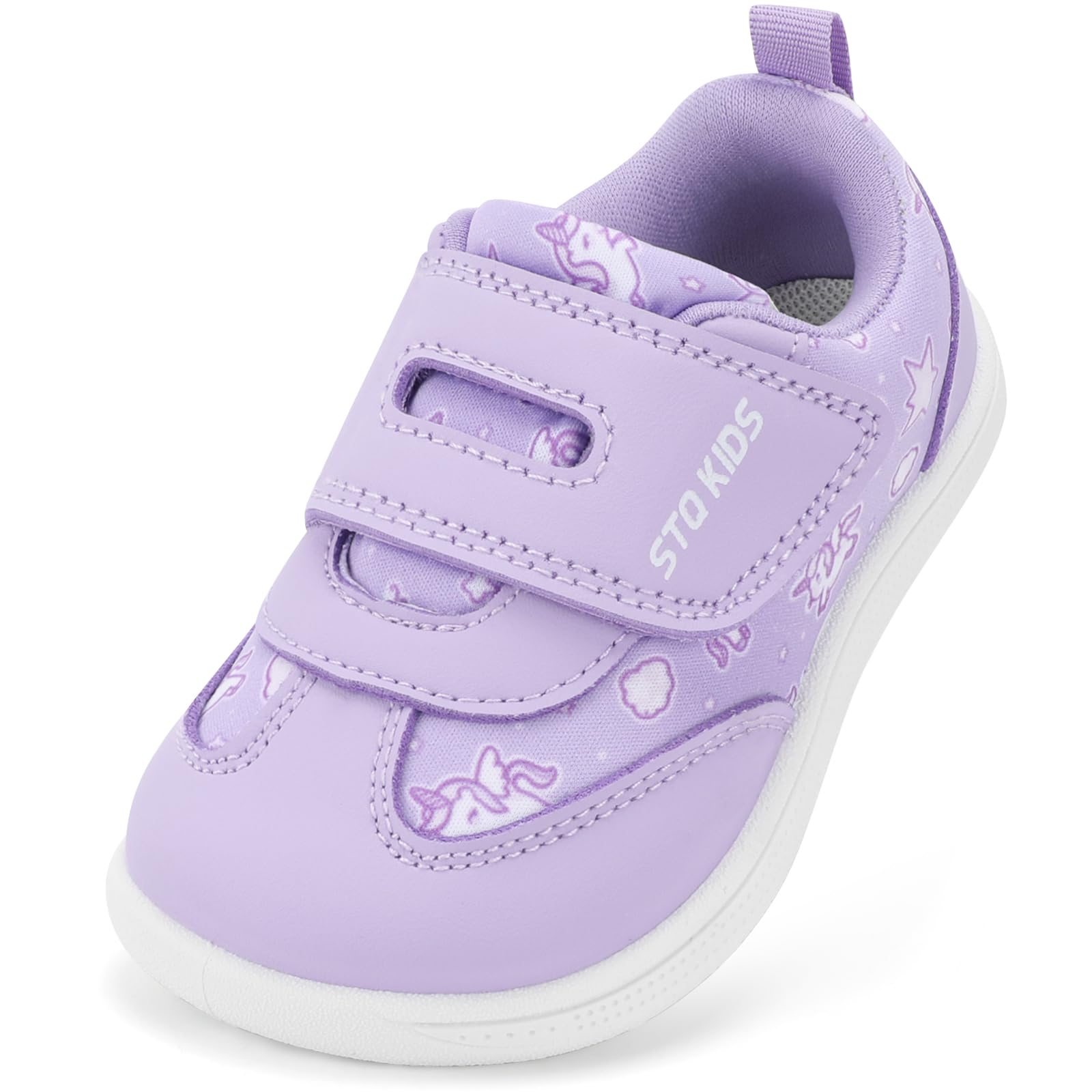
STQ Kids Wide Toe Box Sneaker
Key Features
- Sole: Flexible
- Sizes: Toddler
- Closure: Single hook-and-loop strap
- Toe box: Wide
- Price: Budget
The toe box on this one is shaped like a foot: widest at the ends of the toes, where a flat forefoot actually needs the room, rather than tapering to something two sizes narrower than the rest of the shoe. For a toddler with a low, spreading foot, that shape does more work than any padding inside the shoe.
We hand this pair to the parent of a two- or three-year-old who has already discovered that most toddler shoes pinch. The sole bends easily at the ball, so the foot can push off instead of rolling over the outside of a stiff sole, and the single strap is strong enough that a determined toddler does not kick the shoe off. It wipes clean, which at this age is not a small thing.
Sizing is the one thing to get right: it runs on the small side of the chart, so take the larger size when your child sits between two. Watch how your toddler walks, too — a child who goes up on the outside edge of the shoe is usually in one that is too stiff, and this pair is the opposite of that.
Pros
- Foot-shaped wide toe box
- Sole bends where the toes bend
- Strap holds a determined toddler
- Wipes clean easily
Cons
- Toddler sizes only
The first real shoe we point to for a toddler with wide, flat feet: room at the toes, a bend at the ball, and one strap to fasten.
Best for Washable School Wear
WHITIN W8K6 Barefoot School Shoe
Key Features
- Sole: Flexible
- Closure: Hook-and-loop strap
- Toe box: Wide
- Cleaning: Washable
- Price: Midrange
School shoes take a beating that has nothing to do with quality: mud, paint, and one puddle on the way home. This one goes in the washing machine, and that single fact changes how long you can live with the state of them. The wide toe box and flexible sole are the other reasons it is here.
It is a barefoot shape in a school-shoe wrapper: wide at the toes, flexible through the sole, and fastened with a strap rather than laces. Kids get them on without help, which is the difference between leaving on time and not.
What we appreciate most is that it does not look like a barefoot shoe. It reads as a plain school sneaker, so a child with opinions about their feet being different has nothing to negotiate. Given how often a wide, flat foot arrives with a bit of shoe anxiety attached, that quietness is worth paying for.
The strap ages first. When the hook-and-loop stops gripping, the shoe is finished even if the upper is fine, so check it before a younger sibling inherits them.
Pros
- Goes in the washing machine
- Wide toe box and flexible sole
- Children fasten them alone
- Plain school-sneaker looks
Cons
- Strap can wear out before the upper
Our pick for a wide, flat foot that needs a washable, flexible school shoe a child can put on alone.
Best for Independent Dressing
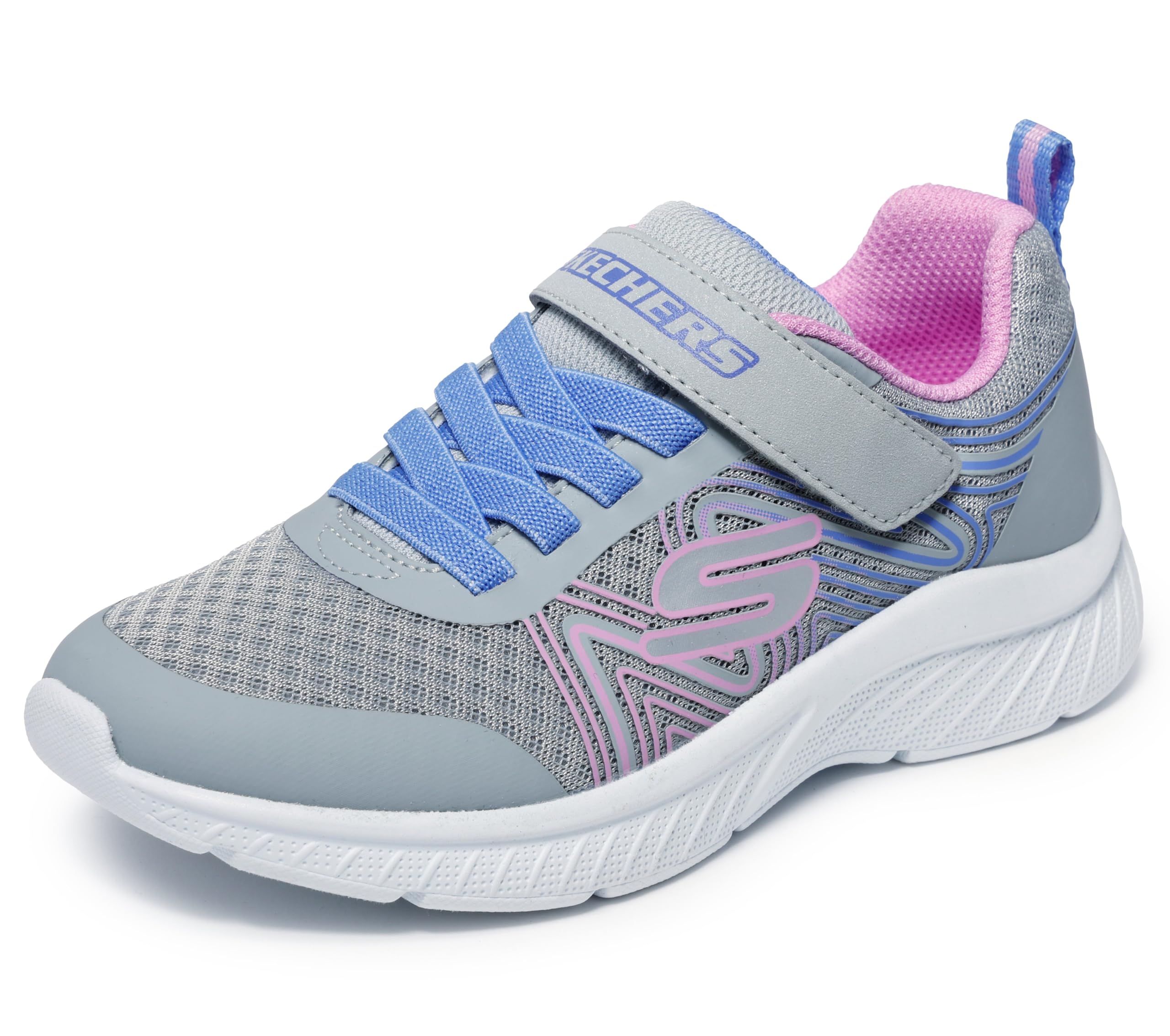
Skechers Microspec Swirl Sweet
Key Features
- Weight: Lightweight
- Closure: Hook-and-loop strap
- Cleaning: Washable
- Price: Midrange
Getting out of the door on a school morning is the real test, and this is the pair that passes it: one strap, a shoe light enough that a five-year-old can haul it on, and nothing to tie. Children who insist on doing it themselves can.
We keep it as the pick for the child who is still learning to dress themselves. There is no lacing to negotiate and not much weight to wrestle, and the colors are the kind children choose for themselves rather than ones an adult talks them into.
Longevity is the trade. The toe and the sole are the first to go, and a pair worn daily may not see a second school year — easier to accept in a shoe that will probably be outgrown first anyway. They also run small, so take the next size up when your child is between sizes.
Pros
- Quick single-strap on and off
- Very light on small feet
- Easy to clean
- Colorways children pick themselves
Cons
- Sole and toe wear within months
For a younger child who insists on doing their own shoes, this is the light, easy pair we reach for — sized up, with a one-year expectation.
Best for Uniform School Days
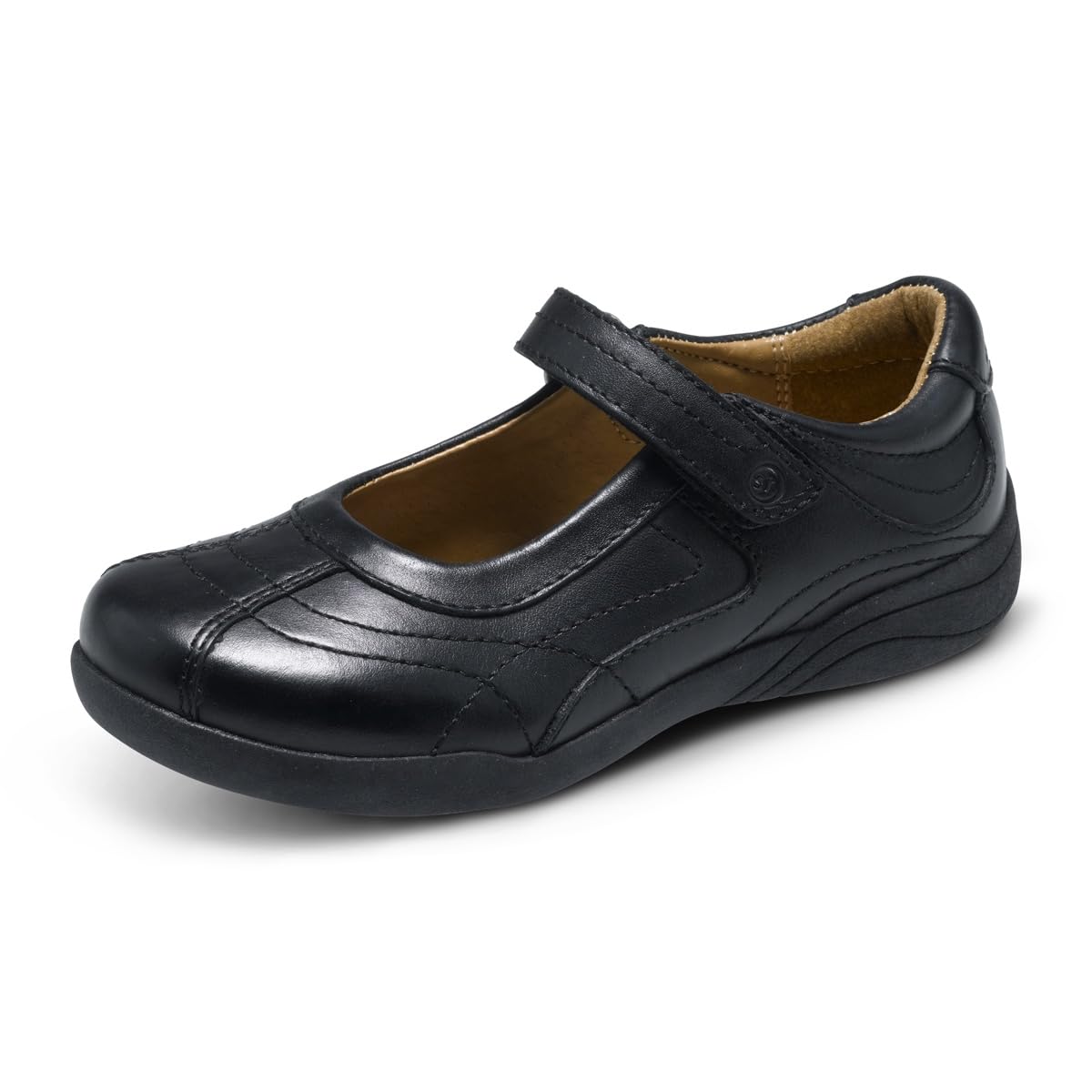
Stride Rite Claire Mary Jane
Key Features
- Sole: Rubber
- Upper: Leather
- Widths: Wide available
- Closure: Hook-and-loop strap
- Price: Midrange
Uniform schools are where a flat foot runs into trouble: the dress code asks for a Mary Jane, and the standard Mary Jane is a narrow strip of leather with a strap across the widest part of the foot. The Claire is the version that comes in wide.
The leather has some give and takes a polish, so playground scuffs come out rather than settling in as grey marks, which is a real advantage in a shoe that has to look smart five days a week. The rubber outsole is there for the playground rather than for show, and children wear them all day without complaining.
The inside is where pairs fail. The lining can peel before the outside shows real wear, which is a frustrating way to lose a shoe that still looks fine, and it is why we treat this as a uniform shoe rather than the everyday one. A Saturday of running is better served by a sneaker.
Where a school requires a Mary Jane, this is the one that does not press across the top of the foot. Keep a sneaker for PE, and let the Claire satisfy the uniform and the foot at the same time.
Pros
- Comes in wide widths
- Leather that polishes out scuffs
- Comfortable for a full school day
- Strap children can adjust
Cons
- Lining can peel before the outside wears
For uniform days, this is the school shoe we recommend for a flat, wide foot — polishable leather and a rubber sole in a dress-code shape.
Best for Budget Barefoot Fit
LeIsfIt Kids Barefoot Shoe
Key Features
- Sole: Zero drop
- Weight: Lightweight
- Toe box: Wide
- Price: Budget
Budget and barefoot rarely turn up in the same shoe, and when they do the sole is usually what gives way. This is the least expensive pair here with a genuinely wide toe box, a flat, zero-drop sole, and enough grip for a playground.
It is the one for the garden, the campsite, and the days the good shoes are drying out. Light enough to live in a bag, stretchy enough that a child can pull them on without undoing anything, and grippy enough for wet grass. The elastic lace is the weak point and can break early, which is the risk you take at this end of the range.
We treat it as the second pair, and that is the sensible place to put money for a foot that grows out of shoes every few months: you get the wide toe box and the flat, flexible sole without paying premium prices for something that will be too small by spring.
Pros
- Lowest price in this set
- Wide toe box with a zero-drop sole
- Good grip for outdoor play
- Light enough to live in a bag
Cons
- Elastic lace can break early
The budget pick for a wide, flat foot: a flexible zero-drop shoe at the lowest price here, best used as the second pair.
Best for Slim, Low-Volume Feet
KUBUA Kids Sneakers

Key Features
- Fit: Runs large
- Weight: Lightweight
- Closure: Adjustable hook-and-loop strap
- Price: Midrange
Sizing is the thing to know before you order. The KUBUA runs large — in some sizes by a full step — so buy the measured size rather than the next one up. Get that right and there is a lot of shoe here for the money: light, adjustable across the instep, and easy to get on.
It is also narrow through the middle, which is why we list it for a slim, low-volume flat foot rather than the broad one the New Balance suits. Flat feet come in both shapes, and a shoe that is roomy at the toes but snug over the instep stops a narrow foot sliding forward.
The colors are bright and they stay bright, which matters to the child even if it does not matter to the fit. Treat it as a shoe for one growth spurt: it holds its shape long enough to be outgrown, and that is the right measure at this price.
Pros
- Light enough for all-day wear
- Adjustable strap across the instep
- Bright colors that hold up
- Low price for a daily sneaker
Cons
- Strap can lose its grip early
For a slim, low-volume flat foot, this is the light, inexpensive pair we point to — order the measured size, not the next one up.
Best for Dress-Up Occasions
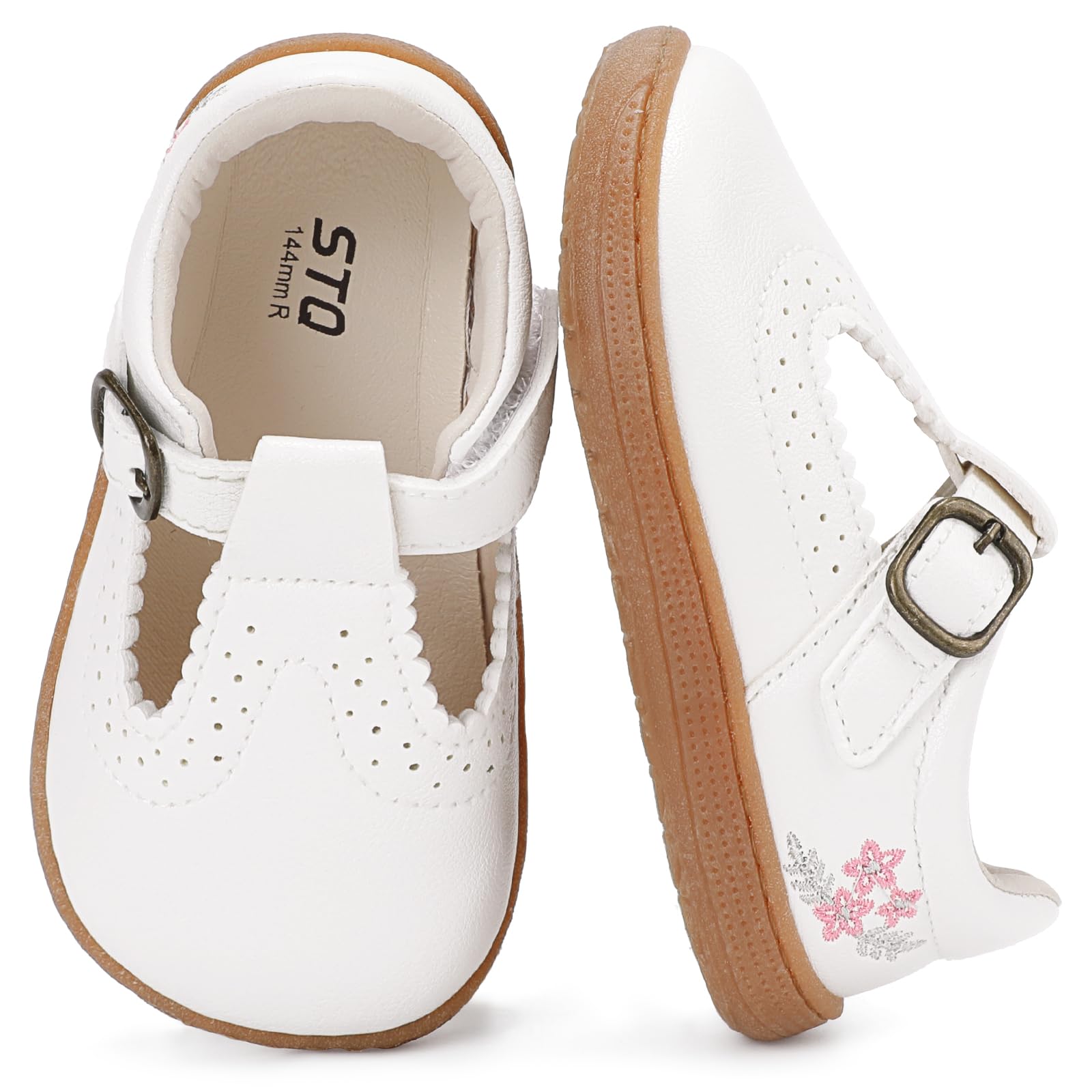
STQ Wide Toe Box Mary Jane
Key Features
- Sole: Flexible
- Style: Mary Jane
- Closure: Hook-and-loop strap
- Toe box: Wide
- Price: Budget
A dress shoe for a flat-footed child is usually a compromise: a thin sole, a narrow vamp, and a strap across the highest part of the foot. This one keeps the Mary Jane look and drops the squeeze — the toe box is wide enough for toes to spread out, and the sole bends where the foot bends.
It is built like a small child’s shoe rather than a scaled-down adult’s: the strap is hook-and-loop, so a two-year-old can get in and out without help, and the whole thing is light enough to wear through a long afternoon without a complaint.
It is an occasion shoe, not the school-year shoe. The pattern is the first thing to look tired, and the uppers are thin enough that daily playground use is not what they were made for. Keep them for the days that need them and they will look new for longer.
We recommend it for the occasions that force a dress shoe — a uniform requirement, a wedding, a recital — where the alternative is a narrow flat a wide foot spends the day complaining about. The flower detail on the white version is the sort of thing a four-year-old notices.
Pros
- Wide toe box in a dress shoe
- Flexible, bendable sole
- Strap a toddler can work
- Low price for a dress shoe
Cons
- Strap can be stiff for little hands
The dress-code and wedding-season answer for a wide, flat foot: Mary Jane looks with a toe box that does not pinch.
How We Tested Kids’ Shoes for Flat Feet
We started by pulling together more than 40 pairs from brands known for supportive kids’ shoes, then narrowed the field by looking at arch support, heel stability, available widths, closure type, and price. We ruled out anything with a squishy heel or a sole that twisted easily in the middle. The final 12 pairs included velcro, lace-up, and hybrid styles, sized for kids from preschool through elementary school.
For four months, our testers—parents with kids who have flat feet—rotated the shoes through the school run, recess, gym class, and weekend errands. We measured each kid’s foot before fitting, checked toe room with a thumb’s width, and noted whether the shoe ran narrow, wide, or true to size. Comfort showed up in small ways: whether a kid complained about rubbing, asked to take the shoes off in the car, or came home with red marks. We also watched how they walked—whether the heel slipped, whether the arch felt supportive without being rigid.
To judge quality and durability, we inspected seams, toe caps, and soles after every few weeks of wear. Velcro straps got a dedicated stress test: kids opened and closed them dozens of times over the test period, and we checked whether the hooks lost grip or the straps curled. For lace closures, we noted whether laces stayed tied through playground time and whether kids could tie them without help. Ease of use mattered too—we timed how long it took a preschooler to put the shoes on solo—and appearance and color got a vote from the actual wearers: if a kid refused to wear a pair, that told us something.
How to Choose Kids’ Shoes for Flat Feet
The most useful thing you can do in a shoe shop is stop reading the word support and measure the width across the ball — that is where most flat-foot fit problems begin.
Width before anything else
A flat foot spreads when it takes weight, so the widest part of the shoe needs to line up with the widest part of the foot. Measure standing, late in the day, and compare the number to the shoe’s width rather than its length. A shoe that is long enough but narrow across the ball makes a child curl their toes to hold it on, which is the opposite of what a low, spreading foot needs.
This is where wide-width options earn their place: the New Balance Rave Run and the Stride Rite Claire both come in wide, while the STQ and WHITIN shapes are built wide from the start. If your child is on the boundary between a standard and a wide fit, take the wide.
Toe box shape, not just toe box size
A rounded, foot-shaped toe box lets the toes lie flat and push off. A tapered one looks neat and squeezes the outer toes together, which is the single most common complaint about shoes that are otherwise the right length. Bend the shoe where the toes bend; if the sole resists there, the foot has to work around it.
Sole choice follows from that. A thin, very flexible sole — the STQ toddler shoe, the LeIsfIt — lets the foot feel the ground and is the barefoot approach. A firmer, cushioned sole like the Rave Run’s suits a child who will run all day on pavement. Neither is better in the abstract; match it to how the shoe will be worn.
If your child wears an orthotic or a brace
That changes the list. A rigid orthotic needs depth and a removable insole, and a brace needs a shoe that opens wide enough to get a braced foot past the collar. Bring the device with you, or buy somewhere returns are easy, because the fit that matters is the one with the insert in place.
A barefoot-style shoe is rarely the answer here: with a very thin, flat sole there is nothing underneath to carry the device. Of the picks here, the laced Rave Run has the most room to work with, and it is the one that has gone over a brace.
Fastenings, and who does them up
A strap a child can reach and pull is worth more than a prettier shoe they need help with every morning. Hook-and-loop is the practical answer up to about age six or seven; after that, laces hold a broad foot more securely and can be re-tied mid-play without taking the shoe off.
Where laces are the closure — the Rave Run, for instance — a double knot is the difference between a secure shoe and a trip hazard. If your child cannot yet tie, that is a reason to choose a strap, not to write off the laced shoes for later.
What wears out first
Kids’ shoes fail in predictable places: the toe, the inside lining, and the strap. Leather uppers polish and hide scuffs; mesh and knit ones wash but thin out. Neither survives a growth spurt, so plan on roughly a pair per school year and check the strap and the toe box halfway through it.
The most expensive shoe here buys fit and width options, not immortality. If your child is between sizes twice a year, a cheaper pair replaced more often can be the better-value route.
Frequently Asked Questions
How much growing room should I leave in kids’ shoes?
With the child standing, you want a finger’s width — roughly half an inch — between the end of the longest toe and the front of the shoe. Measure at the end of the day, when feet are at their largest, and measure both feet, since one is usually bigger.
Buying a size up on top of that is how you get a shoe that slips at the heel and rubs. If the half inch is already there, that is the size.
Do children with flat feet need special shoes?
Most children with flexible flat feet — the kind that disappear when they stand on tiptoe — do not need a prescription shoe. They need a shoe that fits the width, holds the heel, and does not press up under the arch.
See a clinician first if there is pain, a limp, or a change in how your child walks. Footwear will not fix those, and no shoe on this page is sold as a treatment.
Can my child wear hand-me-down shoes?
Yes, if the sole is still even and the shape has not collapsed. Stand the shoes on a table and look from behind: a pair worn down on one edge will keep tipping the foot that way, which is the last thing a flat foot needs.
Uppers that gape, a heel counter you can push flat with a thumb, or a strap that no longer grips are all reasons to pass.
My child’s shoes always wear on the outside edge. Is that the shoe or the foot?
Outer-edge wear is ordinary in children and not automatically a problem. What matters is whether it is even on both shoes and whether it appears alongside a heel that rolls inward, a flat arch that stays flat on tiptoe, or complaints of tired legs.
Replace a pair once the sole is worn through at the edge; a shoe that has already tilted will push the foot further the same way.
Final Verdict
Buy the New Balance Rave Run V2 in wide if your child has a broad, flat foot and can manage laces. It has the most room at the toes, the most secure hold across the middle, and the fewest compromises of anything here — the double knot is the only habit it asks for.
For a toddler, start with the STQ wide toe box instead: the shape does the work while the foot is still forming. And if money is the constraint, the LeIsfIt gives you a wide, flexible, zero-drop shoe at the bottom of the range here, which is exactly the role we give it — the second pair, not the only one.
