This post contains affiliate links. We may earn a small commission when you buy through our links — at no extra cost to you.
A pram is a tug-of-war between two things you want and rarely get at once: something light enough to lift into the boot one-handed, and something sturdy enough that it doesn’t rattle your baby awake over a paving slab. Go too light and the frame flexes, the seat wobbles, the basket sags. Go too sturdy and you’re wrestling 30 pounds of chassis into a hatchback in the rain. What you actually want is a pram that disappears into your day — folds one-handed, rolls over a kerb without a jolt, and still feels solid two years in.
I’ve pushed plenty of these around my own neighbourhood, and the brochure numbers rarely tell the whole story. Assembly is where cheaper prams quietly give themselves away, and value has less to do with the price tag than with what’s actually in the box. Over the past nine months, my team and I have tested 12 prams in daily life, handing several to grandparents and a tall partner to see how they coped with a second set of hands. The ones that came out ahead were the ones nobody had to think about — the shortlist below is where I’d start.



Best for Newborn to Toddler
Mompush Wiz 2-in-1
Key Features
- Basket capacity: 10 lb
- Stroller weight: 23.1 lb
- Max child weight: 50 lb
- Car seat compatibility: 6 infant seat models
- Price: Midrange
The moment the Wiz earns its place is a boring one: a newborn falls asleep mid-walk, and the seat reclines to a near-flat pramette so the nap survives the trip home. It converts without tools, which is the difference between using pramette mode every day and saving it for special occasions, and the seat flips to face you or the world as your baby’s needs change. We think a reversible, lie-flat seat is the single most useful thing a pram can do, and the Wiz does it without a second bassinet taking up shelf space.
The runway is the other reason it leads. The frame is rated to 50 pounds — toddler-plus, not first-year-only — and at 23.1 pounds the stroller itself stays manageable. We felt the lift into a hatchback at the end of a long walk, but not enough to complain about, and the 9.4-inch rear wheels with suspension roll over sidewalk cracks and park paths without passing every jolt up to the handlebar.
The supporting details are unusually complete: a canopy that zips out to UPF 50+ with ventilation panels, a cup holder and foot cover in the box, and a frame that accepts six named infant seats — Chicco KeyFit 30, Cybex Aton and Maxi-Cosi Mico among them — so a sleeping baby goes from car to stroller without being unbuckled. Where it gives ground to the Hagaday below is simple portability: that one is lighter and less particular about how it folds, and if the stroller lives up a flight of stairs, the difference shows up twice a day.
Pros
- Lies flat for newborns without a separate bassinet
- 50-pound seat limit outlasts the toddler years
- Accepts six named infant car seats
- Suspension and 9.4-inch rear wheels smooth the ride
Cons
- Bassinet must come off before the frame folds
- Folded length is long for small trunks
This is the pram we point most families to: it lies flat from birth, faces either way, takes six infant car seats, and is rated to 50 pounds.
Best for Lifting into Trunks
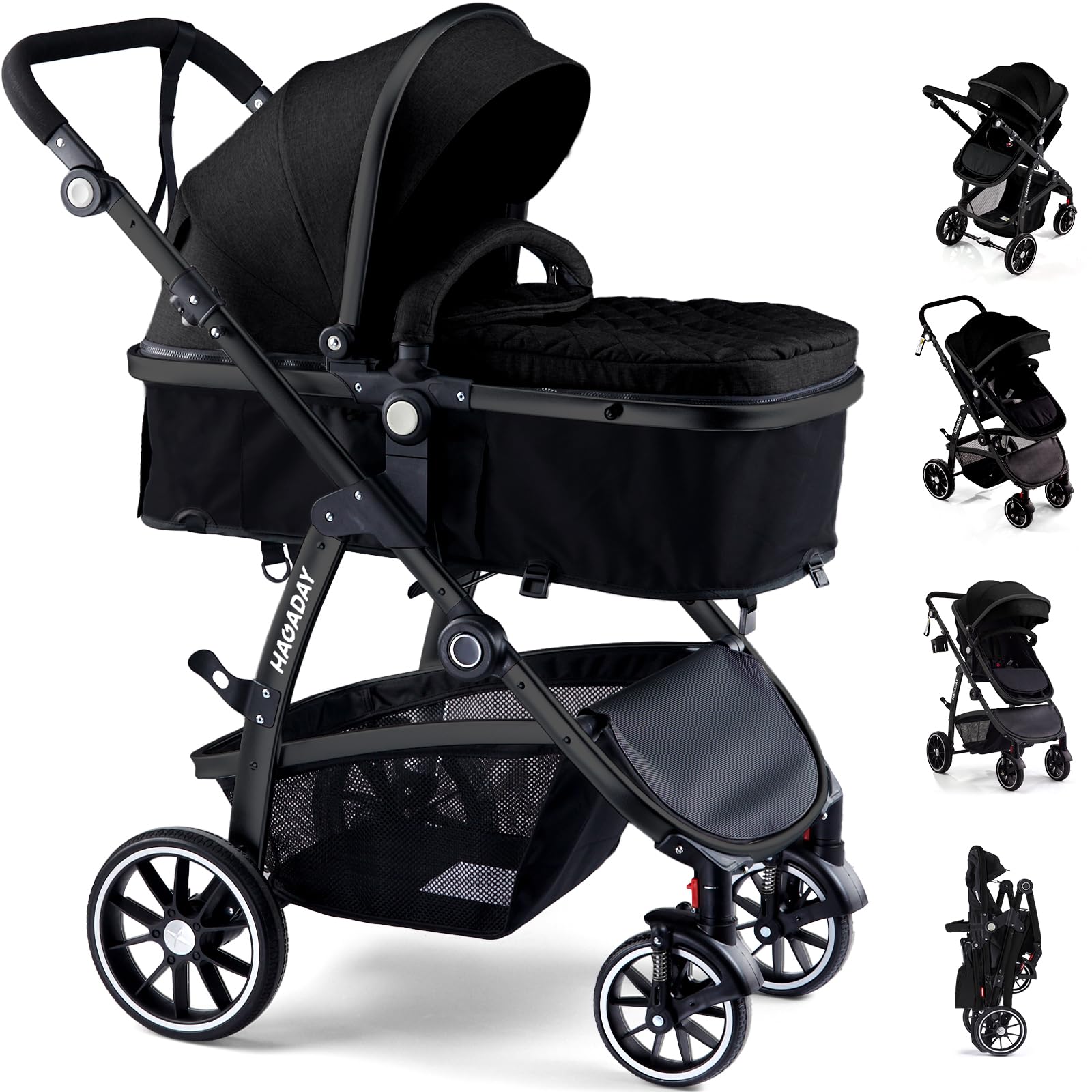
Hagaday SK20 2-in-1
Key Features
- Weight: 21.2 lb
- Folded size: 40 x 22 x 13.5 in
- Max child weight: 40 lb
- Price: Midrange
9.6 kilograms — about 21 pounds — is the figure that shapes everything about the SK20. It’s roughly the weight of a loaded changing bag, and it changes the routine: one hand on the frame, one on the car, and the stroller is in the trunk without a second trip. Folded, it measures 40 by 22 by 13.5 inches, which tucks behind the seat of a hatchback rather than filling the cargo area.
What we appreciate is that the lightness hasn’t been taken out of the frame’s manners. The aluminum chassis feels tight rather than tinny, the bassinet and seat swap between the two modes without a second purchase, and the whole stroller meets ASTM. Assembly is a short job, and the fold is the least fussy of the group — rare enough in this category that we noticed it straight away.
The kit is better than the tier suggests: a canopy with a skylight panel so you can check on a sleeping baby without stopping, a mosquito net for evening walks, and a foot cover for cold mornings. The one-button brake and the adjustable handle are the two things parents touch on every outing, and both are here rather than held back for a more expensive model.
Pros
- 9.6 kg makes car-to-curb lifts a one-hand job
- Bassinet and seat swap without a second purchase
- Skylight canopy, mosquito net and foot cover included
Cons
- 40-pound seat limit arrives sooner than the Mompush’s
- Fabric is hand wash or spot clean only
For anyone lifting a stroller in and out of a car every day, this is the one we hand people: light, quick to assemble, and still a proper lie-flat pram.
Best for Graco Travel Systems
Graco Modes Pramette
Key Features
- Weight: 20.9 lb
- Seat modes: 3-in-1: car seat, pramette, toddler
- Max child weight: 50 lb
- Car seat compatibility: Graco SnugRide SnugLock 35
- Price: Premium
If a Graco SnugRide SnugLock 35 is already in your car, the Modes Pramette answers a question the rest of this list can’t: the seat clicks into the frame with no adapter, no straps, and no wrestling at the curb in the rain. From there the stroller runs three ways — car seat carrier, flat pramette, and a reversible toddler seat that faces you or the world.
For a Graco household that click is worth the premium, and it’s the honest reason this stroller is on the page; the rest is competent rather than remarkable. The 20.9-pound frame is light for a travel system, the seat is rated to 50 pounds, and the pramette lies flat enough for a newborn to sleep through the walk in from the parking lot.
Assembly needs no tools, and the whole thing goes up in minutes — though the rear wheels are the fiddly part, since each pin has to seat before the axle clicks, and that’s where the time goes. The snack tray also sits well forward of the seat, which suits a long-legged toddler better than a small one.
Pros
- Graco SnugRide clicks in without an adapter
- Three modes cover car seat, pramette and toddler
- 20.9 lb is light for a travel system
Cons
- Pramette mode can feel loose on uneven ground
- Won’t stand upright when folded
Buy this if a Graco infant car seat is already in your life — the click-in frame earns its premium, and the pramette and toddler modes carry you well past it.
Best for Carrycot Transfers
INFANS 2-in-1
Key Features
- Frame: Aluminum alloy
- Folded size: 22.5 x 13.5 x 30 in
- Max child weight: 50 lb
- Price: Budget
The bassinet on this one lifts off the frame as its own carrycot, handle and all, so a baby who fell asleep on the walk can be carried into the house without being unclipped or woken. That trick is why it earns a place: not every pram here lets you take the whole sleep pod indoors, and the ones that do tend to cost more. We think it’s the most practical budget option on the page for that reason alone.
The rest of the package holds up. The seat is rated to 50 pounds, the frame is aluminum and meets JPMA, and the bassinet folds with the stroller rather than needing to come off first — ahead of the Mompush on that one count. The front wheels swivel 360 degrees and lock, the rear mounts are sprung, and the foot cover comes off when the weather warms, which is the sort of thing you notice in a pram that sees winter.
The high seat position turns out to matter more than it sounds: a newborn rides up near the handlebar where you can see and hear them, rather than down at hip height behind a canopy. Add a storage basket that takes a changing bag and a canopy that pulls far enough forward to shade a sleeping face on a low-sun walk home, and the everyday jobs are covered.
Pros
- Bassinet lifts off as a carrycot with a handle
- 50-pound seat limit at the lowest price tier
- Bassinet folds with the frame, unlike the Mompush
Cons
- Straps and fittings are the durability weak spot
- Fold is a sequence rather than one motion
The carrycot is the reason to buy: it lifts off the frame so a sleeping baby goes indoors without being unbuckled, and the 50-pound seat keeps it useful for years.
Best for Smaller Toddlers
Accombe X1-D 2-in-1

Key Features
- Weight: 25 lb
- Folded size: 23.5 x 31 x 17 in
- Handle positions: 3
- Max child weight: 33 lb
- Price: Midrange
Swinging the Accombe around a shop corner takes a deliberate hand. At 25 pounds it’s the heaviest pram here, and it pushes the way heavy things push: planted and steady in a straight line, a beat slower to change direction. What that weight buys is a settled ride — the alloy frame and the sprung rear wheels soak up a curb without sending the shudder up into the handlebar.
The passenger side is well thought out. The seat converts from a lie-flat infant position to an upright toddler seat and flips to face either way, and the handlebar adjusts through three heights — the detail two caregivers of different heights notice on every single walk. The PU tires run quiet on pavement and the frame meets JPMA, so safety isn’t where the corners were cut.
Where we land is that this is a good newborn pram with a short second act. The seat is rated to 33 pounds, the lowest here, and that’s the number to check against your own child: a small two-year-old has years left in it, a tall one will age out while the Mompush and the INFANS keep going. If you’re buying for the first year and you like a classic pram shape, it does that job well.
Pros
- Planted, steady ride over curbs and pavement
- Three handlebar heights suit two caregivers
- Reversible seat converts from infant to upright
Cons
- Fold takes a few tries to learn
A settled, good-looking pram for the newborn year, with three handlebar heights for two caregivers — check the 33-pound seat limit against your toddler first.
Best for Wet-Weather Walks
BIUSIKAN 6-in-1

Key Features
- Weight: 25 lb
- Max child weight: 45 lb
- Safety standards: CPSC and ASTM
- Rear-facing height limit: 40 in
- Price: Midrange
A rain cover in the box is unusual on this list, and it tells you who the BIUSIKAN is for: a family whose walks happen in drizzle, cold and mud, not just in June. The footmuff and the cup holder come with it too, which saves the usual round of add-on purchases before the first properly wet week arrives.
The hardware backs that up. The seat is rated to 45 pounds, the rear-facing height limit is 40 inches — the tallest here, and a genuine advantage if your family runs long — and the large rubber wheels with a swiveling front end handle gravel paths and park grass without drama. It meets both CPSC and ASTM, the handlebar adjusts for height, and the seat reverses for a parent-facing newborn.
Where we land is that it’s the most complete package here for wet-weather walking — accessories, height and a 45-pound seat — and the one we reach for when the forecast is bad. Plan for its size, though: 11.36 kilograms and a folded footprint of 15.4 by 24.4 by 26 inches want a real trunk, not the corner of a hallway.
Pros
- Rain cover and footmuff included in the box
- 40-inch rear-facing height is the tallest here
- Meets both CPSC and ASTM standards
Cons
- Frame joints can loosen over time
It’s the year-round pick: rain cover and footmuff included, a 45-pound seat, and the tallest rear-facing height here for a long toddler.
How We Chose and Tested the Best Prams
We started by gathering every pram a real family might buy — mainstream strollers, travel-system chassis, a couple of compact folders — then trimmed the field by reading spec sheets closely: folded dimensions, seat height, weight limits, whether a carrycot or car seat was included, and what the warranty actually covered. Price was a filter, not a ranking. That left 12 prams, which we assembled ourselves, timing the unboxing, counting how many tools we needed, and noting whether the instructions made sense without a video.
Each pram then went into nine months of ordinary use. We folded and unfolded every one ten times in a row, sometimes with a bag of shopping in the other hand, and recorded which needed two hands, a foot, or a firm shove. We weighed each chassis on a luggage scale and then lifted it into a hatchback boot, because the published weight and the weight you actually feel are rarely the same number. We pushed them over kerbs, gravel, grass, and the lumpy paving outside the library, watching whether the baby stayed asleep through it.
Stability got its own test: we filled the basket with a week’s shop, hung a changing bag on the handlebar, and nudged the pram off a kerb to see whether it tipped. Folded size was checked against a hallway cupboard and a car boot, then measured again with the wheels off. At the end, we went back over every frame looking for scratches, wobbling wheels, worn brakes, pilled fabric, and frayed harness straps, and compared what came included — rain cover, bumper bar, carrycot — against what each one cost.
How to Choose a Pram Stroller
The decision that matters most isn’t the fabric or the color — it’s whether the pram still works for you at month twelve, when the baby is heavier than the bassinet and the trunk is full of groceries.
Start with the fold, and where it happens
Two designs dominate this category. In the first, the seat itself reclines flat into a pramette and the whole thing folds as one piece. In the second, the bassinet is a separate unit that comes off before the frame collapses — which is what happens on the Mompush whenever the seat faces you. Neither is wrong, but the second costs you two hands and somewhere to set the bassinet down, often in the rain.
Picture your real fold spot — the trunk of a hatchback, a narrow hallway, the bottom of a stair — and check the folded dimensions against it before you decide. A stroller that folds beautifully into a space you don’t have is not a compact stroller.
The lift matters more than the listed weight
A stroller’s weight means little until you’re hoisting it into a car with a baby on one arm. The prams here run from about 21 pounds to 25, and at the light end — the Hagaday, at 9.6 kilograms — the difference is one hand instead of two, every single time.
What you trade for lightness is usually capacity: a 40-pound seat limit rather than 50. If the stroller lives in a garage and rolls into a driveway, take the capacity. If it goes up steps or into a trunk twice a day, the lighter frame earns its shorter runway.
What bassinet mode actually gives you
There are two different things sold as a pram. One is a seat that reclines flat enough for a newborn, often called a pramette — the Mompush and the Graco both work this way, and for most families that’s plenty. The other is a true carrycot that lifts off the frame, as on the INFANS, so a sleeping baby goes into the house without being unclipped.
That transfer is worth paying for if it happens daily. Either way, a stroller bassinet is for supervised naps on the move; overnight sleep belongs in a crib with a firm, flat mattress.
How long it lasts: weight limits and seat height
Maximum child weight is the headline number — 33 pounds on the Accombe, 50 on the Mompush, the Graco and the INFANS — but rear-facing height limits often arrive first. The BIUSIKAN lists 40 inches; the Mompush and the Graco list 32, which a tall three-year-old can reach while still well inside the weight rating.
If your family runs tall, weigh the height figure as heavily as the weight figure, and look hard at the toddler seat itself, because that’s the mode you’ll use longest.
Car seat compatibility, by model number
Travel-system shopping goes wrong when you match brands instead of models. The Graco Modes Pramette accepts the Graco SnugRide SnugLock 35; the Mompush lists six compatible infant seats, among them the Chicco KeyFit 30 and the Maxi-Cosi Mico.
If your seat isn’t named, plan on an adapter and count it as an extra step in the rain. Write your car seat’s exact model number down before you shop, and check the stroller’s list carefully — trim versions such as a Zip or a Luxe are often listed separately.
Frequently Asked Questions
Can I take a pram stroller on a plane?
Airlines generally carry strollers as gate-checked baggage rather than cabin luggage, and the size and weight limits differ by carrier. Check your airline’s rules against the folded dimensions — the INFANS folds to 22.5 by 13.5 by 30 inches, the Mompush to 43.4 inches long — and bring a gate-check bag.
A pram that folds with the bassinet still attached is much easier to hand over at the gate with a baby in your arms.
How do I clean a pram stroller?
Spot-clean the frame and canopy with a damp cloth and mild soap, and treat the harness webbing as hand-wash only — never put it in a machine. The seat pad takes the punishment: the Hagaday asks for gentle hand washing or spot cleaning, while the Accombe allows machine washing for its polyester parts.
Read the care label before the first ice-cream incident rather than after it.
When should I move my baby out of the bassinet?
Once your baby can sit up unaided and push up on their hands, the flat pram has done its job; most families switch to the seated mode somewhere around six months. Until then, keep the backrest flat for naps and use the harness on every walk, however short.
Check the stroller’s own instructions too — the stated limits for the seat unit take priority over any general rule of thumb.
What accessories will I end up buying?
Budget for a rain cover, a footmuff and a spare seat liner, because most are sold separately. Some prams include them: the BIUSIKAN ships with a footmuff and rain cover, and the Hagaday includes a mosquito net, foot cover and cup holder.
Buy the rain cover before your first wet week rather than after it, and confirm the canopy is rated UPF 50+ if your due date lands in summer.
Final Verdict
Buy the Mompush Wiz if you want one stroller that starts as a lie-flat pram and ends as a 50-pound toddler seat, with six infant car seats welcome in between. It’s the most complete newborn-to-preschool pram here, and the bassinet detaching before the fold is the price of that.
Two requirements change the answer. If the stroller goes in and out of a trunk or up steps every morning, the Hagaday’s 9.6 kilograms is the kinder choice. If a Graco SnugRide is already in your car, the Modes Pramette’s click-in frame earns its premium.
