This post contains affiliate links. We may earn a small commission when you buy through our links — at no extra cost to you.
The first bottle of formula you offer a breastfed baby can feel like a small leap of faith. You worry it will taste metallic, mix up lumpy, or land hard on a tummy that has only known breast milk. What you’re really shopping for is a formula that disappears into the routine: one that dissolves cleanly, smells neutral enough to face at 2 a.m., and sits comfortably enough that feedings don’t turn into a guessing game.
I’ve mixed bottles at midnight and packed powder into a diaper bag for weekend trips, and the gaps between formulas show up fast—in the clumping, the scent, and whether a baby takes the first few ounces without turning away. Over six months, I and a small group of parent testers worked through 12 formulas made for breastfed or supplementing babies, weighing ingredients, mixing consistency, and everyday convenience. The biggest surprise: a gentle-sounding label didn’t guarantee an easy transition; how the powder dissolved and how the baby tolerated it mattered more. The picks below are the ones that earned a repeat buy.


Best for Everyday Supplementing
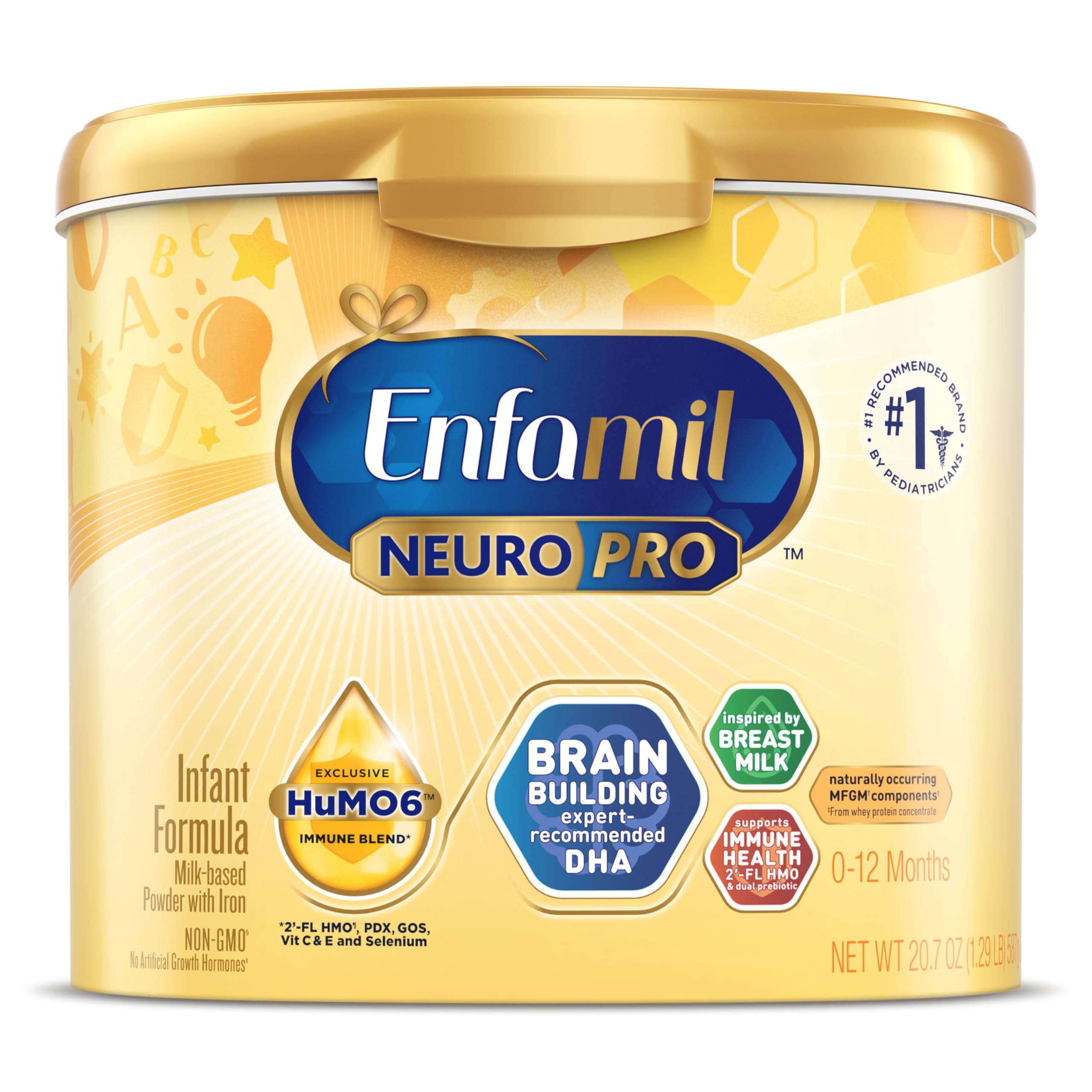
Enfamil NeuroPro
Key Features
- Stage: 0–12 months
- Can size: 20.7 oz
- Formula type: Standard milk-based powder
- Key ingredients: MFGM components, DHA
- Price: Premium
Enfamil NeuroPro is a 20.7-ounce can of standard milk-based powder, with MFGM components and DHA as the headline ingredients. That sounds like marketing until you are standing in the formula aisle: standard is the right starting point for most breastfed babies who need a top-up, and this can does that job without asking you to diagnose a sensitivity first.
We made it our top pick because it combines a broad fit with the fewest complications in the bowl. The powder dissolves readily, the scoop is straightforward, and the can is small enough to keep in a diaper bag or on a kitchen shelf without committing a whole cabinet. In use, that matters more than the ingredient list: you can mix a single bottle without hauling out a blender or a special pitcher.
The trade-off is size. At 20.7 ounces, it is not the can to buy if formula is the main feed for a growing baby; you will be reordering often. For supplementing, that smaller footprint is an advantage. We also keep the usual caveat: if a baby has a diagnosed milk-protein allergy or is preterm, this is not the formula to choose without a pediatrician. For everyone else, it is the low-drama default.
Pros
- Standard milk-based powder for broad use
- MFGM components and DHA on the label
- Mixes readily with a simple scoop
- Small can suits supplementing
Cons
- Some babies become constipated
We make Enfamil NeuroPro our default for topping up a breastfed baby because it is a standard milk-based powder with broad tolerance and no specialty-formula detour.
Best for Night and Travel
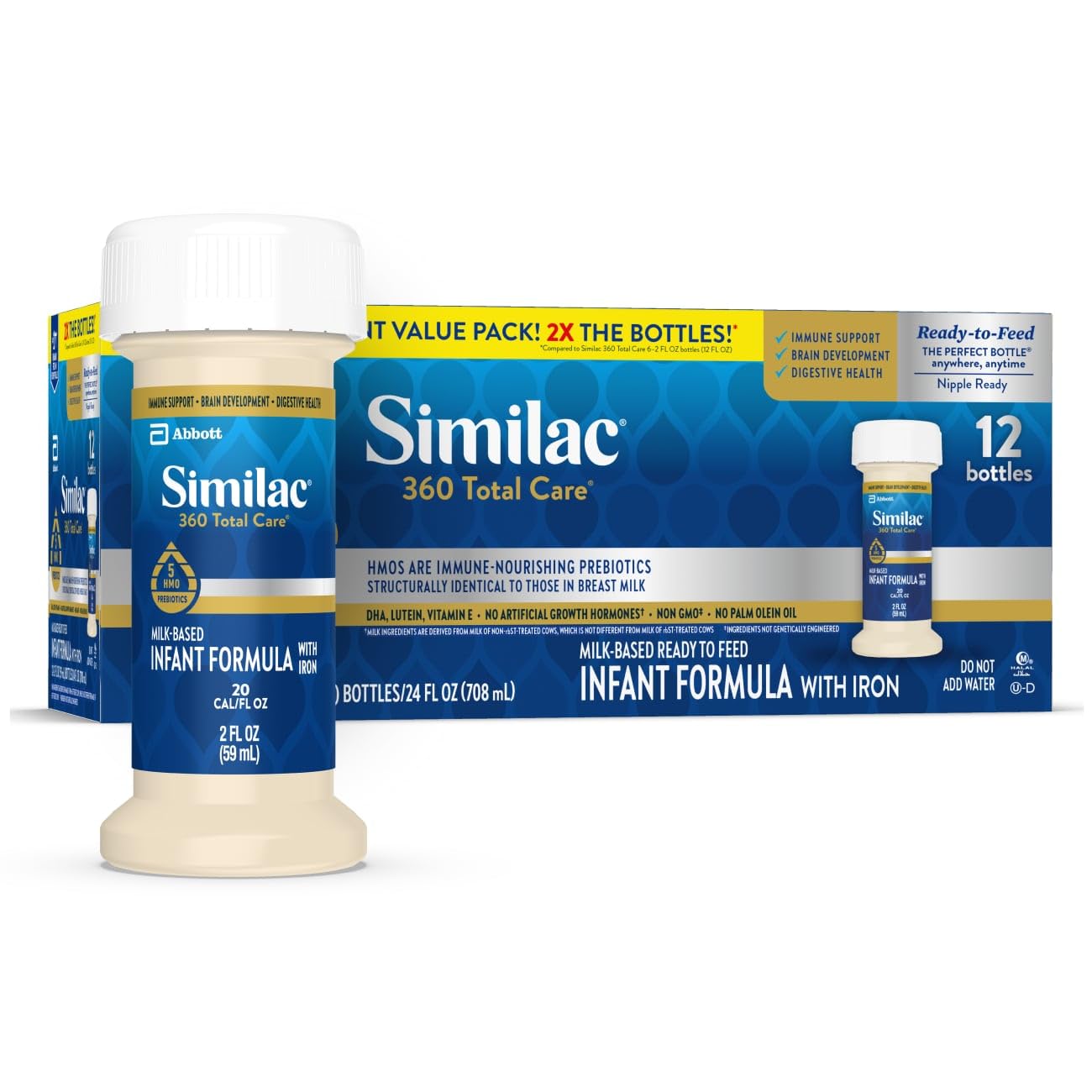
Similac 360 Total Care Ready-to-Feed
Key Features
- Stage: 0–10 months
- Format: Ready-to-feed 2-fl-oz bottles
- Pack size: 24 fl oz
- Key ingredients: 5 HMO prebiotics
- Price: Midrange
At 3 a.m., the difference between a can of powder and a ready-to-feed bottle is not a spec; it is whether you have to count scoops with one eye open. Similac 360 Total Care comes in 2-fl-oz bottles that are already mixed, and that is the entire argument for keeping a pack on hand.
The 2-ounce size is right for a top-up, not a full feed for an older baby; we found that a hungry 6-month-old may want two bottles, which makes the pack disappear faster than the box suggests. For a newborn or a breastfeeding parent who needs someone else to take one feed, the portion is close to ideal. The bottles are also easy to stash in a diaper bag with an ice pack, and there is no scoop to lose.
The formula itself is standard Similac 360 Total Care, with 5 HMO prebiotics and the same whole-baby positioning as the powder. We choose it for the night feed that does not turn into a kitchen project, not for the ingredient story alone. It is the convenience play, and we accept the premium because it removes a decision at the worst possible hour.
Pros
- No mixing or measuring needed
- 2-fl-oz bottles suit small top-ups
- Standard 360 formula with HMO prebiotics
Cons
- Costs more per feed than powder
- Nipples may be sold separately
We reach for Similac 360 Total Care ready-to-feed when the next feed has to happen fast, especially at night or on the road.
Best for Fussy Tummies
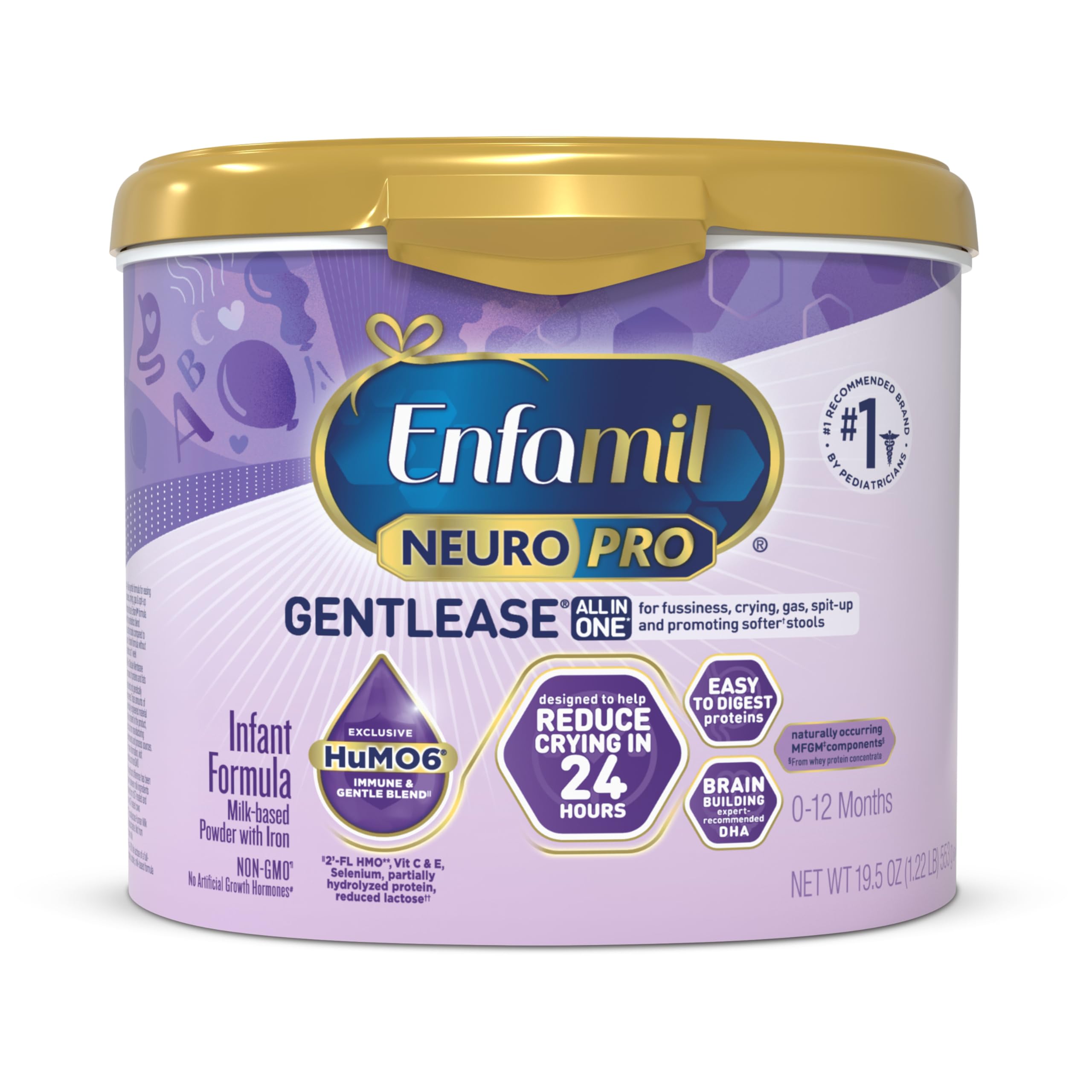
Enfamil NeuroPro Gentlease
Key Features
- Stage: 0–12 months
- Can size: 19.5 oz
- Formula type: Gentle broken-down protein powder
- Key ingredients: DHA, choline, PDX/GOS
- Price: Premium
Gentlease is the formula we point to when a breastfed baby is not just gassy once in a while, but uncomfortable after feeds in a way that is starting to run the household. The selling point is the protein: smaller, broken-down pieces designed to be easier on a sensitive tummy, plus DHA and choline from the NeuroPro side.
The label promises less fussiness, crying, gas, and spit-up within 24 hours. We treat that as a direction, not a stopwatch. In our testing, the more useful question was whether the baby settled over a week of consistent use, and whether the powder mixed without clumps. It did mix well, and the scoop is the same easy-to-use style as the standard NeuroPro can.
This is not the first formula to try if there is no problem to solve, and it is a specialty step rather than a universal upgrade. We still like having it as the next step because it keeps the NeuroPro nutrition while changing the protein, so you are not starting over with an unfamiliar brand. If fussiness continues or there is blood in the stool, vomiting, or poor weight gain, that is a pediatrician conversation, not a formula-swapping one.
Pros
- Broken-down proteins for sensitive tummies
- Designed for gas, fussiness, and spit-up
- DHA and choline for brain support
- Keeps NeuroPro nutrition in a gentle formula
Cons
- Costs more than standard NeuroPro
- Taste can be a hard sell
We keep Enfamil NeuroPro Gentlease in the conversation for a baby whose gas and fussiness have not settled on a standard formula.
Best for Lactose Sensitivity
Similac 360 Total Care Sensitive
Key Features
- Stage: Infant
- Can size: 20.1 oz
- Formula type: Sensitive infant powder
- Key ingredients: 5 HMO prebiotics
- Price: Premium
Sensitive formula is not a softer version of standard formula; it is a different tool. Similac 360 Total Care Sensitive is built for fussiness and gas due to lactose sensitivity, with the same 5 HMO prebiotic blend as the standard 360 line.
That distinction is the reason we recommend it only when there is a reason. A breastfed baby who is comfortable on standard formula does not need to pay for sensitive; a baby who is consistently gassy, spitty, or uncomfortable after feeds may be a candidate, especially if a pediatrician has pointed to lactose. The 360 line keeps the HMO prebiotics and the same familiar scoop, so the switch from standard Similac is less of a leap.
The 360 line keeps the HMO prebiotics, so the switch from standard Similac is less of a leap. Just do not read ‘sensitive’ as ‘hypoallergenic’ — for a diagnosed milk-protein allergy, this is not the formula. It is a targeted tool, not a universal upgrade.
Pros
- Built for lactose-related fussiness and gas
- 5 HMO prebiotics
Cons
- Can is smaller than expected
- Powder can be slow to dissolve
We recommend Similac 360 Total Care Sensitive for a breastfed baby with lactose-related gas, not for a diagnosed milk-protein allergy.
Best for Value Gentle Feeding
Good Start Gentle Pro
Key Features
- Stage: 0–12 months
- Can size: 32 oz
- Protein base: 100% whey, hydrolyzed
- Key ingredients: DHA, HMOs, B. lactis
- Price: Budget
The 32-ounce can is the first thing you notice, and it is not a small advantage: Good Start Dr. Brown’s Gentle Pro gives you more powder per container than most of the others here, which makes it the value pick for a family supplementing several bottles a day.
The protein base is the more interesting part. It is 100% whey, and advanced hydrolysis makes the proteins smaller than intact cow’s milk proteins, a design aimed at easy digestion. Add the probiotic B. lactis and the DHA/HMO blend, and it reads like a gentle formula built for a baby who is already having some tummy trouble. In our testing, it mixed smoothly and did not leave the chalky film some powders do.
We do not start here for a baby who is doing fine on a standard formula, but for a combo-fed baby who has been fussy or gassy, the combination of hydrolyzed whey and a bigger can is compelling. It is also a practical bridge if you are moving from breast milk to more formula and want a gentle landing. Just do not expect the larger can to fix a feeding problem on its own; the protein is the reason to choose it.
Pros
- 100% whey, hydrolyzed proteins
- Probiotic B. lactis included
- 32-oz can goes further
- DHA, HMOs, and probiotics
Cons
- Noticeable, off-putting smell
We like Good Start Gentle Pro for combo-fed babies who need a gentle protein base and a can that goes further.
Best for Organic Supplementing
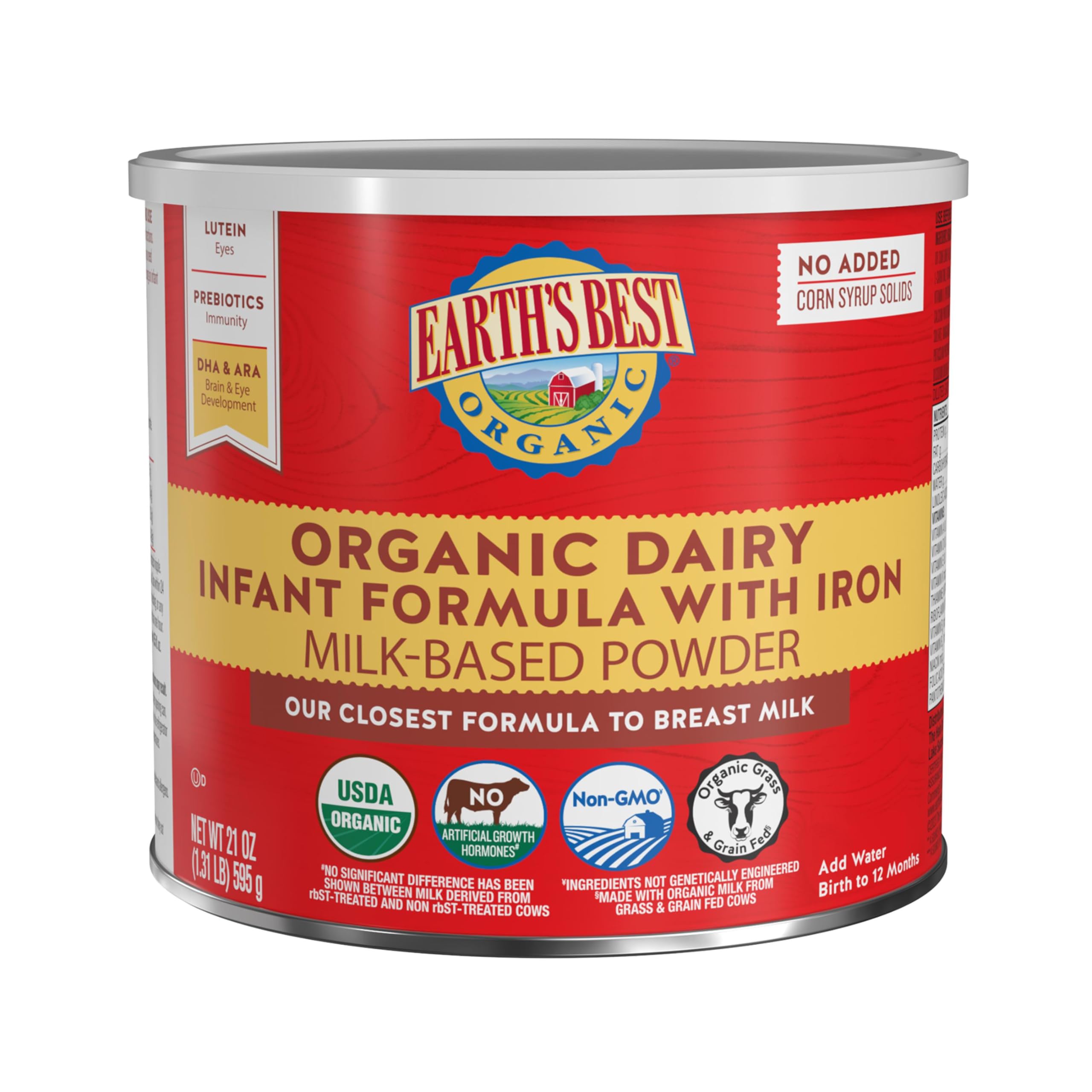
Earth’s Best Organic
Key Features
- Stage: 0–12 months
- Can size: 21 oz
- Formula type: Organic milk-based powder
- Key ingredients: DHA, ARA, lutein, prebiotics
- Price: Midrange
Organic formula is a values choice more than a performance guarantee, and Earth’s Best is the clearest example of that in this group. It uses organic milk from grass- and grain-fed cows, adds DHA and ARA, and skips added corn syrup — the things an organic shopper is looking for.
We see why it has a loyal following. The ingredient list is clean by the standards of the category, and the formula is designed to supplement breastfeeding rather than replace it outright. The powder mixes into a familiar consistency, and the 21-ounce can is a mid-size option that does not take over the cupboard.
We do not choose it as the first pick for a sensitive tummy; the standard formulas and the gentle options here are more predictable on that front. We choose it for a family who wants organic ingredients and is willing to switch if the baby’s digestion disagrees. That willingness matters, because organic is not a guarantee of tolerance.
Pros
- Organic milk and no added corn syrup
- DHA and ARA included
- Designed for supplementing breastfeeding
Cons
- Some babies get constipated
- Noticeable, fishy scent
We see Earth’s Best Organic as the organic pick for families who prioritize ingredients, with the caveat that digestion and scent are more divisive.
How We Tested Formulas for Breastfed Babies
We started by scanning ingredient panels, protein sources, and preparation instructions for more than 30 formulas sold for supplementing breastfed babies, then narrowed the field by cost per prepared ounce, tub size, and whether the powder was easy to find in stores. We crossed off anything with confusing scoop directions or packaging that turned clumpy in the first week. That left 12 formulas, which we tested over six months with a small group of parents who cleared each switch with their pediatrician.
The testing happened where formula actually gets made: kitchen counters at 2 a.m., diaper bags on weekend errands, daycare bottle bags, and the sink after a long day. We mixed each one by the label, noted whether it dissolved cleanly or left flecks on the bottle wall, shook it and watched how much foam settled, and smelled the powder and the prepared bottle. We also tasted a cooled spoonful of each batch to catch anything sharply metallic or cloying.
Each parent kept a simple log for two weeks per formula: how readily the baby took the first ounce, whether bottles were finished, how often they burped or seemed gassy, and what diapers looked like. We compared notes weekly—some formulas mixed easily but produced more bubbles; others smelled stronger yet babies accepted them without a fight. We also left a capped bottle in a diaper bag for four hours to see how the odor changed, tracked cost per prepared ounce, and noted whether the scoop leveled without packing down, because wasted powder and fussy measuring are not convenient at 3 a.m.
How to Choose Formula for a Breastfed Baby
The right formula for supplementing is the one that fits the feed you actually need to hand off, not the one with the longest ingredient list.
Start with Standard, Then Change for a Reason
Most breastfed babies who need a top-up do fine on a standard milk-based formula. We start there because it is the broadest fit and the least expensive way to find out whether your baby tolerates formula at all. Move to a gentle formula when gas, fussiness, or spit-up is persistent enough to disrupt feeds, and to a sensitive formula when lactose is the suspected issue. A diagnosed milk-protein allergy is different: that needs a pediatrician and a medical formula, not a gentler version of a standard one.
Powder or Ready-to-Feed?
Powder is the everyday value: you buy more prepared ounces per container and can mix exactly what you need. Ready-to-feed is the convenience premium, and it earns that premium at 3 a.m., on a trip, or when someone else is feeding the baby. The 2-fl-oz Similac bottles are a good example — already mixed, but small enough that an older baby may need two. Check whether the pack includes nipples; if it does not, add them to the diaper bag before you rely on it.
Read the Ingredients, Then Judge the Fit
Labels now lean on HMO prebiotics, MFGM, DHA, probiotics, and lactoferrin. These are meaningful design choices, but no formula replicates breast milk, and a longer list is not proof your baby will tolerate it. Use the ingredients to narrow the shelf, then judge the formula by the baby in front of you: comfortable feeds, steady growth, and a stool pattern that is normal for them. Organic is a values choice, not a tolerance guarantee.
Compare Cost per Prepared Ounce
Compare cans by the cost per prepared ounce, not the sticker price. A 32-ounce can of powder can be a better value than a 20-ounce can even when it costs more at checkout, while a small ready-to-feed pack can look cheap and disappear in a day. If you are supplementing one or two bottles a day, a smaller can may be the smarter buy because you are less likely to hit the discard date. If formula is the main feed, the bigger can wins.
Give a New Formula a Fair Trial
Introduce a new formula one bottle at a time, and give it a few days before you decide. Babies notice taste and texture, and a single refusal is not a verdict. Watch for comfortable feeding, wet diapers, and steady weight gain rather than one gassy afternoon. Stop and call a pediatrician for blood in the stool, repeated vomiting, poor weight gain, or signs of an allergic reaction. If the first formula does not fit, change one thing at a time so you know what helped.
Frequently Asked Questions
Can I mix formula and breast milk in the same bottle?
Yes, but mix the formula with water first, following the can’s ratio, then add the prepared formula to the breast milk. Do not add powder directly to breast milk, because that makes the bottle stronger than the label intends. Use the mixture within the time your label or pediatrician gives you, and do not save a half-finished bottle.
How long can I keep an open can of powder?
Use the can’s own after-opening window, not the expiration date alone. Write the open date on the lid, keep the dry can in a cool cabinet, and do not store it in the fridge. If the powder smells stale, is caked, or changes color, throw it out even if the date looks fine.
Can I make formula bottles ahead of time?
You can, but follow the can’s storage window and keep the prepared bottles cold until you need them. Do not leave a mixed bottle at room temperature for hours, and discard anything the baby does not finish. Label each bottle with the time you made it so you are not guessing later.
Final Verdict
Enfamil NeuroPro is the formula we recommend first for most families topping up a breastfed baby. It is standard, milk-based, and easy to mix, with MFGM and DHA on the label and a straightforward scoop-to-bottle routine. That combination makes it the low-drama default.
If your baby needs a bottle at 3 a.m. with no scoop, choose Similac 360 Total Care ready-to-feed; if gas and fussiness are the reason you are switching, start with Enfamil NeuroPro Gentlease. The deciding factor should be the problem you are solving, not the longest ingredient list.
