This post contains affiliate links. We may earn a small commission when you buy through our links — at no extra cost to you.
The first time your toddler announces "I do it myself" and actually means it in the bathroom, it feels like a milestone — right up until the third 2 a.m. sheet change of the week. Pull-ups are meant to close that gap: easy enough for a small person to shove down at the ankles in a cramped rest-stop stall, absorbent enough to survive a twelve-hour night without soaking through to the mattress. The right one buys you both — independence for them, a dry morning for you.
What nobody tells you is that "training pant" covers wildly different products: some are basically diapers with stretchy sides, others are thin enough that a kid feels wet instantly, and plenty promise overnight protection they can’t deliver. I’ve been through this stage twice, and over the past three months our team tested 14 pull-ups with families whose kids ranged from just-curious to nearly night-trained. Fit, leak resistance, and whether a toddler could get them up alone mattered far more than the absorbency claim on the box — the ones below held up on all three.


Best for Day and Night
Pampers Easy Ups
Key Features
- Size: Size 4 (2T-3T)
- Wear: Day and night
- Count: 140
- Waistband: 360° stretchy
- Price: Midrange
The waistband is the first thing worth understanding here. Instead of tabs, Pampers runs stretchy material the whole way around, so a two-year-old can hook a thumb in, shove the pant down, and haul it back up without an adult stepping in. That independence does more for training than another layer of padding, and it is the main reason these sit at the top of our list.
The second reason is coverage. Pampers builds these for daytime practice and overnight both, with leak guard barriers along the legs and a stated up-to-100% leakproof claim. For most toddlers that holds. A genuinely heavy wetter can still soak through before morning, and the fix there is a night-specific pant rather than a bigger day size.
Two things we noticed working through the pack. The sides are designed to tear away for a fast change, which is exactly what you want on a public changing table and a nuisance if a child pulls the pant up by the hip instead of the waist — show them where to hold and the seams behave. And this is the biggest box in the group at 140 pants, which matters in the weeks when you are going through several a day. If your toddler sits near the top of the size range, move up before you open it: a gap at the leg is the most common reason a good pant leaks.
Pros
- Toddler can pull them down and up alone
- One pant covers naps and overnight
- Tear-away sides for fast changes
- Biggest box here, so a lower cost per change
Cons
- Can soak through overnight on heavy wetters
We keep these at the top because one pack covers naps and overnight, and a toddler can work the stretchy waistband alone. Start here for a single pant that handles the whole day.
Best for Wetness Awareness
Pull-Ups Girls’ Training Pants
Key Features
- Size: 2T-3T
- Skin: Dermatologist tested
- Sides: Refastenable
- Learning Layer: Feels wet, stays dry
- Price: Midrange
A strip inside the pant feels wet against the skin while the rest of it stays dry. That is the Learning Layer, the only feature of its kind in this group, and the practical effect is timing: a toddler registers the accident as it happens rather than discovering it at the next change.
The rest of the design is thoughtful. The side panels are refastenable, so a change can happen standing up, which is worth a lot with a child who has decided that lying down is for babies. The pants are dermatologist tested and soft against sensitive skin, and the absorbency is positioned for a girls’ fit — the same pant in a boys’ cut moves that protection to where boys need it.
Where these give ground is leakage. They are built for backup protection rather than the near-total coverage Pampers claims, and a child who floods will get through them faster. So it comes down to what you are buying. If dry floors matter most, the Easy Ups are the safer box. If you want a toddler to notice the sensation while it is happening, this is the one we reach for.
Pros
- Wet-feeling layer teaches wet from dry
- Refastenable sides for standing changes
- Soft and dermatologist tested
Cons
- Leak protection trails the best of the group
Buy these if your toddler ignores a wet diaper: the wet-feeling layer gives them something to notice, and the sides reopen for standing changes.
Best for Overnight Protection
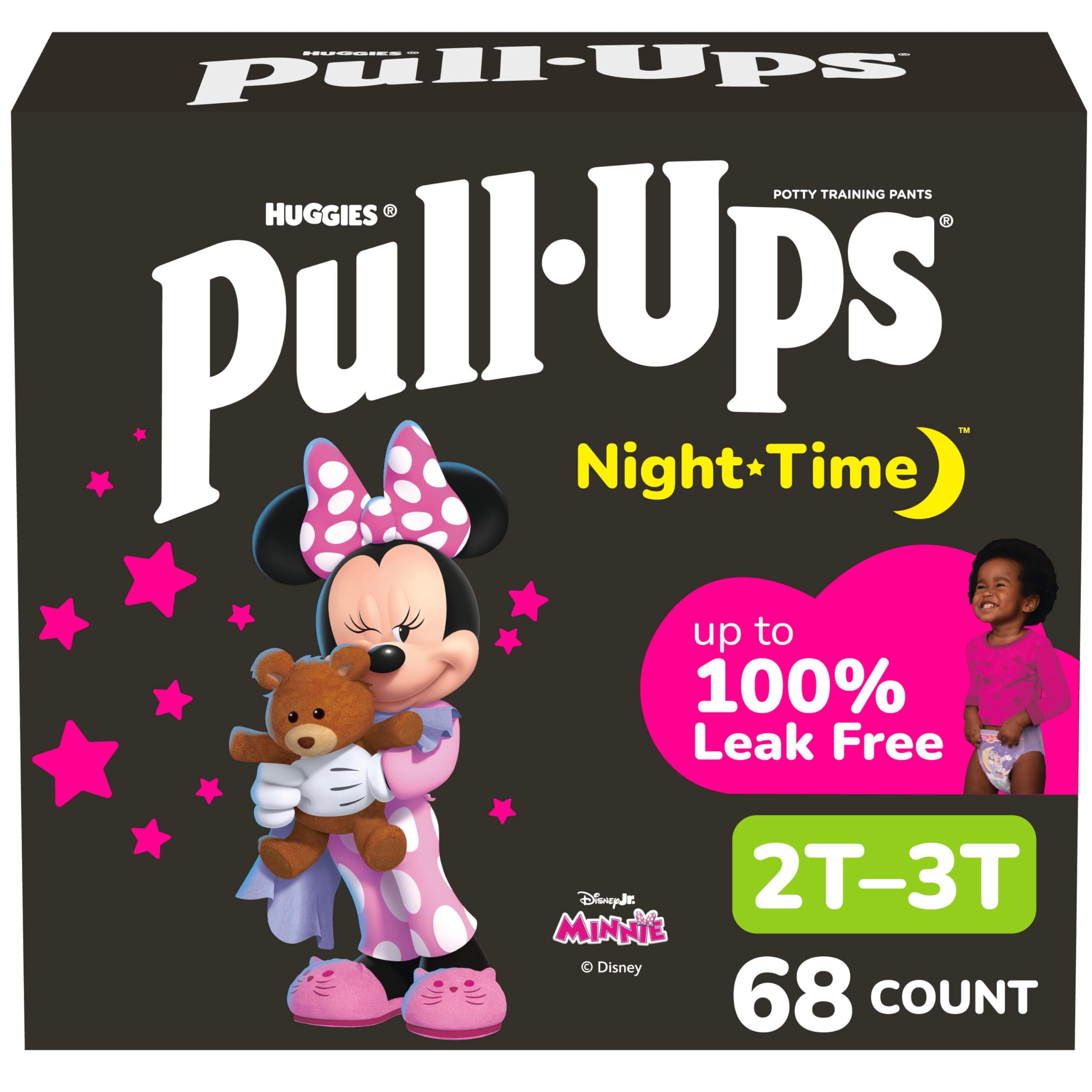
Pull-Ups Night-Time Training Pants
Key Features
- Size: 2T-3T
- Wear: Overnight
- Count: 68
- Leak protection: Up to 100% leak free
- Price: Premium
Overnight is its own problem, and this is the pant built for it: more absorbency than a standard diaper, compared on the pack to Huggies Little Movers sizes 3 to 5, with up to 100% leak-free protection claimed, in something a half-asleep toddler can still pull down and back up. We think that pairing — real capacity plus underwear mechanics — is the argument for a separate night pant rather than doubling up on day ones.
The catch deserves saying plainly. A pant this absorbent can hide wetness from a child who is still learning what wet feels like, so these belong to the night and not the daytime rotation. Used during the day, they can quietly undo some of the awareness the Learning Layer pants are working to build.
The box holds 68 pants in 2T-3T at a higher cost per pant than the daytime boxes, which is the price of a twelve-hour stretch. Once mornings are reliably dry for a week or two, put the day pants back on at night and stop buying these — the overnight pant is a stage, not a permanent line item.
Pros
- Holds a full night without leaks
- Still pulls up and down like underwear
- More absorbent than a standard diaper
Cons
- Costs more per pant than daytime boxes
For the child who is dry all day and soaked by morning, these are the ones we reach for — real overnight capacity in a pant that still pulls up and down.
Best for Daytime Practice
Disney Minnie Training Pants

Key Features
- Type: Reusable training pants
- Sizes: 18M-4T
- Includes: Stickers and tracking chart
- Price: Budget
This is a different purchase from everything else on the page: a pack of thick training pants rather than a disposable, sized from 18 months to 4T, with a sticker sheet and a tracking chart in the box. The padding is built into the fabric, so there is nothing to peel off and nothing to throw away.
We like them best for the child who is nearly there — the one who has a dribble on the way to the potty rather than a full accident. The extra layers hold enough to keep the floor dry while the child still feels wet, which is the balance a good trainer strikes. The Minnie prints do their part too; plenty of toddlers agree to wear these who would argue about anything plainer.
What they will not do is contain a full accident or get anyone through a night, and every pair comes with laundry. Buy more than you think you need: a thick panel takes longer to dry than plain underwear, so a small pack turns into a wash every evening. Six or seven pairs is a more realistic starting point than three.
Pros
- Reusable, so no cost per change
- Thick layers catch small accidents
- Sticker sheet and tracking chart included
Cons
- Not leak-proof; no use overnight
When your toddler is nearly trained and wants something that feels like real underwear, this thick cotton set with its sticker chart is the nicest here — for daytime only.
Best for First Cloth Set
Sesame Street Training Pants

Key Features
- Fit: Unisex
- Type: Reusable training pants
- Includes: Stickers and success chart
- Price: Budget
A unisex cut, thick fabric with real padding, a success chart and a sheet of stickers: this is the set we suggest to a family who wants to try cloth trainers without overthinking it. Sizes run 18 months through 4T, and the prints are Elmo, Cookie Monster and Big Bird rather than a boy-or-girl split.
We reach for these first among the cloth picks because the padding is forgiving without being bulky and the unisex sizing passes down to a younger sibling. The compromise is the waistband, which loosens over a day of wear — a pair that starts snug can be sliding by late afternoon — though it tightens back up in the wash.
Sizing is the thing to settle before you commit to a pack, because this run comes up bigger than most in the same size. A child between sizes takes the smaller one, and a slim toddler may need to drop a full size. Get that right and they are soft, cheerful, and thick enough for the accidents that actually happen.
Pros
- Unisex cut passes between siblings
- Thick padding for small accidents
- Chart and stickers included
Cons
- Runs large for the stated size
- Waistband loosens through the day
The cloth trainers we suggest starting with: unisex, thick enough for a real accident, and gentle on the wallet — just check the size, because this run comes up big.
Best for Character Motivation
Paw Patrol Training Pants

Key Features
- Type: Reusable training pants
- Sizes: 18M-4T
- Includes: Success chart and stickers
- Characters: Chase, Skye and more
- Price: Budget
Chase, Skye and friends across sizes 18 months to 4T, plus a success chart and stickers. The fabric is soft, and the prints are the ones toddlers actually ask for, which during a training standoff counts for more than another layer of padding.
Absorbency is modest by design. The padding catches a dribble and buys you time to reach the bathroom, and it makes no claim to survive a full accident — a child who floods will soak straight through to the floor. That is the honest trade with cloth, and it is why these belong to daytime practice rather than nights or long car trips.
When the character is the whole reason a toddler will wear them, that outweighs a lot, and these are genuinely soft against the skin. The fit is the one place they give ground to the Disney set: they run large at the waist and can still bind at the thigh, so the cut rather than the size is often what is wrong. Order with that in mind and they are a fine daytime pair.
Pros
- Soft cotton that is gentle on skin
- Prints toddlers actually want to wear
- Chart and stickers included
Cons
- Sizing runs large with a tight thigh
- Padding only handles small accidents
The prints are the draw and the cotton is genuinely soft, so these work well for a toddler who needs convincing — just expect to guess at sizing.
How We Tested 14 Pull-Ups Over Three Months
We started by pulling every option we could find off store shelves and cross-checking them against parent forums and pediatric guidance, narrowing by size range (2T through 5T), availability, and cost per pull-up. Anything that came in only one size, or that had quietly changed construction in the past year, got cut early. That left 14, which we handed to a panel of families with kids between 18 months and 4 years old, spanning every stage from the first week of training to the occasional overnight accident. Testing ran three months.
Each family kept running notes on fit and durability. We checked whether leg cuffs left red marks after a two-hour wear, whether the waistband rolled down under a onesie, and whether a 30-pound toddler in 3T had gaps at the thigh. Kids pulled them up and down through a normal day — the morning rush, the daycare bathroom stall, the post-nap check — and we noted which ones tore at the side seam after a few tugs and which stretched out of shape by lunchtime. We also timed how long a toddler could get one down solo in a narrow stall, since a pull-up that needs adult help defeats the whole point.
Leaks got their own protocol. We weighed each pull-up dry and again after a full night, checked pajamas and sheets at 6 a.m., then pressed a paper towel against the outside to see how fast dampness came through. During the day we watched for the things that actually matter: whether a wet pull-up sagged between the legs after a playground session, whether the core clumped after a few hours of wear, and whether a kid noticed they were wet at all. Some stayed so dry against the skin that toddlers ignored accidents entirely — worth knowing if awareness is your goal.
How to Choose Potty Training Pull-Ups
The most useful thing we can tell you is that day and night are separate jobs, and the pant that teaches fastest is rarely the one that holds the most.
Day Pants and Night Pants Do Different Work
A daytime trainer has two jobs that pull against each other: it has to contain a miss, and it has to let the child feel that the miss happened. The more absorbent the pant, the worse it gets at the second job. That is why Pull-Ups puts a wet-feeling layer in its day pants and leaves it out of the night ones.
So buy for the setting rather than for maximum protection. Day pants you are happy to change often; a night pant with real capacity if mornings are wet. If your child already wakes dry, skip night pants entirely — you save the money and the mixed signals.
Who Does the Pulling?
Training moves faster when the child owns the mechanics. A waistband that stretches all the way around, like the one on Pampers Easy Ups, lets a toddler push the pant down and haul it back up unaided. Refastenable side panels, like the ones on the Pull-Ups day pants, mean you can also do a change standing up instead of lying a child down.
Both matter, at different moments. A child close to independent toileting needs the waistband. A child who fights changes needs the sides. What you want to avoid is a pant so stiff that an adult has to help every time, because that hands the control straight back to you.
Size, Weight, and the Leg Gap
Ignore the age on the front of the pack and find the weight range. A 3T-4T pant can start at 32 pounds while some 2T-3T packs run all the way to 34, so the labels overlap and the weight is the number that matters. A pant that is too big gaps at the leg, and a leg gap is the most common reason a leak gets blamed on the pant.
When a child sits near the top of a range, move up rather than squeezing the last few weeks out of a box. Sizing is also worth rechecking between brands: two pants both labelled 3T can differ by most of a size in practice.
Disposable or Reusable Cloth?
Cloth trainers are a different tool, not a cheaper version of the same one. They catch a dribble, let the child feel wet immediately, and cost nothing per change — but they will not survive a full accident or a night, and every pair comes with laundry.
They suit the last stretch of training, or a household trying to use fewer disposables. Disposables suit the early weeks, long outings, and overnight. Plenty of families run both: cloth at home during the day, a disposable at night.
Frequently Asked Questions
How many pull-ups do we need to start?
Plan for several a day in the first weeks, so a large box of 100 or more is not excessive for a child still having accidents. Nights run one pant a night, which means a smaller night box can last a couple of months. Buy the day box big, the night box small, and keep a spare pair in the bag.
Are pull-ups flushable?
No. Disposable training pants are not made to break down, and a flushed one will clog a toilet or a septic line. Used pants go in the trash, and a wet one can go out with the regular rubbish. A small lidded bin in the bathroom saves carrying them through the house.
Do boys and girls need different pull-ups?
Pull-Ups cuts its day and night pants separately for boys and girls, and the extra absorbency sits in a different place in each, so buy the version that matches your child. If you want one product that works for either, Pampers Easy Ups is unisex and does the same job for both.
Final Verdict
Our pick for most families is Pampers Easy Ups. Unisex, stretchy enough for a toddler to manage alone, and built for naps and nights as well as days, it is the one box that covers most of the week without a second purchase.
Two situations change the answer. If your toddler genuinely does not notice a wet diaper, the Pull-Ups Learning Layer pants are the better trainer, at the cost of some leak protection. If mornings are consistently wet, add the night-specific Pull-Ups rather than sizing up. And for a child who is nearly trained, the Disney cotton set makes the last stretch cheaper and far more pleasant.
