This post contains affiliate links. We may earn a small commission when you buy through our links — at no extra cost to you.
The sticker chart that starts strong and ends up curling off the bathroom door is a potty-training cliché for a reason: rewards only work if a toddler can actually use them and they survive the bathroom. A good potty training reward makes the routine feel like a game rather than a negotiation, and it should look tidy enough that you don’t mind leaving it out when grandparents visit. It also has to be worth the money, because nobody wants to buy a refill pack every week.
I’ve spent the past three months rotating 14 reward systems through our bathroom, from magnetic boards to sticker sheets to small token jars, and the differences showed up fast. The ones that worked were fun without being distracting, sturdy enough for a 2-year-old’s grip, and simple enough that I wasn’t doing all the peeling. A few looked cute but lost their stick—literally—by day four. The picks below are the ones that made the routine easier, not another chore.


Best for First-Time Training
COZY GREENS Dinosaur Potty Chart
Key Features
- Theme: Dinosaurs
- Stickers: 194
- Chart size: 14 x 11.2 in
- Finish rewards: 2 crowns and a certificate
- Price: Budget
The certificate is what sold us. Plenty of sets hand over a sheet and a pile of stickers and call it a reward system; this one builds an arc, with a weekly chart, two crowns, and a diploma at the end that a toddler can hold up while you make a fuss. The chart also prints the four steps of using the potty, which turns it from a scoreboard into a script a two-year-old can follow. We think that structure does more of the work than the stickers do, and it is why this is the set we point most families to first.
The volume backs it up. 194 stickers is enough that a child can pick a different one every visit for weeks, and the chart measures 14 by 11.2 inches, so it reads easily from a potty seat and still hangs on the back of a door. Dinosaur fans are well served. If your child is not one, that is the one inflexible thing about the set, because the whole reward hangs on the theme.
The erasable pen, the booklet and the instruction cards are the least load-bearing parts of the kit. The chart, the stickers and the crown do the actual motivating, so do not buy this for the extras. Buy it because it is a complete run from the first sticker to the graduation photo, in one box.
Pros
- Crown and certificate give training an ending
- 194 stickers last weeks without running out
- Printed four-step routine gives the child a script
- 14 x 11.2-inch chart reads from the potty
Cons
- Not water resistant, so it needs a spot clear of splashes
- Chart and stickers are spent after one child
Our pick for most families: a printed routine, a pile of stickers, a crown and a certificate turn training into a finish line a toddler can see.
Best for Sticker-Resistant Toddlers
LIL ADVENTS Potty Time Adventures
Key Features
- Includes: Activity board, stickers, ebook
- Age range: 18 months to 5 years
- Board size: 13 x 11.25 in
- Reward pieces: 14 wooden dinosaurs
- Price: Premium
This costs more than twice what the sticker sets here do, and the first thing to understand is that you are not buying a chart. Fourteen wooden dinosaurs sit behind little doors on an activity board, and your child opens one per success, advent-calendar style. A sticker gets stuck down and forgotten by Thursday. A dinosaur goes in the toy bin and comes back out at bedtime, and that is the difference the money pays for.
That is the case for it, and it holds up. The board measures 13 by 11.25 inches, small enough to sit on a shelf beside the potty and low enough for a small hand to work the doors, and the set is stated as suitable from 18 months with choking, sharp-edge and material testing behind that claim. The step-by-step ebook arrives by email and reads like a friendly primer rather than a manual: useful the night before you start, less so afterwards.
One thing to know before you commit is that this is a dinosaur set and the entire reward depends on a child who likes dinosaurs. What you get on the far side of training is a lasting toy and a child with something to show for the work. For a toddler who had already shrugged off stickers, that trade has been worth it in our experience.
Pros
- Wooden dinosaurs are rewards a child keeps
- Opening a door adds suspense to every success
- Stated suitable from 18 months
Cons
- Reward run ends after fourteen reveals
- Carries a real premium over every paper set
We think fourteen wooden dinosaurs beat any sticker as an incentive, and they are still in the toy bin when the training is over.
Best for Unicorn Fans
Hadley Designs Unicorn Chart Set
Key Features
- Theme: Unicorn
- Charts: 10
- Chart size: 8.5 x 11 in
- Sticker sheets: 4
- Price: Midrange
Ten charts is the reason to buy this one, and it is a better reason than it sounds. Training runs stall, charts get abandoned three stickers in, and a child who loses a month comes back to a fresh unicorn sheet instead of a half-filled reminder of the last attempt. That forgiveness is what a big multipack buys, and it is why we rate this as the set for a stop-start trainee.
The kit is ten 8.5-by-11-inch charts and four sticker sheets, so the supply runs deeper than the chart count alone suggests. The artwork is bright and squarely aimed at the under-four crowd, and the princess and unicorn designs are the pull. Stickers hold firmly once they are down, which is exactly what you want on a chart that gets handled a hundred times.
The friction is at the sheet rather than the wall. The stickers can be stubborn to peel apart, and a toddler waiting to place one while an adult picks at a corner loses interest fast, so peel a strip loose before you head to the bathroom. Hang the chart rather than leaving it flat on the counter, where splashes and a curious hand will find it.
Pros
- Ten charts cover restarts and regressions
- Princess and unicorn designs do the motivating
- Four sticker sheets give plenty of choice
Cons
- More charts than one child will get through
- No reusable piece, so the set is spent when training ends
We recommend it for a unicorn-obsessed toddler and a training run that keeps stalling: ten charts and four sticker sheets are the most forgiving buy here.
Best for Undecided Toddlers
HAJOROM Five-Theme Chart Set
Key Features
- Themes: 5
- Stickers: 63
- Sheet size: 8.5 x 11 in
- Sheets per theme: 3
- Price: Budget
Interest is the whole currency of potty training, and this set’s answer is to keep changing the wallpaper. Five themes, covering construction, dinosaurs, space, a farm and the ocean, each with two posters and a sticker chart, plus 63 stickers. When the dinosaur poster stops earning a reaction, you hang the rocket one and the routine feels new again without anything else changing.
It is the cheapest set here and the widest spread of designs, and that combination is where it earns its place. A toddler who rejects one theme gets four more chances before you buy again, and three sheets per theme leaves room for a regression or a sibling without rationing. The paper is thicker than the price suggests, which matters when a two-year-old insists on hanging it up personally.
What it will not do is outlast the training. Get this one for the weeks in the middle, when the only thing that matters is that tomorrow’s chart looks different from today’s, and treat the last sheet as the end of the road. If you want a reward with an afterlife, the dinosaur blocks or the token board are the better buy.
Pros
- Five themes to swap when interest fades
- Three sheets per theme plus 63 stickers
- Thick paper that survives being handled
Cons
- Paper only, so nothing survives the training
We reach for this one when you do not know what your toddler will latch onto: five themes give you four second chances before you spend again.
Best for Reusable Setup
PUTSKA Magnetic Firefighter Chart

Key Features
- Theme: Firefighter
- Material: Laminated paper
- Board size: 10.6 x 12.2 in
- Reusable pieces: 35
- Price: Budget
A sticker chart has one life. This one can be cleared and started again. Thirty-five pieces cling to a laminated board and lift off when you want a reset, so a run of accidents does not leave you staring at a half-filled chart all week. The fire truck design and the crown at the end give it a theme with some momentum, and it is a welcome change from the dinosaurs and unicorns everything else here runs on.
The pieces are the weak point in the hand. They need to go on flat and pressed down, and a piece that gets knocked loose ends up on the floor, so keep the board where it will not be shouldered on the way past. At 10.6 by 12.2 inches it is a genuinely big board, so find the wall space before you commit rather than wedging it into a narrow gap beside the toilet.
Reusability is what earns this one a place, and it is a real advantage rather than a marketing one: a second child, or a second attempt after a few months off, costs you nothing. Thirty seconds with a flat hand and the board is blank again, which on the days training goes backwards is worth more than it sounds.
Pros
- Magnetic pieces reset instead of being used up
- Fire truck theme and a crown finish
- Big 10.6 x 12.2-inch board
Cons
- Board can warp and stop sitting flat
- Not enough pieces to fill every space
We rate this the only set here you can use twice: magnetic pieces reset for a second child or a second try, and the fire truck theme makes a change.
Best for After Potty Training
Kenson Kids I Can Do It Token Board
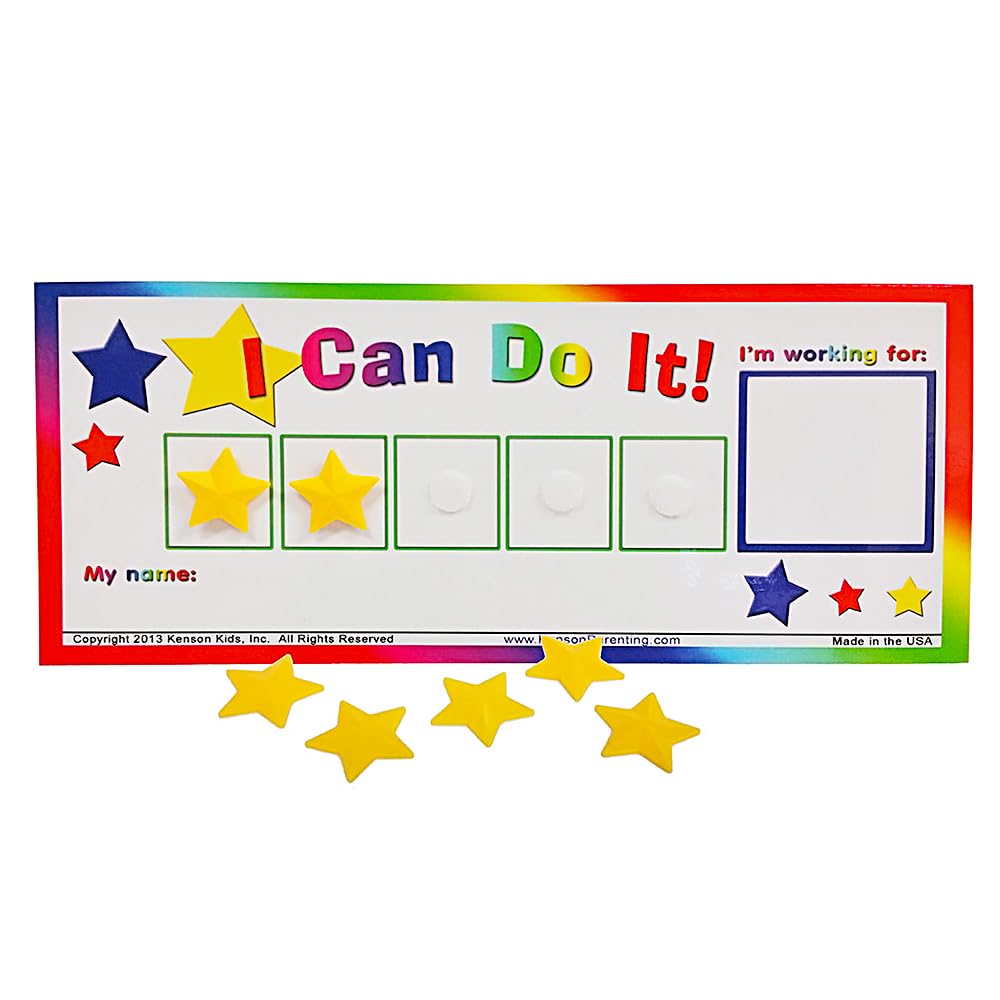
Key Features
- Age range: 3 to 10 years
- Board size: 5 x 11 in
- Reward pieces: Hook-and-loop stars
- Writing surface: Dry erase
- Price: Budget
This is a token board, not a potty chart. A plastic strip with a dry-erase box at the bottom where you write what the child is working toward, and a row of stars that attach with hook-and-loop. Five by eleven inches, a magnetic strip on the back, and a stated age range of three to ten. If you are picturing a dinosaur poster on the bathroom wall, this is not that.
What it does well is the part after the potty. Because the goal is whatever you write in the box, the same board runs sit-on-the-potty this month and stay-in-bed next, and the child keeps a system they already understand. The stars are physical, which is the whole point: a three-year-old can count them and see exactly how far the prize is, and moving one is satisfying in a way that colouring in a square never is.
Where it lands for us is with a child who has already grasped earning, and with a family who wants one system to carry across a year rather than a set to throw away in a fortnight. The hook-and-loop on the stars has held through daily use on our fridge, and the dry-erase surface wipes clean, which is more than we expected from something this small.
Pros
- Reusable stars, with no refills to buy
- Dry-erase goal box changes with the goal
- Carries over to other behaviours after training
Cons
- You supply the potty goal, with no printed steps
We like this one for a child who already understands earning stars, and it is the only board here that still has a job after the diaper days end.
How We Tested Potty Training Rewards
To build our shortlist, I read through parent reviews and compared the formats that come up most often: magnetic reward boards, reusable sticker charts, sticker sheets with themed scenes, and small token systems. I filtered out anything with tiny parts that seemed risky for a 2-year-old, charts with no replacement stickers available, and sets that cost more than a few dollars per week to keep going. We ended up with 14 reward systems and used them for three months with two toddlers in our test group, including during the after-nap and pre-bed potty attempts when patience is shortest.
Each system lived on the bathroom counter or wall at toddler eye level. I watched whether the kids could peel and place stickers themselves, whether the stickers stayed stuck after being moved two or three times, and whether the chart survived a damp cloth wipe after a messy miss. For magnetic sets, I dropped the pieces from counter height onto tile, checked for chipped edges, and noted whether the magnets were strong enough to hold a row of pieces without sliding. I also paid attention to appearance: whether the set looked like something I’d leave out, or something I’d hide in a drawer.
Effectiveness was measured in engagement, not promises. I tracked whether a child asked to use the chart after the first week, whether the reward felt like a game or a bribe, and whether the system still worked once the novelty faded. Value came down to refill costs and how many pieces survived daily handling. The sets that made the cut were fun, sturdy, and genuinely easy to keep using—not just cute for the first three days.
How to Choose Potty Training Rewards
The reward only works if your child wants the piece more than they want to be done with the bathroom, so choose the format first, the theme second, and the count last.
Stickers, Magnets, or a Reward They Keep
Every set here does the same job with a different currency. Stickers are the cheapest and most disposable: one chart, one run, then the recycling. Magnetic pieces can be lifted off and reset, so a bad week does not stare back at you, but they only work if the pieces actually hold where a toddler puts them. A physical reward, like the fourteen wooden dinosaurs in the LIL ADVENTS set, carries more weight with a child who has already proved immune to paper, and it outlives the training entirely.
Match the format to how much your child cares about the reward, not to the price tag. If a sticker already produces a sprint to the potty, there is no reason to spend more.
Count the Restarts, Not the Stickers
A chart with 194 stickers and a set with ten charts cost much the same, and they buy different things. The big sticker pile keeps one chart going for weeks. The ten-chart set survives the child who quits in week two and starts again in week six, which is the more common pattern. If a second child is coming, only the reusable formats pass down — paper does not.
The Theme Does the Motivating
Reward value sits entirely in your child’s head, and the theme is the lever. A dinosaur-obsessed three-year-old will work for a stegosaurus sticker and ignore a unicorn one, which is why there is no single best design on this page. If you know the obsession, buy into it. If you do not, the five-theme set gives you four chances to be wrong before you spend again.
What Survives the Bathroom
A bathroom is humid, splashy, and gets knocked about, and most of these sets are paper. Hang the chart at your child’s eye level and away from the sink. Keep the sticker sheets flat rather than crumpled on the counter, and peel a few stickers loose before you sit down so a waiting toddler is not watching you pick at a corner. If the board is magnetic, press the pieces flat and test the hold yourself first, because a piece that slides off is a piece on the floor.
Plan the Finish Line Before You Start
A reward system needs an ending, or it becomes a permanent toll. The sets that work best build one in: the COZY GREENS kit finishes with a crown and a certificate, and the LIL ADVENTS board runs out of doors after fourteen reveals and leaves a set of wooden dinosaurs behind. Decide on day one what the last sticker buys, say it out loud, and the chart has a shape. Without that, you have hung up a very slow wall calendar.
Frequently Asked Questions
Do potty training reward charts actually work?
They work as a nudge for a child who is already most of the way there, and they do very little for a child who is not ready. Give one a week: if your toddler is not asking about the stickers or reaching for the chart, the problem is timing rather than the chart. Put it away and bring it back in a month.
When should we start using potty rewards?
Look for two of these: a dry diaper for a couple of hours, telling you before they go rather than after, interest in the bathroom, or tugging at their own pants. A child with two of those signs usually takes to a chart within days. A child with none will treat it as wallpaper, however good the stickers are.
Is a magnetic chart safe with a younger child in the house?
Loose magnets are a swallowing hazard, so treat the pieces like any other small part. Keep the board above a crawling sibling’s reach, sweep up anything that falls, and choose a sticker set instead if there is a baby who still mouths toys. Check the stated minimum age on any set with loose pieces before you buy it.
How many stickers should one potty trip earn?
One per success in the first week, while the connection is still forming. Once your child is going without being asked, drop to one sticker a day and let the chart take longer to fill. The reward gets scarcer as the habit gets stronger, which is the direction you want. A bonus sticker for a poop is a reasonable exception.
Final Verdict
If you want one purchase and a plan, buy the COZY GREENS dinosaur chart. Printed steps, 194 stickers, two crowns and a certificate add up to a complete run, with a visible start, middle and graduation, and it costs about the same as the other paper sets here.
Buy the LIL ADVENTS set instead if your toddler has already proved immune to stickers. Fourteen wooden dinosaurs cost real money and run out after fourteen reveals, but they are the only reward on this list a child will still be playing with a month after the diapers go.
