This post contains affiliate links. We may earn a small commission when you buy through our links — at no extra cost to you.
A scooter is one of the few things that gets a kid outside without being asked twice — and one of the few that can rattle itself apart by August if you pick the wrong one. The first one I brought home looked the part until the folding latch started clicking on turns. What you’re actually paying for is a deck that doesn’t flex, a rear brake that stops instead of skids, and a roll smooth enough that a 6-year-old wants another lap.
We’ve spent the past six months with 12 scooters in the hands of families — school runs, driveway laps, park paths — and the differences showed up fast. One thing worth knowing before you shop: the age range on the box is the least reliable number on it. Deck height and wheel size tell you far more about whether a kid can push, steer, and stop with confidence. Below are the ones that held up to both the kids and the assembly wrench.



Best for Toddlers and Preschoolers
Micro Mini Deluxe
Key Features
- Age range: 2 to 5 years
- Weight limit: 110 lb
- Scooter weight: 5.29 lb
- Handlebar height: Up to 27 in
- Price: Premium
The smallest scooter here is also the one we recommend first, and the reason is steering. The Mini’s deck tilts under a child’s weight and the front wheels curve with it, smoothly enough that a two-year-old can follow the logic on the first afternoon. We have watched beginners fight cheaper three-wheelers that resist the lean, and that frustration ends a ride faster than tired legs do.
So the recommendation is easy. For a first scooter, this is the one we hand over. Three wheels, a wide deck and a low stand-over height keep it steady at the shuffling pace a beginner actually rides at, and the whole thing weighs 2.4 kg, so when your child quits halfway around the block it goes over your shoulder without a scene.
Sized for two to five, the Mini asks nothing of you at setup: the T-bar drops in and a hex bolt tightens it. The deck grip holds wet sneakers, the polyurethane wheels roll quietly enough for a paved path or a kitchen floor, and the rear brake sits over the back wheel where a small heel finds it. When your child graduates, the Maxi and the Razor A are the two next steps we rate.
Pros
- Lean-to-steer that beginners follow in minutes
- Stable three-wheel stance at walking pace
- Light 2.4 kg to carry a tired rider home
- Two-year warranty, longest of the three-wheelers here
Cons
- No folding mechanism for the car or closet
- Most expensive three-wheeler in this group
We recommend the Mini for any child between two and five: it steers the way a small rider can follow, and it is the scooter here we trust most with a beginner.
Best for School-Age Kids
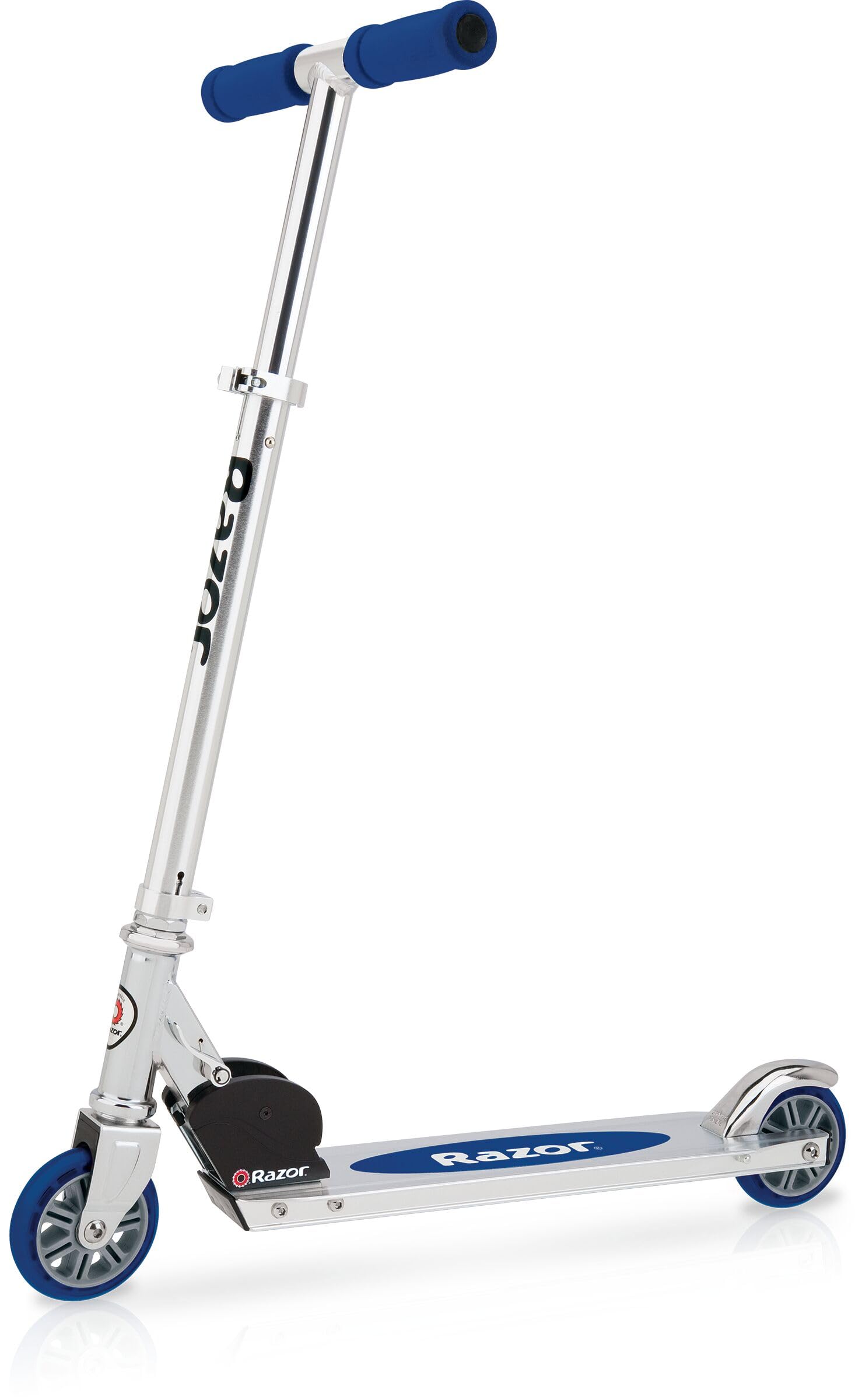
Razor A
Key Features
- Age range: 5 years and up
- Weight limit: 143 lb
- Scooter weight: 4.6 lb
- Handlebar height: 23.6 in
- Price: Budget
The day a child stops leaning and starts balancing is the day the three-wheeler gets boring, and the Razor A is the scooter we reach for at that moment. It has been the same basic machine for decades: an aluminum frame, two urethane wheels, a folding joint at the base of the stem, and a rear fender you stomp on to stop.
At 4.6 pounds it is light enough for a seven-year-old to carry up a flight of stairs, and it folds to something that fits a car footwell — a lever and a hinge, not a puzzle. The 143-pound limit runs all the way into the teenage years, and the handlebar adjusts with a quick-release collar rather than a tool.
We like it for what it refuses to complicate. There is no light show and no app — just a hinge, a brake and two wheels — and nothing on it is a novelty, which is why the folding joint and the fender are the only two things you will ever adjust. At the bottom of the price range for this group, that is the easiest value argument here.
One practical note: buy it when your child is ready, not before. A four-year-old who still leans to turn will find the Razor twitchy next to a three-wheeler, and there is no shame in another year on the Mini.
Pros
- Light 4.6 lb aluminum frame a kid can carry
- Folds flat enough for a car footwell
- 143 lb limit runs into the teen years
- Rear fender brake a child can work alone
Cons
- Handlebar height stops at 23.6 in
- Small solid wheels are harsh on cracked pavement
We hand the Razor A to a child who can already balance and wants to go faster than three wheels allow — it is light, it folds, and it is the cheapest scooter here.
Best for Value Three-Wheeler
besrey 402
Key Features
- Folding: One-step, no assembly
- Age range: 3 to 10 years
- Wheel size: 4.72 in
- Weight limit: 110 lb
- Price: Midrange
The besrey’s party trick is a one-step fold. Press, fold, and the whole scooter is short enough to lie flat in a trunk, with no assembly at all out of the box. That is the feature we kept using, because a scooter that lives in a hallway gets ridden and a scooter that has to be wrestled into a car does not. On top of that it is the best value three-wheeler here — most of the composure of the premium pick for a lot less money.
It rides like a proper lean-to-steer scooter: 4.72-inch wheels, a wide grippy deck that takes both of a small child’s feet, and motion-activated LEDs in the wheels that glow as they spin. The T-bar adjusts through several heights, the frame is rated to 110 pounds, and the whole thing weighs about 2.8 kg — light enough to hang off a stroller handle between rides.
Better still, nothing needs charging: the LEDs run off the spinning wheels, so a scooter that sat in a garage for a month still lights up on the first push. Nothing about it feels hollow, and the two-year warranty is the longest on this page. The fold, in the end, is what sells it — a scooter you can put in the trunk is a scooter that goes to the park, the grandparents’ and the beach, and that is more riding than most kids get.
Pros
- One-step fold with no assembly at all
- Wide deck that takes both feet
- Motion-driven LEDs with no batteries
- Two-year warranty, the longest here
Cons
- Three small wheels are slow on long runs
Our pick when you want the premium three-wheeler feel without the premium price: it folds in one step, steers properly, and lights up as it rolls.
Best for Older Kids, 5-12
Micro Maxi Deluxe LED
Key Features
- Wheels: Three, motion-activated LED
- Age range: 5 to 12 years
- Weight limit: 110 lb
- Handlebar height: 68 cm
- Price: Premium
The first push after dark is the moment the Maxi makes its case. The wheels light as they roll, so the whole scooter is visible from the side — on a suburban sidewalk at five o’clock in November, that is worth more than any bell. No batteries, either: the LEDs are driven by the wheels turning.
For the five-to-twelve set, this is the three-wheeler we name, and the argument is the same one that sells the Mini. It does exactly what a child’s weight asks of it, which is the difference between a scooter that carves and one that argues. The T-bar rises to 68 cm, the deck takes a bigger stance than the toddler version, and the 110-pound rating covers a nine-year-old with room to spare.
The componentry is the sort you stop noticing: an anodized aluminum T-bar, polyurethane wheels, a slip-resistant deck, and a quiet roll that does not announce itself down the street. It weighs 2.5 kg, so it is a one-hand carry when the ride ends early. The light-up wheels are the version we point families at, because a scooter a child wants to ride at dusk is a scooter that gets used.
The ceiling here is age, not build. At twelve, most kids want the bigger wheels and the shove of a two-wheeler, and a Maxi becomes the spare that a younger sibling inherits — a good second life for something this solid.
Pros
- Three-wheel stability with room to carve
- LED wheels that need no batteries
- T-bar grows through ages five to twelve
- Quiet, smooth roll on polyurethane wheels
Cons
- The most expensive scooter in this group
For the five-to-twelve set who still want three wheels, this is the one we name: it steers with them, lights up, and lasts long enough to hand down.
Best for Budget Toddler Scooter
Gotrax KS1

Key Features
- Age range: 2 to 8 years
- Wheel size: 4.5 in
- Weight limit: 110 lb
- Scooter weight: 5.1 lb
- Price: Budget
The fender brake over the back wheel is the first thing we check on a scooter, and on the Gotrax KS1 it is the part that gives us pause: it can snap off underfoot. Press it hard before the first ride and look at how it is mounted, then keep checking it for the first month. That is a five-second habit, but it is the difference between a scooter you hand a child and one you do not.
The rest of the package is well judged for the money. Three wheels, a lean-to-steer front end, a wide anti-slip deck, 4.5-inch wheels on ABEC-7 bearings, and LEDs in all three wheels that need no batteries. It splits into two pieces at the press of a red button to fit a trunk, and the handlebar offers three heights across ages two to eight.
What we kept coming back to is how much of the premium experience it delivers for a fraction of the price: the lean is there, the roll is quiet, the deck has real foot room. It is not as composed as the Mini, and the brake is why we cannot put it higher. Bought as a second scooter — the one that lives at a grandparent’s house or in the car — it is hard to argue with.
Pros
- Lean-to-steer at a budget price
- LED wheels on all three, no batteries
- Splits in two for the trunk
- Three handlebar heights for ages two to eight
Cons
- Steering can feel stiff for a very light rider
A strong budget three-wheeler for ages two to eight, with one caveat we take seriously: inspect the brake before the first ride.
Best for Sharing Between Kids
BELEEV A8

Key Features
- Folding: Folds and locks shut
- Age range: 3 to 12 years
- Weight limit: 110 lb
- Scooter weight: 5.73 lb
- Handlebar height: Up to 32.2 in
- Price: Midrange
Fold the A8 and it clicks shut on its own, which sounds like a small thing until you have carried a folded scooter through a parking lot with one hand while holding a smaller child with the other. It is the detail that made us reach for this one on school mornings.
It is a lean-to-steer three-wheeler with extra-wide front and rear wheels and LEDs that light as they roll, and at 2.6 kg it is one of the lighter scooters in this group. The deck is wide and grippy, the fold is a single movement, and there is nothing to assemble beyond sliding the T-bar in and setting the height.
The lean is light enough for a small rider to trigger, which is not true of every three-wheeler here, and the extra width in the wheels keeps it from feeling tippy on a cambered sidewalk. The handlebar climbs in four steps to just over 32 inches, so a three-year-old and a seven-year-old can share the same scooter with a minute of adjustment.
Where it lands for us: this is the family scooter, the one that starts with a four-year-old and gets handed down, with a fold that makes it an easy thing to keep in the car. Past eight or so the handoff goes to a Maxi or a Razor, but by then it has earned its keep.
Pros
- Widest age rating here, three to twelve
- Fold that locks itself shut
- Light 2.6 kg and simple to store
- Wide wheels with motion-driven LEDs
Cons
- 12 cm wheels keep it on smooth pavement
The family scooter we keep coming back to: widest age range here, a fold that locks itself shut, and a lean small riders can actually trigger.
Best for Tight Budgets
Lifemaster Mini

Key Features
- Lights: Motion-driven LED wheels
- Age range: 2 years and up
- Wheel size: 4.72 in
- Weight limit: 110 lb
- Price: Budget
At the bottom of this group’s price range, the Lifemaster keeps the parts a two-year-old actually uses: three wide wheels, a deck big enough for both feet, and a lean-to-steer front end that turns when a small body leans. Everything else is where the savings went, and for a first scooter that is the right trade.
The lights are the draw for a lot of kids. Motion drives them, so there are no batteries to chase, and they are bright enough to be seen at dusk — though they wash out in strong daylight, which is worth knowing before you promise a light show on a sunny afternoon.
Setup is a stem in a socket and a clamp, and the T-bar adjusts as the child grows. What we watch is that clamp: the handlebar has come off at that joint in use, so it is worth checking the bolt every few weeks rather than assuming it stays tight. Do that, and the rest of it — the wide deck, the quiet roll, the 110-pound rating — is more scooter than the price suggests.
Pros
- Least expensive three-wheeler in this group
- Wide deck and an easy lean for tiny riders
- Motion-driven LEDs with no batteries
- Adjustable handlebar as the child grows
Cons
- Doesn’t fold; the stem lifts out instead
We point budget-first families here: it is the least expensive three-wheeler in the group and still steers and rolls the way a toddler needs.
Best for Big Kids and Teens
WAYPLUS KS1

Key Features
- Age range: 6 years and up
- Wheel size: 8 in
- Weight limit: 240 lb
- Handlebar height: 31 to 37 in
- Price: Midrange
Eight inches of wheel is the dividing line in this group. Below it, a scooter is a pavement toy that stops dead at a crack; above it, with front suspension and ABEC-9 bearings, the WAYPLUS rolls over tree roots and bad asphalt and keeps going. If your kid rides to a friend’s house rather than up and down the driveway, that difference is the whole purchase.
It is built for older riders: ages six and up, up to 240 pounds, with a handlebar from 31 to 37 inches and a wide 20-inch bar for leverage. It folds with a single button, and the deck is long enough that a teenager does not look ridiculous on it.
You feel the size in the ride, which is the point. The front suspension soaks up the kind of pavement that shakes a child’s arms numb on a four-inch-wheel scooter, and the rear brake is a proper foot brake rather than a fender you hope for. It is also the one scooter here rated for adults, so a parent can take a turn without it complaining.
Where we come out: this is the scooter for the child who has outgrown toy scooters and the parent who has stopped wanting to carry one. It is not the one we hand a five-year-old, and it is overkill if the ride is a lap of the driveway — but for the school run and the park path it is the most grown-up ride in this group.
Pros
- 8-inch wheels and suspension smooth out bad pavement
- 240 lb limit covers teens and adults
- One-button fold with a 31 to 37 inch bar
- Wide deck that suits older riders
Cons
- 9 lb is a lot for a child to carry
- Rear wheel has come apart under hard use
Our choice for big kids and teens: 8-inch wheels and suspension that make a real ride out of a scooter trip, with a 240-pound limit behind it.
How We Tested These Scooters, From Assembly to Dusk Rides
We started with spec sheets: deck dimensions, wheel size and material, weight limit, brake type, and whether the brand sells replacement wheels, grips, and brake pads at all. Anything with a low weight limit or a deck a kid would outgrow in a season got cut before we ordered. That left 12 scooters, and we handed them to families with kids ranging from toddlers to about 10 years old.
The first thing we did with each one was build it using only the tools in the box, timing ourselves and taking note of whether the instructions matched the parts bag, whether the folding latch needed two hands and a knee, and whether it was still tight and quiet after months of school runs. I stepped on every deck myself — briefly, well under the stated limit — to feel how much it gave.
Size mattered more than we expected. We measured deck height and wheel diameter, then watched smaller riders push off and turn; low decks on bigger wheels were consistently easier than light scooters on tiny ones. For stability, we watched kids lean into turns, roll over sidewalk cracks, and hit the curb cut at the park at speed, and we tested every rear brake on a slope with a parent spotting. Lighting got checked at dusk, not in a garage: built-in or add-on, how far the beam actually threw, and whether it still worked after a week of bumpy pavement.
Enjoyment is harder to measure than a brake, so we simply asked whether kids were reaching for the scooter unprompted two weeks in. Value showed up in the boring places — brake pads that can be swapped, grips that don’t shred, a clamp that stays set.
How to Choose a Kids Scooter
The right scooter is the one your child can steer on the first afternoon; everything else, from price to lights, is a detail arranged around that.
Three wheels, then two
Under about five, three wheels do the job: two in front, one behind, on a deck wide enough for both feet. The steering on a good one is lean-to-steer — the deck tilts and the front wheels follow — which builds the balance a two-wheeler will later need.
Past five or six, most kids want to travel faster than a small-wheeled three-wheeler will carry them, and a two-wheel scooter with a rear brake is the natural upgrade. The trap is buying three wheels for a five-year-old who is already bored of them; if your child rides a balance bike confidently, they are closer to two wheels than the age chart suggests.
Fit the height, not the weight limit
A generous weight capacity tells you the frame won’t fold; it tells you nothing about whether the handlebar is high enough. Compare the child against the bar’s top setting — roughly hip height, or a little above — and look at deck length too, because a tall child on a short deck ends up standing with their feet overlapping.
If your child is already at the top of a scooter’s height range on the day you buy it, expect a season rather than three years. Buying one size up is not the answer either: a bar that sits at chest height is hard to steer and harder to trust.
Brakes and the parts that wear
A rear foot brake is standard, and the ones that fail tend to fail at the mounting rather than the pad. Press the brake hard before the first ride and look at how it is fixed to the deck; a brake that flexes or rocks is one to keep an eye on.
The other wear point is the handlebar clamp. A collar that isn’t tight turns a lean-to-steer scooter into a wobbly one, and a bolt that works loose is how a bar eventually comes off in a child’s hands. Spend a minute with a hex key every few weeks; a long warranty is worth more here than a light show.
Folding, carrying, and the trip home
A folding scooter fits a trunk, a hallway closet and the basket under a stroller; a fixed one lives by the front door and gets ridden less. Think about how the scooter actually travels before you pay for the hinge, though: a fold adds a joint, and a joint is another thing to check.
Weight decides who carries it. A light scooter gets carried by the child; a heavy one gets carried by you, usually one-handed, usually with something else in the other hand. If the scooter rides in a car twice a week, folding earns its place. If it never leaves the block, put the money into wheels and steering instead.
Frequently Asked Questions
Do light-up scooter wheels need batteries?
The wheels on the scooters here don’t. The LEDs sit inside the wheel and a magnet and coil generate the current as it spins, which is why they glow brightest at speed and go dark when your child stops to talk.
That means nothing to charge or replace, but also nothing to see when the scooter is standing still, and in bright daylight the glow mostly disappears. If the lights are for being seen on the way home from school in winter, they do that job; if they’re for a summer afternoon, expect less.
Why won’t my child’s three-wheel scooter turn?
Because they’re pushing the handlebar instead of leaning. On a lean-to-steer scooter the bar is fixed and the deck tilts; the turn comes from body weight, so a child steering with their hands gets nothing but a scooter that runs wide.
Practise on smooth, flat pavement and have them look where they want to go, because the lean follows the eyes. If the front still binds when you tilt the empty deck by hand, the scooter is the problem rather than the rider.
Can a kids scooter handle grass, gravel or a dirt path?
Small solid wheels — most of the three-wheelers here — stop dead in grass and skitter on gravel. If your child will ride off pavement regularly, an 8-inch wheel with front suspension is the difference between a scooter that rolls and one that has to be carried.
On a driveway, a sidewalk or a smooth park path, small wheels are fine and the lighter scooter is the better buy. Match the wheel to the surface your child actually rides on, not the one on the box.
Final Verdict
The Micro Mini Deluxe is the scooter we recommend first, and the reason is narrow and specific: at two, three and four, a child learns to steer by leaning, and the Mini is the scooter here that makes that feel effortless instead of resisting it. Paying premium money for a first scooter is easier to justify when the thing it buys is confidence.
Once your child is five and wants speed, the Razor A takes over — it’s the cheapest scooter in this group and the one that hands a kid real two-wheel independence. If they still want three wheels at six, the Maxi Deluxe LED is the version to buy.
