This post contains affiliate links. We may earn a small commission when you buy through our links — at no extra cost to you.
Baby skin is roughly a third thinner than an adult’s, which is why a lotion that feels lovely on your own arm can leave a rough red patch on a baby’s cheek by morning. I watched it happen with my nephew, whose skin reacted to the first three creams we tried. What you actually want is something a little boring: a formula that holds moisture through a nap, a diaper change, and a bath, and doesn’t announce itself with a smell. That’s what a good baby moisturizer fixes — dry patches, chapped cheeks, and the redness that creeps in along the diaper line.
Over the past three months, my team and I have used 14 baby moisturizers on cheeks, elbows, and the diaper line, and the differences came down to texture and what’s actually in the tube. One thing nobody tells you: "fragrance-free" on the label doesn’t always mean unscented in practice — several formulas still carried a noticeable scent from botanical extracts. The picks below run from a thick cream for winter cheeks to a light lotion you can spread one-handed at 3 a.m.


Best for Everyday Body Lotion
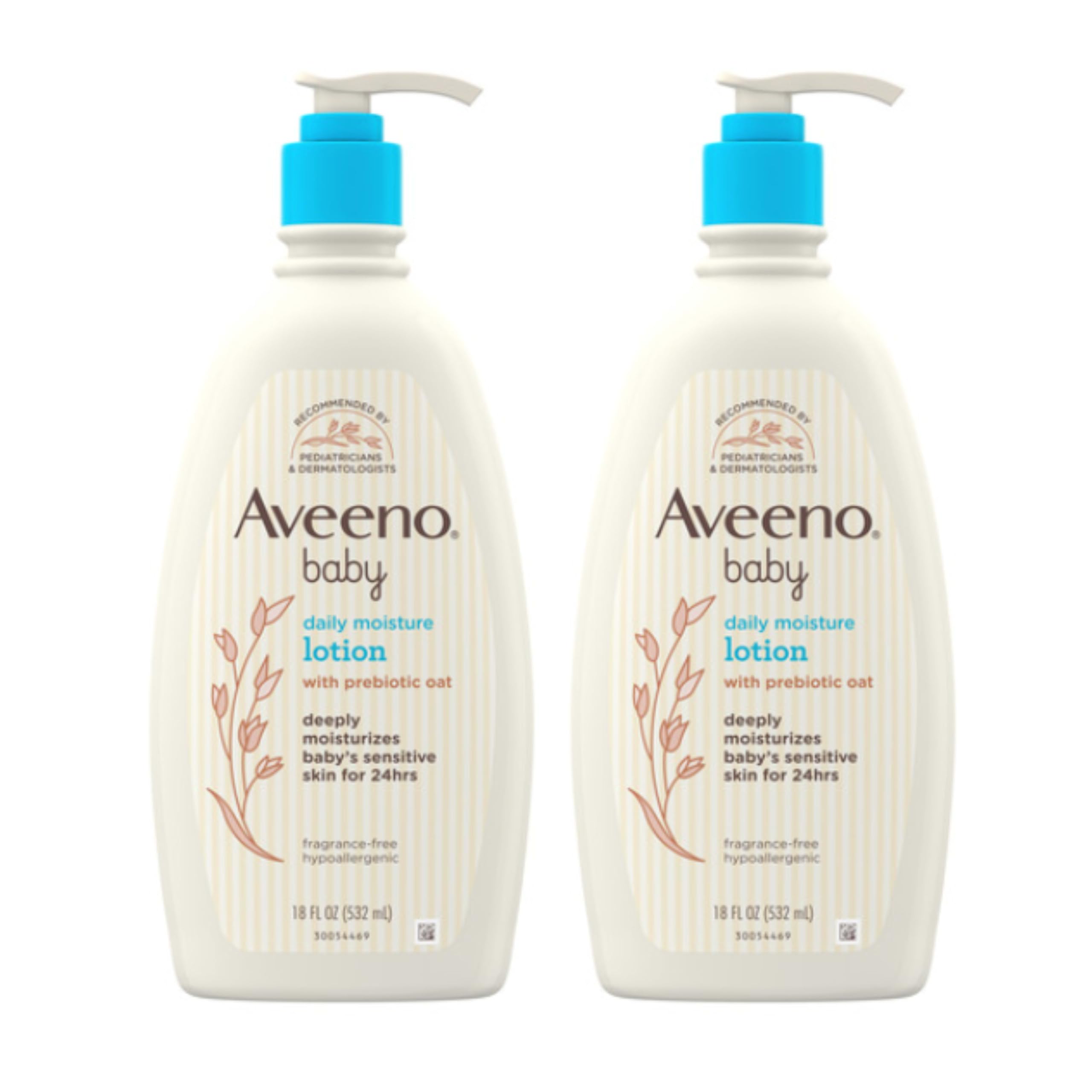
Aveeno Baby Daily Moisture Lotion
Key Features
- Size: Two 18 fl oz bottles
- Fragrance: Fragrance-free
- Key ingredient: Prebiotic oat
- Moisture claim: 24 hours
- Price: Midrange
Two 18-ounce bottles, fragrance-free, built on prebiotic oat: this is the least dramatic product in the guide and the one we expect most families to finish first. A daily baby lotion has a short job list. It has to rub in without a fight, leave nothing slippery inside a sleepsuit, and be boring enough that you keep reaching for it twice a day for a year.
It clears all three, which is why it’s our top pick. The formula is hypoallergenic and free of fragrance, parabens, steroids, phenoxyethanol and phthalates, so it’s the bottle you can hand a nervous first-time parent without a caveat. Aveeno’s 24-hour moisture claim is the label’s own; what convinced us is the texture, which spreads over a whole wriggling baby and dries fast enough that you’re not wrestling a lotioned leg into a sleepsuit five minutes later.
The limit is depth. This is a lotion, so it isn’t the answer for rough patches or cracked cheeks — that’s a cream or an ointment job, and we cover both below. Next to the CeraVe lotion it feels similar for less per ounce and comes in a bigger bottle; next to the Eucerin it’s a touch richer. And the twin pack is the practical bit: one bottle in the bathroom, the second wherever you change diapers.
Pros
- Fragrance-free and hypoallergenic for newborn skin
- Absorbs fast with no greasy film
- Twin pack splits between bathroom and diaper bag
- Costs less per ounce than most lotions here
Cons
Our default recommendation for most babies: fragrance-free, quick to rub in, and sold in a twin pack that makes twice-daily use painless.
Best for Very Dry Patches
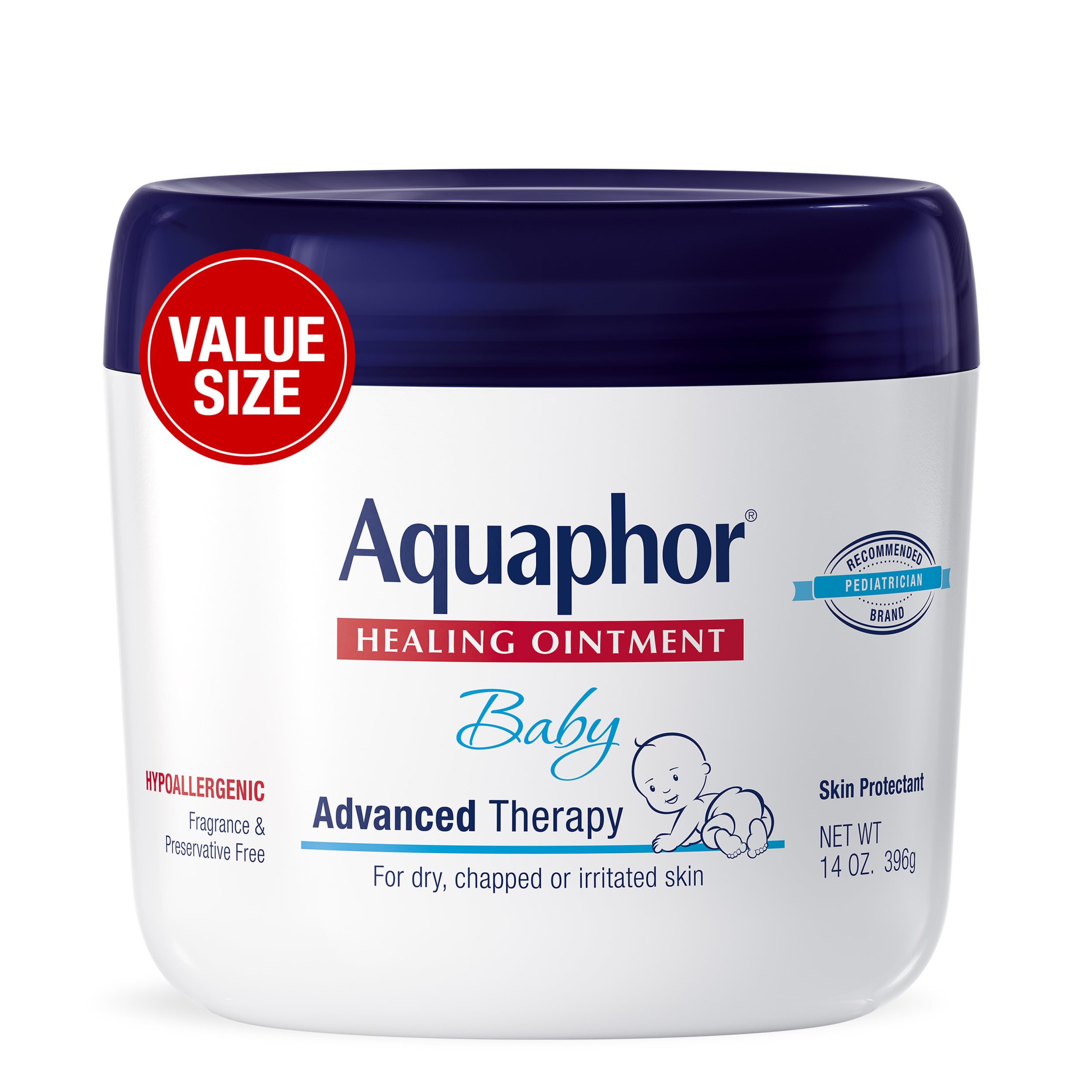
Aquaphor Baby Healing Ointment
Key Features
- Size: 14 oz jar
- Format: Ointment
- Fragrance: Fragrance-free
- Active ingredient: 41% petrolatum
- Price: Midrange
Thick, tacky and slow to rub in — the Aquaphor jar is the opposite of a lotion, which is exactly why it earns a place. It’s 41% petrolatum, fragrance-free and preservative-free, and it works by staying on the surface of skin rather than vanishing into it.
We reach for it when skin is damaged rather than merely dry: the dribble rash under a chin, chapped cheeks after a cold week of runny noses, the shins of a baby who commando-crawls across a rug. On those spots it does more in one night than a lotion manages in a week, and the texture that makes it a poor all-over moisturizer is the same texture that keeps a barrier in place under a permanently wet chin. It’s also the multitasker here — the same jar handles dry patches, minor scrapes, and the chapping that winter hands get.
A thin coat is all it takes, so the 14-ounce jar comfortably outlasts the newborn stage and one is plenty. Two practical notes from using it: fingers go into the product every time, which is messier than a pump, and the film is slow enough that we save it for bedtime or covered areas rather than five minutes before an outing.
Pros
- Barrier that holds on wet, chapped skin
- Fragrance-free and preservative-free
- 14 oz jar lasts through the newborn stage
- Handles dribble rash, chapping and dry patches
Cons
- Jar packaging is messier than a pump or tube
Not an everyday lotion, but the jar we reach for when skin is cracked, chapped or dribble-raw and needs a barrier rather than moisture.
Best for Eczema-Prone Skin
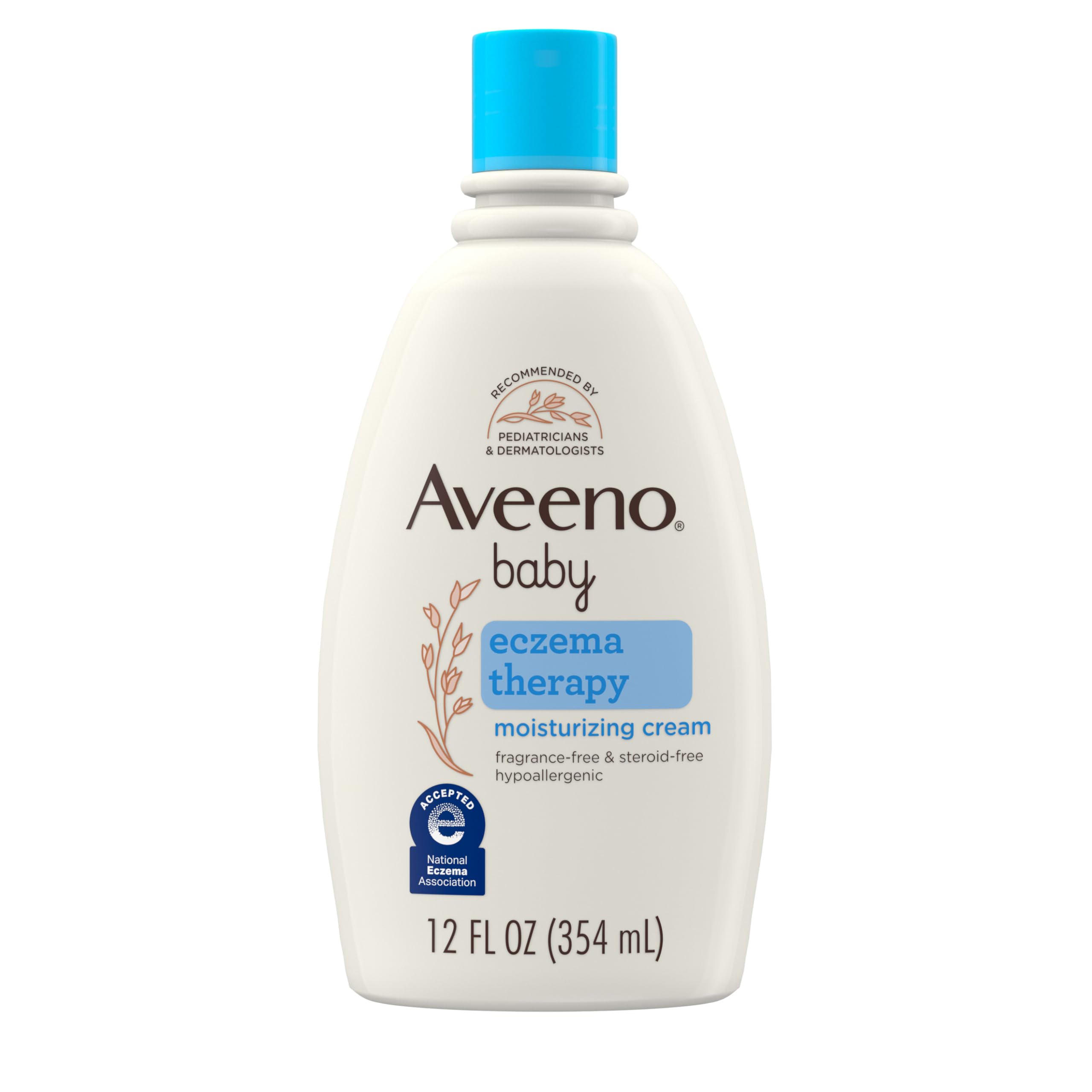
Aveeno Baby Eczema Therapy Cream
Key Features
- Size: 12 fl oz
- Fragrance: Fragrance-free
- Recognition: Eczema association seal
- Key ingredient: Colloidal oatmeal
- Price: Midrange
The National Eczema Association Seal of Acceptance is the small print on the front of this one, and it’s the reason it made the list. The cream pairs colloidal oatmeal, a skin protectant, with vitamin B5, and it’s fragrance-free and free of steroids, parabens and phenoxyethanol.
What the seal means in practice is that the formula has been accepted for eczema-prone skin, not that it treats a flare. On rough, itchy patches it’s the pick we move to when the everyday lotion stops being enough. It’s a cream, so it sits between the Aveeno lotion and the Aquaphor ointment: rich enough to change how a rough patch feels after a few days of regular use, light enough that morning and night applications don’t turn into a fight.
Not every baby tolerates it. The same cream that settles one child’s cheeks can sting another’s, so a small test patch on the first night is worth two minutes of your evening. For a family already dealing with recurring rough patches, though, it’s the strongest eczema-specific choice in this group, and the 12-ounce size lasts because you’re treating areas rather than a whole body.
Pros
- Eczema association seal of acceptance
- Colloidal oatmeal plus vitamin B5
- Fragrance-free with no steroids
- Rich without a greasy film
Cons
- Pricier per ounce than the everyday lotion
The pick for a baby with rough, itchy patches: richer than a lotion, fragrance-free, and the only cream here built around eczema-prone skin.
Best for Sensitive Skin Daily
CeraVe Baby Lotion
Key Features
- Size: 16 fl oz
- Dispenser: Pump bottle
- Fragrance: Fragrance-free
- Key ingredients: Ceramides, hyaluronic acid
- Price: Midrange
Three ceramides, hyaluronic acid and vitamin E in a 16-ounce pump bottle: CeraVe’s baby lotion is built around the skin barrier rather than around a scent or a bedtime ritual. It’s fragrance-free, paraben-free, dye-free and phthalate-free, and it carries the eczema association’s seal as well.
The first thing we noticed is how completely it disappears. It goes on thinner than the Aveeno and dries to nothing — no shine, no tack, nothing for a vest to catch on. Nothing in the formula is there to smell nice, and that’s the point. The pump is the second thing we appreciate: one-handed doses at the changing table, with no lid to hold between your teeth.
That combination makes it our pick for a baby who runs warm or a household in a humid climate, where a rich cream feels like too much. It’s also the tidy way to get ceramides into the routine without paying premium prices. The limit is richness — on genuinely rough patches this lotion isn’t enough, and we move up to a cream or the ointment.
Pros
- Ceramides plus hyaluronic acid for the barrier
- Absorbs to nothing, no film
- One-handed pump bottle
- Fragrance-free, dye-free and phthalate-free
Cons
- Not rich enough for rough or eczema-prone patches
Buy this one if you want a fragrance-free daily lotion that disappears instantly and comes in a pump you can work one-handed.
Best for Fragrance-Free Budget
Eucerin Gentle Baby Lotion
Key Features
- Size: 13.5 fl oz
- Dispenser: Pump bottle
- Fragrance: Fragrance-free
- Key ingredients: Shea butter, provitamin B5
- Price: Budget
The least expensive fragrance-free lotion here is also one of the nicest to use, which is a combination worth flagging. Eucerin’s baby lotion is a 13.5-ounce pump bottle with shea butter and provitamin B5, no drying alcohols, no dyes and no parabens.
It’s lighter than the Aveeno and thinner than the CeraVe, closer to a milk than a cream, and that’s the trade you’re making. On normal-to-dry skin it absorbs in seconds and leaves nothing behind. On genuinely rough patches you’ll want to layer it or move up to something richer, and in the depths of winter it may not be enough on its own.
No scent at all, which for a lot of parents is the entire point, and the pump gives you a controlled squirt for an arm or a leg. What we like most is that the price lets you be generous with it — after every bath, again in the morning, a dab on the face — without doing arithmetic. If you want fragrance-free and don’t need a heavy cream, this is the value pick of that group.
Pros
- Cheapest fragrance-free lotion in this set
- Pump bottle, easy to use one-handed
- No scent, no dyes, no drying alcohol
- Absorbs in seconds on normal skin
Cons
- Light formula needs layering on very dry skin
The fragrance-free lotion to buy if you want to spend the least and still get something genuinely gentle for daily use.
Best for Big-Family Value
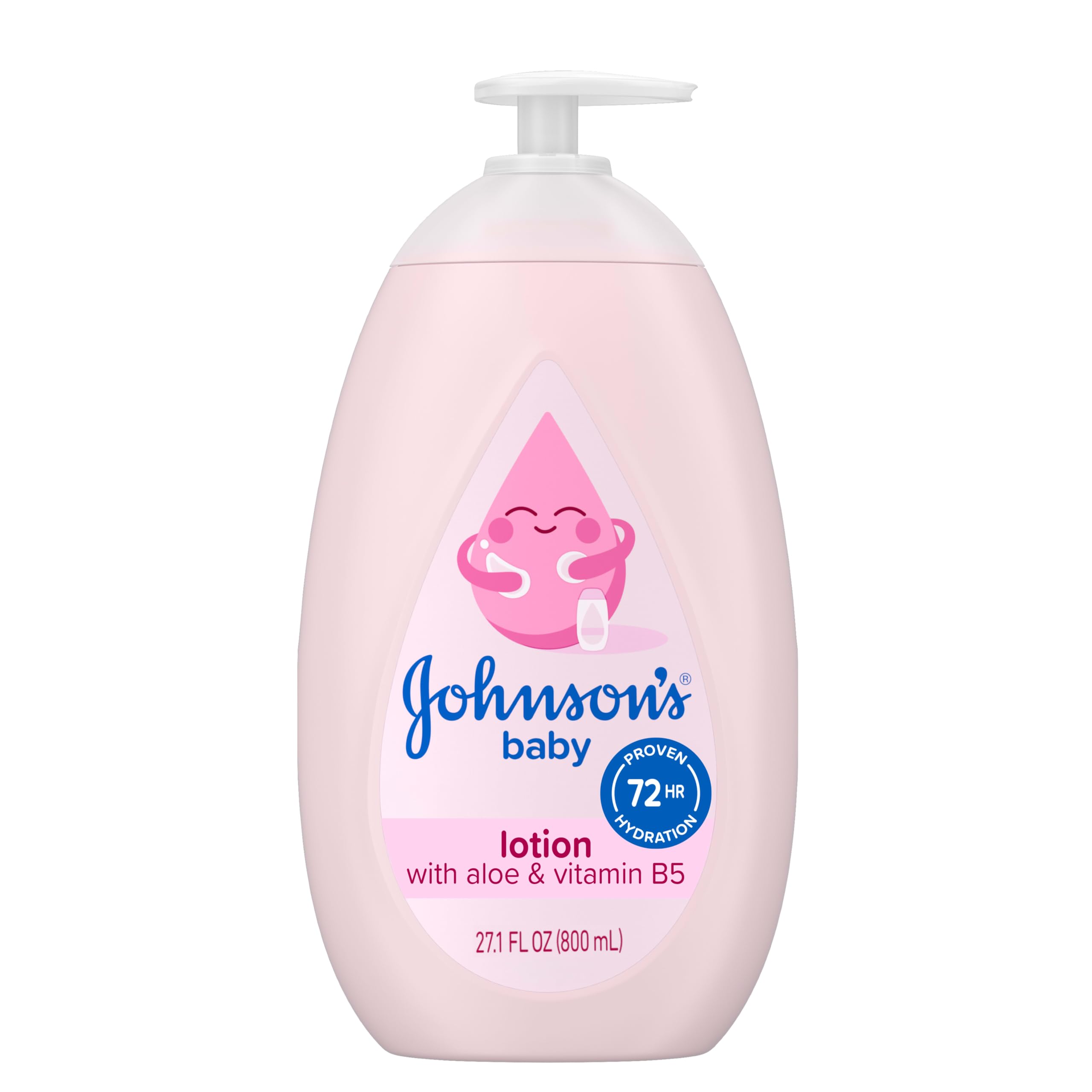
Johnson’s Baby Lotion with Coconut Oil
Key Features
- Size: 27.1 fl oz
- Scent: Coconut
- Moisture claim: 72 hours
- Key ingredients: Coconut oil, aloe, vitamin B5
- Price: Budget
This is the bottle that smells like a baby, and that single fact decides the purchase. Johnson’s coconut oil lotion is the biggest container in this guide at 27.1 fluid ounces, it’s pH-balanced and hypoallergenic, and it’s made with coconut oil, aloe and vitamin B5 without parabens or dyes.
If the smell is what you’re after, it’s a genuinely good everyday lotion: light, quick to rub in, no oily residue, and a 72-hour hydration claim on the label. We found it dries fast enough to be a real everyday bottle rather than a special-occasion one, and it’s the cheapest per ounce by a wide margin — which is why it ends up as the family bottle rather than the baby’s.
It’s a lotion, so don’t expect it to do much for cracked skin or an eczema flare; this is the everyday bottle, not the repair kit. But for a toddler who goes through lotion and a household that likes the classic smell, nothing here comes close on volume or price per ounce.
Pros
- Biggest bottle here by a wide margin
- Largest volume per dollar in this group
- Light, quick-absorbing everyday lotion
- Coconut oil, aloe and vitamin B5 formula
Cons
- Scented, so it isn’t the first bottle for a newborn
The value bottle for families who love a classic baby smell and go through a lot of lotion; skip it if you need fragrance-free.
Best for Scented Splurge
Noodle & Boo Super Soft Lotion

Key Features
- Scent: Signature baby scent
- Format: Lotion
- Free from: Parabens, phthalates, sulfates, dyes
- Key ingredients: Sweet almond oil, vitamins E and C
- Price: Premium
Noodle & Boo is the bottle you buy when you want your baby to smell like a baby, and it’s the most expensive thing in this guide for exactly that reason. The Super Soft lotion has a distinct, sweet scent that people remember, and we understand why the brand has a following.
The formula behind it is solid: sweet almond oil with vitamins E and C, plant-based, free of parabens, phthalates, sulfates, PPGs and dyes, and both pediatrician- and dermatologist-tested. It’s thick in the bottle but absorbs faster than you expect, and a small amount covers an arm and a leg, which is the only reason the price is defensible.
The scent is also the honest limitation. This isn’t fragrance-free, and it isn’t the bottle to start with on a newborn whose skin is still an unknown quantity; it’s the one to buy once you know scented products suit your baby, or as a gift where the smell is the point.
So the recommendation is conditional but real: worth it if you love the scent, because nothing else here duplicates it, and the absorption and coverage are genuinely good. Skip it if you’re shopping for a fragrance-free household — the scent is the product, and there’s no version without one.
Pros
- Signature scent people buy it for
- Thick in the bottle but absorbs quickly
- A small amount covers a lot of baby
- Free of parabens, phthalates, sulfates and dyes
Cons
- Most expensive per ounce in this group
A premium buy for parents who want the scent as much as the moisturizer; the absorption is good and the smell is the whole point.
Best for Warm-Weather Lotion
Cetaphil Baby Daily Lotion

Key Features
- Size: 13.5 fl oz
- Scent: Calendula
- Free from: Parabens, colorants, mineral oil
- Key ingredients: Vitamin E, sweet almond oil
- Price: Budget
For a hot nursery and a baby whose skin is basically fine, a thin lotion makes more sense than a cream, and that’s where Cetaphil’s calendula lotion fits. It’s a 13.5-ounce bottle with vitamin E, sweet almond oil and sunflower seed oil, hypoallergenic, and free of parabens, colorants and mineral oil.
It goes on wet and light and disappears almost immediately, which is exactly right in July and exactly wrong in February. The calendula gives it a soft scent that isn’t the classic baby-lotion smell, and it’s the sort of thing a baby either tolerates without noticing or doesn’t.
The real limit, for us, is consistency. This is a runny lotion, and runny lotions don’t hold their own on genuinely dry skin — if your baby’s shins are rough or there’s eczema in the picture, it will feel like it vanishes rather than helps.
So treat it as a good second bottle: a summer lotion, a toddler lotion, a spare in the diaper bag for a baby with normal skin. It isn’t the one to buy first for a winter newborn with dry patches — one of the fragrance-free lotions is the more sensible first purchase.
Pros
- Light and fast-absorbing for hot weather
- Soft calendula scent
- Free of parabens, colorants and mineral oil
Cons
- Scented with calendula rather than fragrance-free
A light calendula lotion that suits a summer routine and normal skin, as long as nobody in the house needs fragrance-free.
How We Tested: Patches, Bath Times, and 3 A.M. Changes
To build the shortlist, I started with moisturizers actually marketed for infants and read the full ingredient list on every one, not just the front of the tube. Anything with a heavy fragrance load or a drying alcohol near the top got set aside, and I cross-checked the survivors against ingredient guidance from a pediatric dermatologist. From there I filtered by price, tube size, and how many ounces you get per dollar, since a baby moisturizer gets used three or four times a day and a small jar runs out fast. That left 14 formulas.
Each of the 14 got a 24-hour patch test on an adult inner forearm first, checking for redness, warmth, or stinging, before the parents on the team used it on their own babies. Over the next three months, the testing was just real life: after the evening bath, at the morning diaper change, on wind-chapped cheeks before a stroller walk, and on the dry patches behind the knees.
Consistency mattered more than I expected. I spread each one across the back of my hand to see whether it sat on top of the skin or sank in, then timed how long it took to stop transferring to a sleeve — the greasy ones left marks on sleep sacks. At the diaper line, we checked at the next change to see whether the barrier was still there. In the morning, we felt cheeks to judge whether the moisture had actually held overnight, and wrote down every reaction, from a faint flush to extra fussing at application. Scent got a simple sniff test, and I noted which "unscented" formulas still smelled like something.
How to Choose a Baby Moisturizer
Format and fragrance decide almost everything here; the name on the bottle decides very little.
Start with the format, not the brand
A lotion is the default for a reason: it spreads over a whole body, absorbs within a minute, and stands up to twice-daily use. Step up to a cream when patches are still rough after a week of lotion, and to a balm or ointment when skin is actually damaged — chapped, cracked, or raw under a dribble chin.
The mistake we see most often is buying an ointment as the only moisturizer. It seals beautifully, but it’s slow to spread and leaves a tacky film, so it belongs on spots rather than on a wriggling baby from neck to ankle.
Settle the fragrance question early
Fragrance-free is the sensible default for a newborn and for any baby whose skin has reacted before, and the fragrance-free half of this guide is deep enough that you give nothing up. Scented products are a preference: a lavender bedtime lotion, the classic coconut smell, a soft calendula one.
Don’t be talked into ‘natural’ fragrance being gentler. Lavender, calendula and coconut are scent, and a scented lotion is one to test on a small area before you use it on a whole baby.
Buy a size that matches your routine
Daily full-body use burns through ounces faster than most parents expect — roughly a bottle every month or two in the first year, more if you apply morning and night. That makes a large pump bottle or a twin pack the sensible buy, and the pump the format you’ll appreciate at three in the morning.
The trap is buying the biggest bottle of something untested. A giant bottle of a lotion that stings your baby is the most expensive bottle in the house. Buy one, use it for a week, then buy the multi-pack.
What the eczema and gentle labels actually mean
An eczema association seal means a product has been accepted for use on eczema-prone skin; it doesn’t make it a treatment. Colloidal oatmeal is a recognized skin protectant and ceramides support the barrier — both useful in a moisturizer, neither a replacement for a pediatrician’s plan during a flare.
‘Hypoallergenic’ and ‘pediatrician recommended’ are claims rather than tests run on your child, so treat them as a starting point. If skin is cracked, weeping or spreading, that’s a doctor question rather than a moisturizer question.
Frequently Asked Questions
How often should I apply baby moisturizer?
Twice a day is a reasonable default — after the bath and again in the morning — plus a dab on any patch that looks dry. Applying to slightly damp skin straight after a bath helps a lotion go further, and most of the picks here are labeled for daily use on face and body.
If you’re applying five times a day and skin still looks rough, the formula is too thin for your baby rather than the routine being wrong.
Do I still need a separate diaper cream?
Not necessarily. A petrolatum ointment does the barrier job at the diaper area as well as it does on chins and shins, so a dedicated cream is optional. What matters is a thick layer rather than a rubbed-in one, and a fresh application at every change while skin is sore.
Can adults use these baby moisturizers too?
Yes. Several are labeled for the whole family, and the fragrance-free ones work fine on adult skin. The constraint is volume: a 13-ounce bottle disappears quickly when two adults are also using it after every shower, so keep the baby’s bottle separate or buy the larger size. The scented picks are the ones to leave in the nursery.
Final Verdict
Most families should buy the Aveeno Baby Daily Moisture two-pack and stop thinking about it: fragrance-free, fast-absorbing, and enough lotion that you won’t ration it. Two situations change that answer.
If rough, itchy patches are already there, the Aveeno Eczema Therapy cream is the one carrying the eczema seal and the colloidal oatmeal, and it’s built for spots rather than whole bodies. If skin is cracked, raw or dribble-chafed, go straight to the Aquaphor jar — a thin coat overnight does what no lotion will.
