This post contains affiliate links. We may earn a small commission when you buy through our links — at no extra cost to you.
Bath time with a newborn is supposed to be a sweet ritual, but the first time you lower a slippery baby into a full-size tub, it feels like a trust fall. A good baby bath tub gives you a safe, angled spot to perch them, keeps them from sliding under, and saves your back while you juggle soap and a washcloth. I’ve tested 14 tubs over the past six months in kitchen sinks, a standard bathroom tub, and at my parents’ house on weekends—because a tub that only works in one spot isn’t much help.
The pattern: size and suitability matter more than bells and whistles. A sink-sized tub is lovely for a newborn but cramped once your baby can sit up; adjustable designs last longer, though some are bulkier to store. Price didn’t predict quality—a few cheaper tubs felt sturdier than pricier ones—and portability is worth checking if baths happen at Grandma’s. Convenience comes down to draining and cleaning, not gadgets.




Best for Newborns to Toddlers
Fisher-Price 4-in-1 Sling ‘N Seat Tub
Key Features
- Stages: 4
- Dimensions: 29.8 x 17.6 x 7.5 in
- Max weight: 25 lb
- Drain and storage: Drain plug and hanging hook
- Price: Midrange
The stage that decides whether a baby tub was worth buying isn’t the newborn one. It’s the stretch from about four to eight months, when your baby has outgrown the mesh sling but still folds sideways the moment you sit them up. Most tubs here handle one end of that stretch or the other; this one has a seat built for the middle of it.
The four stages run from a mesh sling for a newborn, through that Sit-Me-Up insert, to a bare tub rated to 25 pounds. At 29.8 by 17.6 by 7.5 inches it drops into most kitchen sinks and sits inside an adult tub without wobbling, and there’s a drain plug plus a hook on the back for hanging it over the shower head between baths.
We think it’s the best all-rounder in this set, and the reason is the overlap: the sling, the insert and the bare tub cover each other’s weak spots instead of leaving a gap at the exact age when bath time gets difficult. The insert clicks in firmly, which is what you want with a wriggling baby, and it’s stiff enough to fight you when you want to rinse underneath it. We ended up leaving it in place and running water straight through the drain.
The sling is the part we’d rework if we could, because it’s wipe-clean rather than machine washable and needs a rinse and a wipe after every use. The rinse bottle and scoop in the box are the sort of thing you’d otherwise be buying separately in week two.
Pros
- Four stages, newborn sling through 25-pound toddler
- Sit-Me-Up insert covers the unsteady-sitter months
- Drain plug and hanging hook for quick cleanup
- Fits most kitchen sinks and adult bathtubs
Cons
- Sling is wipe-clean only, not machine washable
This is the tub we recommend to most families: four overlapping stages, a seat for the unsteady-sitting months, and a shape that fits a kitchen sink.
Best for Splashy Sitters
Skip Hop 4-in-1 Wave Tub
Key Features
- Stages: 4
- Dimensions: 28.1 x 19 x 12.2 in
- Max weight: 25 lb
- Item weight: 4.4 lb
- Price: Midrange
Twelve inches of side wall doesn’t sound like a feature until your baby discovers that kicking is the best part of bath time. The Wave stands 12.2 inches tall against 7.5 on our top pick, and that extra wall is most of the reason we point splashy households this way.
The four stages come with weight ranges rather than vague ages: an infant bather for 0 to 6 months up to 15 pounds, an upright bather for 3 to 9 months up to 20 pounds, a sit-up support, and then a 25-pound toddler tub with everything out. The mesh sling is machine washable on cold and hangs dry, which is a genuine advantage over the wipe-only sling on the Fisher-Price. At 28.1 by 19 by 12.2 inches it’s wider than the top pick, so measure your basin before you commit — this one wants a bathtub.
The sit-up insert lifts out without a fight, and that matters because it’s the stage you’ll be rinsing most often. It’s also the best-looking tub in this group; the wave profile and high sides don’t read as baby equipment, which counts for something if it’s going to live in your bathroom rather than a cupboard.
Where it gives ground is in the small parts. On a smooth countertop the shell can creep, so keep a rubber mat under it, and the hanging hook is the piece most likely to give out after a year of daily use. Hang it low, or not at all.
Pros
- High sides keep splashes inside the tub
- Machine-washable sling that hangs dry
- Four stages with clear weight limits
- Shapely enough to leave out between baths
Cons
- Printed stickers inside can flake off
- Hanging hook is the weak point
If your baby treats the tub like a wave pool, the Wave’s high sides and machine-washable sling make it our pick — just check it fits your basin first.
Best for Travel and Hotels
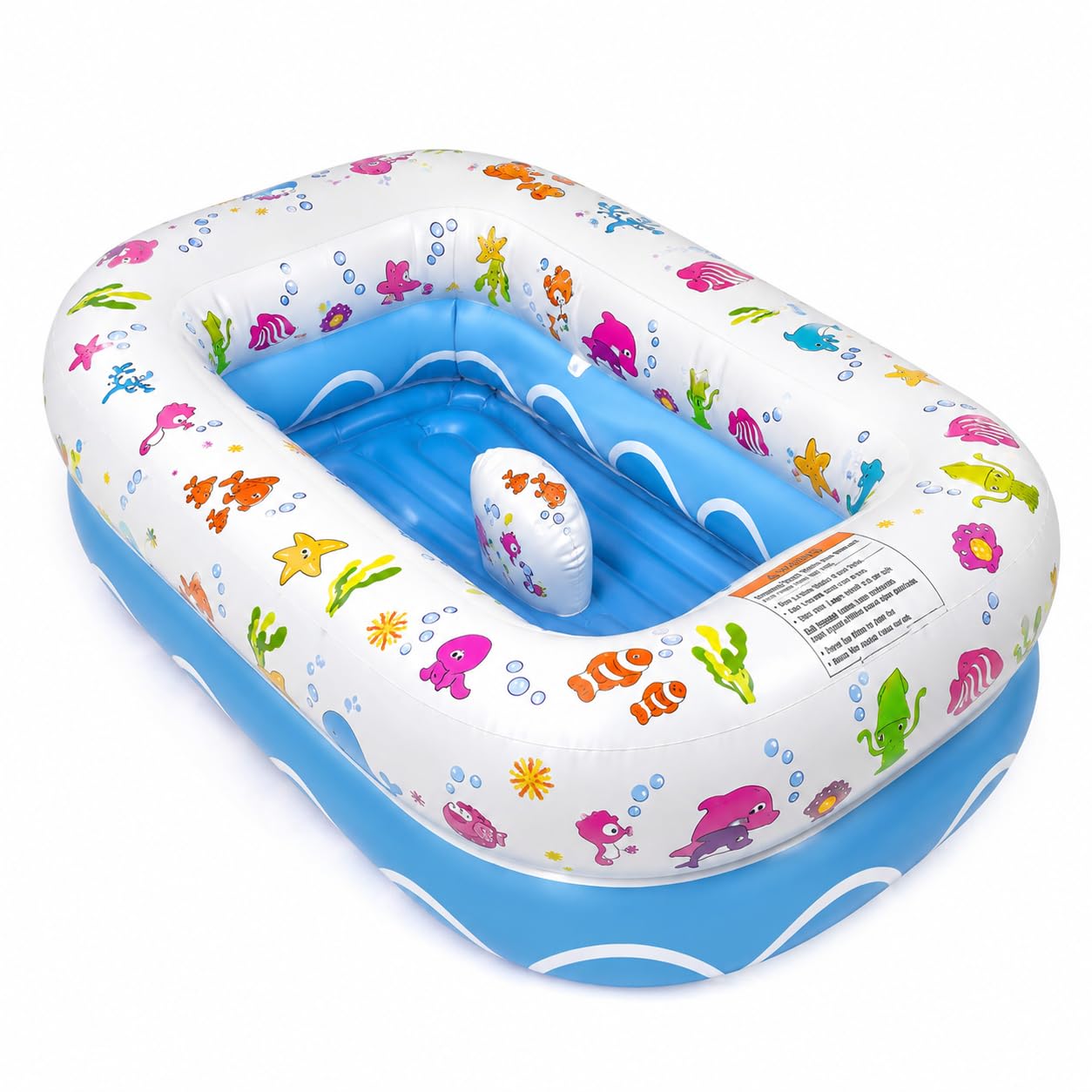
Mommy’s Helper Inflatable Tub
Key Features
- Age range: 6 to 24 months
- Dimensions: 26 x 18 x 12 in
- Max weight: 27.5 lb
- Item weight: 15.7 oz
- Price: Budget
The piece that does the actual work in an inflatable tub is the bump in the middle. Here it’s a saddle horn that sits between your baby’s legs, and it’s the reason a six-month-old who can’t balance yet stays upright while you reach for the washcloth.
We think it earns its place as the travel tub in this set. Rated for 6 to 24 months and up to 27.5 pounds, it weighs just over fifteen ounces, deflates flat, and has a drain plug so you can empty it without tipping a floppy tub of water over a hotel carpet. It’s the one that lives in the car and stays there.
The catch is breath. There are two chambers to fill through a double valve, and getting them properly firm takes a few minutes of lung work the first time; a small hand pump turns that into a non-event and is worth keeping in the bag with it. Expect to top up the air every few baths as the walls soften.
Soft walls are the trade you’re accepting. They cushion a baby who tips over, and they support a sitter far less than molded plastic does, so this isn’t the tub for a baby who’s already pulling up. For a weekend at Grandma’s or a week in a rental with nothing but a shower, none of that matters.
Pros
- Packs flat enough for a suitcase or trunk
- Center saddle horn keeps a sitter upright
- Drain plug empties without tipping
Cons
- Takes real breath to inflate without a pump
- Soft walls support a sitter less than rigid plastic
The travel tub we recommend: it packs flat, holds a sitter upright, and turns any hotel tub or shower floor into a place to bathe a baby.
Best for Sink or Tub
Boon Soak 3-Stage Tub
Key Features
- Stages: 3
- Age range: 0 to 18 months and up
- Item weight: 2.4 lb
- Temperature check: Color-changing drain plug
- Price: Budget
A drain plug that changes color when the water gets too warm removes a whole category of doubt from bath time, and on the Soak it’s the detail that makes the rest of the tub make sense. The tub itself is shaped like a recliner: a contoured back wall, non-slip foam, and an adjustable bump underneath that moves down as your baby grows.
We think it offers the best sink-to-tub flexibility here. It’s rated from birth to 18 months and up, fits most double sinks and full-size tubs, and weighs 2.4 pounds, so moving it from the kitchen to the bathroom is a one-hand job. The plug doubles as the temperature check, and the tub is white, which shows you the ring before it turns into a problem.
The newborn stage is where it asks the most of you. That adjustable bump is the only thing holding a small baby in position, and set low it lets a newborn slide toward one side — run it to the highest setting for the first few months and check it before you add water. Older sitters get a wide, stable seat and a lot less fiddling.
It’s also the plainest tub here, which we mean as a compliment: white plastic, no character theme, nothing to peel, and nothing that looks out of place in a guest bathroom.
Pros
- Fits double sinks and full-size tubs
- Color-changing plug flags water that’s too warm
- Reclined back with non-slip foam
- Light enough to carry one-handed
Cons
- 90-day warranty is short for daily use
For a household that wants one tub for the kitchen sink and the big bath, the Soak’s temperature-sensing plug and reclined shape make it our pick.
Best for Newborn Sink Baths
Skip Hop Soft Sink Bath
Key Features
- Material: Terry cloth and foam
- Age range: 0 to 6 months
- Dimensions: 19 x 12.75 x 10.5 in
- Max weight: 20 lb
- Price: Budget
In the first month, bathing a newborn is less about the tub and more about not bending over the big bath at eight in the evening with a floppy eight-pounder in your arms. A foam bather that drops into the kitchen sink solves most of that, and this one does it with a padded whale tail under the head and not much else.
The details are deliberately simple: terry cloth over foam, a mesh bottom that lets water through, a hook-and-loop strap so it can hang dry, and machine washing whenever a rinse isn’t enough. It measures 19 by 12.75 by 10.5 inches and is rated to 20 pounds or about six months.
We think it’s the right buy for the newborn window specifically, short as that window is. A sink bather is the difference between a bath you can do alone and one that needs two people, and this is the softest landing in this set for a baby who still needs head support.
Two habits keep it useful. Hang it by the strap after every bath, because a foam bather that goes into the laundry basket damp is a bather that grows spots. And put a towel under it if your sink has a polished surface, since it will slide on smooth enamel.
Pros
- Cradles a newborn in a kitchen sink
- Machine washable and quick to hang dry
- Mesh bottom drains water fast
Cons
- Covers only the first six months
For the first six months, a soft sink bather beats a full-size tub, and this is the one we recommend: it cradles a newborn and goes in the wash.
Best for Older Toddlers
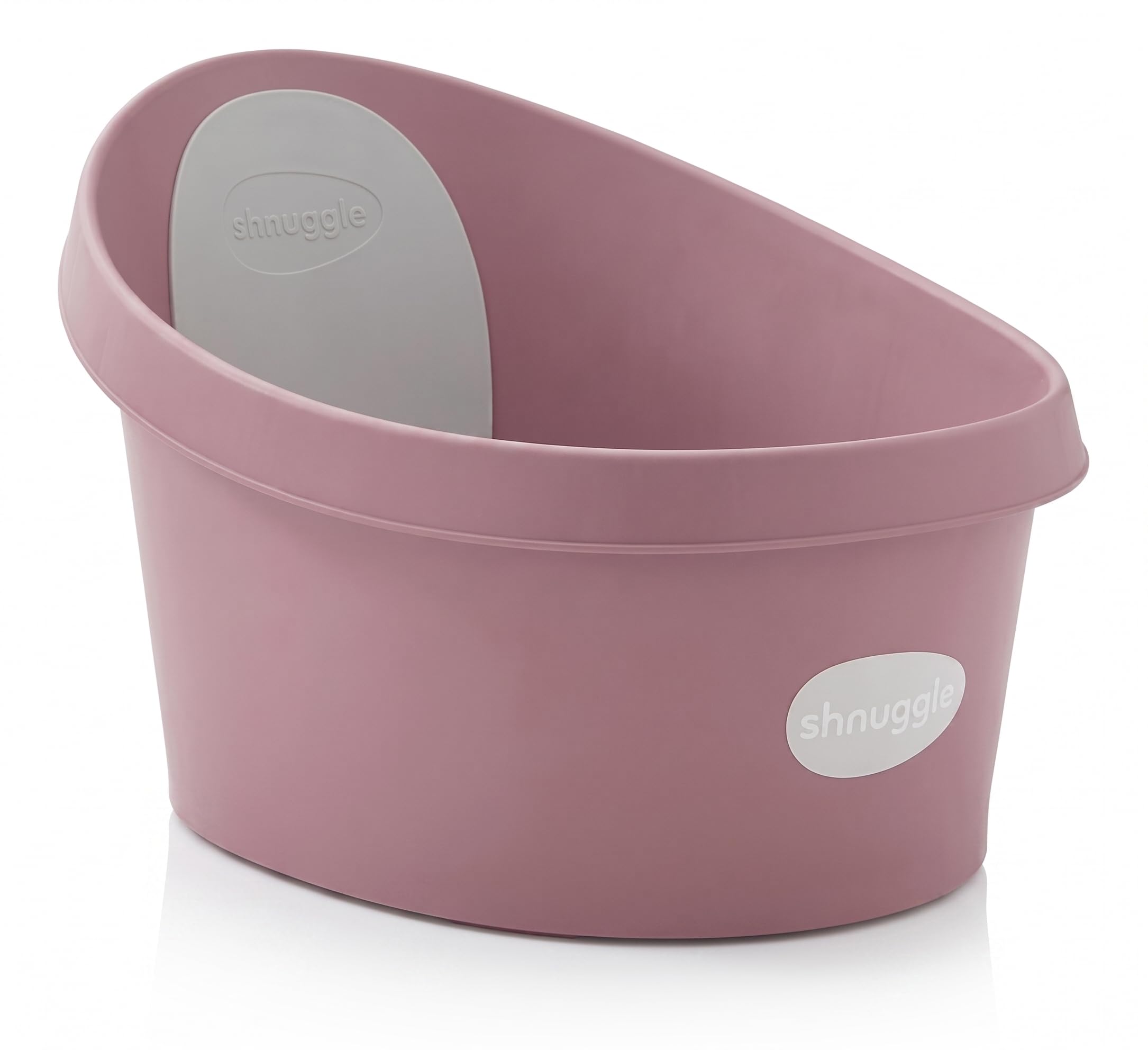
Shnuggle Toddler Bath
Key Features
- Drain: Plug and fill line
- Stage: Toddlers
- Material: BPA-free
- Item weight: 4.41 lb
- Price: Premium
There’s a specific evening when the baby tub stops working. Your toddler can sit, can pull up on the rim, and a 25-pound weight limit suddenly reads as a suggestion. The Shnuggle Toddler Bath is built for the years after that, and it’s the only tub here designed for a child who has already outgrown a baby bath.
It’s one molded tub with a contoured base, a foam backrest, a grippy surface inside and an anti-slip base, plus a drain plug and a maximum fill line so you can’t overdo the depth. It weighs 2 kg, is made from BPA-free material, and is shaped to sit inside most shower trays and adult baths.
We think the base is the part that earns the money. A toddler who stands up mid-bath meets a tub that doesn’t move, and the high sides give them something to hold that isn’t the tap. The foam backrest is warmer against the skin than bare plastic, which is often the difference between a child who settles back and one who complains about being cold.
The fill line matters more than it sounds. It caps the depth at something a sitting toddler can enjoy without you hovering, and the plug means you can drain it while your child is still in the bath rather than lifting a full tub over the side.
Pros
- Anti-slip base that stays put in the big bath
- Roomy enough for a two-year-old to play
- Drain plug and marked maximum fill line
Cons
- No newborn or infant stage
- Does not fold for storage
For a toddler who has outgrown the baby bath but isn’t ready for the open tub, this is our pick: roomy, stable, and hard to tip.
Best for Small Bathrooms
MoreFeel Collapsible Tub

Key Features
- Included: Thermometer, towel, cushion
- Age range: 0 to 36 months
- Dimensions: 27 x 17 x 9 in
- Folded thickness: Under 4 in
- Price: Midrange
Under four inches. That’s what this tub folds down to, and if your bathroom is the size of a closet, that number is the entire argument. Two folds take it from a 27-inch tub to something you can stand behind the door or slide under the crib.
Open, it measures 27 by 17 by 9 inches and is rated from birth to 36 months, with a soft floating cushion for a newborn, a drain hole, and a real-time temperature sensor set into the wall. It arrives with a hooded towel, which is a nicer extra than it sounds when you’re assembling a bath kit from scratch.
The cushion is the weak link. It’s soft enough to sag under a heavier baby, and it holds a newborn fairly high, so square it up before you add water. Set the whole tub on a non-slip mat inside the big bath rather than on a countertop, and check that both folding joints are locked before you fill it.
Here’s where we land: buy it for the fold, not the gadgetry. As a small-bathroom tub it earns its place, because nothing else here disappears like it does; as a do-everything tub it doesn’t, because the cushion support is the least reassuring in this set. The thermometer is a second opinion at best — it doesn’t switch off between baths and it can drift, so test the water with your wrist anyway.
Pros
- Folds to under four inches for storage
- Built-in thermometer for water temperature
- Hooded towel and cushion included
Cons
- Cushion sags under a heavier baby
- Thermometer can drift or stop reading
If your bathroom has no room for a full-size tub, this is the one to get: it folds to under four inches and still gives a newborn a cushioned place to lie.
Best for Station-Style Bathing
The First Years Rain Shower Tub

Key Features
- Stages: 3
- Dimensions: 30.5 x 16.7 x 9.5 in
- Max weight: 25 lb
- Item weight: 7.5 lb
- Price: Premium
A tub with its own shower head is either the best idea in this guide or the most unnecessary, and which one depends entirely on how you feel about bath time. The Rain Shower has a rotating arm that directs a gentle spray, a handheld head, a soft brush built into it, and a fresh-water tank so the rinse isn’t the water your baby has been sitting in.
The rest is a conventional three-stage tub: a sling for a newborn, an inclined side for an infant, and an upright side with the sling out for a toddler. It’s rated to 25 pounds, measures 30.5 by 16.7 by 9.5 inches, and arrives needing assembly.
At 7.5 pounds it’s the heaviest tub here by a clear margin, which matters if you fill it on the counter and lift it to the sink every night, and doesn’t matter at all if it lives in the big bath and gets drained in place. The tank and the spray mean fewer trips with a cup, and the brush is one less thing rattling around the caddy.
Where we hesitate is the plumbing. Every extra channel is somewhere water sits after the bath, so this one wants a proper dry-out rather than a shake and a hook. If you want a bath station — one spot with everything attached — it’s the only tub here that offers one. The brush in the shower head is the detail that sold us: it’s exactly where your hand already is, and it’s one less thing to pick up with a wet baby in the other arm.
Pros
- Built-in shower arm and handheld rinse head
- Fresh-water tank keeps rinse water clean
- Sling and inclined side for newborns
Cons
- Heaviest tub here at 7.5 lb
- Requires assembly before first use
For parents who want a bath station rather than a tub, this is the pick: a built-in shower, a fresh-water tank, and a brush in the head.
How We Tested Baby Bath Tubs
We started by researching the category—sink inserts, foldable tubs, inflatable options, and convertible models with newborn inserts—and narrowed a long list by size, price, and whether the tub could be used from the newborn stage through sitting up. That left 14 tubs, which we tested for six months in real bathrooms and kitchens, not a lab.
Each tub went through the same run: I measured its footprint in a standard kitchen sink and a full-size tub, filled it to the marked line, and timed how long it took to drain. I carried every one from closet to bathroom and packed the portable models for weekends at my parents’ house. With a 6-week-old and a 6-month-old as testers, I watched how well the seating held them—whether a newborn slid down or an older baby could sit upright without slumping.
Stability got its own check: I set each tub on a dry tub floor, filled it, and gave a gentle nudge to see if it tipped or flexed. Durability meant inspecting seams, hinges, and drains after repeated use; inflatable models got checked for air loss over a week. I also noted whether adjustable pieces were easy to snap in and clean around, since a clever insert is useless if milk or soap scum collects in the crevices. Value came down to whether the tub’s size and lifespan justified its price.
How to Choose a Baby Bath Tub
The tub that works is the one that fits the stage your baby is in this month, not the one with the longest feature list — and the stage most tubs get wrong is the one in the middle.
Buy for the stage you’re in now, not the one you’re imagining
Every convertible here promises newborn-to-toddler coverage, and every one is really three tubs in a row. The newborn stage lasts about three months, the sit-with-help stage runs from roughly four to eight months, and the toddler stage can run another year. If you’re buying before the baby arrives, weight the middle: a sling is easy to design and a bare tub is just a tub, but an insert that holds an unsteady sitter is where cheap designs fall apart.
If your baby is already sitting independently, skip the convertibles. A toddler tub gives you more room for the same money, and you avoid paying for a sling you’ll never unfold.
Measure your sink before you trust the word compact
Compact in a listing usually describes the folded or deflated size, not the footprint you’ll be filling. A full-size convertible runs 27 to 30 inches long and 17 to 19 inches wide; that’s a fit for most kitchen sinks and a tight squeeze for a bathroom basin. Measure the inside of your sink at its widest point and compare it with the open dimensions.
If the tub is going inside the adult bath, width matters more than length, because you need kneeling room beside it. The Wave is the widest convertible here at 19 inches, which is exactly why it wants a bathtub rather than a basin.
Support is what you’re actually paying for
A sling, an insert or an adjustable bump does one job: it stops a baby who can’t sit from sliding sideways into the water. Look at whether the support can be set high for a small newborn and then moved as the baby grows, and whether it comes out entirely when your baby starts sitting.
Then look at the base. Non-slip feet, a grippy underside or a shape that sits inside the big bath all beat a smooth shell on a countertop; a tub that creeps is a tub you chase with one hand while holding a baby with the other.
Draining and drying decide how much you’ll like it
Bath water is heavy and it goes everywhere. A drain plug lets you empty the tub where it stands instead of carrying a full tub to the sink, and a hook or strap lets it hang dry rather than sit in a puddle. Check whether the mesh sling is machine washable — wipe-clean works, but it means a rinse and a wipe every single night.
Mesh, foam and cushions all hold water. Anything that can’t hang is a mildew risk in a humid bathroom, and a foam bather pushed damp into a laundry basket is the classic version of that mistake.
Weight, folding and where it lives between baths
Full, any of these is a two-hand lift. Empty, the gap between four pounds and seven and a half decides whether you carry it to the counter or leave it in the bath. If storage is your binding constraint, a collapsible tub folds to under four inches and an inflatable packs to nothing; both trade rigidity for the space they give back.
If you have a cupboard or a hook, a rigid tub is the steadier place to put a baby, and a hanging hook costs nothing.
Frequently Asked Questions
How long does a baby bath tub last?
Most convertibles are rated to about 25 pounds, which is roughly 18 to 24 months for an average baby, and the newborn sling is usually outgrown around 15 pounds. Sink bathers stop at about 20 pounds or six months. Buy for the end of the range rather than the start: a tub rated to 25 pounds takes you from birth to a toddler who wants to sit up and splash.
Can I just use the kitchen sink instead of buying a tub?
For a newborn, often yes. A clean sink is the right height, you’re already standing at it, and you’re not bending over a bath at the end of the day. The catch is depth and hardness — a sink is shallow and cold, and a wriggling baby knocks against the sides.
A foam or terry sink bather fixes both for about six months. Once your baby can sit, a sink stops working and you need a real tub.
How warm should the bath water be?
Warm enough that your inner wrist stays comfortable after ten seconds. If it’s too warm for your wrist, it’s too warm for a baby. A temperature-sensing drain plug, like the one on the Boon Soak, is a useful backup on distracted evenings, but it reads slowly and doesn’t replace the wrist test. Fill to the tub’s marked line rather than to a depth that looks about right.
Final Verdict
The Fisher-Price 4-in-1 is the tub we point most families to, because it covers the four-to-eight-month stretch with a dedicated insert rather than leaving it to a sling that’s already too small. If your baby is already kicking, the Skip Hop Wave’s higher walls are the better answer; if the tub has to disappear between baths, the MoreFeel folds to under four inches and hangs behind a door.
Buy the one that matches the stage you’re in this month, and let the next stage be a separate purchase.
