This post contains affiliate links. We may earn a small commission when you buy through our links — at no extra cost to you.
A kids metal detector has one job: make a child feel like an explorer, not a technician. The problem is that many models beep at every bottle cap and fence nail, then fall apart after one enthusiastic swing into a rock. A good one is light enough for small arms, simple enough to turn on without a grown-up manual, and sturdy enough to survive being dropped in the driveway. It turns backyard clutter into a treasure hunt without turning the grown-up into tech support.
I’ve spent the last four months handing 14 detectors to kids ages five to 10, and the difference between a fun afternoon and a meltdown came down to three things: accurate detection, comfortable build, and a beep that means something. The picks below are the ones that kept everyone digging, not the ones with the loudest claims.
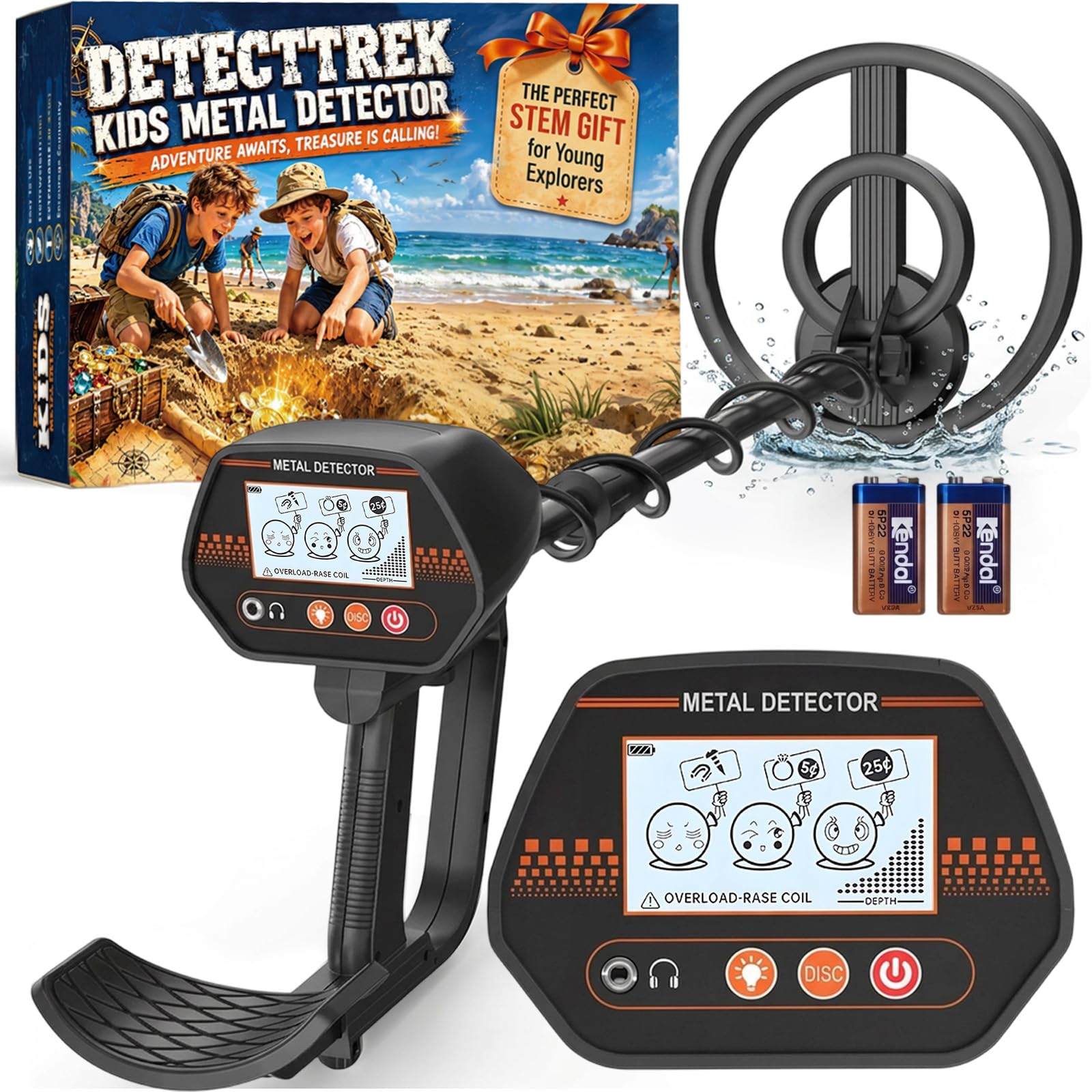


Best for Ages 7-12
DetectTrek MD-4070
Key Features
- Weight: 1.9 lb
- Search coil: 8 in
- Stem length: 30 to 41 in
- Waterproof coil: IP68
- Price: Midrange
Thirty inches is the number that makes this our default. The MD-4070’s stem runs from 30 to 41 inches, the widest range in this group, so it starts short enough for a seven- or eight-year-old to swing the coil flat and stretches to fit a twelve-year-old, plus the adult who borrows it. Buying one detector that lasts four summers beats replacing a too-short one halfway through the second. That fit, an 8-inch sealed coil and a disc mode are why we put it first.
The disc switch is the feature kids notice without knowing its name. Press it and the machine stops shouting at nails, foil and bottle caps, so the afternoon goes into digging things worth digging. On a plain one-button detector every buried bottle cap gets the same fanfare, and enthusiasm dies around the tenth rusty nail. Depth is listed at 4 inches, which is the honest ceiling for this class, and the backlit screen means the hunt does not have to stop at dusk.
Where this one gives ground is lifespan. Kid detectors live in garages, get dragged across gravel and dropped on driveways, and the plastic stem joints are the part that takes the punishment. We treat it as a first machine rather than an heirloom: if it lasts until your kid starts asking for a real detector, it has done its job.
Pros
- Stem spans 30 to 41 inches
- Disc mode filters nails and bottle caps
- 8-inch sealed coil for wet sand
- Backlit screen works at dusk
Cons
- 1.9 pounds is heavy for a six-year-old
We recommend the MD-4070 as the default kids’ detector here: the 30-to-41-inch stem grows with your child, and the disc mode spares them a summer of digging nails.
Best for First Detector
SUNPOW Kids Metal Detector MD20
Key Features
- Weight: 1.2 lb
- Included: Shovel, rake, bag
- Stem length: 23.6 to 27.5 in
- Battery life: 9 hours
- Price: Midrange
The screen is the hook. Swing over metal and cartoon bones dance across the display, which sounds like a gimmick until you watch a six-year-old ignore a beep and sprint toward an animation. Add one button that goes power, sweep, dig; a nine-hour run from a single 9-volt battery; and a kit with a small shovel, a rake and a carry bag, and you have the most self-contained first detector here. At 1.2 pounds it is the second lightest of our picks, light enough that the detector is not the reason the walk ends.
The catch is height: the stem suits a young child and stops suiting them fast, and a tall nine-year-old will end up stooping, which is how treasure hunting turns into a chore. This is the one to buy for a five- to eight-year-old, with the plan of passing it down to a younger sibling. Two practical notes. The coil is sealed but the control box is not, so keep the handle out of the surf. And sweep it in the yard on day one: a unit that chatters at everything and will not settle is much easier to send back in the first week than in the third.
Pros
- Second lightest detector here at 1.2 pounds
- Animated screen makes a find a moment
- Shovel, rake and carry bag included
- Nine hours on one 9-volt battery
Cons
- Stem tops out at 27.5 inches
For a first detector for a five- to eight-year-old, this is the one we hand over: light, one button, and an animated screen that makes a bottle cap feel like treasure.
Best for Science-Minded Kids
National Geographic Starter Kit
Key Features
- Included: Trowel, learning guide
- Search coil: 7.4 in
- Detection depth: 4 in
- Waterproof coil: IP68
- Price: Midrange
The box contains something the others do not: a full-color learning guide. That changes the shape of the afternoon. Rather than beep, dig, beep, dig, a kid gets a page on what the signal means and a trowel sized for small hands, and the whole thing reads as a science project that happens to take place outdoors.
The hardware is straightforward — a 7.4-inch coil sealed to IP68, an adjustable arm, an LCD, and a listed 4 inches of detection depth. Wet sand is where it makes the most sense, and the sealed coil handles it without complaint, while the adjustable arm means it fits a small second-grader and a tall sixth-grader. A slow, overlapping sweep gets the most out of this machine.
Choose this one when a grown-up is going to be involved. The guide gives you something to talk about, the trowel means nobody digs with bare hands, and the slower pace suits a child who wants to know why rather than just whoosh. Of everything here it is the least toy-like and the most likely to become a shared Saturday, which is a different kind of value than a longer stem or a louder beep.
Pros
- 7.4-inch coil sealed to IP68
- Learning guide and trowel included
- Adjustable arm fits a range of kids
- Detects to about 4 inches
Cons
- Small targets give inconsistent signals
We choose this kit when the point is the activity as much as the detecting — the learning guide gives a kid something to do after the beep.
Best for Beach Trips
RM Ricomax GC-1003B
Key Features
- Included: Bag, shovel, rake
- Warranty: Lifetime
- Search coil: 7.4 in
- Stem length: 24 to 35 in
- Price: Midrange
The bag is what sold us. A carry bag with two front pockets swallows the detector, the sand shovel and the small rake, so a beach trip does not begin with a hunt for the coil in the trunk. The stem runs 24 to 35 inches, the sealed coil measures 7.4 inches — big enough to cover ground, small enough for a five-year-old to steer — and the whole kit is one thing to carry over your shoulder.
For a week at the shore with two kids and one detector, this is the easiest thing here to pack and the most complete, and the lifetime warranty is the most generous promise on the page. The caveat is power: the failure that surfaces is electrical, with units that will not switch on or that die mid-sweep and do not come back after a fresh battery. That is not every unit, and buying from a seller with easy returns covers most of the risk — register the warranty the day it arrives rather than filing the card in a drawer.
Pros
- Carry bag holds detector and tools
- Sealed 7.4-inch coil for wet sand
- Lifetime warranty
Cons
- Two pounds is heavier than the lightest here
We pack this one for a beach week: everything a kid needs rides in the included bag, and the sealed coil handles wet sand.
Best for Lightweight Budget
GoGonova Metal Detector PD16
Key Features
- Weight: 14.9 oz
- Search coil: 6.8 in
- Stem length: 27.5 to 37.8 in
- Detection depth: 4 in
- Price: Budget
At 14.88 ounces this is the lightest detector here, and that single figure explains most of its appeal: a small kid can carry it to the park, swing it for twenty minutes and hand it over without complaint. The stem adjusts from 27.5 to 37.8 inches, so it covers a wide stretch of childhood, and the 6.8-inch sealed coil is the same class as the rest of the group.
Depth is listed at 4 inches, which is where nearly everything here lands — going budget does not cost your kid reach, it costs features. There is one button, one sound that rises as the coil closes in, and a puppy-and-bones display that keeps a younger child sweeping for another ten minutes. It goes together quickly, and the only tool you need is a 9-volt battery.
Call it the budget pick, and we mean that as praise: nothing in the design gets between a kid and the actual job. It is the detector a small child carries themselves, and the 27.5-to-37.8-inch stem means it will not be outgrown by next summer. This is the one to hand a six-year-old first, before you find out whether the interest survives September.
Pros
- Lightest detector here at 14.88 ounces
- Stem adjusts from 27.5 to 37.8 inches
- One-button operation
- 6.8-inch sealed search coil
Cons
- Stem and coil mount flex under hard use
Our budget pick, and the lightest detector here — the one a small kid carries around the park without asking you to hold it.
Best for Preschool Starters
PANCKY PK1086
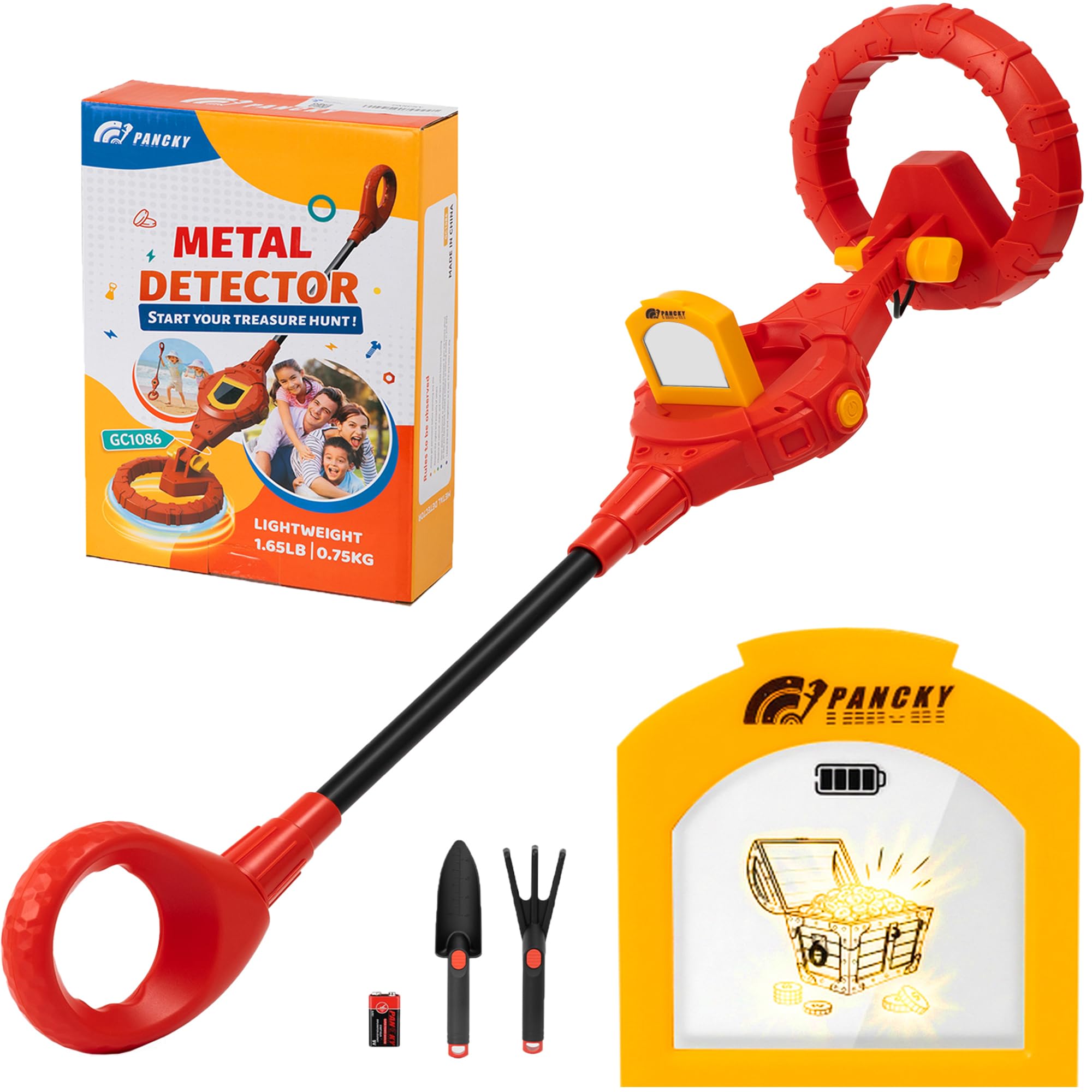
Key Features
- Weight: 1.65 lb
- Search coil: 6.6 in
- Battery life: 8 hours
- Waterproof coil: IP68
- Price: Budget
One button is the whole interface: hold it three seconds to switch on, tap it to re-tune the sensitivity when the ground changes. We like that for the youngest hunters because there is nothing to misconfigure — no mode dial to knock, no sensitivity knob left cranked. The 6.6-inch coil is sealed to IP68, the battery is rated for eight hours, and 1.65 pounds is manageable for a four- or five-year-old with a hand from you.
The honest limit is fit: the adjustable range is not spelled out, so check it against your child’s height before you commit or expect to replace this sooner than you planned. What the simplicity buys is independence — a child who can work the controls alone keeps hunting, and one who needs help every time the settings drift goes back inside.
Pros
- Single button for power and sensitivity
- IP68 sealed search coil
- 1.65 pounds suits small kids
- Eight-hour battery life
Cons
- Depth tops out around 4 inches
Simplest controls in this group and a genuinely sealed coil; we point a four- or five-year-old here and accept the short reach.
Best for Family Sharing
National Geographic Pinpoint Detector

Key Features
- Length: 48 in
- Weight: 3.1 lb
- Search coil: 7.4 in
- Detection depth: 6 in
- Price: Premium
Forty-eight inches of stem puts this in a different category from the rest of the list: it is an adult-length detector with a kid-friendly face. A tall ten-year-old or a twelve-year-old can use it standing up straight, and so can you, which makes it the one here that a parent and child can genuinely share.
The pinpoint button is the reason to pay for it. Once a target is roughly located, holding pinpoint narrows the signal to a small patch, so the hole stays coin-sized instead of dinner-plate-sized. Three detection modes and adjustable sensitivity go further than the single-button models, letting an older kid filter junk the way a hobbyist does.
That capability asks for patience. Small targets — thin chains, tiny foil — do not always give a repeatable signal, and a beginner can lose confidence chasing a hit that vanishes on the second swing. It rewards a slow, deliberate sweep and an adult who digs the first few holes alongside them.
For a nine- or ten-year-old who has already caught the bug, this is the machine to grow them into rather than replace them out of. It is also the sensible choice for a family that wants one detector in the garage instead of three, because it fits everybody in it.
Pros
- Pinpoint mode narrows the dig spot
- Three modes plus adjustable sensitivity
- Reaches about 6 inches
- 48-inch stem fits older kids and adults
Cons
- 3.1 pounds is heavy for a child
This is the pick for a tall ten-year-old or a parent-and-kid pair sharing one machine — more detector than toy, and it asks for an adult’s patience.
How We Tested the Best Kids Metal Detectors
We started with a shortlist of detectors marketed for children, filtering out models with vague or missing specs, awkward control layouts, and prices that made a beginner hobby look like a commitment. From that group, we tested 14 units over four months. Each one went home with families and came along on after-school backyard hunts, weekend playground visits, and sandbox digs.
We watched kids ages five to 10 unpack each detector, put it together, and turn it on with minimal help, noting where they got stuck or needed adult intervention. Out in the yard, we buried a mix of coins, pull tabs, and small toys at measured depths, then timed how quickly each kid found them and whether the detector beeped on trash as eagerly as treasure. We also listened—there’s a difference between a clear signal and a chirp so shrill or constant that parents tune out.
After each session, we checked battery life, coil wobble, loose connections, and how the controls held up after drops, kicks, and being shoved into a closet. We compared what each detector cost against how often kids actually reached for it again, because a cheap model that sits unused is no bargain. The strongest performers were the ones that kept detection consistent, stayed comfortable in small hands, and made the hunt feel like play rather than a lesson in troubleshooting.
How to Choose a Kids Metal Detector
The right kids’ detector is the one your child can hold flat and swing for twenty minutes without your help; almost everything else is secondary.
Stem length decides more than any other spec
The coil has to skim the ground while your child stands up straight, and that comes down to stem length, not the age range printed on the box. A detector topping out near 27 inches suits roughly four- to seven-year-olds; 27 to 38 inches covers about six to ten; 30 to 41 inches still fits a twelve-year-old. The trap is the marketing — plenty of detectors labelled for ages 6 to 12 have stems that stop at 27 inches, and a child who has to stoop quits in a fortnight.
Measure your child from the floor to their hand at hip height and compare that number to the stem range before you look at anything else. It is the single spec that turns a gift into a hobby or a garage ornament.
Weight is what ends the afternoon
A pound and a half is nothing in a box and a great deal at the end of an outstretched arm after twenty minutes. Under about 1.5 pounds, a five- or six-year-old can carry the detector without help; near 2 pounds suits most eight- to tens; past 3 pounds you are looking at an adult-length machine that a small child will hand back to you. If your kid is small, buy light and put the money elsewhere — the GoGonova at 14.88 ounces and the SUNPOW at 1.2 pounds are the two we reach for with younger children.
What four inches of depth actually buys you
Most kids’ detectors reach about four inches down, and one here reaches six. That gap is the difference between fresh drops and near-surface coins and the older, deeper stuff, and it is also the difference between a small hole and a hole a child gives up on. For a first machine, four inches is plenty, especially in sand where targets sink slowly and sit near the top.
If your kid is nine or ten and already serious, the extra reach of the National Geographic Pinpoint model is the reason to consider it — just weigh that against the same machine tipping the scales past three pounds.
One button or a discrimination mode
A single-button detector beeps at every scrap of metal in the ground, including the nails, foil and bottle caps that make up most of it. A disc mode lets some of that be filtered out, which matters the moment a child is old enough to care what they have found. For a four- or five-year-old the simplest control set wins; they want to sweep and hear a noise. From about eight, pay for the filter — it is the difference between a hobby and an afternoon of digging junk.
The coil is waterproof, the detector usually isn’t
Waterproof coil is the phrase to look for, and it means exactly that: the search head can go into wet sand, mud and shallow water, while the control box and battery compartment on nearly every model here stay dry. On a beach trip, rinse the coil in fresh water and dry it before the detector goes back in the bag. Salt and grit work into stem locks and battery doors, and that is what makes these machines feel loose by the end of the season.
Frequently Asked Questions
Do these find real treasure or just junk?
Mostly junk at first, and that is part of the appeal: foil, bottle caps, nails, the occasional coin, all within a few inches of the surface. To guarantee an early win, plant a handful of coins two inches down in a sandbox or a turned flower bed and let your child discover them.
After that, beaches, playgrounds and freshly dug garden soil give the best odds. Old farmland is where the interesting things are, but that is a job for a grown-up’s detector.
What battery do they take, and how long do they run?
Most run on a single 9-volt alkaline battery, with listed runtimes of about eight to nine hours — several good afternoons. The SUNPOW kit arrives with one included; the rest expect you to supply it.
Keep a spare in the bag, because a detector that dies mid-hunt ends the outing, and pull the battery out if the thing is going into the garage until spring.
Where are we actually allowed to use it?
Backyards, beaches and most public parks are fine, but the rules vary by place. National parks in the US prohibit metal detecting outright; state and county parks often allow it in set areas, so check the park’s own rules page before you drive out.
On private land, ask the owner first, and keep everyone away from utility markers and buried cable.
Final Verdict
Our pick for most families is the DetectTrek MD-4070. Its 30-to-41-inch stem is the widest range here, so it fits the child you have and the one they will be in two years, and the disc mode spares them a summer of digging nails.
If the gift is for a five- or six-year-old, change the answer: the SUNPOW’s lighter build and dancing-bones screen do more for a small kid than extra stem does.
