This post contains affiliate links. We may earn a small commission when you buy through our links — at no extra cost to you.
The moment a toddler stops clinging to your neck in the pool usually arrives with a floatie strapped around their middle. The trouble is that the wall of inflatable rings, vests, and arm bands all promise the same thing, and very few of them stay put once a squirmy two-year-old starts kicking. What you’re really shopping for is a fit that holds, flotation that keeps a small chin above the waterline, and a design your kid will tolerate for longer than four minutes.
Over the past three months, we’ve had 14 toddler floaties in backyard pools, off a lake dock, and around the shallow end of a community pool, plus living-room try-ons that told us plenty before anyone got wet. The differences in fit and flotation showed up fast. Sizing matters more than the age printed on the box, and no floatie replaces you being within arm’s reach. The picks below are the ones that held their shape, stayed on, and kept kids happily afloat.


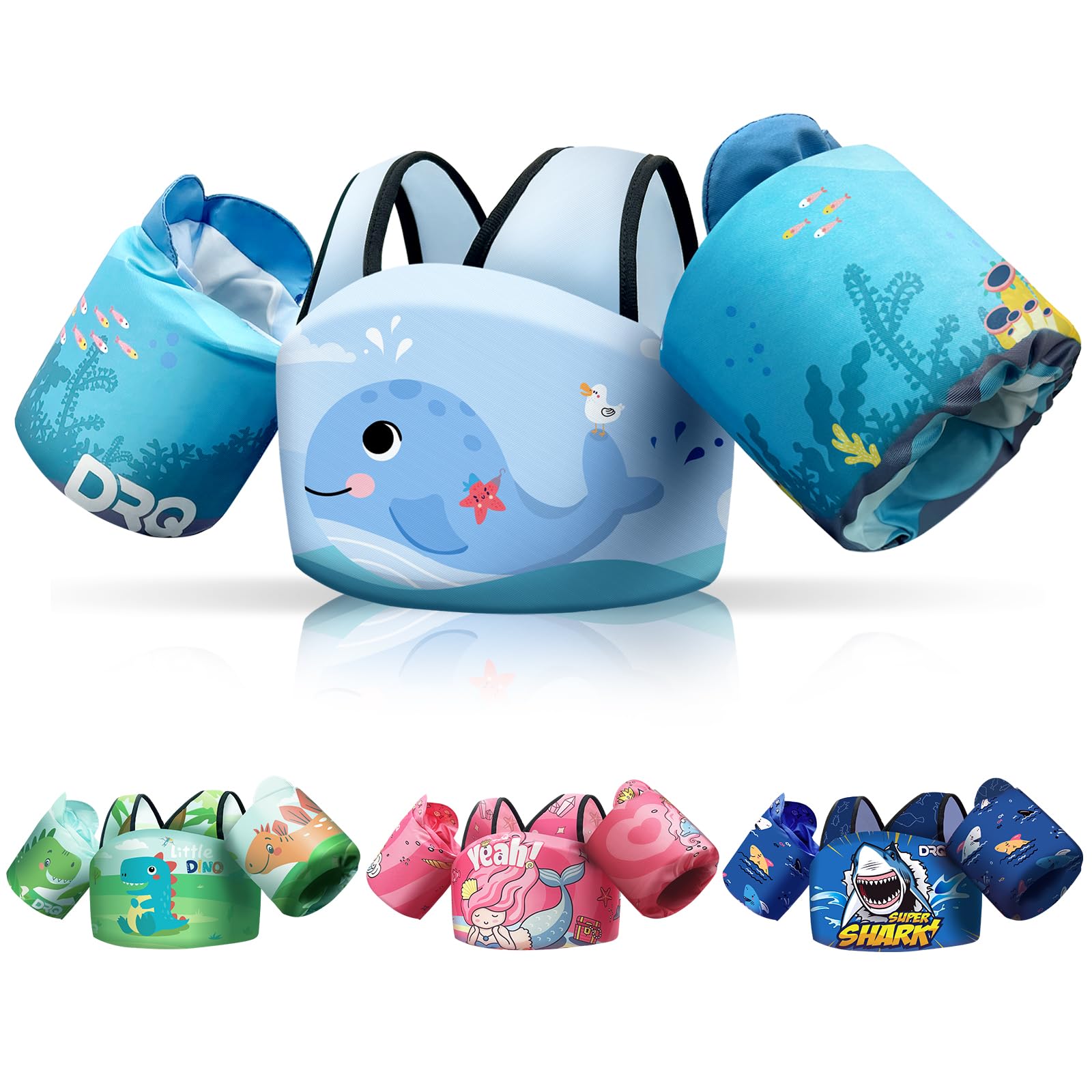

Best for Pool and Boat
Body Glove Paddle Pals
Key Features
- Ages: 2-6 years
- Closure: Three-point back buckle
- Weight range: 33-55 lbs
- USCG approval: USCG approved, Type V/III
- Price: Premium
The over-the-shoulder harness is what separates this vest from the belt-style puddle jumpers most of us picture. A floatie that sits around the chest rides up toward a toddler’s ears the moment they jump in or get lifted out, and you spend the afternoon hauling it back down; the Paddle Pals is cut like a shirt, so the foam stays where it belongs through jumping, climbing out and being carried back to the steps. It’s also USCG-approved as a Type V/III device, the line on the label that decides whether a child can wear it on a boat and whether a pool with a flotation rule lets it through the gate. That combination is why it’s our top pick.
Fit runs 33 to 55 pounds, roughly ages two to six, and the adjustability is real: a three-point back buckle plus the shoulder harness pulls the vest in at the chest rather than only at the waist. The buckles close behind the child, which is deliberate — small hands can’t reach around to undo them, and a vest that stays on is worth more than one that’s easy to take off. The multi-panel polyester is chafe-resistant and cut away from the throat, which matters on a long day.
Two things to know before you order. It’s the most expensive certified vest here, so if the budget is tight, the Dark Lightning arm-wing vest does the certified job for a lot less. And it starts at 33 pounds, which leaves out a two-year-old still in the high twenties — that child needs a smaller option first. For everyone inside the range, this is the one we hand over without a second thought.
Pros
- Shoulder harness stops the ride-up over the ears
- USCG-approved for boats and pool flotation rules
- Rear buckles a toddler can’t undo alone
- Chafe-resistant panels for long water days
Cons
- Most expensive certified vest here
- Starts at 33 lbs, so lighter toddlers are out
This is the vest we recommend for most families: USCG-approved, cut like a shirt so it stays down over the ears, and sized for the whole 33-55 lb stretch.
Best for Budget Certified Vest
Dark Lightning Arm-Wing Vest
Key Features
- Ages: 2-7 years
- Design: Arm wings, dual rear buckles
- Weight range: 33-55 lbs
- USCG approval: USCG approved
- Price: Budget
The style most parents remember is the 30-to-50-pound puddle jumper; the certified range on this vest starts at 33 pounds and runs to 55. That gap is worth checking before you order, because a 31-pound two-year-old sits outside a label that the shape fits perfectly well. Inside the range you get the floatie toddlers already accept — two foam arm sleeves joined to a chest panel, nothing to inflate and nothing to leak — with two rear buckles set far enough back that a child can’t reach around and pop them.
We were struck by how little there is to go wrong. No valve, no bladder, no pump to lose on holiday; the foam is the flotation, and the mesh-shouldered shell doesn’t hold water. The arm wings matter more than they look, because they keep the head up while leaving both arms free to paddle — which is why this is the one we hand to a toddler who has decided that full vests are an outrage. At a shade over seven ounces it disappears into a beach bag.
Where it gives ground is coverage. An arm-wing vest supports less of the torso than a full jacket, so for a long day on a boat, or water where you want a collar and a grab handle, the Body Glove’s harness is the better call. And with a single size that tops out at 55 pounds, a tall seven-year-old will be at the ceiling of it. For pool days, lessons and the beach, it does the certified job for the least money here.
Pros
- USCG-approved in a familiar arm-wing shape
- Cheapest certified vest here
- No inflation, no valves, nothing to leak
Cons
- Single size tops out at 55 lbs
- Less torso coverage than a full vest
We recommend this one when your toddler wants their arms free and you still want USCG approval on the label, for the least money here.
Best for Preschool Pool Days
SwimWays Swim Trainer
Key Features
- Ages: 2-4 years
- Weight range: 33-55 lbs
- USCG approval: USCG approved
- Sun protection: UPF 30+
- Price: Budget
Two things decide whether a pool vest gets worn: whether it passes the pool’s flotation rule and whether the child puts it on without a fight. This one clears both. It’s USCG-approved for 33 to 55 pounds, so it satisfies the pools that turn away anything un-certified, and the mermaid print with built-in arm floaties means a four-year-old asks for it instead of negotiating. The twill cover is our favorite detail on a hot day — it’s rated UPF 30+ and wipes clean, which is more than most foam vests offer.
Fit is dual adjustable straps with quick-release buckles, and the vest is shaped for the younger end of the range; the maker puts it at two to four years. On a small three-year-old it sits high and snug, which is exactly what you want. On a five-year-old already at 50 pounds it starts to look like a costume. The integrated arm floaties keep the head up without the arm bands sliding down, which is the failure that ruins ordinary water wings.
The honest limit is lifespan. Two to four years and 33 to 55 pounds is about two summers, and the listing carries no warranty at all, so check the seams at the end of each season. If you want a vest that still fits at six, buy the Body Glove instead. If you have a three-year-old and a pool membership, this is the one that actually gets worn.
Pros
- UPF 30+ twill cover, unusual in a swim vest
- USCG-approved for pool flotation rules
- Built-in arm floaties that stay put
- A print kids ask to wear
Cons
- Outgrown after about two summers
- No warranty
Our pick for the 2-to-4-year-old who lives at the pool: certified flotation, UPF 30+, and a print that gets it worn without an argument.
Best for Hard-To-Fit Kids
DRQ Toddler Swim Vest
Key Features
- Closure: Dual back buckles
- Chest fit: 27-35 in
- Arm opening: About 4.5 in
- Weight range: 22-66 lbs
- Price: Budget
Almost every vest here gives you a weight range and leaves the rest to guesswork. DRQ publishes the numbers that decide whether it actually fits: a chest of 27 to 35 inches, an arm opening of about 4.5 inches, and an arm circumference of 10 to 13 inches. For a stocky three-year-old or a very slim four-year-old, that’s the difference between ordering once and ordering twice, and it’s why this is the one we point at when a child is hard to fit.
The range is the widest in this group, 22 to 66 pounds, so it covers a light two-year-old and a solid six-year-old with the same vest and a strap adjustment. The closure is a double buckle at the back with an extra press, so it takes adult hands to open, and the crossed straps hold the vest down at the shoulders instead of letting it creep up. In the water it keeps a toddler upright — the shape that keeps a face clear — and the armholes are cut wide enough to paddle in.
One thing to be clear about: this is a buoyancy aid, not a life jacket. The listing classes it as a pool float, so it’s for supervised pool and beach play, not for a boat or a pool that insists on a certified PFD. If that’s your water, the Body Glove or the Dark Lightning vest is what you want. For everything else — and especially for a child between sizes — this is the most adaptable vest here.
Pros
- Published chest and arm measurements
- Widest range here at 22-66 lbs
- Double buckle an adult has to open
Cons
- A buoyancy aid, not a life jacket
Buy this one if your toddler is hard to fit or you want the vest to last: measured chest and arm sizing, a double buckle, and a 22-66 lb range.
Best for Sensitive Necks
Chriffer Toddler Swim Vest
Key Features
- Ages: 2-7 years
- Closure: Double-lock buckles
- Neckline: U-shaped front
- Weight range: 33-55 lbs
- Price: Budget
A U-shaped front is the kind of detail you only appreciate after a vest has left a red line under your toddler’s chin. Chriffer cuts the neckline away at the front and finishes it smooth, so there’s nothing pressing on the throat when a child looks up, and the elastic sleeve openings stretch to fit thin arms without gaping on the ones that aren’t. We noticed it most at the end of a long session, when this was the vest nobody wanted off.
The closure is the other half of the story: two buckles with side tabs you squeeze, fiddly enough for an adult and effectively impossible for a two-year-old. The fabric and stitching at the pull points are reinforced, which is where a vest gives out first when the construction is thin. Just under eight ounces makes it light enough to forget, and the bright colorways keep a small head easy to spot in a crowded pool.
It runs large. The stated range is 33 to 55 pounds, but the cut is roomiest at the top of it — on a smaller toddler there can be enough slack for the vest to slip up over the head, and there’s no smaller size to drop to. Before you get in, lift the child gently by the shoulders: if the vest rides up past the ears, it’s the wrong size for that child today. For a solid three- or four-year-old, it’s the most comfortable vest here.
Pros
- Cutaway neckline spares the chin
- Elastic sleeves fit thin arms
- Double-lock buckles kids can’t open
Cons
- Runs large on smaller toddlers
The comfortable one: a cutaway neckline that spares the chin and elastic armholes, for a toddler in the middle of the 33-55 lb band.
Best for Boats and Docks
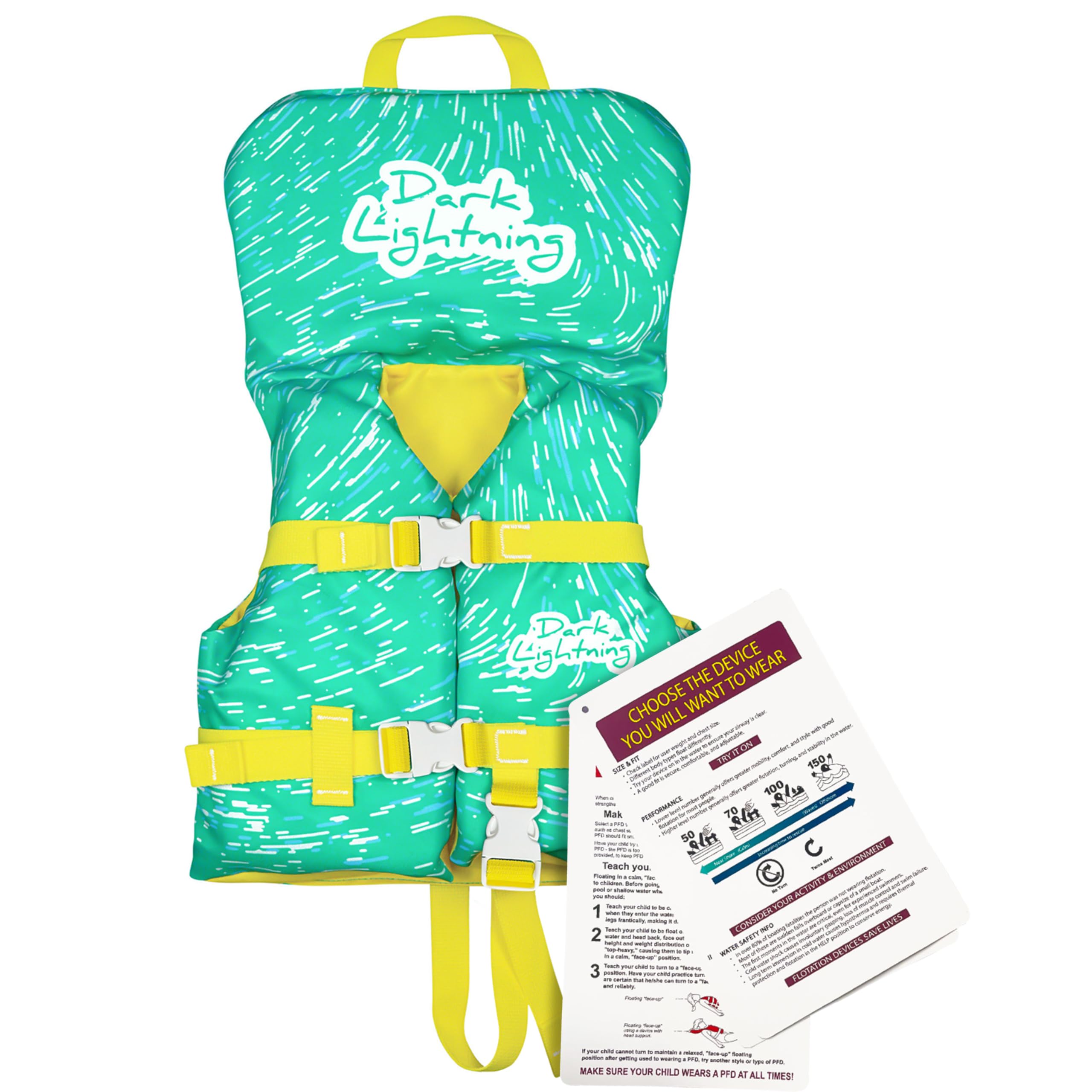
Dark Lightning Infant Vest
Key Features
- Ages: 1-3 years
- Weight range: 0-30 lbs
- USCG approval: USCG approved
- Safety features: Headrest, leg strap, grab handle
- Price: Midrange
The grab handle across the back is the part we used most. A wet toddler in a life jacket is an awkward armful, and a strap to lift by turns getting out of a pool or off a dock into a one-handed job. Under it sits the rest of what a small child needs on open water: a foam collar that holds the head up, a leg strap so the jacket can’t ride up over the hips, and a bright shell that’s easy to spot from the shore.
It’s USCG-approved for children under 30 pounds, and the practical fit is narrower than that. This is a jacket for a toddler in the 20-to-30-pound range, roughly one to three years old, not for a baby in the first year — a four-month-old is swamped by the collar, and a child who fits it comfortably is often close to outgrowing the weight limit. Check the label against your child’s weight rather than the age on the box.
For a boat, a dock or a cold lake, all that foam is exactly right, and the headrest is what you want if a toddler goes over the side in a hurry. For a backyard pool where a child is paddling and jumping, it’s a lot of jacket; the arm-wing vest leaves more of the body free and still carries USCG approval. So this is the one we pack for travel and open water, and the one that stays in the bag when the plan is three hours in the shallow end.
Pros
- USCG-approved for under 30 lbs
- Grab handle for lifting out
- Headrest and leg strap hold position
- Bright shell is easy to spot
Cons
- Best fit is 20-30 lbs, not babies
- Lots of foam for pool play
Our pick for a 20-to-30-lb toddler on a boat or dock: certified, with a headrest, leg strap and grab handle for lifting them out.
Best for Lighter Toddlers
Gogokids Puddle Float Jumper

Key Features
- Size: S, 24-33 lbs
- Weight: 5.92 oz
- Size range: 24-66 lbs, two sizes
- Device type: Pool float
- Price: Budget
Every certified swim vest here starts at 33 pounds. This one starts at 24. That single number is why it earns a place: if you have a two-year-old in the high twenties who is too light for a USCG vest but too big for an infant jacket, the small size of this jumper is designed for exactly them, and the range runs to 66 pounds in the larger size.
The design is familiar, done with more foam than usual — 40 percent thicker arm sleeves and wider armholes so a small arm can still paddle — plus a shoulder harness that resists slipping and a buckle set at the back where a child can’t reach. What we didn’t expect at this level is how little it weighs: under six ounces, which is the difference between a vest that goes in the day bag and one that lives in the car. The two-year manufacturer warranty is longer than most here.
What it isn’t is a life jacket. The listing classes it as a pool float, so it’s for supervised pool and beach play and won’t satisfy a boat, a dock or a pool that insists on a certified PFD — for those, buy one of the USCG-approved vests above. As the option for a toddler who is still too light for them, it’s the one we’d reach for.
Pros
- Small size fits 24-33 lb toddlers
- Thicker foam and wider armholes
- Two-year manufacturer warranty
Cons
- Pool float only, not for boats
The small-size answer for a 24-to-33-lb toddler who’s under the weight floor of the certified vests here, at a pool-aid price.
How We Tested Toddler Floaties
We started by gathering every toddler floatie we could find that listed a weight range rather than just an age, then cut anything with a vague size chart, a single inflation chamber, or a buckle a child could pop on their own. That left 14 floaties, which we tested over three months — mostly weekday afternoons in a backyard pool, a weekend at a lake dock, and sessions at the shallow end of a community pool. Before any of that, each one came home for a dry run on the living room rug, because a floatie a toddler refuses to wear is a floatie that doesn’t work.
Fit got checked first: we measured arm openings and chest straps against a 25-pound and a 32-pound toddler, then watched whether straps crept loose after 20 minutes of kicking and whether anything rubbed raw under the arms or across the back of the neck. For flotation, we noted where the waterline landed on each kid’s chin when they leaned forward to paddle, whether a floatie tipped them face-down, and how quickly they righted themselves. We also opened one chamber on each multi-chamber design mid-swim to see what the backup actually did.
On safety, we counted chambers and valves, looked for a U.S. Coast Guard or ASTM label, and checked whether a child could get themselves out of the harness. Quality meant inflating and deflating each floatie ten times, leaving them in the sun between sessions, and watching seams and valves for splits and slow leaks. Value came down to how many summers a floatie would survive and whether it adjusted as a kid grew. Sessions ran 20 to 30 minutes, and we paid attention to which kids asked to take theirs off — and to which floaties were marketed for infants, since most of those fit toddlers poorly and infants not at all.
How to Choose Toddler Floaties
The first thing worth reading on any toddler floatie is the small print, because the gap between a certified flotation device and a pool toy decides where your child can actually wear it.
Certified flotation or pool swim aid
The label splits this category in two. A USCG-approved vest is a personal flotation device, rated to a stated weight range and accepted on boats and at pools that enforce a flotation policy. A swim aid — foam panels and straps, the shape most of us grew up with — is built to help a child paddle in a supervised pool and nothing more. Both have a place, and we put more weight on the certified label than on any other feature here. Boat, dock or lake: only a certified device counts. Backyard pool with an adult within arm’s reach: a lighter swim aid gives a toddler more freedom to kick.
Start with weight, not age
The weight range on the label is the number the maker certifies; the age on the box is a rough guide. Two traps. The familiar 30-to-50-pound stage is certified at 33 to 55 pounds on some vests, so a 32-pound toddler can sit outside a label that the shape fits perfectly well. And buying a size up to grow into is the classic mistake — an oversized vest rides up over the ears instead of holding the chest, which is less support, not more. Fit the child you have, and use the published chest measurement whenever a maker gives one.
What keeps a toddler upright
Foam placement decides how a child floats. Arm wings hold the head up and leave both arms free to paddle. A full vest with a chest panel and shoulder straps sits higher on the torso and stays put when a child jumps in. A collared jacket with a headrest and a grab handle does the most for the smallest toddlers, at the cost of bulk. Whatever you buy, test it in the shallow end: hold your child while they float on their front and then their back, and watch whether the vest pushes the face toward the water. A shape that tips them forward is the wrong shape for that child.
Buying for more than one summer
Toddlers gain weight quickly, and a vest that fits in June can be tight by September. A wide range buys seasons — DRQ’s 22 to 66 pounds covers a light two-year-old and a solid six-year-old — while a narrow one lasts about as long as a pair of shoes. The trade-off is bulk: foam sized for a five-year-old is a lot of vest around a two-year-old. Rinse any vest in fresh water after chlorine or salt, dry it flat rather than in the sun, and check the buckles and seams before the first swim of each season.
Frequently Asked Questions
How long can my toddler wear a floatie at a time?
Long enough for a good swim, then off for snacks and shade. Take it off during breaks, and look under the straps, around the chin and under the arms while it’s off — that’s where a wet seam rubs. If a red mark is still visible after a ten-minute break, loosen the shoulder straps or move to a vest with a cutaway neckline.
Can we pack toddler floaties for a trip?
Yes, and they travel better than inflatable toys because there’s nothing to puncture or pump. Foam doesn’t compress: a full vest takes roughly the space of a folded sweatshirt, while an arm-wing style is bulkier at the shoulders but lighter — the vests here run from about six to nine ounces. Pack the vest flat at the bottom of the case and leave the inflatable rings at home.
Can two children share one floatie?
Only if both are inside the label’s weight range, and each child still needs the straps re-adjusted. A vest fitted to a 45-pound child sits loose on a 30-pound one and rides up the moment they jump in, so the range belongs to the vest and the fit belongs to the child. Check the label against each weight, and do the shoulder lift before every session.
Final Verdict
Our default is the Body Glove Paddle Pals. The shirt-style harness is the difference you feel every time you lift a wet toddler out of the water, and the USCG approval means it works on a boat, at a lake and at any pool with a flotation rule. If your child wants free arms, or you want certified flotation for less, take the Dark Lightning arm-wing vest.
And if your toddler is still under 33 pounds, start with the small Gogokids jumper and move up once they’re inside a certified range.
