This post contains affiliate links. We may earn a small commission when you buy through our links — at no extra cost to you.
A toddler at the pool is equal parts joy and anxiety. One minute they’re launching into your arms, the next they’re wriggling out of a floatie that suddenly seems too loose. A good swim vest keeps their head up, stays put when they squirm, and lets them enjoy the water instead of clinging to your neck. Over the past three months, my team and I put 12 toddler swim vests through pool days, splash-pad afternoons, and the constant in-and-out of real family swimming.
The differences that matter are fit, float, and how they hold up after chlorine and sunscreen. We checked for red marks on bare skin, how sizing ran on different builds, and whether foam stayed firm after washes. We watched kids, too: some vests turned them into happy frog-kickers, others had them clawing at buckles. None replace your hands and eyes—especially for infants—but the right vest makes supervision easier and the cost easier to justify. The picks below earned their spot in the pool bag.


Best for All-Around Pool Vest
Body Glove Paddle Pals
Key Features
- Security: Shoulder harness and 3-point back buckle
- Age range: 2–6 years
- Weight range: 33–55 lb
- USCG approval: Type III / Level 70
- Price: Premium
The over-the-shoulder harness is what makes the Paddle Pals our top pick. It’s USCG-approved as a Type III/Level 70 vest for children 2 to 6 years and 33 to 55 pounds, and the panels wrap over the shoulders instead of sitting like a belt around the middle. That shape is why it stays put when a child jumps in and comes up with the foam still where it belongs.
A three-point back buckle takes an adult a moment to line up and a child much longer to undo. We appreciate that detail at the pool: the vest doesn’t become a negotiation every time your toddler wants to get in the water. The polyester panels are soft enough for long play, and the dinosaur print has obvious appeal.
Flotation is the main event, and this is a life jacket first. It is built to keep a child’s head above the water in pool, lake, and beach use, and the back buckle and shoulder harness work together to stop the vest riding up. It is not the most stripped-down aid for stroke practice; a CE panel vest gives more adjustable buoyancy. But for one vest that covers supervised pool play and boating, this is the default we trust most in this group.
The catch is the weight floor. At 33 pounds, it leaves out smaller toddlers, who need the REALIKE or Limmys instead. Once your child is in range, the vest has room to grow through the stated range, and the back buckle is the detail we want on a wriggling toddler.
Pros
- USCG-approved Type III flotation
- Patented shoulder harness resists ride-up
- Back buckle discourages self-removal
- Comfortable multi-panel polyester
Cons
- Starts at 33 lb; smaller toddlers need another vest
We recommend the Paddle Pals as the default toddler vest because its USCG-approved harness stays put through jumps and pool play.
Best for Learning to Swim
Limmys Neoprene Swim Vest
Key Features
- Size: Chest 20.9–23.6" (18 mo–4 yrs)
- Closure: Dual buckles and zipper
- Buoyancy: 8 removable foam panels
- Certification: CE EN 13138-1
- Price: Midrange
Eight removable foam panels are the reason the Limmys is our learning pick. Pull one or two out as your child’s kick gets stronger, and the vest changes with them instead of staying at full buoyancy all summer. That is a more thoughtful design than a fixed foam vest, and it’s why we prefer it for lessons and pool practice.
The neoprene is soft and stretchy, with a padded under-leg strap that keeps the vest from sliding up around the neck. We noticed the difference around the chin and underarms: there’s less of the rubbing that makes kids fight a vest. Dual buckles and a zipper keep it on, and the high-visibility pink is easy to spot in a crowded pool.
The Limmys is CE-certified to EN 13138-1, not USCG-approved, so it is a swim aid rather than a boat life jacket. That distinction matters if your pool or water park requires USCG approval. The fit also runs small; check the chest range before ordering, especially for a tall 4-year-old. Buckles are the part we want to see last, so give them a tug before each session.
Pros
- Removable panels adjust buoyancy as skills grow
- Soft neoprene reduces chafing
- Padded under-leg strap keeps vest down
- CE-certified to EN 13138-1
Cons
- Runs small; check chest measurement
- CE buoyancy aid, not a USCG life jacket
We pick the Limmys when the goal is learning to swim, because the removable panels let you dial buoyancy down as confidence grows.
Best for Uscg Arm-Wing Style
Dark Lightning Arm-Wing Vest
Key Features
- Style: Arm wings with chest vest
- Age range: 2–7 years
- Weight range: 33–55 lb
- USCG approval: Yes
- Price: Budget
The arm-wing silhouette is familiar to any parent who has bought floaties before: two foam sleeves and a chest panel, with the child’s arms free to paddle. What makes this Dark Lightning version worth a look is that it adds USCG approval and two rear buckles to that familiar shape.
We were impressed by how much the rear straps do for security. They adjust over the shoulders and close behind the back, where a toddler can’t reach them easily, and the chest panel keeps the arm wings from sliding down. For a 33-to-55-pound child who wants the independence of arm floats but needs a certified vest, this is the pick.
The arm wings do hold a child more upright than a panel vest, which is reassuring for a nervous beginner but less helpful for learning a flat kick and stroke. If lessons are the goal, the Limmys gives you more adjustment. If you want a USCG vest for pool and beach play, with the floatie feel your child already knows, this one is easy to recommend.
Pros
- USCG-approved for 33–55 lb
- Dual rear buckles are hard for kids to open
- Familiar arm-wing feel
Cons
- Arm wings encourage an upright position
- Starts at 33 lb
We like this one for families who want a USCG-approved vest with the familiar arm-wing feel and adult-only rear buckles.
Best for Lightweight Swim Aid
Speedo Swim Flotation Vest
Key Features
- Size: Large
- USCG approval: No
- Sun protection: UPF 50
- Weight capacity: 60 lb
- Price: Budget
The first thing to notice on the Speedo is the warning: it is not a US Coast Guard-approved life jacket and not a lifesaving device. We don’t treat that as a flaw for a pool aid, but it does decide where this vest belongs. It is for a child already comfortable in water, not for a boat or a water park that requires USCG approval.
What the warning buys you is a light neoprene vest that doesn’t feel like a suit of armor. The Speedo is easy to swim in, with UPF 50 protection and a soft strap between the legs. We like it for a confident 3- or 4-year-old who needs a little help staying up during pool play, not for a toddler who is still learning to keep their face out of the water.
The armholes are the weak spot. In long salt-and-sand sessions they can rub under the arms, so rinse the vest after use and check the skin before a second swim. The Large covers up to 60 pounds, but check the chest and armholes rather than buying by age. A roomy vest that floats up around the ears is not doing its job.
Pros
- Lightweight neoprene doesn’t restrict movement
- UPF 50 sun protection
- Helps build water confidence
Cons
- Not USCG approved; not a life jacket
For a child already comfortable in water, the Speedo is our light pool aid, not a life jacket.
Best for Budget Pool Vest
Chriffer Kids Swim Vest
Key Features
- Front: U-shaped neckline
- Closure: Dual back buckles
- Age range: 2–7 years
- Weight range: 30–55 lb
- Price: Budget
The Chriffer is the budget pick because it gives you the security features that matter without the premium price: a U-shaped front, two back buckles that an adult has to release, and a shoulder harness that keeps the foam in place. We didn’t expect this level of coverage from the least expensive vest in the group.
The cut is generous. The 30-to-55-pound range works best for a bigger toddler, and smaller children get lost in the foam. That’s the trade-off: you get room to grow and a vest that doesn’t feel tight across the chest, but a 2-year-old at the bottom of the range may swim in it. Check the chest fit before you commit.
In the water, it holds a child upright and keeps the head up, which is what you want for supervised pool and beach play. It is not USCG-approved, so don’t treat it as a boat life jacket. The dual back buckles are the detail we appreciate most: they’re adult-release, and they keep a curious toddler from undressing mid-swim.
Pros
- Budget price for a secure vest
- Dual back buckles are adult-release
- U-shaped front reduces neck rubbing
Cons
- Cut generously; best near upper weight range
- Not USCG approved
We suggest the Chriffer for a larger toddler on a tight budget who needs secure back buckles and a roomy, easy-wearing vest.
Best for Small Toddlers
REALIKE Kids Swim Vest
Key Features
- Size: Small (2–4 yrs / 22–33 lb)
- Strap: Adjustable nylon under-leg strap
- Closure: Three safety buckles
- Material: Neoprene
- Price: Midrange
The Small REALIKE is one of the few neoprene vests here cut for a 22-to-33-pound toddler, and that alone earns it a place. If your child is too small for the Body Glove’s 33-pound floor, this is the fit-first alternative: a sleeveless vest with a wide under-leg strap and three buckles to keep it snug.
We like the soft neoprene for a toddler who is in and out of the pool all afternoon. The wide strap between the legs is less likely to dig in than a thin crotch strap, and the sleeveless cut leaves arms free for paddling. The adjustable nylon strap takes up slack at the chest, so you can get a close fit without cinching the shoulders.
The trade-off is stability. Some toddlers tip forward in this vest, especially when they’re still learning to balance in water. It suits a child who can right themselves with a hand or who stays within arm’s reach, not a passive baby. The Small is snug, so check the weight and chest before ordering.
Pros
- Fits 22–33 lb toddlers
- Soft neoprene with wide crotch strap
- Three buckles for a snug fit
Cons
- Not USCG approved; pool aid only
- Small size runs snug; check weight
We keep the REALIKE in the mix for 22–33 lb toddlers who need a soft neoprene vest with an under-leg strap and a snug fit.
Best for Boating with Toddlers
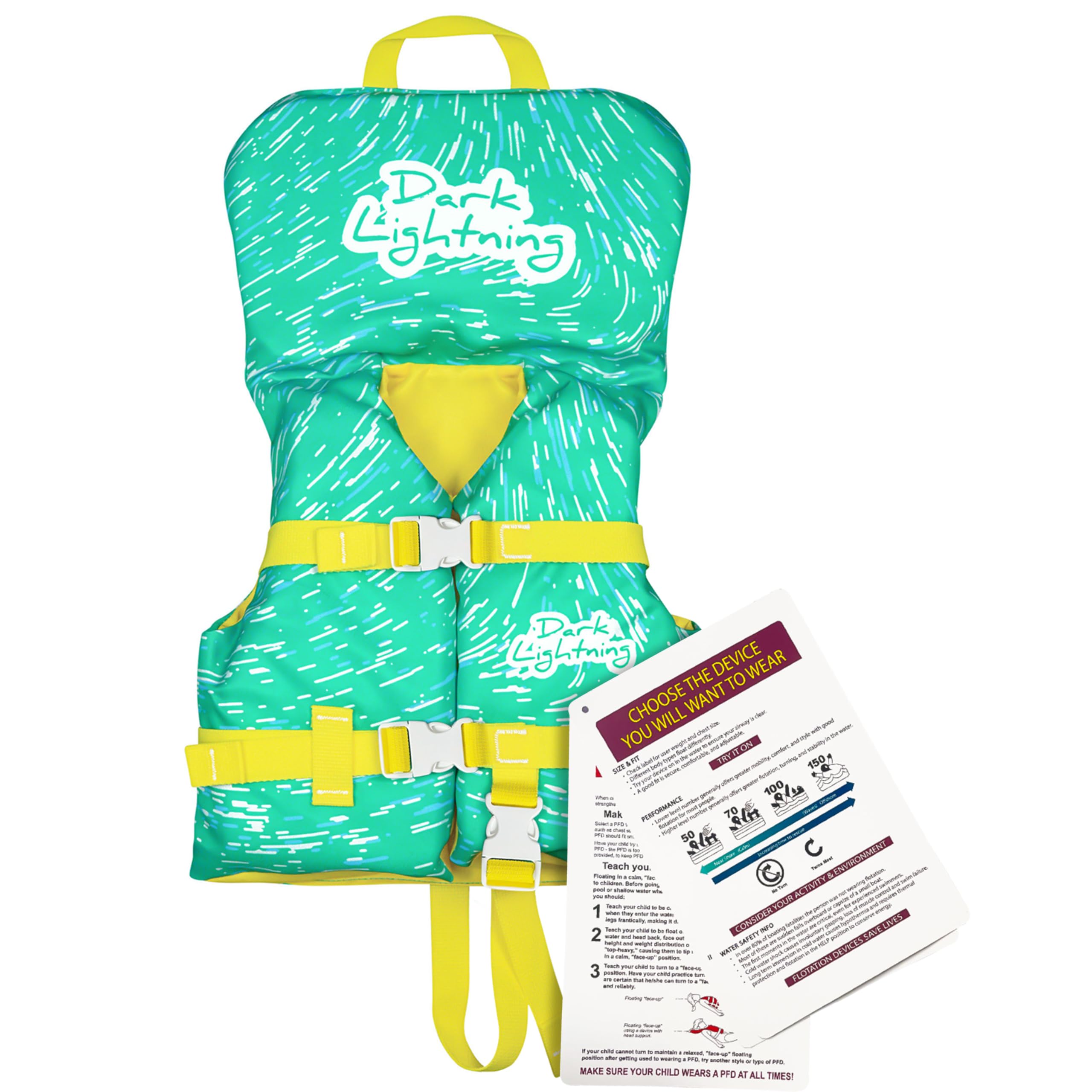
Dark Lightning Infant Vest
Key Features
- Features: Headrest, leg strap, grab handle
- Age range: 1–3 years
- Weight range: 0–30 lb
- USCG approval: Yes
- Price: Midrange
The headrest and top grab handle tell you what this Dark Lightning vest is for: a parent reaching down to haul a small child out of the water, not a toddler learning to paddle across the pool. It is USCG-approved for 0 to 30 pounds, with a leg strap and a supportive collar that keeps a baby’s head up.
We recommend it for boating and dock time with a 20-to-30-pound toddler, where the grab handle and headrest matter more than arm freedom. The foam is bulky, and that is the point: it keeps a small child face-up and gives you something to grab. It is not a swim-learning aid, and it is not the vest we reach for at swim lessons.
The fit runs big for very small babies, and the 0-to-30-pound label covers a wide range of bodies. Check the leg strap and shoulder fit with the vest on before you leave the dock, and size up when the straps run out of adjustment. For a larger 1-year-old or a small 2-year-old, it is a sensible boat-first choice.
Pros
- USCG-approved for 0–30 lb
- Headrest and grab handle aid recovery
- Adjustable leg strap secures fit
Cons
- Runs big for very small babies
We put this Dark Lightning vest on our boating shortlist for 20–30 lb toddlers, where the headrest and grab handle matter more than swim learning.
How We Chose and Tested Toddler Swim Vests
We started with more than 30 toddler swim vests and narrowed the field by reading sizing charts, weight ranges, and buckle designs. We eliminated anything with a loose neck opening, a single flimsy strap, or no crotch strap for kids who can’t yet swim independently. That left 12 vests, which we tested over three months in backyard pools, at a shallow community pool, and on a lake weekend.
Fit came first. I adjusted each vest according to its label, then watched how it sat on toddlers of different builds—slim 2-year-olds and sturdier 3-year-olds. We checked for red marks after 20 minutes over bare skin and over a rash guard, and we noted whether the vest rode up toward the ears when a child lifted their arms or jumped in. For floatability, we watched whether a child’s mouth and nose stayed clear during forward leans, back floats, and assisted jumps, and how much hand support an adult still needed. We also tugged on buckles and straps while the vest was wet to see if anything slipped or popped loose.
After each session, we rinsed and hung the vests, then checked seams, foam, and fabric for stretching or fading. We tracked enjoyment the unscientific way: did the child ask to put it back on, or fight it at the pool bag? For infant suitability, we noted which smallest sizes actually cinched down securely on a 20-pound 1-year-old and which gaped at the neck or let a child slump forward. At the end, we compared adjustability, drying time, and how well each vest held its shape against what it cost.
How to Choose a Toddler Swim Vest
The right toddler swim vest is the one that stays in place when your child jumps in, so start with the weight range and the closure system before you look at the print.
USCG Approval or a Swim Aid
We put USCG approval first if the vest will ever go on a boat. A Type III vest like the Body Glove Paddle Pals is a life jacket; a CE-certified aid like the Limmys is built for lessons and pool practice, not for satisfying a boat requirement. Neither replaces adult supervision. For pool-only use, a CE or unapproved swim vest can be fine, but read the label before you assume it will pass a water park’s rules.
Fit by Weight and Chest
Age on the package is a rough guide at best. A 2-year-old can be 24 pounds or 34, and the difference changes which vest fits. Measure weight and chest, then check the vest’s stated range: the Body Glove starts at 33 pounds, the REALIKE Small covers 22 to 33, and the Chriffer is cut generously for the upper end of its range. A vest that gaps at the chest or rides above the shoulders is the wrong size even if the age matches.
Closures That Keep It On
We look for a shoulder harness, back buckles, and an under-leg strap rather than a simple waist belt. The harness keeps the foam from sliding up when a child jumps in; the back buckles put the release where a toddler can’t reach it. A crotch strap stops the vest from riding up around the neck, especially on a small child. The Limmys and REALIKE use an under-leg strap, while the Body Glove relies on its over-the-shoulder harness. Check all buckles before every swim.
How Much Buoyancy, and Where
More foam isn’t automatically better. A USCG life jacket holds a child higher and more upright, which is what you want on a boat; a swim aid with less foam lets a child practice a more natural position in the pool. Removable panels, as on the Limmys, let you take buoyancy away as skills improve. Arm-wing designs like the Dark Lightning are reassuring for beginners but tend to keep a child vertical, so they’re less useful for stroke practice.
Comfort, Chafe, and Upkeep
Neoprene feels soft against skin but can trap heat and rub under the arms after a long session. Polyester panel vests are usually cooler and quicker to dry. Either way, rinse the vest in fresh water after chlorine or salt, air-dry it flat, and check the foam and straps for tears. If your child has sensitive skin, a quick test fit before a full afternoon in the water saves a lot of complaining.
Frequently Asked Questions
Can my toddler wear a swim vest in the pool without me holding them?
No. A vest adds buoyancy, but it can still tip a small child face-down or let them slip into deeper water. Keep a hand on a non-swimmer and stay within arm’s reach; for a toddler, that means touch supervision, not watching from a lounge chair. The USCG or CE label tells you what the vest is designed for, not that your child is safe alone.
What should my toddler wear under a swim vest?
A snug-fitting swimsuit or rash guard works best. Loose clothing can bunch under the straps and make the vest ride up, and a rash guard also cuts down on neoprene rubbing under the arms. Skip additional arm floats or a second vest; layer only what the vest’s instructions allow.
What if my toddler hates wearing a swim vest?
Try a short fit session on dry land first, then a shallow pool where they can touch the bottom. A soft neoprene vest with a wide under-leg strap is less likely to chafe, and a print they choose can help. If the vest rides up or presses on the neck, the problem is usually fit, not the vest itself.
Final Verdict
Start with the Body Glove Paddle Pals if your toddler is between 33 and 55 pounds and you want one USCG-approved vest for the pool, beach, and boat. The over-the-shoulder harness is the difference: it keeps the foam down when a child jumps in.
If lessons are the priority, the Limmys’ removable panels make more sense; for a smaller 22-to-33-pound toddler, the REALIKE is the fit-first choice. On a tight budget, the Dark Lightning arm-wing vest still gives you USCG approval.
