This post contains affiliate links. We may earn a small commission when you buy through our links — at no extra cost to you.
The first postpartum bowel movement is its own event—equal parts dread and necessity. A stool softener won’t make it vanish, but the right one can turn a dreaded hurdle into a non-event by drawing water into the stool rather than forcing your body to do something it isn’t ready for. The best ones are gentle enough to take around the clock, effective enough that you’re not white-knuckling it, and easy enough to swallow one-handed at 3 a.m. while holding a baby.
Over the past three months, a panel of new mothers and I tested 14 stool softeners—capsules, gummies, powders, and chewables—because the differences between them aren’t just about the active ingredient. Some powders clump into a paste no matter how hard you stir; some chewables taste like chalk; some are priced per dose in a way that adds up fast when you’re taking them daily for weeks. We logged every cramp, every clump, and every bottle that ran out sooner than expected, and the picks below are the ones we’d hand to a friend who just got home from the hospital.



Best for Postpartum Recovery
Colace Clear 50 mg
Key Features
- Count: 28 softgels
- Format: Clear softgel
- Formula: Dye-free and stimulant-free
- Active ingredient: Docusate sodium 50 mg
- Price: Midrange
Colace Clear wins the size contest, and in this category that is not a small thing. The softgels are petite, clear, and dye-free — small enough to get down with one mouthful of water, no head-tilt and no second attempt. We have handled a lot of capsules for this guide, and the ones that made us sigh were never the ones that worked better; they were the ones that were a chore at 3 a.m. on day four.
Underneath the size it is plain docusate sodium at 50 mg, stimulant-free, doing the ordinary softener job: pulling water into the stool so what is already there is softer and easier to pass. There is no senna in it, so nothing sends you hurrying, and no dye to stain a shirt, a sheet, or the inside of a diaper bag if a capsule works loose. Docusate’s usual window is 12 to 72 hours, which is worth saying plainly — this is something you take ahead of need, not a rescue.
Half strength is the detail to check before you order. If your provider has said 100 mg, one of these is not that dose; you take two, or you buy the 100 mg bottle instead. The Clear softgels make most sense at 50 mg — as a gentler start, as a step down later, or as the smallest possible thing to swallow in a week when you are already taking everything else in the house.
What keeps it at the top is the combination rather than any single number: dye-free, stimulant-free, small, and gentle enough that the nightly routine does not become another thing to dread. There is nothing clever about it, and that is the point.
Pros
- Smallest softgel in this guide
- Dye-free and stimulant-free
- Gentle, with no cramping reported
- The strongest postpartum fit here
Cons
- Only 28 softgels per bottle
Our default postpartum pick: a small, dye-free, stimulant-free 50 mg softgel that is easy to swallow and easy on the gut.
Best for Bulk Value
HealthA2Z Docusate 100 mg
Key Features
- Count: 400 softgels
- Onset: 12 to 72 hours
- Formula: Stimulant-free
- Active ingredient: Docusate sodium 100 mg
- Price: Budget
Four hundred softgels is the whole argument. The same docusate sodium 100 mg that the brand-name bottles charge a premium for, stimulant-free, in a container big enough to cover a full recovery and then sit in the cabinet for a year. We opened this one after a run of small pharmacy bottles, and the difference in what you get for the money is not subtle.
The capsules themselves are ordinary, slightly tacky softgels that go down easily. They can stick a little to each other in a pill organizer, which does not change the dose but is a good reason to keep the bottle cool and dry rather than on a warm bathroom shelf. The label puts relief in the same 12 to 72 hour window as the rest of the docusate group, so take it at bedtime and give it the two or three nights it asks for.
Where it stops being the right answer is if you want a small bottle, or if you are the kind of person who loses track of giant containers. Four hundred softgels is a commitment to shelf space, and if you only need two weeks of help, the count is working against you rather than for you. For everyone else — especially anyone who has done this before and knows they will be taking it daily for a while — it is the sensible buy.
Pros
- 400-count bottle covers a whole recovery
- Same 100 mg docusate as brand names
- Easy to swallow
- Effective at keeping things regular
Cons
The value pick: 400 stimulant-free 100 mg softgels that cost far less per dose than brand-name bottles with the same ingredient.
Best for Pill-Free Dosing
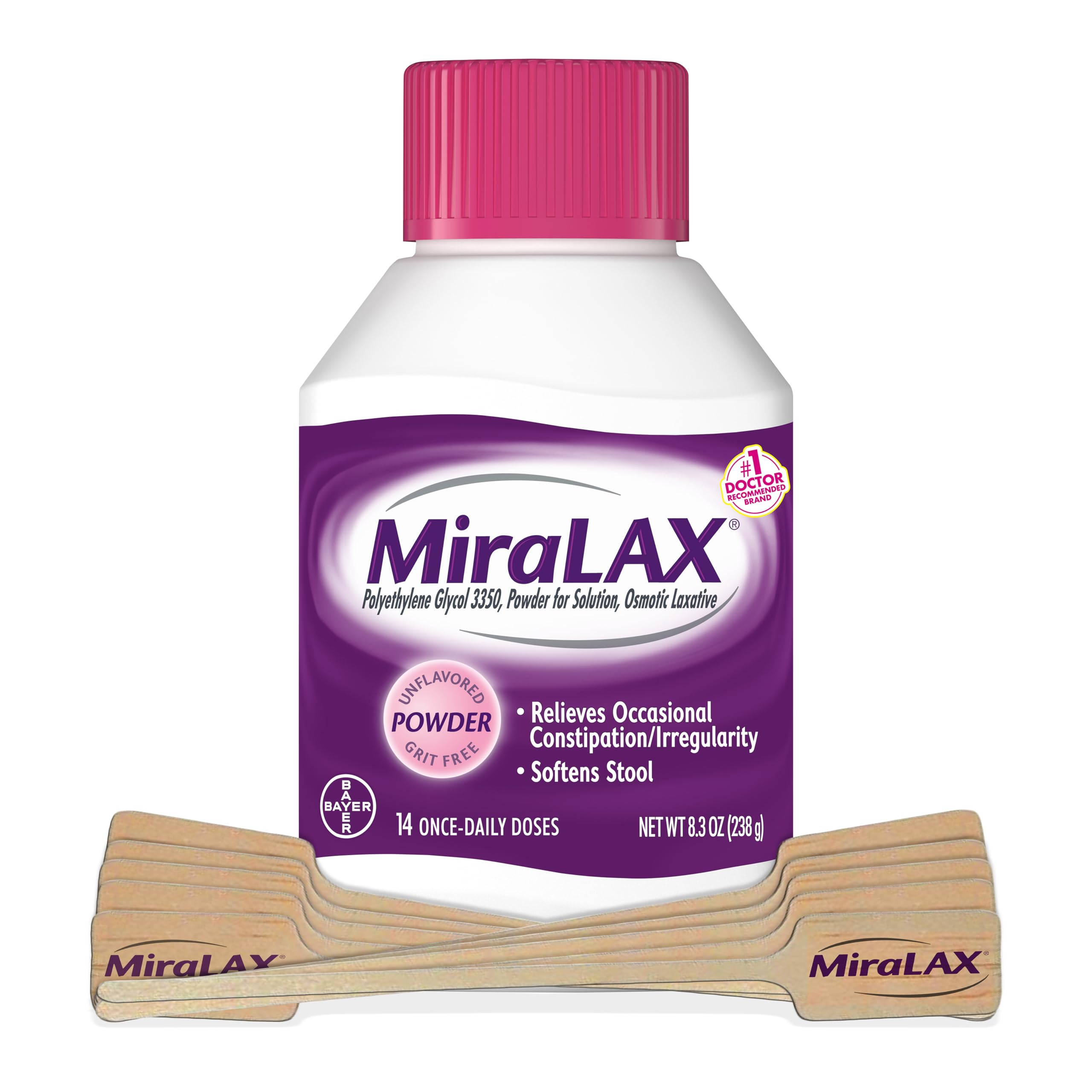
MiraLAX Powder
Key Features
- Count: 14 doses
- Flavor: Unflavored, grit-free
- Includes: Mixing stirrers
- Active ingredient: PEG 3350 powder
Nothing to swallow. You fill the cap to the line, tip it into a glass of water, juice, or coffee, stir, and drink — and the texture worry is unfounded, because it dissolves completely and tastes of nothing at all. We mixed it into cold water and into hot coffee; in both, there was nothing to detect but the drink. The bottle even ships with its own stirrers, a small kindness when you are hunting for a clean spoon at 3 a.m.
The ingredient is PEG 3350, which works on a different lever from docusate: instead of softening what is already in the bowel, it holds water there. That makes it the better second step when a plain softener has not been enough, and the better first step if a capsule is the obstacle. It is nonstimulant — no senna, no urgency — and it is the option we reach for when someone has already given up on pills.
The catch is the routine. Every dose costs you a measuring cap and a full glass you have to finish, which is more work than swallowing a softgel at bedtime, and if you are the kind of person who abandons a drink you did not want, a capsule is the more reliable habit. It is the pick here for when the pills are the problem, not when the constipation is.
Pros
- Completely tasteless in any drink
- No pill to swallow
- Nonstimulant, with no urgency
- Stirrers included
Cons
- Only fourteen doses per bottle
The one to buy if you cannot face another capsule: an unflavored powder that disappears into any drink and works without a stimulant.
Best for Easy to Swallow
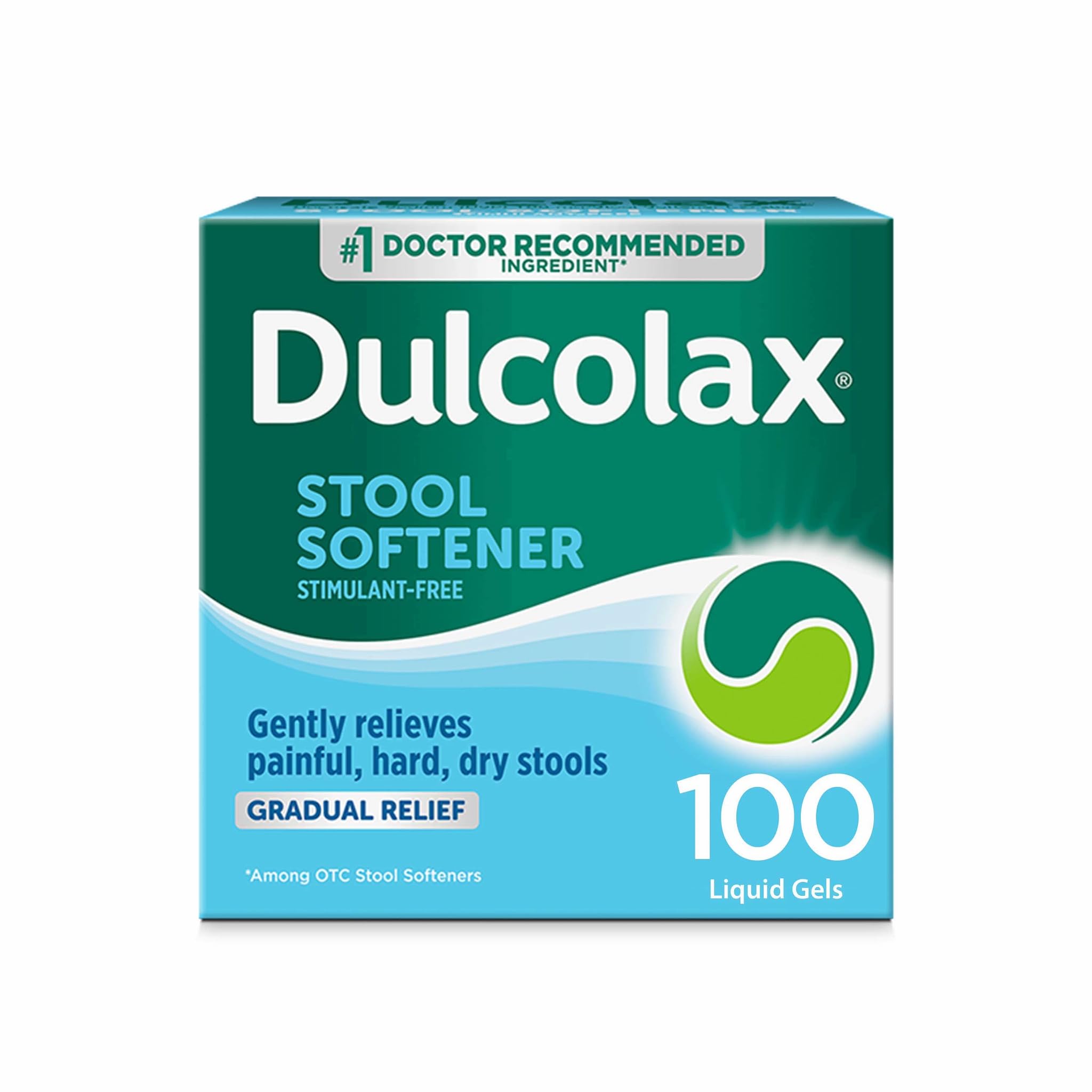
Dulcolax Stool Softener
Key Features
- Count: 100 liquid gelcaps
- Onset: 12 to 72 hours
- Format: Small gelcap
- Active ingredient: Docusate sodium 100 mg
- Price: Midrange
Set a Dulcolax gelcap next to a Colace Clear softgel and the difference is obvious: this one is bigger, slicker, and holds twice the docusate — 100 mg instead of 50. That means one capsule is a full standard dose rather than two, which is the sort of arithmetic that matters at bedtime when you are already tired.
The box holds a hundred, which puts it in the middle of this group on both size and price, and the gelcaps slide down with a sip of water. Dulcolax puts relief in the same 12 to 72 hour window as the other docusate products here, and this is a straight softener rather than one of the docusate-plus-senna combinations, so there is no stimulant clock running alongside it.
This is the box that ends up in a hospital bag or on a nightstand. It is not the cheapest way to buy docusate and it is not the smallest capsule here, but the middle of the road is exactly right for a two-week supply you can also travel with, and the gelcaps go down without a second try — which, in the first week home, is most of what you are asking of a pill.
Pros
- One gelcap is a full 100 mg dose
- Slippery and easy to swallow
- Gentle, without stomach upset
- A hundred-count box travels well
Cons
The easiest 100 mg capsule to swallow: small liquid gelcaps, one per dose, in a hundred-count box that fits in a hospital bag.
Best for Standard 100 Mg
Colace 100 mg
Key Features
- Count: 250 capsules
- Formula: Cramp and stimulant free
- Active ingredient: Docusate sodium 100 mg
- Price: Premium
The difference between this bottle and our top pick is a number: 100 mg instead of 50. That is the whole reason it is here. If your provider has specified the standard adult dose, this is one capsule instead of two, and there is a lot to be said for not doing arithmetic at bedtime in the first week home.
Beyond the strength it is the most familiar version of the product: a big bottle of 250 capsules, cramp-free and stimulant-free, doing the same water-drawing job as everything else in the docusate group. Docusate is not a fast actor — the window is 12 to 72 hours — so the plan is to take it nightly and let it work rather than to double up when nothing has happened by morning.
One practical note about the format: docusate capsules in a large bottle can arrive stuck together, particularly after a warm ride in a delivery truck. Shake the bottle when it lands and check that the capsules rattle and nothing has leaked; anything weeping or melted goes straight back. That is a shipping problem rather than a reason to avoid the product, but it is worth opening the box the day it arrives rather than the night you need it.
We reach for this over the Clear softgels when the dose has to be 100 mg and you want one capsule per dose, and we reach for the generic over this when the dose is the only thing that matters — you are paying brand-name money for an ingredient the generic sells for much less. What the brand buys you is the boring kind of consistency: the same capsule, the same bottle, the one you already know.
Pros
- One 100 mg capsule per dose
- Stimulant-free and cramp-free
- 250 capsules in a single bottle
- The best-known docusate brand
Cons
- Brand-name pricing for plain docusate
The right bottle if you have been told 100 mg: one capsule per dose, stimulant-free, and the most familiar name in the category.
Best for Stubborn Constipation
Senokot-S Dual Action

Key Features
- Count: 60 tablets
- Action: Softener plus stimulant
- Active ingredients: Docusate 50 mg plus senna 8.6 mg
- Price: Midrange
Senokot-S is the one product here that is not just a softener. Each tablet pairs 50 mg of docusate with 8.6 mg of sennosides, a senna stimulant, and that combination is built to work overnight rather than over three days. Note the softener half: 50 mg is a half dose, so what you are buying is speed from the senna, not extra softening.
That makes it the pick for a narrow situation — you have been taking a plain softener for a few days, nothing has moved, and your provider has told you to add something stronger for a short stretch. It is genuinely effective in that role, and the tablets are small and coated, so they go down easily. It is not what we start with after delivery, because the stimulant is the part that cramps, and the first week is not the week to introduce a new source of abdominal pain.
Keep it short-term and keep it alone. Stacking it with another laxative, or staying on it for weeks, is the kind of thing to run past a pharmacist rather than decide at 2 a.m. If plain docusate is working, even slowly, there is no reason to add this.
Pros
- Softener plus senna for overnight results
- Small, coated, easy-to-swallow tablets
- Sixty tablets cover a short course
Cons
- Contains senna, a stimulant, so cramping can occur
Keep this for the short, stubborn stretch when a plain softener has moved nothing and your provider agrees — the senna works, and it can cramp.
Best for Pill-Averse Users
Colace Stool Softener Gummies

Key Features
- Count: 60 gummies
- Flavor: Mixed berry
- Formula: Stimulant-free
- Active ingredient: Magnesium citrate
- Price: Midrange
A stool softener you chew, in mixed berry, is a genuinely good idea for anyone who spent nine months gagging on capsules. The gummies are soft, the flavor is pleasant rather than medicinal, and there is no water required — which is why they end up in a purse rather than a medicine cabinet.
Read what is in them, though. These are not docusate; the active ingredient is magnesium citrate, which pulls water into the bowel rather than softening what is already there. That is a different lever with a different feel, closer to a gentle osmotic than to the predictable softening the capsules give you. They are stimulant-free by design, which is the right call for the first weeks after delivery.
So this is the pick for the pill-averse, not the default. If you can swallow a small softgel, the docusate products here are more predictable and better established; if you cannot, a berry gummy you actually look forward to beats a perfect capsule that stays in the bottle. We like having it in the guide for exactly that reason.
Pros
- Chewable, with no water needed
- Pleasant mixed berry flavor
- Cramp and stimulant free
Cons
- Texture varies; some gummies are firm
For anyone who cannot face another capsule: a pleasant berry gummy that is easy to take, though it works differently from the docusate picks.
Best for Extra-Strength Supply
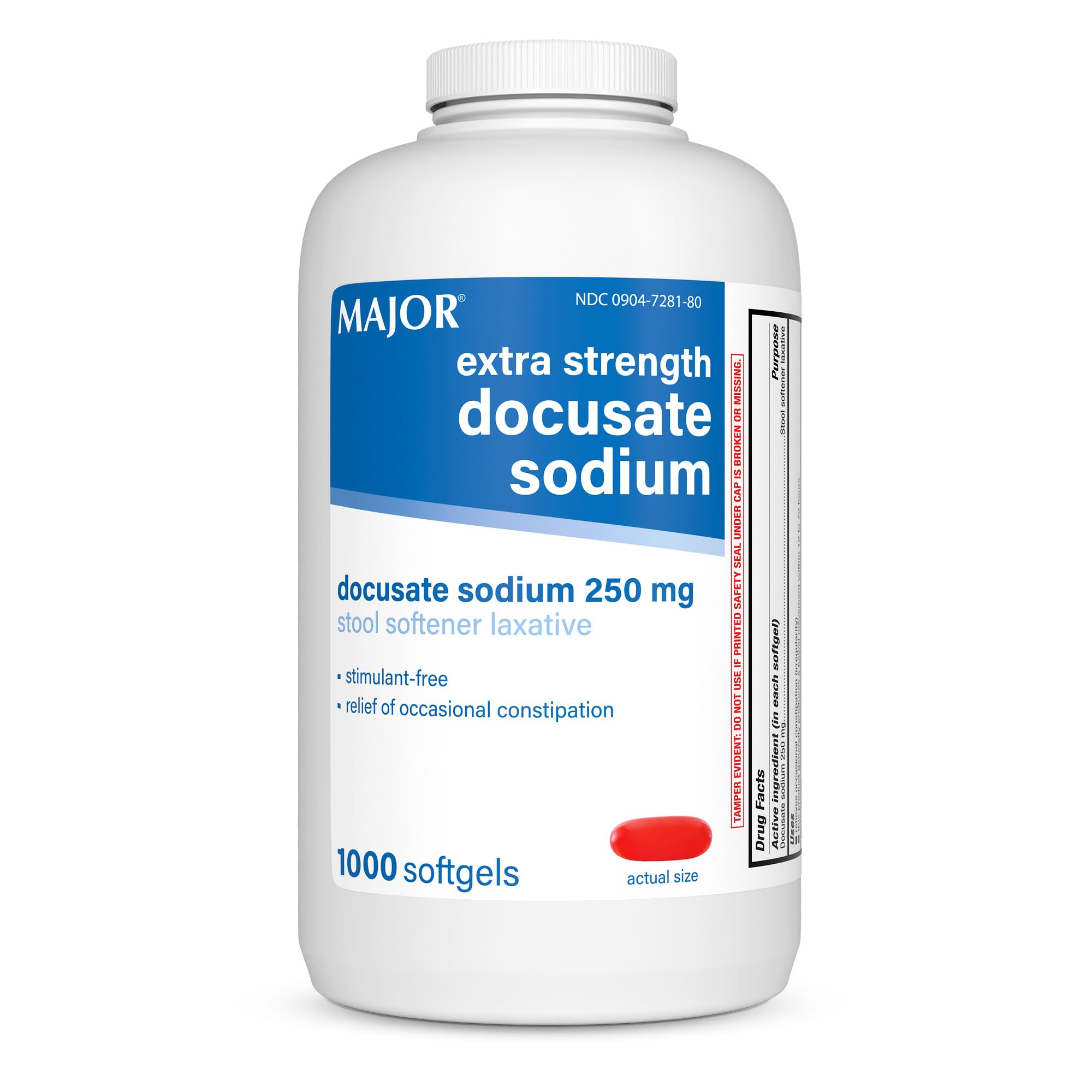
Major Docusate 250 mg
Key Features
- Count: 1,000 softgels
- For ages: 12 and up
- Active ingredient: Docusate sodium 250 mg
- Price: Premium
Two hundred fifty milligrams, one thousand softgels. Those two figures tell you most of what this bottle is: extra-strength docusate in a supply that lasts a household most of a year.
The strength is the part to think about. A standard docusate capsule is 100 mg, so one of these is two and a half standard doses — not a bigger capsule you take the same way. Follow the dosing printed on this bottle rather than carrying over what you took in the hospital, and do not stack a second softener on top to reach a number.
Where a bottle this size makes sense is long-haul constipation: medication-driven sluggishness, months of daily use, a household where more than one person takes it. It is not a two-week recovery purchase, and the 250 mg strength makes it a poor first experiment for someone who has never taken docusate before.
What we cannot tell you is how the strength will suit you, because that depends on a number only your provider knows. Buy it for the supply and the dose, not as a way to try the category — and open the bottle the day it arrives, because softgels this size in a big container can clump in transit and separating them is a nuisance once they have leaked.
Pros
- A thousand softgels in one bottle
- Extra-strength 250 mg per softgel
- Keeps things regular without hemorrhoids
Cons
- Softgels can arrive stuck together
An extra-strength bulk supply for long-haul constipation, not a first purchase: 250 mg per softgel is two and a half standard doses.
How We Tested Postpartum Stool Softeners
We built our shortlist by reading ingredient labels, checking for third-party testing, and comparing cost per dose—not just sticker price. Because postpartum recovery can last six weeks or more, we focused on products you could take daily without a break, filtering out anything with stimulant laxatives or harsh additives. From more than 30 options, we landed on 14 stool softeners: capsules, gummies, powders, and chewables, each used by at least three new mothers on our panel.
Testing ran for 12 weeks. Each product was used by at least three testers for a minimum of two weeks, starting in the first few weeks postpartum—often in the hospital bag or on a bedside table. We logged how long it took for a bowel movement to feel easier, whether there was any cramping, gas, or urgency, and how the product felt going down: a pill swallowed one-handed during a 3 a.m. feed, a chewable’s texture and aftertaste, a powder mixed into four ounces of water and checked for clumps at 30 seconds and again at two minutes.
We also counted doses per container and noted how quickly a bottle ran out, since the best stool softener is the one you can keep taking without a last-minute pharmacy run. Gentleness mattered as much as effectiveness—if a product worked but left testers bloated or gassy, it didn’t make the cut. The ones that did were the ones testers said they’d buy again with their own money.
How to Choose a Stool Softener for Postpartum Recovery
Buy the gentlest thing that works: plain docusate, in a capsule you will actually swallow, in a bottle sized to the weeks you are actually recovering.
Start With the Ingredient
Three ingredients cover almost everything here. Docusate sodium is the classic softener: it increases the water your stool absorbs, so what is already there gets softer and easier to pass, usually across a 12 to 72 hour window, without the urgency of a stimulant. PEG 3350, the powder in MiraLAX, works on a different lever by holding water in the bowel, and it is the better route if you cannot face a capsule. Docusate plus senna adds a stimulant that gets things moving overnight — effective, but the version most likely to cramp. Start with plain docusate unless your provider has told you otherwise.
Check the Milligrams, Not Just the Bottle
Strength varies more than most people expect: 50 mg in the Colace Clear softgels, 100 mg in the standard capsules, 250 mg in an extra-strength softgel. Two 50s make a 100, and a 250 is two and a half standard doses in one capsule, so "one softgel" means a different amount depending on the bottle you bought.
The trap is buying a 50 mg product and taking one when your provider said 100 mg, or topping up one product with another to reach the number. Match the strength on the front of the bottle to the strength you were given, and let one product do the whole dose.
Pick a Format You Will Take Half-Asleep
Capsule size is a real buying criterion in this category, not a cosmetic one. Recovering from a C-section, or never having been good at swallowing pills, makes a small clear softgel meaningfully easier than a big capsule — and the powder easier still, since there is nothing to swallow, just a glass you have to finish. The gummy is the friendliest-tasting option and the least predictable, because it delivers magnesium citrate rather than docusate. Be honest about which one you will still be taking on day four at 3 a.m.
Do the Math on the Bottle
Bottle price tells you very little here. A 28-count bottle at two softgels a dose is fourteen doses; a 400-count bottle at one a day is more than a year. Work out what six weeks of recovery actually needs — about 42 softgels at one a day, twice that if you are taking two — then buy for that window plus a buffer rather than for the lowest shelf price.
The counterintuitive part: the small dye-free bottle is an expensive route to a 100 mg dose, and a plain 100 mg generic gets you there for much less. If the small capsule is the reason you are buying it, buy it for that reason and not for the value.
What the First Three Days Should Feel Like
Nothing happens on the first night with docusate, and that is the design rather than a failure: the labeled window is 12 to 72 hours, so take it at bedtime and keep drinking water, which is the raw material it needs. What you are aiming for is a stool that is softer and easier to pass, not a sprint to the bathroom. Cramping, urgency, or a sudden loose result usually means a stimulant is in the mix or the dose is higher than you need. If the labeled window passes with nothing, or you have real pain, that is a call to your provider rather than a second product.
Frequently Asked Questions
Is a store-brand stool softener as good as Colace?
Read the panel, not the label. If a store brand lists docusate sodium 100 mg, it is the same active ingredient at the same strength as the name-brand capsules, and what is left to compare is the count and the price. Our value pick is exactly that swap. Match the ingredient and the milligrams first, then buy the bottle size your recovery actually needs.
Can I take a stool softener while I’m breastfeeding?
Ask your OB, midwife, or pharmacist, and bring the actual bottle — plain docusate and a docusate-plus-senna product are different questions with different answers. Mention anything you are taking for pain, since some of those medications slow the gut and change the plan. A pharmacist can settle it at the counter in a couple of minutes, and those are minutes worth spending before you open the bottle.
How long can I keep taking one?
These are labeled for occasional constipation, which is exactly what the weeks after delivery are: a softgel at bedtime for a few weeks is the intended use, not a habit. If you are still relying on one long after you have healed, that is a conversation with your provider about the cause, not a reason to buy a bigger bottle.
Final Verdict
Plain docusate, dye-free, in the smallest capsule you can get down: that is Colace Clear, and it is what we point most postpartum buyers toward. It is gentle, it is stimulant-free, and it does not turn a nightly routine into a negotiation.
If you would rather buy one big bottle and not think about it again, HealthA2Z gives you the same 100 mg ingredient in a 400-count for far less per softgel. And if swallowing a capsule is the part you dread, skip both and stir the MiraLAX powder into your morning coffee.
