This post contains affiliate links. We may earn a small commission when you buy through our links — at no extra cost to you.
A foot of fresh snow is either the best thing that can happen to a Saturday or the start of twenty minutes of whining, depending on whether your kid stays on top of it. Snowshoes fix that in about three strides: the backyard, the sledding hill, and the unplowed park path are all back in play. The catch is that kids’ snowshoes aren’t adult pairs shrunk down — they’re sized by weight, not shoe size, and the bindings have to work with a five-year-old’s mittens on.
I’ve buckled small feet into these for a few winters now, and my kids are honest — and brutally picky — critics: if the gait feels clumsy, a strap pinches, or the color is wrong, they’re done in ten minutes. We’ve run 12 pairs through a full year of snow, from our own backyard to groomed trails, and the gap between a pair they forget they’re wearing and one they fight you over comes down to a few details. Several got handed down to a younger sibling, which turned out to be the real durability test.


Best for Trail Hiking
MSR Tyker
Key Features
- Deck size: 6.5 x 17 inches
- Binding fits: Kids 7.5-13.5; adult men’s 1-4.5
- Snowshoe weight: 2.1 lb
- Weight capacity: Up to 90 pounds
- Price: Premium
Steel crampons and a row of molded traction bars sit under the ball of the foot, and that hardware is what decides whether a child stays upright once a trail has been walked into ice. It is the most convincing grip in this group: the molded plastic rails on the cheaper pairs are fine in fresh snow, but steel is what bites on a refrozen track, and a six-year-old who slips twice in the first hundred yards is finished for the day. Above it sits a single injection-molded deck, 6.5 by 17 inches.
Two details make the Tyker our default. The first is the 90-pound rating, which covers a good stretch of childhood rather than a single winter — a first-grader and a nine-year-old can share the same pair. The second is the binding: MSR sizes it for kids’ shoe sizes 7.5 through 13.5 and adult men’s 1 through 4.5, so it keeps fitting as boots grow, and the buckles are shaped for small, mitten-covered hands rather than adult fingers. Add the longest stated warranty in this group, three years, and the premium stops feeling like a splurge.
What you give up is the extras. There are no trekking poles and no carry bag, both of which come with kits here that cost less, and at 2.1 pounds the Tyker is heavier than the toddler-sized Snowflake. For the seven-to-ten-year-old this shoe is built for, neither matters much: the weight comes with a deck built to survive seasons of use, and a child who learns to balance without poles ends up the steadier walker.
Pros
- Steel crampons bite on packed and icy trails
- Bindings span kids’ 7.5 to adult men’s 4.5
- 90-pound rating covers several winters
- Three-year limited warranty, longest stated here
Cons
- No trekking poles or carry bag included
- Heavier than the small-kid picks at 2.1 pounds
Our pick for a child who will actually hike: steel crampons, bindings that size up to adult feet, and 90 pounds of capacity carrying one pair across several winters.
Best for First-Timers
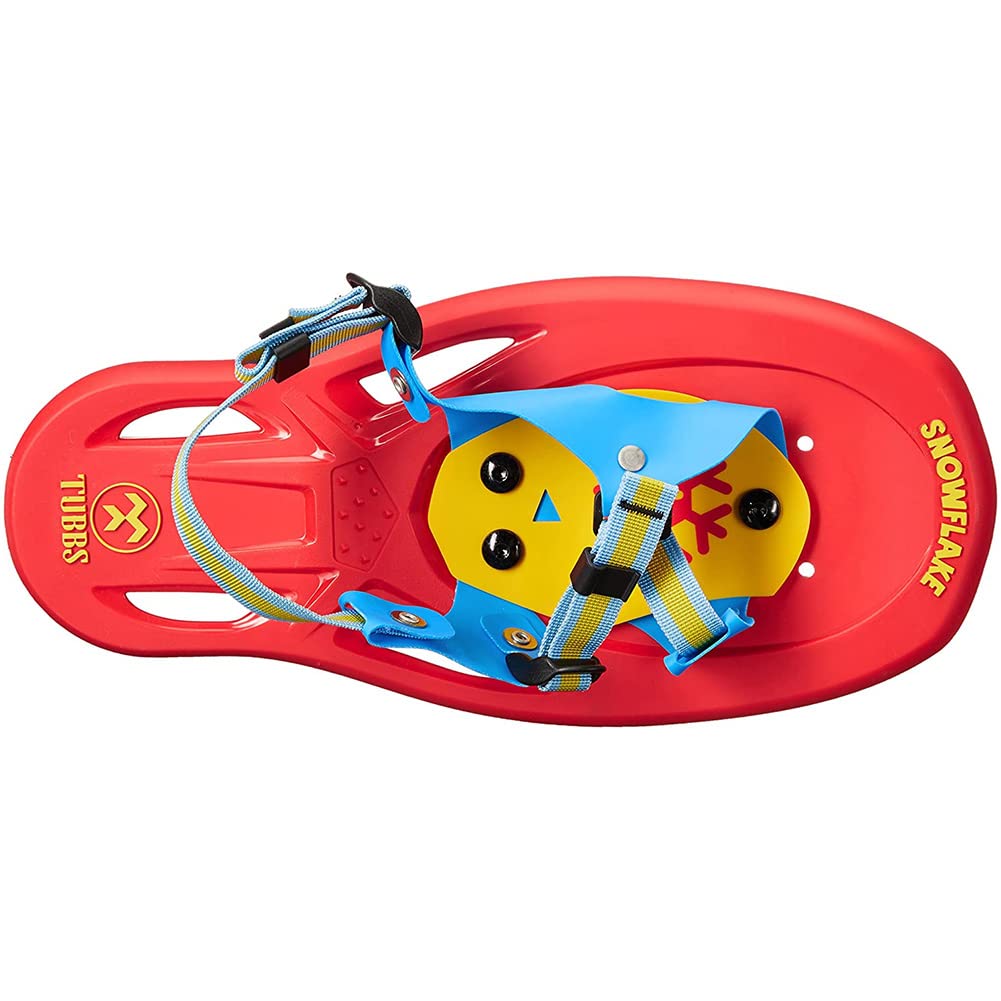
Tubbs Snowflake
Key Features
- Binding: Two-step strap
- Deck size: 14 inches
- Snowshoe weight: 16 oz
- Weight capacity: Under 50 pounds
- Price: Budget
Sixteen ounces, and a ceiling of 50 pounds: those two numbers say more about the Snowflake than the ages-three-to-six label does. Plenty of six-year-olds weigh more than 50 pounds, and the shoe that suits a 35-pound four-year-old is not the shoe for a 60-pound second-grader. We like that it does not try to cover everyone. A small child gets a narrow 14-inch deck that will not trip them, a shoe light enough that they forget it is there, and a binding that takes seconds.
The two-step binding is the part we appreciate most for a first-timer. There is no ratchet to wrestle and nothing to thread: the strap goes over the boot, pulls snug, and that is the whole procedure. Kids who have never worn snowshoes work it out fast, which counts for more than any specification on a cold morning when everyone’s gloves are already off. There is a sticker pack in the box too — a small reward at the end of the first walk, and worth more than it sounds.
Scope is the trade. Under 50 pounds only, so most families get two winters out of it, and there is nothing else in the box — no poles, no bag. For a first pair that gets used in the yard and on a flat trail, that is the right trade: you are not paying for equipment your child will outgrow before getting any use from it.
Pros
- 16 ounces per shoe, light for small legs
- Two-step strap binding is quick to learn
- Narrow 14-inch deck suits a wobbly beginner
Cons
- 50-pound ceiling means two winters at most
- No poles or carry bag included
For a three- or four-year-old we start here: 16 ounces, a binding they can work alone, and a price that does not sting if the interest fades.
Best for Older Kids
Yukon Charlie’s Sno-Bash
Key Features
- Binding: Ripcord one-pull
- Included: Snowshoes, trekking poles, carry bag
- Deck size: 7 x 16 inches
- Weight range: 25 to 100 pounds
- Price: Premium
Two snowshoes, a pair of kid-length trekking poles, and a carry bag arrive in one box, which is one purchase instead of three and one thing to remember in the car. The rating runs from 25 to 100 pounds, wide enough to carry a four-year-old and the same child at nine, and the deck is a 6000-series aluminum rocker frame with an Energy Flex axle that gives a little as the stride rolls.
The Ripcord binding is a single pull to tighten and a single pull to release, and it is the detail that makes the Sno-Bash work for a family: a kid in thick gloves gets in and out without an adult kneeling in the snow. The 7-by-16-inch deck is generous for a 30-pound beginner and about right for a 60- or 70-pound kid. The 100-pound top of the range is where we get cautious — a heavy child in deep powder will sink more than that number suggests, so treat it as a packed-trail and wet-snow shoe.
For a nine- or ten-year-old who is out with the family most weekends, this is the youth kit that covers the most ground: rated high enough to grow into, simple enough to put on alone, and complete without a second order.
The heel strap is the piece to watch — it can work loose on the walk and needs re-tightening — and the poles are the part with the shortest life; if one snaps, the walk is not over, because the snowshoes do not need them. It is also the priciest pair here, and for a child under 40 pounds the deck is more shoe than they can use.
Pros
- 25-to-100-pound rating grows with the child
- One-pull Ripcord binding works in gloves
- Trekking poles and carry bag included
Cons
- Heel strap can work loose mid-walk
- Priciest pair here; too much deck under 40 pounds
Our pick for older kids and long-term value: rated from 25 to 100 pounds, with a one-pull binding gloves can manage and poles in the box.
Best for Reluctant Walkers
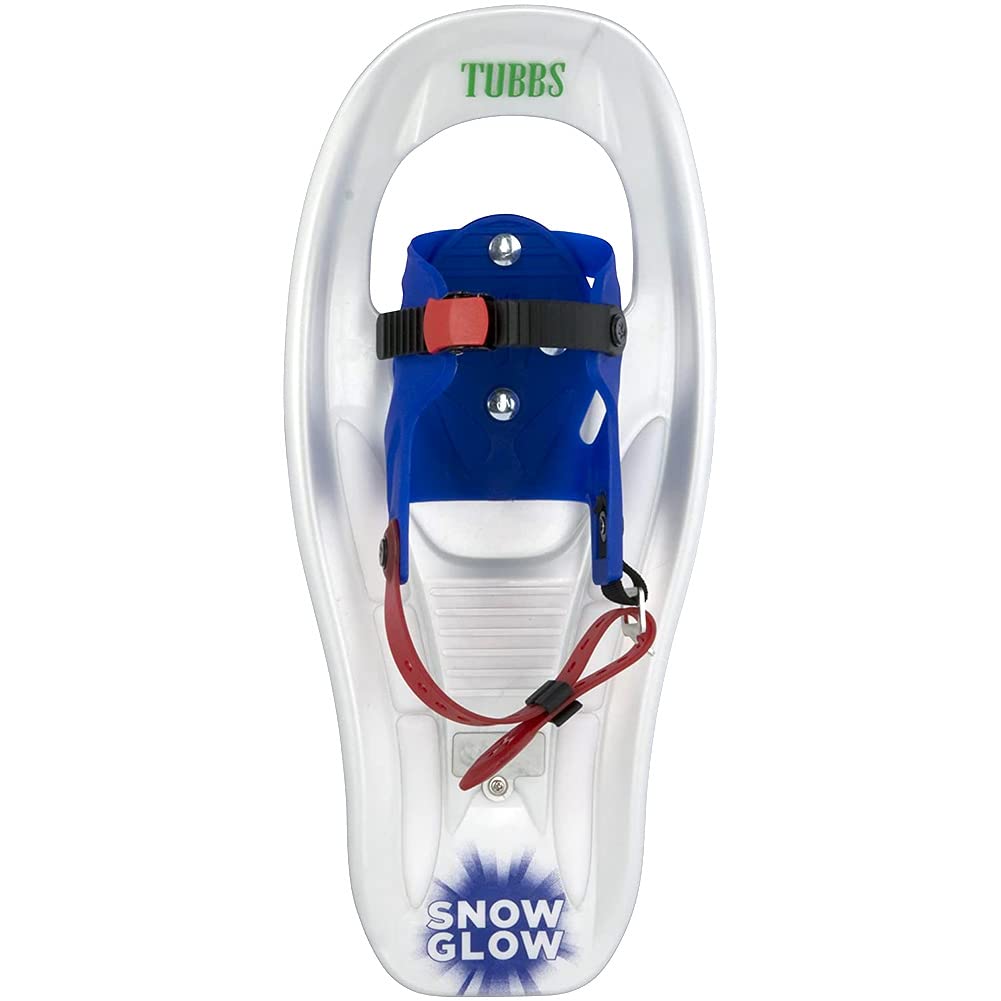
Tubbs SnowGlow
Key Features
- Extras: LED lights in the deck
- Binding: QuickLock2
- Deck size: 16 inches
- Fits shoe sizes: Kids 11 to adult 6
- Price: Budget
Flashing LEDs in the deck are the reason a reluctant five-year-old puts these on without an argument, and that is a real feature rather than a novelty — it is the one thing here that competes with a screen. The SnowGlow is sized for ages four to eight and for shoe sizes kids 11 through adult 6, which makes it the natural step up once boots get bulky and a toddler binding stops being enough.
Underneath the lights is a decent snowshoe. The 16-inch deck floats a 45- or 50-pound child in fresh snow, the molded traction rails give enough bite for a packed sledding hill, and the QuickLock2 binding locks over the instep with one lever — no threading, no second pair of hands. Our favorite part is that last one: a binding a child can close themselves is worth more on a cold morning than any amount of tread.
Two things to check before ordering. The binding runs snug, and a thick snow boot can be a fight to seat, so try them with the boots your child actually wears rather than the sneakers they had on when the box arrived. And the lights are electronics on a piece of snow gear: when they stop, the snowshoe still works, but if the lights are the entire reason your kid agreed to come along, that is worth knowing before you are standing in a parking lot.
Pros
- LEDs flash with every step and get kids moving
- QuickLock2 one-lever binding stays snug
- 16-inch deck floats a mid-size child
Cons
- Binding runs snug on thick snow boots
When motivation is the hurdle, this is the pair: lights that make kids want to walk, a one-lever binding, and a 16-inch deck for ages four to eight.
Best for One-Box Kit
Retrospec Drifter

Key Features
- Frame: Aluminum
- Included: Poles, terrain attachments, mesh bag
- Deck size: 14 inches
- Weight capacity: Up to 50 pounds
- Price: Midrange
The single-ratchet binding is what we care about most at this size: one lever, one pull, and a child can get the shoe on without help. That sounds like a small thing until you have crouched in the snow to refasten a four-year-old’s heel strap for the third time. Around it sits a 14-inch aluminum frame rated to 50 pounds, a full-floating pivot under the foot, and a bundle that includes collapsible poles with terrain attachments and a mesh carry bag.
The pivot is what makes the Drifter feel like a real snowshoe rather than a plastic paddle. The deck swings free and drops its tail as the foot lifts, so snow clears instead of packing up underfoot, and a kid’s stride stays close to walking. The poles break down small enough to live in the mesh bag, which makes the whole bundle easy to carry to the trailhead and back.
Fifty pounds is the catch. This is a four-to-seven-year-old’s shoe, and by the time a child is carrying 60 pounds it is time to move up, so buy it for the child you have rather than the one they will be in three years. Within that range it is the most complete small-kid kit here — shoes, poles, and a bag for one decision.
Pros
- Ratchet binding a child can work alone
- Aluminum frame with a full-floating pivot
- Collapsible poles and mesh bag included
Cons
- 50-pound rating limits it to younger kids
For a four- to seven-year-old, this is the one-box answer: a binding they can work alone, a floating aluminum frame, and collapsible poles in the bag.
Best for Big Kids and Teens
G2 Kids Snowshoes

Key Features
- Included: Poles, snow baskets, storage bag
- Deck size: 20 x 9 inches
- Deck material: HDPE
- Weight capacity: Up to 220 pounds
- Price: Midrange
Two numbers on the G2 tell you who it is for: a 220-pound weight rating, and a deck the specifications list at 20 by 9 inches even though the name says 16. That is not a toddler’s snowshoe. It is sized closer to a small adult shoe, which makes it the one here to consider for a ten- or twelve-year-old who has outgrown youth bindings and wants to keep up on a real trail.
What you get for the size is proper hardware. Aluminum crampons sit underfoot for grip on packed or icy ground, an HDPE deck sheds snow and floats without much bulk, and the one-pull ratchet binding is built for cold weather — G2 says it can be fastened with one finger even with gloves on, which is exactly the claim that matters with the wind up at a trailhead. Trekking poles, snow baskets, and a storage bag come in the box.
For a tall, heavy kid this is the pair that will not feel like a toy: it takes a bigger boot, carries weight the 50-pound shoes cannot, and gives a confident walker real traction. Our reservation is the sizing. A 45-pound seven-year-old will be lifting more shoe than they need, and the length takes getting used to on a narrow packed path — this is a shoe for the top of the youth range, not the start of it.
Pros
- Aluminum crampons grip packed and icy trails
- One-finger ratchet binding for cold hands
- HDPE deck floats without much bulk
- Poles, baskets, and storage bag included
Cons
- Name says 16 inches, specs list a 20-inch deck
- Too much shoe for a small or light child
Our pick for big kids and young teens: aluminum crampons, a glove-friendly ratchet, and a rating that runs to 220 pounds.
How We Tested Kids’ Snowshoes
We started with the kids’ snowshoes sold by brands we already trust for adult winter gear, then narrowed the list using weight ranges, binding type, and deck shape. Anything sold only by age with no weight chart got cut, and so did bindings that couldn’t be tightened with gloves on.
That left 12 pairs, which we used for a full year: a whole winter of weekends on a sledding hill and groomed Nordic trails, plus an off-season in the garage to see what cracked, rusted, or seized. Most sessions started in a cold parking lot, where I timed how long it took a kid to get both shoes on and off without help and without pulling their mittens off.
On the snow, we watched how high each pair sat in fresh powder, how the crampons bit on a packed, icy slope, and whether the tails dragged or clipped a heel at a walk and at a run. Fit got checked over bulky boots and thin ones, and I asked every kid the same question on the way home: would you wear these again tomorrow? Appearance moved more of these rankings than parents expect — the pairs in colors my kids actually liked came out of the bin without being asked.
Durability showed up late: deck scuffs, worn crampon teeth, bindings that stretched or froze solid after a season, and then several pairs passed down to younger siblings to see what survived a second owner. Ease of use decided more of these calls than anything else.
How to Choose Kids Snowshoes
The thing that decides whether a pair of kids’ snowshoes works is weight — the child’s, in boots, measured against the shoe’s rating — and almost every other choice follows from getting that right.
Start With Weight, Not the Age on the Box
Age bands are a rough guide and nothing more; the weight rating is the real limit. Weigh your child in their snow boots with snow pants on, and pick a shoe rated comfortably above that number. A 50-pound ceiling is a three- or four-year-old’s shoe, while a 90- or 100-pound rating carries a child into the tween years.
The trap is buying for the child your kid will be in three years. A deck sized for someone heavier is a heavy, wide, tripping hazard for a small walker today, and it does not float them any better than the correct size does. Buy for the child standing in front of you.
The Binding Is Where the Day Is Won
Nearly every serious fit complaint about kids’ snowshoes ends in the same place: the binding. Look for a design a child can tighten alone in mittens — a single ratchet or a one-pull strap, with a heel strap that comes over the boot rather than under the sole. The one-pull setups on the Sno-Bash and the Drifter are the easiest of these to work with cold hands.
Then try it on with the boots your child will actually wear. Snow boots are taller and wider than shoes, and a binding that closes easily in the living room can turn into a wrestling match at the trailhead.
Deck Size, Flotation, and What’s Underfoot
Flotation is surface area against weight. A 14-inch deck suits a child in the 35-to-45-pound range; step up to 16 or 17 inches around 50 to 80 pounds; the 20-inch shoe here is really a big-kid and teen size. Underneath, steel or aluminum crampons and molded traction bars earn their keep on packed, refrozen, and icy paths, while a plain molded plastic base is fine in fresh snow and the backyard.
A deck much longer than your child needs is a trip hazard, however well it floats — and on a narrow packed path it takes a confident walker to manage.
Poles, Bags, and What Wears Out First
Included trekking poles help on flat ground and add arm fatigue on a climb, and they are the piece most likely to break before the snowshoe does. Take them, but do not choose a kit solely because it has them. A carry bag matters more than it sounds, because snowshoes spend most of their life in a car trunk between outings.
In spring, check the deck fittings, binding straps, and buckles. Those are the wear points, and a pair dried and stored indoors will be ready for the next winter.
Frequently Asked Questions
Are kids’ snowshoes actually worth buying, or can my child just walk in boots?
On a packed path or an inch or two of snow, boots are fine and the snowshoes can stay in the car. They earn their place the moment the snow gets deep enough that a small child is postholing to the knee — that is when a 14-inch deck turns a miserable trudge into a walk.
If you are unsure how often you will get out, borrow or rent for a season first. One real outing tells you more than any specification.
How long will a pair last before my child outgrows it?
Most families get two to three winters from a youth pair. Weight is the limit that arrives first, so check the rating each fall: the 50-pound shoes here suit a three- to five-year-old, while a 90- or 100-pound rating carries a child into the tween years.
Check the stated binding shoe size as well, because a tall child can outgrow the boot fit before they reach the weight ceiling.
How old does a child need to be to start snowshoeing?
Most kids are ready around three or four — old enough to walk steadily in snow boots and stay upright on uneven ground. Start on flat, packed snow for twenty or thirty minutes, and let them walk in boots first so the snowshoes feel like a treat rather than a restriction.
Bring a snack and turn back before anyone gets cold. The goal of a first trip is wanting to go again, not covering distance.
Final Verdict
If you are buying one pair this winter for a child somewhere between five and twelve, the MSR Tyker is our answer. Steel crampons handle the packed trail, the bindings are shaped for mittens and sized to fit a first-grader through a young teen, and the 90-pound rating with a three-year warranty means you buy once.
Two situations change that. If your child is three or four and under 50 pounds, the Tubbs Snowflake is the gentler first pair — lighter, narrower, and quick to put on. If you are outfitting a tall, heavy kid at the top of the youth range, the Yukon Charlie’s kit and its 25-to-100-pound span with poles included make more sense than a shoe that stops at 90.
