This post contains affiliate links. We may earn a small commission when you buy through our links — at no extra cost to you.
The first time a kid steps onto the ice, the skates are either helping or fighting them. A stiff, badly fitted pair turns a fun lesson into a battle with laces, cold fingers, and wobbly ankles, which is why the right pair makes such a difference. I’ve watched my own kids and a rotating crew of beginners try 12 pairs over one full winter of lessons, open skates, and backyard afternoons, and the differences show up fast.
The pattern was hard to miss: the best kids’ skates were not the fanciest ones. They were the pairs a child could put on without a fight, that stayed snug without cramming toes, and that left enough room to grow without turning into clown shoes. Kids’ feet change fast, so size is not a one-time number; check adjustable shells and toe room, and resist sizing up more than half a size. The picks below are the ones that made learning feel less like a production and more like a good time.
Best for First Figure Lessons
Jackson Ultima Classic 200
The Classic 200 earned the top spot on one thing: a boot that holds a young ankle upright without feeling like a cast. The reinforced vinyl upper, padded Nylex lining and felt tongue add up to a skate a nervous beginner can trust in the first ten minutes, and the Mark I blade is forgiving enough that new skaters are not tripping over their own edges. We kept coming back to it because it does the job a first pair is actually for, which is letting a child stand up.
Sizing decides whether that support reaches the foot. Jackson asks you to use its own chart rather than your child’s shoe size, and the boots come out snug and true when you do: roomy enough across the forefoot for a wider foot, still locked at the heel. Buying a size up to gain another year does the opposite, because the boot slides, the ankle rolls, and the support you paid for never reaches the foot.
Before the first session, have the blades checked at a pro shop. New skates do not always arrive with an edge worth trusting, and a two-minute sharpen is the cheapest improvement you can make to any pair here. After that the upkeep is minimal: a PVC outsole that needs nothing and a white upper that wipes clean with a damp cloth.
Pros
- Supportive vinyl boot steadies young ankles
- Forgiving Mark I blade for first glides
- Snug, true fit when the chart is followed
- Low-maintenance PVC outsole
Cons
- Fixed sizing leaves no room to grow
We point families buying a child’s first real pair here: supportive enough for lessons, forgiving enough for a first wobbly lap, and simple to look after.
Best for Growing Feet
Lake Placid Summit Adjustable
A push button on the heel is the whole idea here: press it, slide the shell forward, and the boot grows. For a child who adds a shoe size a year, that turns one purchase into three or four winters of skating, and it is why we hand this pair to families who are not certain their kid will take to the ice.
This is a well-made version of the adjustable idea. The woven lining and padded collar are genuinely warm, the waterproof sole shrugs off slush on the walk from the car, and the straps are simple enough that a child who insists on doing it themselves can manage. What it will not do is hold a shaky ankle the way a lace-up figure boot does, because the shell gives sideways under a wobbly skater and the child ends up leaning on the sides of the boot.
That softer hold is the trade, and it only matters for some kids. A confident four- or five-year-old who just wants to get around the rink will never notice it; a child in weekly lessons who needs the boot to keep them straight will, and they belong in the Jackson instead. For everyone else this is the pair that survives growth spurts, since the stainless blade and the shell hold up season after season.
Pros
- Grows through several sizes with a push button
- Warm woven lining and a waterproof sole
- Straps a kid can manage without help
- Blade and shell last several seasons
Cons
- Push button can bind when extending
We recommend the Summit to families buying for a fast-growing kid who skates for fun: the push-button sizing buys years, as long as the boot is not being asked for lesson-level ankle support.
Best for Preschoolers, No Laces
Riedell Soar Junior
Key Features
- Blade: Spiral stainless steel
- Lining: Thinsulate and velvet
- Closure: Velcro, no laces
- Skill level: Beginner
- Price: Premium
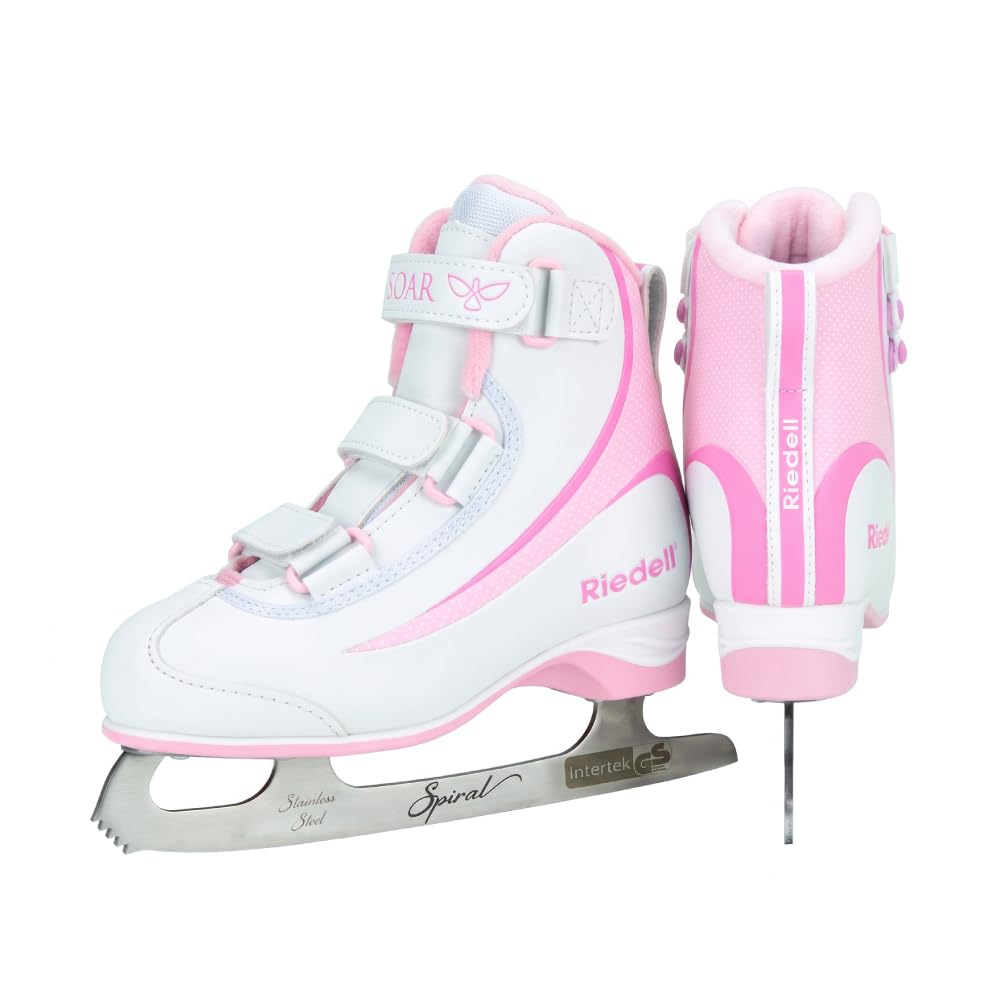
Laces and a four-year-old are a bad combination, and the Soar Junior solves it with velcro straps across the instep instead. A preschooler can close them without help, take them off without help, and get back to the part they care about, which is being on the ice.
The rest of the boot is built for small, cold feet: a foam-backed velvet lining, 3M Thinsulate insulation, and a split tongue that opens wide so a small foot goes in without a fight. The Spiral stainless steel blade is a proper steel blade rather than an afterthought, and the light support rating is right for this age, with enough structure to stop the ankles folding and not so much that a four-year-old is fighting the boot.
Where it stops is lessons. Once a child is skating weekly, working on edges and one-foot glides, the velcro cannot be tensioned around a narrow ankle the way laces can and the support tops out; that is the moment to move to a lace-up figure skate. For a first or second season, though, this is the easiest pair here to live with, and the Thinsulate lining means a January outdoor rink does not end in tears.
Pros
- Velcro straps a preschooler can manage alone
- Thinsulate lining for cold outdoor rinks
- Split tongue opens wide for small feet
- Stainless steel Spiral blade
Cons
- Sizing runs small for some children
For a preschooler who wants to do it themselves, we recommend the Soar Junior: velcro instead of laces, a warm lining, and light support that suits a first season.
Best for Advancing Lesson Skaters
Jackson Ultima Artiste
This is not the pair you buy before a first lesson; it is the one that makes sense once a child is skating weekly. What changes at that stage is the blade and the boot: an Ultima Mark IV instead of an entry-level blade, a microfiber lining with memory foam around the ankle, and Jackson’s flex notch, which lets the boot bend forward at the ankle instead of creasing against the shin.
The flex notch is the detail we appreciated most. A boot that refuses to bend forward is what makes kids skate stiff-legged and complain about their shins, and the notch lets the ankle flex while the sides stay firm, which is exactly the combination a skater needs to start bending into edges. The polyurethane-coated upper is a step up from the vinyl boot on our top pick, too, and it is the part that keeps these looking presentable into a second season.
Give it time. The boot is deliberately firm and takes a handful of sessions to soften, which is normal at this level and is what you are paying for, because a boot that bends on day one will not hold an edge by March. Fit is close and follows Jackson’s chart, so measure rather than guessing from shoe size; a half size short will crush toes by the second period.
Pros
- Ultima Mark IV blade, factory sharpened
- Flex notch allows forward ankle bend
- Memory-foam padding around the ankle
- Coated upper resists wear better than vinyl
Cons
- Lace hooks are the first thing to wear
We recommend the Artiste once a child skates weekly and lessons have turned serious: a better blade, a flex notch that lets the ankle bend, and a boot that lasts.
Best for Toddler Play Skating
Nattork Butterfly Adjustable
The Nattork reaches the smallest feet in this group: X-Small covers 7C to 9C, where the other adjustable skates here start around a child’s size 1. That alone earns it a place, because a three-year-old in an oversized rental boot is not learning anything except that ice is cold. The butterfly print and purple shell are the sort of detail that gets a hesitant kid to sit down and put them on, and we are not above using that.
The push button is the other half of the argument. Press it and the shell slides through four positions, so a pair bought for a three-year-old in December still closes around the foot in February. The fleece lining is soft against bare ankles, the plastic shell keeps the ankle from rolling sideways, and the fit tracks shoe size closely enough that most parents land in the right place on the first try.
It is a play skate, and playing is what most toddlers are doing anyway. For a first or second winter, a few trips to the pond, a rink birthday party, and a parent who does not want to spend much on something that will be outgrown, this is the sensible pick, and nothing else here reaches down to a three-year-old’s foot.
Pros
- Reaches down to toddler sizes 7C-9C
- Push button adjusts through four sizes
- Fleece lining is soft on bare ankles
- Butterfly print kids want to wear
Cons
- Plastic shell gives less ankle support than a lace-up
We recommend the Nattork for a toddler’s first winters on the ice: it reaches sizes the others do not, grows with a push button, and looks the part to a three-year-old.
Best for Older Kids
K2 Raider Adjustable

Key Features
- Sizes: Youth 4-8
- Lining: Thinsulate
- Closure: Speed lacing
- Expandable sizes: 5
- Price: Midrange
The other adjustable skates here top out around a youth 4, which leaves an eight-year-old choosing between a boot that pinches and an adult skate that swallows them. The Raider runs from 4 to 8 and expands through five sizes inside that span, covering exactly the years when feet grow fastest and a kid’s tolerance for being cold and uncomfortable is lowest.
K2’s Softboot construction is the reason it feels less like a rigid shell: the boot flexes with the foot instead of bracing against it, and the junior cuff supports the ankle without locking it. The speed lacing system is a single handle you pull and release, which a nine-year-old can work with gloves on, and the Thinsulate lining is a real answer to an outdoor rink in February.
What we think of it: this is the pair for the kid who wants a sporty skate rather than a white figure boot, the one who has been in rentals and wants to be on the ice thirty seconds after the car door opens. It is a recreational boot rather than a lesson skate, and for a confident older beginner who skates for fun, that is the right call anyway.
Pros
- Five expandable sizes across youth 4-8
- Speed lacing a kid can tighten alone
- Thinsulate lining for cold outdoor ice
Cons
- Speed lacing gives less ankle-specific tuning
We recommend the Raider for older kids in youth sizes 4 to 8, especially a child who would rather pull a handle than sit still for laces.
How We Tested and Sized the Best Kids Ice Skates
We built the shortlist by comparing current kids’ models at major retailers and specialty shops, then narrowed it to 12 pairs that covered different closure systems, blade styles, and adjustable sizing. Testing ran through one full winter, about five months, with weekly learn-to-skate classes, open-skate sessions, and a handful of backyard-rink afternoons.
Sizing got as much attention as skating. Before each session, we traced each kid’s foot, checked toe room with a thumb’s width, and noted whether the heel lifted when they stood. We tested every pair with the socks they’d actually wear on the ice, then checked pressure points after 20 minutes. With adjustable skates, we watched whether the size changes held a secure fit or left the boot feeling sloppy.
For ease of use, we timed how long each kid took to get in and out without help and watched their first ten minutes on the ice. We noted whether a beginner could stand, glide, and stop without the skate fighting them, and whether laces or buckles stayed put between laps. After each session, we asked where the skates pinched, rubbed, or felt wobbly; those notes decided which pairs moved on.
How to Choose Kids Ice Skates
Every kids’ skate makes the same bet: fit one foot size properly now, or grow through several sizes approximately, and the rest of the decision follows from which bet suits your child.
Fixed sizing or adjustable sizing
A lace-up figure boot like the Jackson Classic 200 puts the ankle where the maker intended, which is why we favour it for a child in weekly lessons. An adjustable pair like the Lake Placid Summit trades some of that hold for years of wear, because the shell slides forward as the foot grows. Neither is wrong; they answer different households.
Pick fixed sizing if the skater is in a lesson program and will be on the ice every week. Pick adjustable if you are buying for a child who skates a dozen times a winter, for a family that hands boots down, or for a kid whose feet are in the middle of a growth spurt you can already see.
Fit the chart, not the shoe size
Children’s skate sizes do not track shoe sizes, and buying by shoe size is the single most common way these purchases go wrong. Measure the foot from heel to longest toe and match it against the brand’s own chart; Jackson prints one for exactly that reason. The boot should hold the heel down and let the toes just brush the end.
Buying a size up so it lasts does the opposite of what you want: the boot slides, the ankle rolls, and the support you paid for never reaches the foot. That is the trap to name out loud before you order.
Laces, buckles or velcro
How much of the dressing do you want to do? Velcro straps on the Riedell Soar Junior let a four-year-old get in and out alone, which matters more than it sounds when you are kneeling on cold rubber. Push-button shells like the Summit and the Nattork are quick, but the tension is set by the shell rather than by you.
Laces give the finest control around the ankle, and a lace-up boot is what a lesson program expects once a child is working on edges. Most kids who dress themselves at home can handle laces somewhere around six or seven.
Blades and the first sharpen
Almost every kids’ skate arrives with a blade attached and an edge that may or may not be ready for ice. Run a thumbnail across the blade: it should catch rather than slide. If it slides, take both skates to the pro shop before the first session, because a fresh sharpen costs little and transforms a beginner’s first hour.
Figure blades also carry a small toe pick, which beginners use to find balance, and it is a reason learn-to-skate programs start in figure skates rather than hockey boots.
Warmth, rust and storage
A cold kid is a finished kid, so lining earns its keep: Thinsulate in the Riedell and the K2, a warm woven lining in the Summit, fleece in the Nattork. Thin socks let the boot do that work; thick socks just change the fit you measured for.
The routine after skating is the same for every pair here. Wipe the blades dry, leave the tongues open to air, and never zip them into a bag wet. Rust starts overnight, and a pitted edge is a sharpening problem nobody can undo.
Frequently Asked Questions
Should we buy skates or keep renting at the rink?
If your child will skate more than a handful of times this season, owning wins. Rental skates are shared, often dull, and rarely fit a small foot well, which is exactly the combination that makes a first-timer hate the ice. A properly sized entry-level pair will carry a child through a couple of seasons and then a younger sibling.
Are figure skates or hockey skates better for a beginner?
Figure skates, for almost every first-timer. The boot is stiffer around the ankle and the blade has a toe pick and a flatter profile, which makes standing and stopping easier to learn. Hockey skates have no toe pick and a rockered blade that rewards a confident skater, so they make a better second pair once a child has decided they want to play.
What socks should a child wear in ice skates?
One thin pair, not two thick ones. Thick socks change the fit you measured for and let the heel lift, which costs the ankle stability the boot was bought to provide. A thin wool or synthetic sock is the usual choice; cotton is the one to avoid, because it holds moisture and turns cold against the toes.
What age can a child start skating?
Most learn-to-skate programs take children at three or four, once they can stand and follow simple instructions. For that age, look at how far down the sizing runs: the Nattork’s X-Small covers 7C to 9C, and the Riedell Soar Junior is listed in a 13 JR. Expect to replace the pair within about two years, which is the argument for an adjustable boot.
Final Verdict
Buy the Jackson Classic 200 for a child starting lessons. It gives a beginner the ankle support and forgiving blade they need, it fits properly when you follow Jackson’s chart, and it will still be the right skate once they are gliding without thinking about it.
If your kid grows a size a year and skates for fun rather than lessons, the Lake Placid Summit’s push-button sizing makes better sense of the money. And if your skater is four and cannot manage a lace, the Riedell Soar Junior is the pair that gets them onto the ice without a wrestle in the parking lot.
