This post contains affiliate links. We may earn a small commission when you buy through our links — at no extra cost to you.
Mineral sunscreen sounds like the easy answer: zinc oxide and titanium dioxide sit on the surface and bounce UV rays away, which is exactly what you want on skin that’s only a few months old. The catch is everything that comes with it — the white cast that turns a baby into a tiny mime, the paste that drags instead of glides, and the wrestling match with a wriggling 8-month-old. Pick the wrong tube and you get a sticky, tearful mess and, twenty minutes later, a sunburn anyway.
I spent this summer working through 14 mineral formulas, from drugstore tubes to pricey sticks, on my own kids and my testers’ — stroller walks, backyard sprinklers, a week at the beach — and the gap between a good one and a bad one shows up in the first thirty seconds of application. One thing I didn’t expect: water-resistant and easy-to-reapply-after-a-nap are rarely the same product, and the sunscreen you have to fight a baby to put on is the one that ends up skipped. The picks below are the ones we used all the way down to the crimp.


Best for Everyday Baby Coverage
Blue Lizard Baby Mineral Sunscreen
Key Features
- SPF: 50+
- Size: 5 oz
- Water resistance: 80 minutes
- Active ingredient: Zinc oxide
- Price: Budget
The cap is what convinced us. Blue Lizard’s Smart Cap tints when it is in strong sunlight, so the question of whether a baby needs sunscreen gets answered by a glance at the bottle by the door rather than a squint at the sky. On a bright morning it had already turned before breakfast was over, which is exactly the nudge we want on a day that looks harmless.
The formula underneath is what earns the spot. It is zinc oxide at SPF 50+ with calendula and organic aloe, fragrance-free and vegan, and it holds its water resistance for the full 80 minutes. What struck us in use is how far a squeeze goes: this is a genuine lotion rather than a paste, so it glides over arms, legs, and the back of a neck in one pass, and a baby who hates being held still is finished before she starts to object.
Where it needs managing is over a rich baby lotion. Put it on thick and it stays tacky for a while; thin layers, one at a time, set much faster, and by the time we were buckling a car seat it had stopped feeling like anything at all. It is the tube we reach for first, and the one we restock without thinking about it.
Pros
- Spreads like a lotion rather than a paste
- Smart Cap tints in strong sunlight
- Holds 80 minutes of water resistance
- Fragrance-free with calendula and aloe
Cons
- Leaves a pale sheen on deeper skin tones
- Five ounces goes fast with daily all-over use
We recommend the Blue Lizard lotion as the baby sunscreen to buy first: an easy-spreading SPF 50 that holds through 80 minutes of swimming and warns you when UV is strongest.
Best for Whole-Family Body Coverage
Thinkbaby Baby Sunscreen SPF 50+
Key Features
- SPF: 50+
- Size: 6 oz
- Age range: 6 months to 5 years
- Water resistance: 80 minutes
- Price: Midrange
Six ounces is the number that separates Thinkbaby from the rest of this group. It is the largest single tube here, and the difference shows up in week three of a hot summer, when a five-ounce tube is being squeezed flat and this one still has weight in it.
The cream is old-fashioned in the best sense: thick, white, and slow to spread, which is precisely why it holds on a beach day. You warm a stripe between your hands, press it on, and it stays through splashing and a towel-off. It is also the one pick here with a real scent, a soft coconut smell that we found pleasant and that a fragrance-avoiding household will want to skip.
The label lists it for six months to five years, which covers exactly the years when a child is in and out of water constantly. This is the tube to hand a family with two children and a paddling pool; it is the one that gets used up rather than forgotten at the back of the cabinet.
Pros
- Largest single tube here at six ounces
- Holds through swimming and toweling off
- Protection starts as soon as it is on
Cons
- Leaves a white film, especially on deeper skin
- Takes extra scrubbing at bath time
Buy Thinkbaby if you are covering more than one child: the six-ounce tube is the largest here, and the thick cream stays where you put it through a long afternoon at the pool.
Best for Diaper-Bag Lotion
Baby Bum SPF 50 Sunscreen Lotion
Key Features
- SPF: 50
- Size: 3 oz
- Water resistance: 80 minutes
- Active ingredient: Zinc oxide
- Price: Midrange
Three ounces is the right size for a stroller pocket, and the travel tube slides into a diaper bag without adding a lump. That matters more than it sounds. The sunscreen you carry is the one that gets reapplied at the playground; the big family tube stays in the hall closet.
The formula is zinc oxide at SPF 50 with coconut oil, shea butter, and cocoa butter, and it is fragrance-free, which is worth having when a baby’s face is under yours for an hour at a time. It rubs in more easily than the thick creams in this group and leaves skin feeling moisturized rather than chalky, and 80 minutes of water resistance means a splash pad does not end the coverage.
Our reservation is reactivity. This is a plant-based formula carrying several botanical oils, and a baby who has already reacted to a lotion deserves a patch test on the inner arm the day before, not a full application in a parking lot. Handled that way, it is the tube we refill before it is empty, because the day it runs out is the day you need it.
Pros
- Three-ounce travel tube fits a diaper bag
- Fragrance-free with plant oils
- 80 minutes of water resistance
Cons
- Three ounces is small for daily all-over use
- Can leave white residue where it is not rubbed in fully
We keep the three-ounce Baby Bum tube in the diaper bag: it is fragrance-free, spreads without a fight, and gives you a full body pass when you are out and forgot to plan.
Best for Eczema-Prone Skin
Aveeno Baby Continuous Protection Lotion
Key Features
- SPF: 50
- Certification: National Eczema Association Seal of Acceptance
- Water resistance: 80 minutes
- Active ingredient: Zinc oxide
- Price: Midrange
Aveeno’s baby lotion is the one we hand to the household whose baby has already reacted to two other sunscreens. It carries the National Eczema Association Seal of Acceptance, it is built on naturally sourced 100% zinc oxide with skin-soothing oat, and it is fragrance-free, paraben-free, and tear-free. When a rash means a ruined week, those credentials are worth more than an elegant finish.
On the skin it behaves like a classic zinc cream, and it rewards a bit of technique: warm it between your palms, press it on in thin layers rather than pushing a blob across a wriggling leg, and give it a minute before you dress the baby. Do that and it stays through 80 minutes of water and a long afternoon in the shade.
It comes off at the end of the day with a warm washcloth and some patience, which is the trade for a formula that hangs on that well. For a baby whose skin has rejected everything else, that is a fair deal, and the oat-and-zinc pairing is the part we trust most.
Pros
- National Eczema Association seal of acceptance
- 100% zinc oxide with soothing oat
- Tear-free and fragrance-free
- Holds through 80 minutes of water
Cons
- Leaves a noticeable white cast
- Three-ounce tube is small for daily all-over use
For a baby with eczema or skin that reacts to everything, we point to Aveeno’s mineral lotion: the eczema seal and oat formula earn their place, as long as you can live with a thick, white application.
Best for Face Touch-Ups
Aveeno Baby Mineral Sunscreen Stick
Key Features
- SPF: 50
- Size: 0.47 oz
- Water resistance: 80 minutes
- Active ingredient: Zinc oxide
- Price: Midrange
Two seconds is about how long it takes to swipe this across a nose, and that is the whole argument. Our first attempt happened in a parking lot with a baby already strapped into the stroller: instead of unclipping her, we leaned over, ran the stick across her cheeks and ears, and left. No lotion on our hands, no wrestling match.
It is zinc oxide at SPF 50 with 80 minutes of water resistance, and it is free of fragrance, parabens, and phthalates. It glides rather than drags, closer to a soft balm than the chalky sticks we have tried, and on a toddler who wants to do it herself that matters: she can manage her own nose and the result looks even enough.
There is a slight sheen after application, less than a lotion leaves, and it survives a hand-wipe and a snack. Ours lives in a jacket pocket rather than the bathroom shelf, which is the honest measure of how often we reach for it.
Pros
- Glides on with no lotion on your hands
- Matches the lotions at 80 minutes of water resistance
- Toddlers can help apply it
- Fragrance- and paraben-free
Cons
- Half an ounce covers face and ears only
This is the stick we reach for at the park gate: it glides over a nose and ears without lotion on your hands, and its 80-minute water resistance matches the lotions here.
Best for Sensitive Faces
Neutrogena Pure & Free Baby Stick

Key Features
- SPF: 50
- Size: 0.47 oz
- Certification: National Eczema Association Seal of Acceptance
- Active ingredient: Zinc oxide
- Price: Budget
Mineral sticks usually announce themselves with a white stripe down the nose. This one does not. It goes on clear enough that you have to look for it, which is why it is the stick we hand to a parent who has given up on mineral sunscreen looking natural.
The active is zinc oxide, and the formula is hypoallergenic, free from PABA, parabens, dyes, and fragrances, and carries the National Eczema Association Seal of Acceptance. It applies with almost no drag and settles to a weightless, non-greasy finish, the closest thing in this group to forgetting you are wearing sunscreen.
Our reservation is depth of color. On light and medium skin it disappears; on deeper skin the zinc still leaves a soft pale cast, so the invisible claim has a limit. Inside that limit it is the most comfortable stick here, and the one that lives in the glovebox for the drive home from the beach.
Pros
- Goes on nearly clear for a mineral stick
- Weightless, non-greasy finish
- Hypoallergenic and fragrance-free
- National Eczema Association seal of acceptance
Cons
- Still leaves a pale cast on deep skin tones
- Runs out quickly with daily face use
The Pure & Free stick is the least visible mineral stick we tried, which makes it an easy sell for a face, as long as you know it still reads pale on deep skin.
Best for Short Ingredient List
Badger Mineral Baby Sunscreen Cream
Key Features
- SPF: 40
- Ingredient count: 7
- Water resistance: 40 minutes
- Active ingredient: Non-nano zinc oxide
- Price: Premium
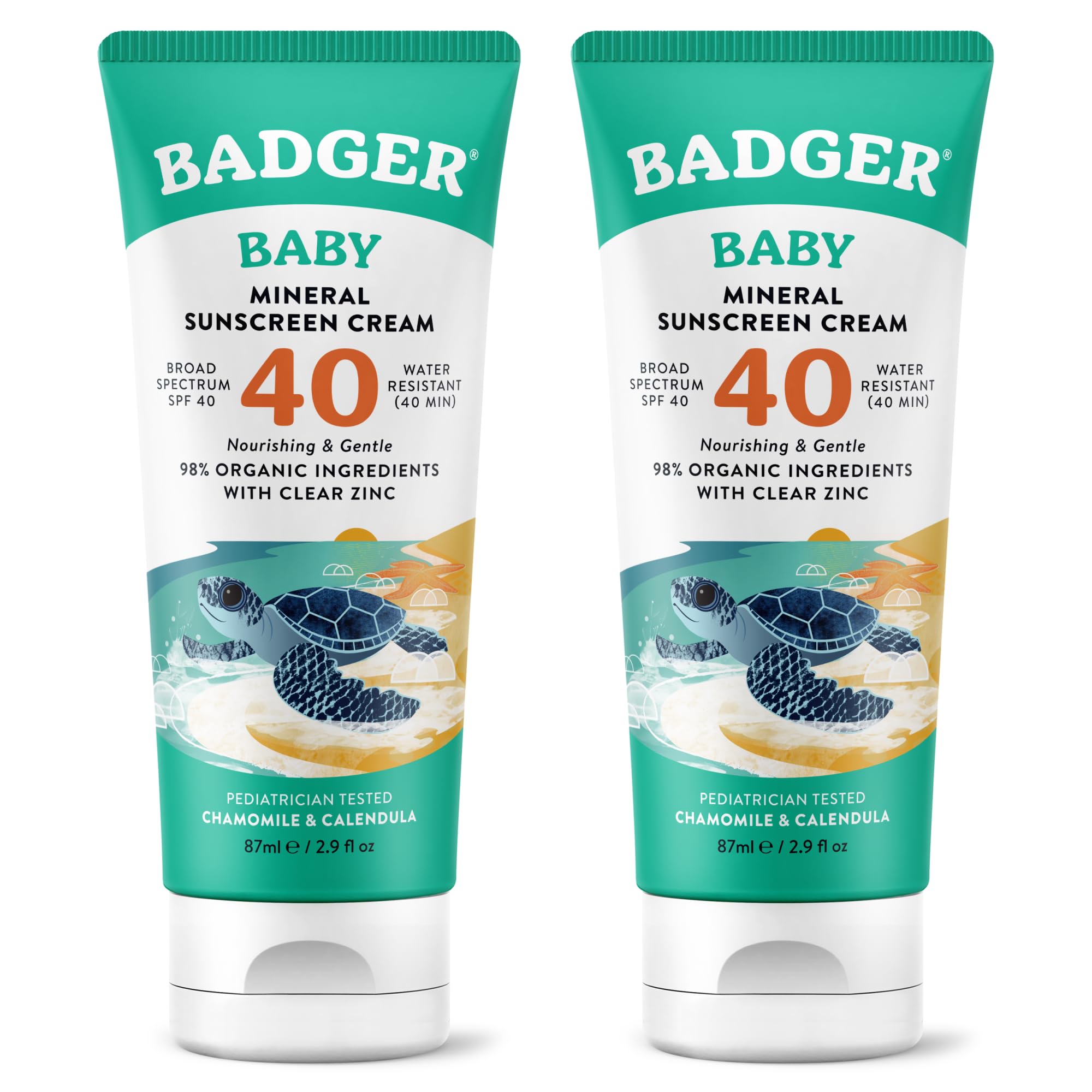
Seven ingredients, and the list is short enough to read out loud: non-nano zinc oxide, organic sunflower oil, and soothing chamomile among them. For a household that reads labels closely, that is the pitch, and nothing else here comes close.
It is SPF 40 with 40 minutes of water resistance, the shortest water window in this article, which is why we treat it as a backyard and everyday cream rather than a pool one. The formula is 98% organic and pediatrician tested, and the label describes it as newborn safe, so it is the first one we think of for the smallest babies on a shaded walk.
Getting it onto a baby takes technique. It is thick, closer to a body butter than a lotion, and warming a small amount between your palms before dotting it on and rubbing it in a thin layer makes a real difference to both the spread and the whiteness. Skip that step and you will be smoothing a stubborn film while your baby tries to escape.
What you are buying is a short ingredient list and a cream that behaves like a moisturizer, and both hold up. What you give up is convenience: this two-pack is the priciest way here to buy sunscreen, and a pool day will have you reapplying far more often than with the others. For a baby who spends summer in the backyard rather than the water, that is a good trade.
Pros
- Seven-ingredient formula
- 98% organic with non-nano zinc
- Doubles as a moisturizing cream
Cons
- Marks dark fabric and stroller webbing
- SPF 40 is the lowest protection level here
Choose Badger if the ingredient list is the deciding factor: seven ingredients, non-nano zinc, and a cream that stays where you put it, at the cost of a short water window.
How We Tested Baby Mineral Sunscreens Through a Full Summer
We started by reading ingredient panels instead of marketing copy: every formula in the running used zinc oxide or titanium dioxide as its only active filter, and anything with a chemical filter or a fragrance we could smell through the cap got cut early. That left 14 mineral formulas, spanning drugstore tubes to boutique sticks, which my team and I used from May through August — morning stroller walks before the UV index climbed, backyard sprinkler afternoons, a beach week, and the reapplication that always follows a nap.
Application got the closest scrutiny, because that’s where mineral formulas fall apart. I squeezed each one onto a forearm and counted the seconds of rubbing before the white cast faded, then photographed a baby’s cheek in direct sun right after application and again 20 minutes later to see whether the cast settled or just sat there. We noted which ones went on thick and stayed greasy, which thinned out to a workable lotion, which separated into a watery pool after a day in a hot diaper bag, and which pilled under a hat brim or smeared straight onto the car seat.
Protection and skin compatibility were tracked daily: no burn after a two-hour outdoor stretch, plus an evening note on redness, bumps, or dry patches, watched closely on the kids with eczema-prone skin. We sniffed every tube straight from the cap, since fragrance-free doesn’t always mean odorless, and compared cost per ounce rather than sticker price, because a cheap tube you dread using is the most expensive one in the bag.
How to Choose a Mineral Sunscreen for a Baby
The sunscreen that works is the one you can get onto a moving baby quickly and will happily reapply an hour later; everything else on the label is secondary to those two things.
Read the active ingredient before the SPF number
Every pick here uses zinc oxide, the mineral filter that sits on the skin’s surface and deflects UV rather than absorbing it, and that is the form most often suggested for babies. The SPF number matters, but less than you might think: the practical gap between SPF 40 and SPF 50 is small, while the gap between a thin smear and a full, even layer is enormous. Buy the highest number you will apply generously, and do not treat a 50 as permission to stretch the time between applications.
Decide between a lotion and a stick
Lotion covers ground. A five- or six-ounce tube handles arms, legs, and a squirming torso, and it is the only sensible way to protect a baby in a swimsuit. A stick earns its place on faces, ears, and the back of the neck, and on the third application of the day when speed is everything. The trap is buying a half-ounce stick and expecting it to do a whole body; it will not last a week. Most families end up with both, lotion in the bag and a stick in a pocket.
Be realistic about white cast and texture
Zinc sits on the surface, so some paleness is the price of a mineral formula, and how much you notice depends on skin tone and on how you apply it. Warm the cream between your palms, build it in thin layers, and let it settle for a minute instead of rubbing hard. On deeper skin, expect a visible tint from most of these; the sticks in this group are the least conspicuous. Texture decides whether the tube gets used, so buy something you do not dread applying.
Check the water resistance window
Eighty minutes is the standard here, and Badger’s cream is the outlier at 40. That figure is not how long your baby stays protected all day; it is how long the product survives immersion before it needs replacing. If your summer is a backyard sprinkler and a shaded stroller, 40 minutes works with a reapplication after water play. If it is a pool or the sea, choose 80 minutes and set a timer on your phone.
Match the formula to your baby’s skin
If your baby has eczema or has reacted to a sunscreen before, start with the fragrance-free options that carry the National Eczema Association Seal of Acceptance; Aveeno’s lotion and Neutrogena’s stick both qualify. Patch-test on the inner arm a day ahead. A short ingredient list is not automatically gentler and a long one is not automatically harsher, but a short list makes it easier to work out what caused a reaction. Keep the tube you used so you can compare.
Frequently Asked Questions
At what age can I start using sunscreen on my baby?
The products here list their own minimums, and Thinkbaby and Baby Bum both give six months as the starting point, so follow the age guidance printed on the tube you buy. Below that, the usual approach is shade, light clothing, and a hat rather than cream, and a pediatrician is the right person to ask about a younger infant’s skin. Once your baby is old enough, apply about 15 minutes before you head out.
Will mineral sunscreen stain clothes or the stroller?
It can. Zinc oxide leaves a pale mark on dark fabric and on stroller webbing, and the thickest cream here, Badger’s, is the one most likely to do it. Let the sunscreen set for a minute before you dress your baby or strap them in, and rinse marked straps with warm water and mild soap rather than scrubbing at them.
Does sunscreen expire, and how should I store it between seasons?
Check the date stamped on the crimp of a new tube before the first use, and write the month you opened it on the cap so you are not guessing next June. A tube that has spent the summer in a hot car is worth replacing even if the date looks fine. Buy fresh at the start of the season instead of relying on last year’s half-empty bottle.
Do we need sunscreen in the shade or on a cloudy day?
Yes, at reduced exposure. UV passes through cloud and bounces off sand, water, and pale pavement, and a stroller canopy shades without blocking everything. On an overcast morning, cover the exposed strips, which are the face, ears, hands, and tops of feet, and keep the same reapplication habit you would use in full sun.
Final Verdict
The Blue Lizard Baby lotion is the one to buy first. It spreads faster than the thick creams here, its 80-minute water resistance covers a pool afternoon, and the Smart Cap gives you a warning before the sun gets serious.
Change the requirement and the answer changes: a household covering three children should take Thinkbaby’s six-ounce tube, and a baby with eczema or a history of reactions should start with Aveeno’s oat-and-zinc lotion. Either way, keep a stick in the bag for faces.
