This post contains affiliate links. We may earn a small commission when you buy through our links — at no extra cost to you.
The best backyard afternoons are the unplanned ones — the sprinkler gets dragged out, a neighbor kid wanders over, and suddenly it’s dark and nobody wants to go inside. The wrong toy kills that momentum: it tips when a 4-year-old hauls on the handles, takes two adults and an hour of cryptic instructions to build, or leaves your toddler standing on the sidelines watching the bigger kids. The right one earns its patch of grass, holds up to a whole neighborhood of kids, and costs less than a family day out. What it really buys you is the thing you wanted in the first place: kids outside, playing, without you hovering.
We spent six months with 12 of these spread across a few backyards, and my kids and their friends were merciless critics. One thing I’d tell any first-time buyer: look for a weight limit listed per kid, not just an age range, and pace out your actual patch of grass before you fall for the photo. The footprint on the box is almost always kinder than the one in your yard.



Best for Summer Water Play
Step2 Rain Showers Water Table
Key Features
- Players: 1 – 4
- Assembled size: 39.02 x 24.02 x 32.01 inches
- Accessory pieces: 13
- Recommended ages: 18 months – 10 years
- Price: Midrange
Pour a bucket of water into the top tray and it falls back through a maze of ramps, spinners, and buckets into the pond below — and because the maze pieces lift out and rearrange, the same trick feels new a month later. That loop is why this is the one we tell people to buy first: it gives a two-year-old something to do and a five-year-old something to change. The table is built for one to four players, and on a warm afternoon it will hold all four.
Assembly is the one chore. The screws bite into undrilled plastic, so line the pieces up, hold them, and drive them home with a power driver rather than a hand screwdriver; the top section is much easier with a second person holding it steady. Budget an evening rather than ten minutes, then forget about it.
What’s left is a 39-inch table that stays where you put it, since nothing this size folds into a closet, so pick its spot before you fill it. The 13 accessories — bucket, two cups, duck, frog and fish squirters, strainer, flipper, two spinning pieces, three maze pieces — all nest in the basin, and the plastic has come through direct sun without going chalky. If you want the same water play with shade and a pretend grill, the Step2 patio below is the upgrade; if you need something you can put away, it’s the tunnel.
Pros
- Pour-and-rain tray with rearrangeable maze pieces
- Sturdy enough for toddlers to lean on
- 13 accessories and no batteries
- Holds four kids at once
Cons
- Rigid 39-inch table stays where you set it
Our default recommendation: it keeps four kids at one basin, takes being leaned on, and asks a single evening of assembly in return.
Best for First Toddler Slide
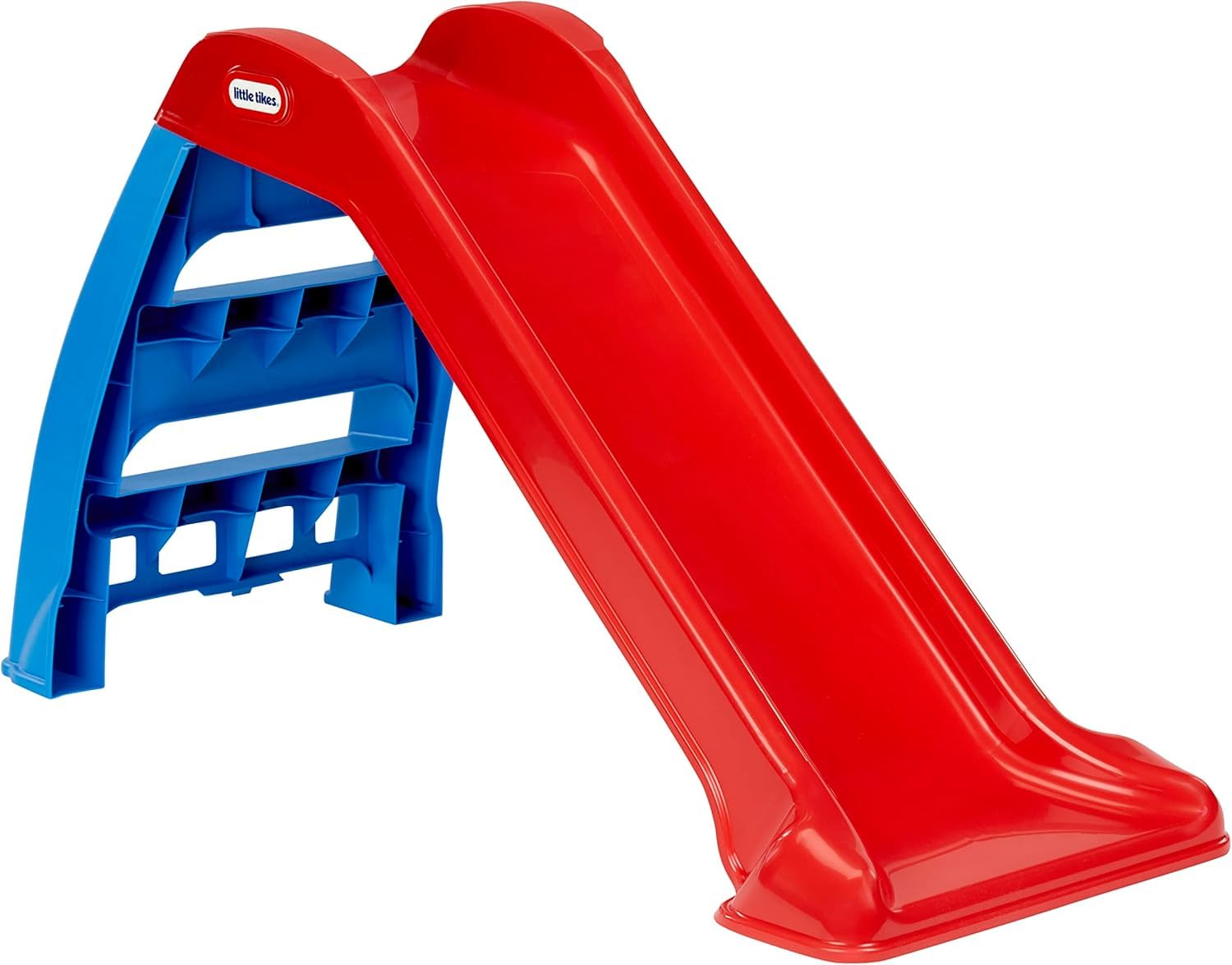
Little Tikes First Slide
Key Features
- Storage: Folds without tools
- Weight limit: 60 lb
- Assembled size: 39 x 18 x 23 inches
- Recommended ages: 18 months – 6 years
- Price: Midrange
At 23 inches tall and 39 inches long, this is a slide a two-year-old can climb and ride without anyone standing behind them. The steps are molded into the back, the run is short enough that they’re on the grass before they pick up speed, and the whole thing weighs nine and a half pounds, which means one adult can shift it across the yard without putting anything down.
For the money, nothing else here earns its space as easily. It snaps together from four pieces, folds flat without tools when the afternoon is over, and its 60-pound limit covers most six-year-olds. We think of it as the toy you buy before you’re ready to commit to a play set — and the one we point a family with a small patio and a one-and-a-half-year-old toward before anything bigger.
The width is the detail that decides it for you: 18 inches across suits a toddler’s hips and gets snug for a five-year-old, so most families get three good years rather than six. For a first slide in a compact yard, that’s the right trade, and the folding is what makes it liveable the rest of the year.
Pros
- Folds flat without tools
- Light enough to carry in one hand
- 60-pound limit covers most six-year-olds
- Snaps together from four pieces
Cons
- Handles can work loose from their slots
- Plastic feels light next to playground gear
We reach for this one first with a toddler: the only slide here that folds into a closet, and the easiest to move out of the way.
Best for Shaded Pretend Play
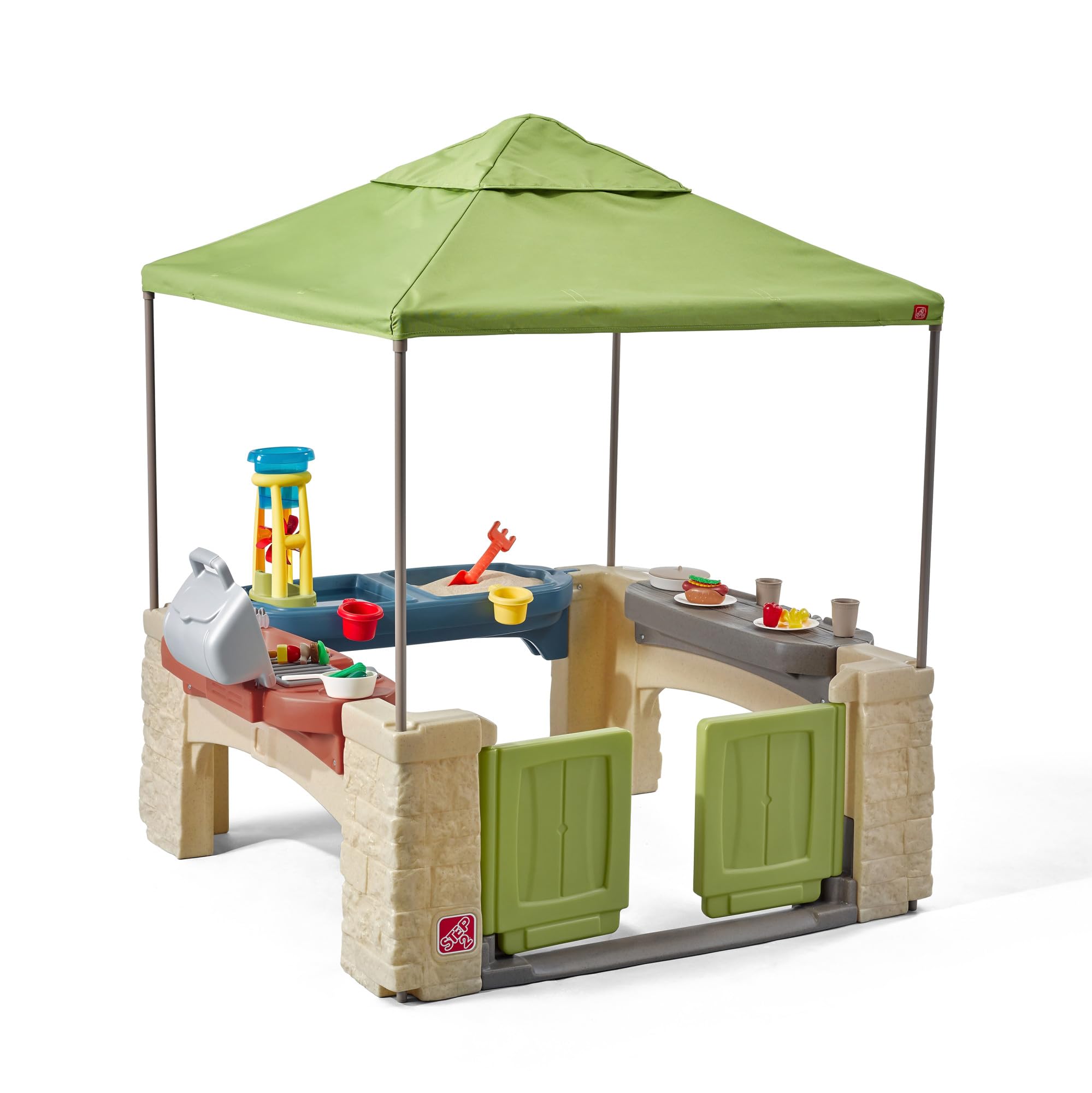
Step2 Playtime Patio
Key Features
- Canopy: Removable
- Assembled size: 47.5 x 47.5 x 60 inches
- Accessory pieces: 16
- Recommended ages: 24 months – 8 years
- Price: Premium
The canopy is the part that sells this. A plastic play structure in full July sun gets hot enough that kids drift away from it, and the removable roof here keeps the counter in shadow while a two-year-old works through the sand and water. Take the canopy off and it becomes a play kitchen for the basement, which is more versatility than we expected from a piece this size.
Inside the footprint you get a pretend grill, a long counter, a sink with sand and water, and 16 accessories — pots, pans, silverware, plates, sand toys. Two two-year-olds can stand at it without bumping elbows, and because the front is open they wander in and out rather than getting wedged in a doorway.
It’s the biggest spend on this list and it earns that in our book if your yard is where everyone ends up. We found assembly runs about an hour with a drill, and one determined adult can finish it alone — the roof is the only step that really wants a second set of hands. The payoff is a play space that stays interesting from two to about six, which is a long run for something that lives outside year-round.
Pros
- Removable canopy keeps the counter shaded
- Grill, sink, sand, and 16 accessories in one footprint
- Room for two toddlers side by side
- Handles sun and storms
Cons
- 47.5-inch footprint needs a slab or lawn corner
- Heaviest pick here at 44 pounds
This is for the family whose yard is the neighborhood hangout: shade, water, sand, and pretend cooking in one footprint that shrugs off weather.
Best for Mixed-Age Swinging
PACEARTH 40-Inch Saucer Swing
Key Features
- Frame: Foam-padded iron
- Included: Two straps and carabiners
- Seat diameter: 40 inches
- Weight capacity: 600 lb
- Price: Midrange
Forty inches across and rated to 600 pounds, this is a swing an adult can sit on while a four-year-old sprawls in the middle, and three kids fit side by side without anyone hanging off an edge. That capacity is the whole argument: a belt swing is one child at a time, and this one turns the branch in the corner into the busiest spot in the yard.
It arrives with two reinforced straps and locking carabiners, so you need a stout limb, a beam, or a swing set with its old seats removed. What we paid attention to before hanging it was clearance — a 40-inch saucer swings in a wider arc than a belt swing, so check that the seat and the feet on it stay off the ground and away from a fence or trunk.
The fabric is where it ages. The colored border can begin separating from the black netting after a few summers, and taking it down when the weather turns is the cheapest way to get more seasons out of it. For a family with a toddler and a nine-year-old at the same address, though, it’s the piece that gets used every day it’s dry.
Pros
- 40-inch seat holds an adult and a child together
- 600-pound capacity covers the whole family
- Straps and locking carabiners included
- Foam-padded frame is soft on shins
Cons
- Fabric border can separate from the netting
With one sound branch and kids of different sizes, this is the swing everybody uses, including the adults who were just going to push.
Best for Small Yards
Moncoland Play Tunnel
Key Features
- Weight: 1.4 lb
- Storage: Collapses into a bag
- Tunnel length: 69 inches
- Opening diameter: 18.1 inches
- Price: Budget
A toddler’s first move is to crawl in and sit down inside it, which is exactly what a 69-inch tunnel with mesh sides is for: you can see them, they can see out, and at 1.4 pounds they can drag it across the grass themselves. Pop it open and it becomes a fort, an obstacle, and a hiding place in about three seconds.
It’s one of the cheapest ways on this list to add a destination to a yard, and by far the smallest to store — it twists down into its own bag and hangs on a hook in the garage between visits. The 18-inch opening is sized for toddlers and small preschoolers, so a six-year-old will get stuck at the shoulders and lose interest. Buy it for the one-to-three window and it earns its keep; expect to pass it on rather than grow into it.
Pros
- Collapses into a storage bag
- Mesh sides keep a toddler in view
- Stands up to toddlers, pets, and weather
Cons
The cheapest way to give a toddler a place of their own outside, and the only pick here that folds down into a bag.
Best for Quick Outdoor Games
Nerf Vortex Aero Howler
Key Features
- Tail: 3-finned
- Weight: 5.64 oz
- Construction: Foam
- Price: Budget
It whistles on the way out — a real rising note from the air holes in the nose — and that sound does more work than any feature on the box. You hear where the ball is going before you see it, which matters when there are three kids in the yard and one ball in the air.
The three-finned tail is what makes it fly straight from a small arm. A plain foam football wobbles out of a six-year-old’s hand; this one holds a line, and the molded grip gives small fingers somewhere to sit. The foam body is soft enough that a bad catch stings a lot less than a real ball, which is why it ends up in the house on rainy days too.
The tail is also the part that goes first. It crimps and bends, and a bent tail turns those tight spirals into a wobble, so don’t leave it folded under a pile of bikes. Even so, it’s the toy we reach for when we want a kid outside for twenty minutes with no assembly, no batteries, and no adult setup — and the one that goes in the beach bag.
Pros
- Whistles loudly enough to track in flight
- Finned tail throws straight for small arms
- Foam body is soft on bad catches
- No setup, no batteries
Cons
- Tail bends and loses its flight line
The best small purchase here: it flies straight, whistles the whole way, and gets a kid outside with no setup at all.
Best for Driveway Creativity
Kid Made Modern Sidewalk Chalk

Key Features
- Colors: Multicolor
- Pieces: 24
- Container: Carrying box
- Price: Budget
On plain concrete these lay down color the way a marker does — dense, bright, and legible from the porch — which is more than we can say for the pale pastel buckets most of us grew up with. The neon shades are the ones that survive a sunny driveway instead of fading into gray.
Twenty-four pieces come in a plastic carry box with a lid, and the box is half the reason to choose this set: it goes out in one hand and comes back in the same one, rather than rolling around the garage floor until spring. The pieces are thick enough for a two-year-old’s fist, so a toddler can make a mark without an adult holding their wrist.
It’s still chalk. Pieces snap when they’re dropped or leaned on, and a few can arrive broken in the box; the long ones become nubs by August. They’re labeled non-toxic, which matters at the age when everything goes in a mouth, and the marks rinse off concrete with a hose or a good rain.
For the smallest outlay here you get an afternoon’s entertainment that stores in a cupboard and needs no adult to set up. Ours lives by the back door for the ten minutes before dinner, which is exactly the kind of use a driveway is for and exactly the kind of toy that gets forgotten in a list of bigger ones.
Pros
- Dense, bright color on concrete
- Carry box with a lid
- Washes off with water
- Chunky enough for toddlers to grip
Cons
- Breaks when dropped or pressed hard
The least expensive thing in this guide and the one we use most: bright, washable, and out of the cupboard in ten seconds.
Best for Teaching Kids to Catch
Ayeboovi Toss and Catch

Key Features
- Ages: 3 years and up
- Players: 4
- Set includes: 4 paddles, 4 balls, 1 storage bag
- Price: Budget
Four paddles and four balls in one bag means nobody stands around waiting for a turn, which is the standing problem with a two-paddle set and a family of four. The paddle is a plastic disc with a velcro face, and the ball sticks where it lands, so a three-year-old succeeds on the first afternoon instead of the first summer.
That sticky catch is the point. Catching a real ball is hard; catching this one is a matter of getting the disc in front of the throw, and the success rate stays high enough that a small kid keeps going instead of drifting off. The paddles are light, the grips suit small hands, and the set works on grass, sand, or in shallow water.
The balls are where the set gives ground. The velcro disc peels away from the foam after enough catches, and once it’s gone that ball is finished. Keep the spares in the bag and rotate them and the set gets through a season or two of real use; leave it out in the sun and the foam stiffens faster.
We still recommend it for the three-to-six window, because nothing else here teaches a child to catch so quickly and nothing else packs down to a bag you can sling over a shoulder. The paddles outlast the balls by a wide margin, which tells you what you’re really buying.
Pros
- Four paddles so nobody waits a turn
- Sticky catch works for three-year-olds
- Packs into one bag for the beach
Cons
- Velcro tears away from the foam balls
The fastest way to teach a preschooler to catch: four paddles, sticky balls, and a bag that goes to the beach.
How We Chose and Tested Backyard Toys
We started with a shortlist of roughly 40 toys pulled from manufacturer spec sheets and customer reviews, then cut it down by price, footprint, and whether the maker published a weight capacity per child. Anything that needed more than a screwdriver, or that gave an age range and nothing else, didn’t make the cut. The 12 that survived spent six months outdoors in real yards rather than on a showroom floor.
Assembly came first, because that’s where the afternoon goes. I built each one solo with a timer running, noting where the instructions stalled, how many predrilled holes actually lined up without a fight, and whether the hardware came bagged by step or dumped into one bag. Handles and rails got the harshest test of all: kids hanging off them by one arm, swinging, and pulling sideways to see if anything flexed.
Then the kids took over. We watched on weekend afternoons, after school, and through a long stretch of hot sprinkler weather, paying attention to which toys got returned to on day four and which got abandoned by day two. Durability was checked the boring way — left out in sun and rain, joints wiggled monthly for wobble, and every Velcro closure on play tents and canopies pulled open and resealed a few dozen times to see whether it still gripped.
Since a lot of these get bought for a 2-year-old with older siblings close behind, we had toddlers in the yard too, noting which step heights and handle positions they could manage alone and which sent them hunting for an adult’s hand. We measured each toy’s real footprint against the listed dimensions, and weighed the price against how many seasons it looked likely to last.
How to Choose Backyard Toys for Kids
The backyard toys that actually get used share two qualities: a kid can start playing without an adult, and a parent can put the thing away in a couple of minutes.
Match the Weight Limit to Your Heaviest Kid
Every toy here carries a stated weight limit, and that number decides how many seasons you get. The Little Tikes slide is rated to 60 pounds — roughly a six-year-old — while the saucer swing holds 600, which is why a grown-up can ride it too. Buy for the child you have plus a couple of years, not for the toddler in the product photo.
If two siblings will share one toy, the limit belongs to the bigger one. A slide bought for a two-year-old with a five-year-old sibling is a two-year purchase, not a five-year one.
Measure the Footprint, Then Measure Where It Sleeps
Backyard toys don’t shrink in the garage. The water table is 39 inches wide and rigid; the play patio is 47.5 inches square and 60 inches tall; the slide folds flat and the tunnel collapses into a bag.
The trap is the word compact. In a listing it usually means the box fits a car trunk, not that the toy disappears in November. Walk the spot you have in mind and picture it sitting there in the off-season before you commit.
Budget for the Assembly, Not Just the Box
Two picks here go together with a power driver rather than a screwdriver, and the water table’s screws bite into undrilled plastic — line the pieces up, hold them, drive them home. Read the assembly note before ordering and decide honestly whether you’re doing it alone.
We rank a toy with a ten-minute setup above a better one that takes an evening, because the one that takes an evening spends its first summer in the box. A folding slide or a pop-up tunnel is playing within minutes; a play patio is a project.
Decide Where the Water and the Sand Go
Water tables and sand kitchens are the highest-value toys on this list and the messiest. Put them on grass or on a patio with a drain rather than a deck that stains, and plan to tip the basin out and let it dry in the sun instead of topping it up for a week.
Check the hose reach and the muddy path at the same time. Once kids find the water, the table doesn’t move again until fall.
Hang a Swing Once, Properly
A 40-inch saucer swing needs a sound limb or beam and enough clearance that the seat doesn’t scrape the ground once it’s loaded. The straps and locking carabiners come in the box; the branch doesn’t.
Pick the spot before anyone cuts anything, and check the limb again each spring. This is the one job on the list where a second opinion is worth having.
Frequently Asked Questions
How do I keep a water table from getting slimy?
Empty it after every session and let the basin dry in the sun before refilling — standing water is what turns the plastic slippery. A wipe with a household cleaner every few days handles the rest, and Step2 builds the table for exactly that kind of cleaning.
If the table sits in shade all day, move it. Sun on an empty basin is the cheapest maintenance there is.
Will sidewalk chalk stain my driveway?
On plain concrete and asphalt, no — a hose or a good rain takes it off. Painted, sealed, or stained surfaces are the ones to watch, so draw a short test line in a corner and check it a day later before you hand a toddler the whole box.
Concrete is the safe canvas; a painted pool deck is not.
Can plastic play equipment stay outside all winter?
The molded plastic parts can. The water table and the play patio are built from double-walled plastic with a fade- and crack-resistant finish, and they handle a full summer of sun without chalky color.
Fabric is the exception: unhook the saucer swing and store it dry, and bring in the chalk, the foam ball, and anything a mouse would chew.
Final Verdict
If the yard gets one new thing this year, make it the Step2 Rain Showers water table. Four kids, one basin, and a maze they can rebuild — that’s the highest play value per square foot on this list, and the assembly is a single evening you pay once.
Add the Little Tikes slide if you have a toddler who wants to climb alone and a closet to fold it into. Choose the Playtime Patio instead if the yard is where everyone ends up and shade matters more than floor space. Everything else here is a cheap way to fill the gaps between them.
