This post contains affiliate links. We may earn a small commission when you buy through our links — at no extra cost to you.
A newborn’s hand stays open for about as long as it takes to lose your nerve. You uncurl one tiny finger, reach for the ink pad, and suddenly there’s a purple smear on the changing table and a baby who has decided this is the worst thing that has ever happened to them. A good print kit solves both problems at once: it holds still when you can’t, keeps the ink where it belongs, and leaves you with a record of how small they were in those first weeks.
My team worked through 14 kits over four months, with babies from two weeks old to just sitting up, and the failures are remarkably consistent. Ink dries out between the first foot and the second, cardstock buckles under a wriggling heel, and a pad generous enough for a six-month foot swallows a newborn’s hand whole. The ones that worked shared a shallow, wide pad, card stock that doesn’t curl as it dries, and packaging that already looks like a gift. What follows is what survived our changing table.


Best for Complete Clay Keepsake
KeaBabies Clay Keepsake Frame
Key Features
- Display: Tabletop or wall
- Frame size: 13" x 7.8"
- Print method: Air-dry clay
- Frame material: Wood with glass cover
- Price: Midrange
The reason to choose the KeaBabies kit is the finished object: a horizontal wood frame with glass, room for two clay impressions, and a place for the baby’s name and date. That is a more complete keepsake than a sheet of loose prints, and the white frame fits a nursery without looking like a craft project.
We recommend it first for parents who want the whole thing to look intentional, not just captured. The included alphabet stencil and paint are the difference between a cute impression and a personalized piece. The stencil is fiddly, and lining up the letters takes more patience than pressing the clay, but it is the detail that makes the frame feel like yours.
Air-dry clay is the part to respect. It begins to set quickly, so unwrap it only after the baby is fed and calm, and have the roller, tray, and frame ready. Press firmly but gently; the clay holds detail well when it is fresh. The process rewards preparation rather than a slow, relaxed session.
We appreciated that the frame can sit on a table or hang, and the glass keeps dust off the clay. The included paint and cutouts let you carry the nursery colors into the display. It is the rare kit that gives you something you can put on the wall the same week, with a personal detail that does not look store-bought.
Pros
- Complete frame, clay, and personalization
- Two prints in one display
- Wood frame with glass cover
- Stencil and paint for name and date
Cons
- Clay can crack as it cures
We recommend the KeaBabies clay frame as the best default for a display-ready newborn keepsake, as long as you can work quickly before the clay sets.
Best for No-Clay Framed Kit
PewinGo Inkless Frame Kit
Key Features
- Display: Tabletop
- Ink pads: 2
- Print method: Clean-touch ink pad
- Frame material: Wood
- Price: Midrange
If the idea of pressing a newborn into clay sounds like a two-person wrestling match, the PewinGo kit takes that variable out. You get a wooden tabletop frame and two clean-touch ink pads, so the print happens on a card and the card goes into the frame. We recommend it for parents who want the display without the craft-project cleanup.
The frame is simple and horizontal, with a clean look that suits a nursery shelf. Two pads matter because newborns are wiggly: one pad for a hand and one for a foot is a sensible split, and the cards give you a redo if the first press slides. The clean-touch film keeps wet ink off the baby, which is the part we care about most.
We think the narrow age window is the real trade-off, but it is the right one for a newborn-focused keepsake. The kit is aimed at babies from birth to six months, and the pad window suits tiny hands and feet rather than a toddler’s. For an older baby, choose the Green Pollywog frame instead.
Pros
- No clay to knead or dry
- Two ink pads included
- Complete tabletop frame
- Keeps wet ink off baby
Cons
- Tabletop display only, no wall mount
We recommend PewinGo for a framed keepsake without clay dust or drying time, especially when you want a second pad for another try.
Best for Baby Book Prints
Pearhead Clean-Touch Ink Pad Kit
Key Features
- Ink pads: 4
- Print method: Clean-touch ink pad
- Ink pad window: 2.5" x 3.5"
- Impression cards: 12
- Price: Budget
The stack of pads and cards is the point of the Pearhead kit. Four clean-touch pads and twelve impression cards mean you are not gambling the whole project on one perfect press. The clean-touch film sits between the ink and the baby, so the skin stays clean even when the print is not perfect.
The process is straightforward: place the pad face down on the card, press the hand or foot onto the clean side, and lift. The result is only as good as the stillness you can get, which is why the extra cards matter more than the extra pads. The ink sits on the card rather than the baby, so there is no tiny foot to scrub afterward. The pads are sized for newborn hands and feet, so this is not the kit for a toddler’s hand or a large dog’s paw.
We recommend this set for baby books, pet prints, and anyone who wants several attempts without buying another kit. The trade-off is on the card: let each print cure flat and out of reach before it goes into an album. That patience is the price of the clean process, and for a baby book it is a fair one.
Pros
- Four pads and twelve cards
- Ink stays off baby’s skin
- Works for baby and pet prints
Cons
- Prints can smudge before fully dry
- No frame or display included
We recommend Pearhead’s four-pack for baby books, paw prints, and extra attempts, since the mess-free process is easy and the cards give you room to redo.
Best for Photo Plus Prints
Green Pollywog Frame Kit
Key Features
- Age range: Up to age three
- Frame size: 16" x 9.5"
- Photo slot: 4 x 6 inch
- Print method: Clean-touch ink pad
- Price: Midrange
Three openings is what sets the Green Pollywog frame apart: one handprint, one footprint, and a 4 x 6 photo, all in a horizontal wood frame. That layout makes it feel like a family portrait rather than a pair of isolated impressions. The spacing is the useful part: the prints and photo read as one composition instead of three separate projects.
The larger format is the practical advantage. The kit is built to capture prints up to age three, which is unusual in a category that often stops at the newborn stage. We recommend it for a first birthday display or for a family that wants one frame to cover the baby’s first years, not just the first month. That longer window matters if you missed the tiny-newborn stage or want a print from a sitting baby.
The frame is the reason to buy. It is sturdy, with glass and a matte wood finish, and the photo slot gives it a life beyond the newborn phase. The included pad gets you started, and the three-opening layout is what we keep coming back to.
Pros
- Hand, foot, and 4 x 6 photo slots
- Fits prints up to age three
- Sturdy wood frame with glass
Cons
- Included ink pad can give faint prints
We recommend the Green Pollywog frame for a photo-plus-prints display that suits an older baby, with a layout that grows past the newborn stage.
Best for Extra Print Attempts
PATO Inkless Print Kit
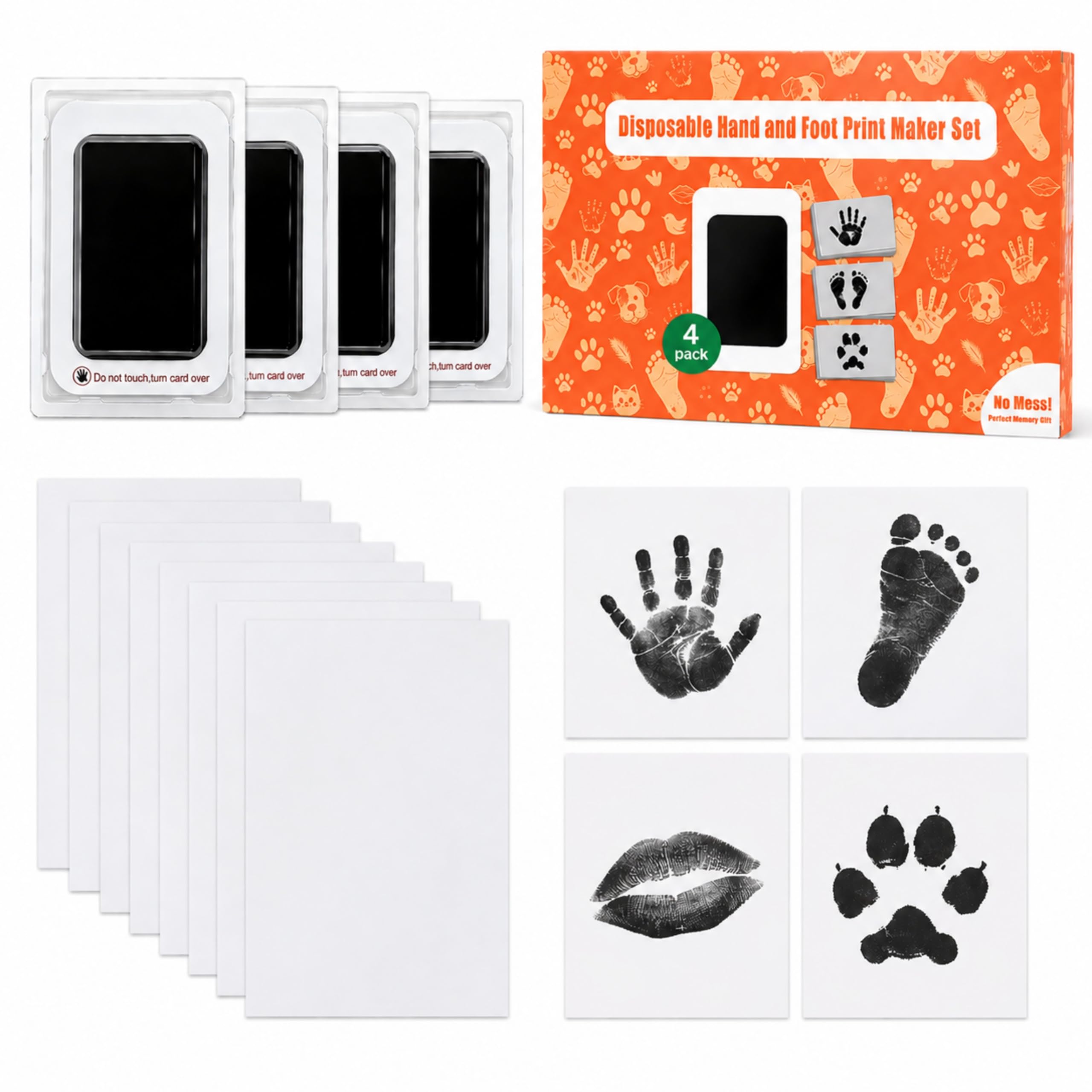
Key Features
- Ink pads: 4
- Print method: Inkless clean-touch
- Imprint cards: 8
- Ink pad window: 2.36" x 3.74"
- Price: Budget
Four pads and eight cards is a sensible shape for a spare-attempt kit. We recommend the PATO set for baby books and extra prints, because it gives you enough goes to try a hand, a foot, and a redo without committing to a frame. The clean-touch window is compact, and the inkless design keeps wet ink off the baby.
It is a simple kit, and that is the appeal. There is no clay to knead, no glass to worry about, and no display decision to make. The cards are the keepers, so choose your best print and file it in a baby book or a frame you already own. For a first-time parent who wants a low-stakes first attempt, that is a useful thing to have in the drawer.
If you are choosing between this and a framed kit, start with the frame when the wall is the goal; choose this when the baby book is the goal. The eight cards give you room to be picky, which is the real luxury with a wiggly subject.
Pros
- Four pads and eight cards
- Clean-touch inkless process
- Works for baby and pet prints
Cons
- No frame or display included
We recommend the PATO four-pack as a spare-attempt kit for baby books, with enough pads and cards to get a hand, a foot, and a redo.
Best for Single Keepsake Print
ReignDrop Ink Pad
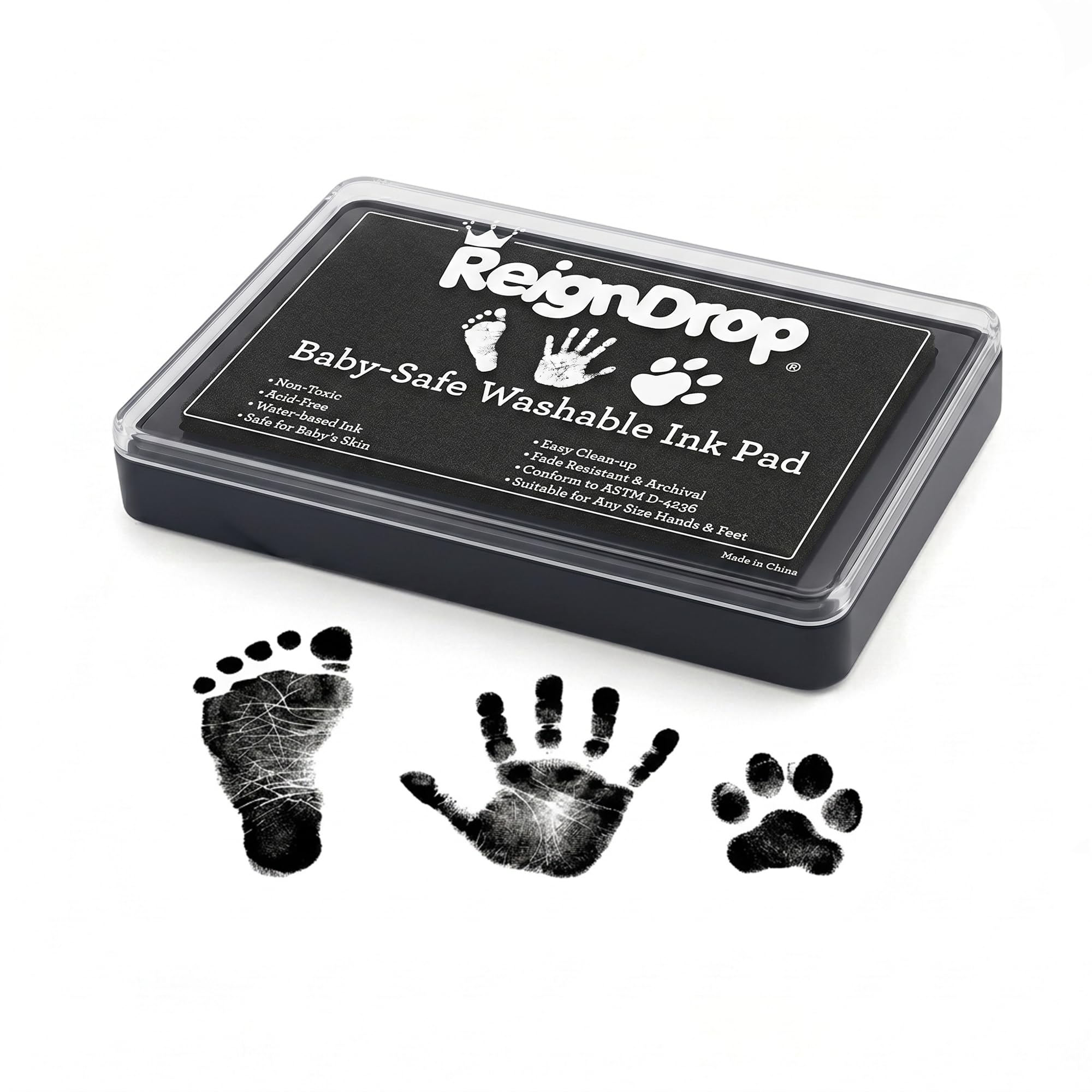
Key Features
- Ink type: Non-toxic, acid-free
- Material: Sponge
- Pad size: 3.74×2.48 inches (9.5×6.3 cm)
- Print method: Pre-inked sponge pad
- Price: Budget
A single pre-inked sponge pad is the simplest version of this purchase. There is no frame, no clay, and no stack of cards to manage: you dab the pad on the hand or foot, press it to paper, and wipe the skin clean. The pad is smaller than the multi-packs, so it suits a newborn foot or a small paw better than a toddler’s hand.
The size is compact and the sponge is pre-inked, so there is no bottle to open or pad to assemble. That makes it easy to keep in a diaper bag for a first print. The ink is labeled non-toxic and acid-free, and the pad works for a pet paw print as well as a baby’s foot. It is a one-color, one-surface tool, so there is not much to learn.
We recommend it when one good print is the whole job. It is not the one we reach for when we want a matching hand and foot set or a frame-ready result. For a single baby-book page or a paw print, though, it is the least fussy thing here.
Pros
- Single pre-inked pad
- Non-toxic, acid-free ink
- Works for baby and pet prints
Cons
- Can dry out before use
- May need several washes to clean skin
We recommend ReignDrop as a single-pad option for one keepsake or a pet paw print, not for a many-print session.
How We Tested 14 Baby Hand and Foot Print Kits
We started with roughly 40 kits and cut the field to 14 for hands-on testing, filtering first by ink format (stamp pad, inkless, and clay), then by whether a kit included archival cards, extra paper, and clear safety documentation. Anything that charged a frame-sized premium for two sheets of cardstock didn’t make the cut. Testing ran across four months, with babies ranging from two weeks old to just sitting up.
Most of the work happened on the changing table right after a nap or a warm bath, when hands are uncurled and feet are relaxed, plus a few sessions during a grandparents’ visit where we made duplicate prints. We timed each attempt from opening the box to a finished print and counted how many tries it took before one landed clean enough to keep. Then came cleanup: how many wipes it took to get ink off a palm, whether it lifted off a countertop, and whether anything transferred to a onesie on the way to the sink.
We checked prints at ten minutes and again the next morning for smudging and drying time, since a print that looks perfect on the card and smears under a thumb is no keepsake. We also compared a newborn print to a six-month print on the same card to see whether the sizing held up, and noted whether the finished card dropped into a standard frame. Kits earned credit for producing several usable prints without buying refills, and for packaging that could be handed over as a gift without a trip to the store.
How to Choose a Baby Hand and Footprint Kit
The best kit is the one that matches how much mess, waiting, and display space you are willing to take on.
Start with the print method
Clay gives you a dimensional impression and a finished object that feels more like a sculpture than a piece of paper. The trade-off is timing: air-dry clay begins to set as soon as it is unwrapped, and it can crack as it cures. Clean-touch ink pads keep wet ink off the baby and produce a flat print on a card, which is easier to redo but can stay tacky. We choose clay when the frame is the point and inkless when the baby book is the point.
Decide whether you want a frame or just prints
Framed kits solve the display problem for you: the print has a home, and the glass keeps dust off. They also commit you to a size and a layout, and some frames hold only one print. A pad-and-card kit is more flexible: you can put the best print in a baby book, add it to a frame you already own, or give a second copy to grandparents. If you are unsure, buy the frame kit first and add a multi-pack for extra attempts.
Match the print window to the baby’s age
Newborn kits are sized for tiny hands and feet, often with an ink window around 2.5 by 3.5 inches. That is perfect for the first few months and frustrating once the baby grows. If you want a print from a sitting baby or a toddler, look for a kit that explicitly says it captures prints up to age three, like the Green Pollywog frame. The trap is assuming ‘baby’ means any age; check the stated range before you buy.
Count the attempts before you start
A single pad is a single shot, and a wiggly newborn can turn a good print into a smudge. We prefer at least two pads or a kit with several cards, because the second attempt is often the one you keep. Four pads and twelve cards, as in the Pearhead kit, give you room for a hand, a foot, and a redo. If you are buying a framed kit, check whether it includes a spare pad or card.
Plan for drying and cleanup
Clay starts to set quickly, so stage the roller, tray, and frame before the baby is in position. Inkless prints need a flat, out-of-reach place to cure; stacking cards too soon is how smudges happen. Keep the baby’s skin clean with a wipe or mild soap and water, and follow the kit’s instructions for the ink. A little prep turns a tense five-minute window into a print you actually want to display.
Frequently Asked Questions
How do I get a good print from a wiggly newborn?
Wait until the baby is deeply asleep or calm after a feed, and use two people: one holds the limb steady, the other presses the pad or clay. Press the material to the hand rather than pulling the hand to the material, and keep a spare card or pad within reach. A practice press on your own hand teaches you how much pressure the pad needs.
Can I use a baby print kit for a pet?
Yes, many clean-touch pads and some clay frames work for a paw or nose print. The limiting factor is the window: a pad around 2.5 by 3.5 inches suits a newborn or a small pet, while a large dog’s paw needs a bigger surface or a clay kit you can roll wider. Check the pad size before you buy.
Will the prints fade over time?
Some pads use archival ink, and those prints hold up better in a baby book or frame. If the kit does not say archival, keep the print out of direct sun and away from damp, and take a phone photo as a backup. For a display piece, glass or a frame helps more than leaving the card on a shelf.
Final Verdict
For most families, the KeaBabies clay duo is the one to buy: it gives you a finished, personalized frame with both prints, and the extra prep is worth it for a keepsake you will actually hang. If clay sounds like a stress you do not need, PewinGo’s inkless frame kit is the easier route. For loose prints and multiple attempts, Pearhead’s four-pack is the practical add-on.
