This post contains affiliate links. We may earn a small commission when you buy through our links — at no extra cost to you.
Pregnancy is not the moment to gamble on a mystery ingredient panel. I wanted more protein without a scoop of stimulants, sketchy herbs, or a chalky shake I’d abandon after two sips. The label matters more than the flavor banner: added sugars, sugar alcohols, gums, fillers, and caffeine can all hide in a tub that looks wholesome.
A good protein powder should make it easier to hit your protein needs on days when meat, eggs, or a full meal sounds awful—not add a new worry. Over six months, my team and I mixed 14 powders into morning smoothies, afternoon shaker cups, and small bedside glasses for queasy days. We looked for powders that dissolved without a gritty finish, tasted clean rather than candy-sweet, and left us comfortably full instead of bloated.
Some were whey, some plant-based; some leaned on fiber and probiotics, while others kept the ingredient list short. The picks below are the ones we’d actually keep in rotation, whether you’re blending a full breakfast or just trying to get a few more grams in before a prenatal appointment.


Best for Highest Protein
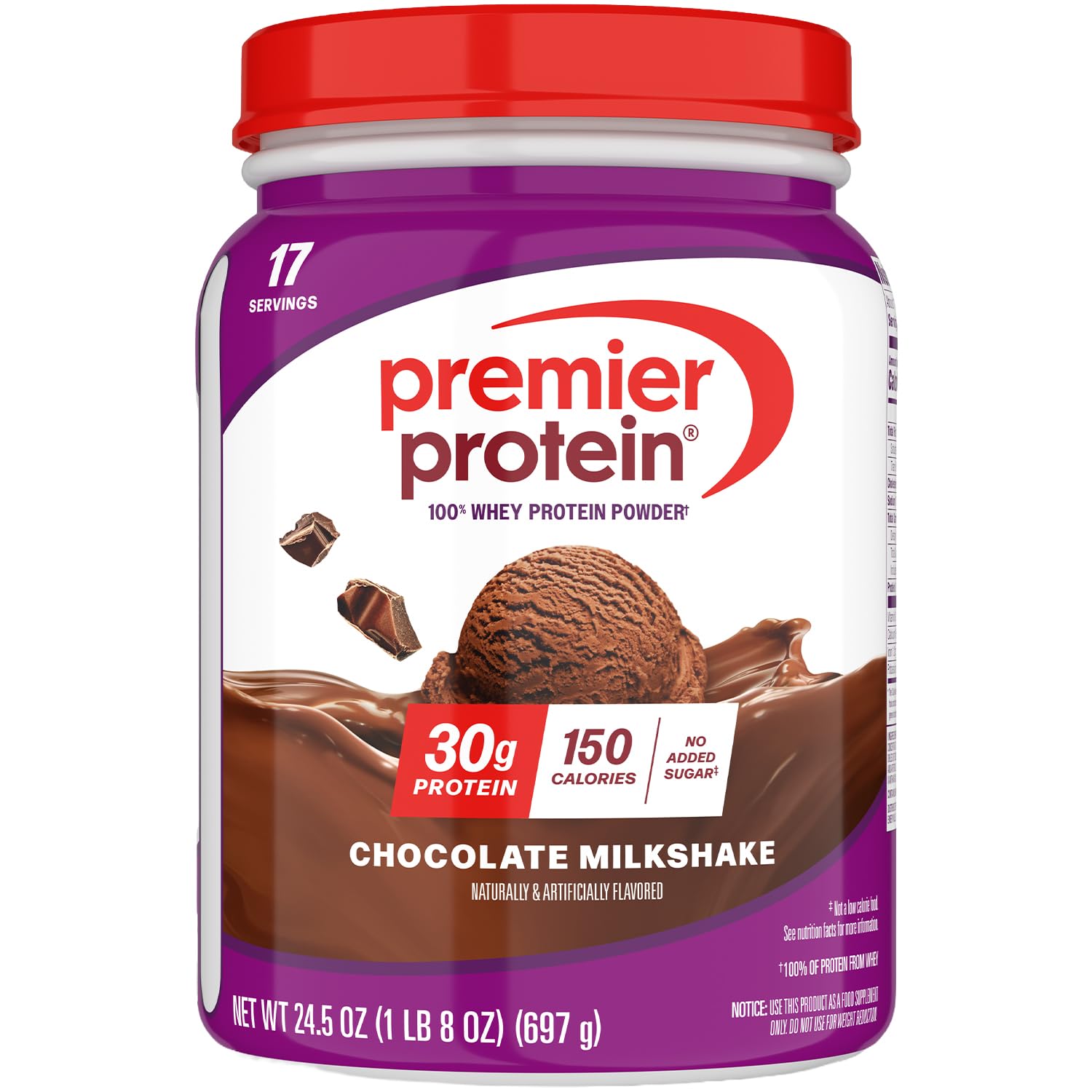
Premier Protein 30g Whey
Key Features
- Protein source: 100% whey
- Servings per tub: 17
- Sugar per serving: 0.04 oz
- Protein per serving: 1.06 oz
- Price: Midrange
Thirty grams of protein in one scoop is the number that decided this for us. Most everything else here lands in the low twenties, which means a second scoop, a thicker shake, and a longer sit at the counter — three things that are hard to sell when your appetite has shrunk and your stomach is negotiating. Fewer, smaller sips that still clear 30 grams is exactly the job a pregnancy protein powder needs to do.
It also happens to be the best-tasting whey we tried. The chocolate is rich without the fake-candy edge that makes so many powders taste like a candle, and it carries 1 gram of sugar, 3 grams of carbs, and 150 calories — numbers that leave room for an actual breakfast. All nine essential amino acids come with it, which plant blends have to work harder to assemble.
The catch is dairy, plainly. If lactose has started to disagree with you, skip this one. The other quirk is clumping: dump the powder into the water and you get a shaker full of paste, so put the liquid in first and the scoop second and it comes out smooth. Seventeen servings per tub means a daily scoop gets you about two and a half weeks, so buy with that in mind.
Pros
- 30g of complete whey protein per scoop
- 1g sugar, 3g carbs, 150 calories
- Best-tasting whey in this group
Cons
- Dairy-based, so off the table with lactose trouble
- 17 servings per tub go quickly
For the most protein in a single scoop with barely any sugar, this is our pick — as long as dairy still sits well with you.
Best for Plant-Based Diets
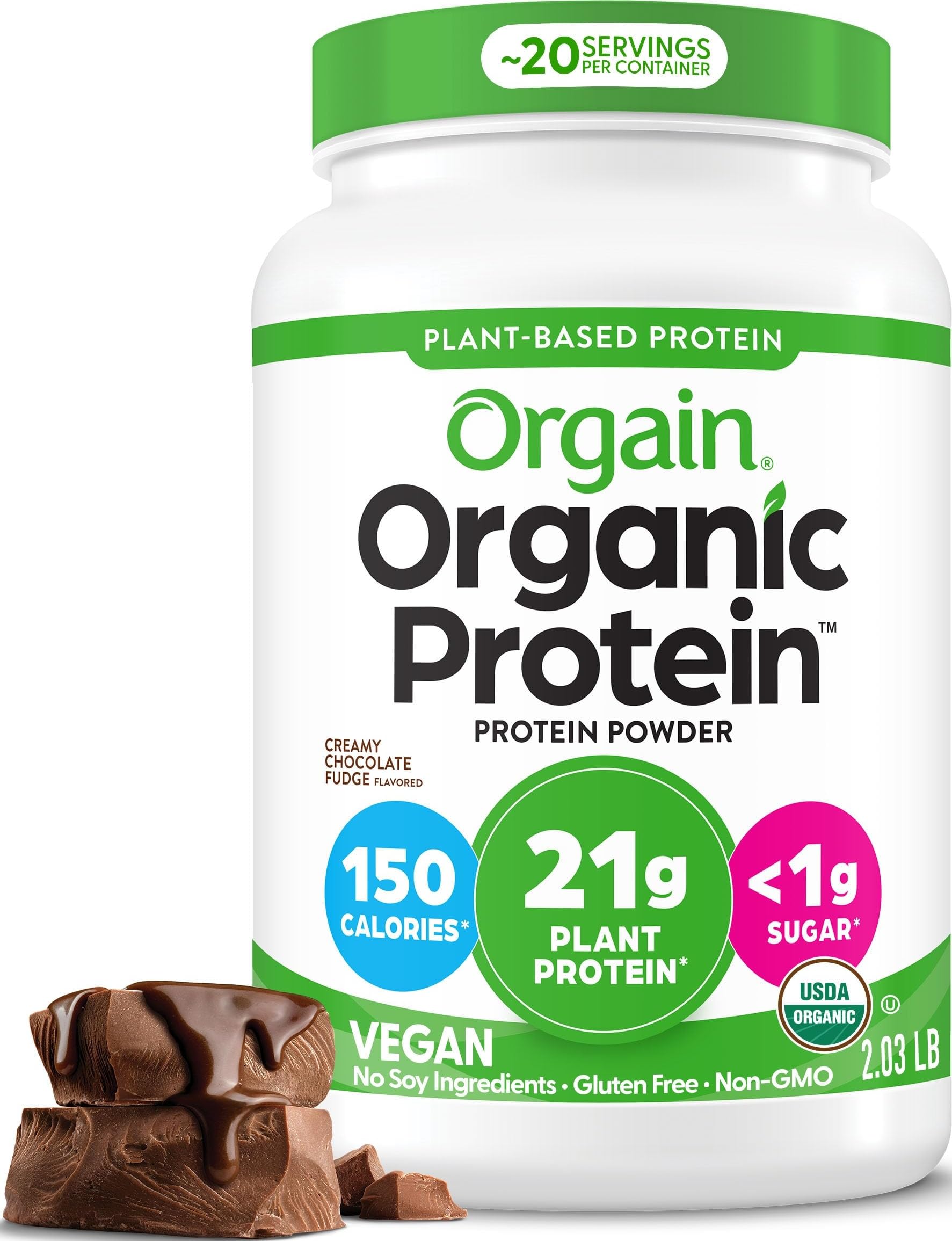
Orgain Organic Vegan 21g
Key Features
- Protein source: Pea, brown rice, chia
- Fiber per serving: 0.25 oz
- Sugar per serving: 0g
- Protein per serving: 0.74 oz
- Price: Budget
If Premier is the whey answer, this is the plant one, and it’s the tub we reached for on the days a dairy shake felt like too much. Twenty-one grams of complete protein from organic peas, brown rice, and chia, zero sugar, and seven grams of prebiotic fiber is a combination that’s genuinely hard to find at this price.
What we appreciate most is that nothing on the label needs translating. It’s USDA Organic, vegan, gluten-free, made without soy or carrageenan or erythritol, and the ingredient list stays short. Twenty-one grams is a real contribution to a day’s protein rather than a token sprinkle, and the fiber counts for something in a category where regularity is a daily project.
Texture is where the deal gets harder. In water alone it’s sweet and a little sandy, and no amount of shaking changes that. We had much better luck with unsweetened almond milk and a frozen banana, which gets it close to a milkshake — worth knowing before your first glass. The vanilla is the milder of the two flavors if chocolate reads too sweet for you.
Pros
- 21g complete plant protein with zero sugar
- 7g prebiotic fiber per serving
- Short, organic, dairy-free ingredient list
Cons
- Sweetness runs high, especially in chocolate
Our plant default: complete organic protein with zero sugar and real fiber, if you can live with a chalky shake.
Best for Sensitive Stomachs
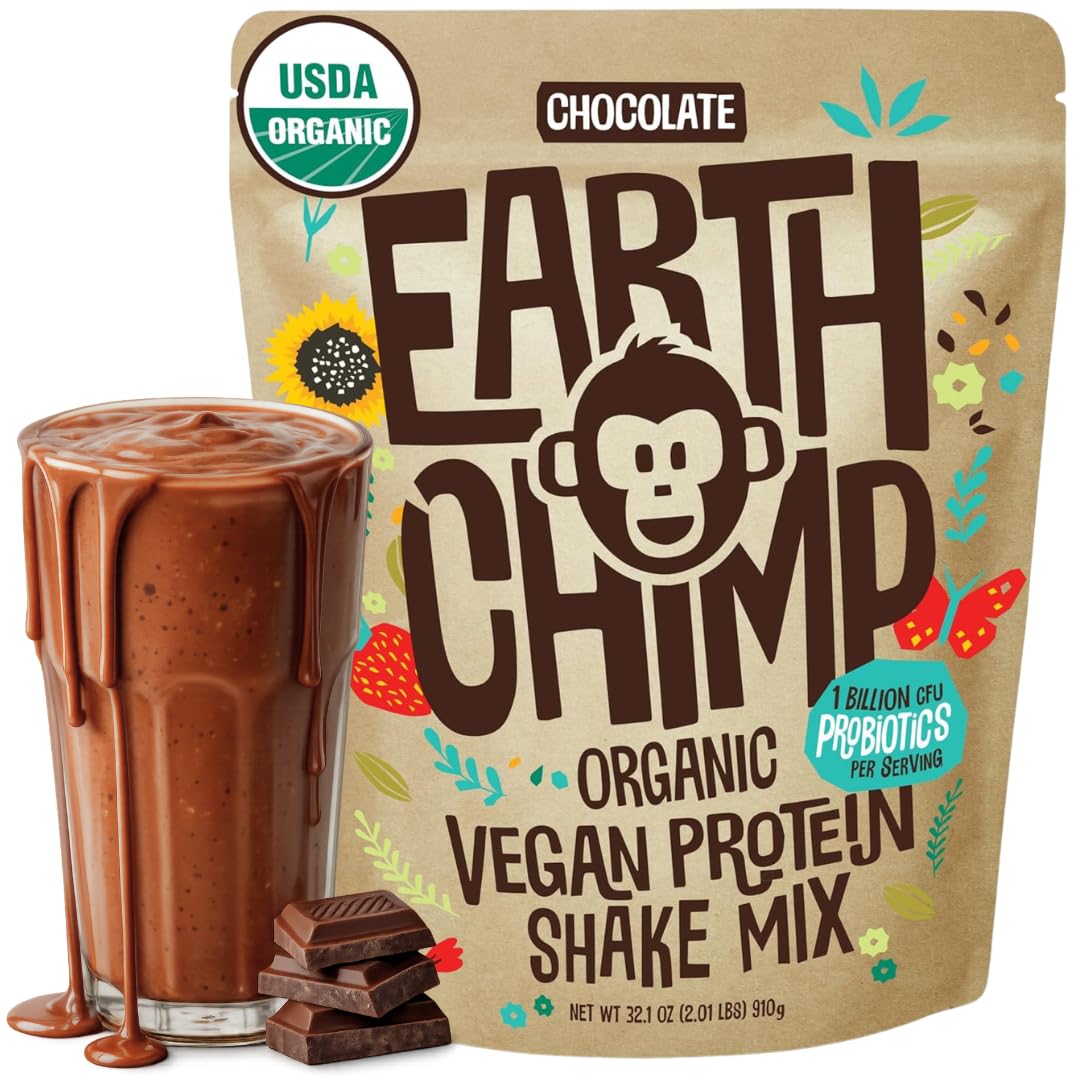
EarthChimp Organic Vegan
Key Features
- Added sugar: 0g
- Servings per tub: 26
- Fiber per serving: 0.14 oz
- Protein per serving: 0.71 oz
- Price: Midrange
The list of what EarthChimp leaves out is longer than what goes in. No stevia, no erythritol or other sugar alcohols, no carrageenan, no artificial sweeteners — the sweetness comes from monk fruit, dates, and organic cocoa instead. When your digestive system has become the most opinionated member of the household, a short list of unknowns is worth paying for.
Under the hood it’s 20 grams of plant protein with all nine essential amino acids, 4 grams of fiber, 120 calories, and a billion CFU of Bacillus coagulans per serving. Of the plant powders here, this is the one that gave us the least trouble — nothing to plan the morning around. The chocolate tastes like dark chocolate rather than candy, which is either the selling point or the dealbreaker depending on the cravings you wake up with.
Twenty-six servings per tub puts it at the higher end of what we recommend spending, and it’s the pricier of our two plant picks. What you’re paying for is the difference between a powder you tolerate and one you look forward to, which for a lot of pregnant shoppers is the only comparison that ends up mattering.
Pros
- No stevia, sugar alcohols, or carrageenan
- 1 billion CFU probiotics plus 4g fiber
- Smoothest plant texture in this group
Cons
- Costs more per tub than Orgain
The plant powder we point people to when their stomach has stopped cooperating: clean sweeteners, live probiotics, and the smoothest texture here.
Best for Unflavored Blending
Sprout Living Pumpkin Seed
Key Features
- Flavor: Unflavored
- Protein source: Cold-pressed pumpkin seed
- Servings per tub: 14
- Protein per serving: 0.71 oz
- Price: Midrange
There is no flavor here at all, which is either the entire point or an instant no. The ingredient list is a single line: cold-pressed organic pumpkin seed. No sweetener, no gum, no natural flavoring, nothing to read twice.
That blankness is what makes it the most useful tub in the group. When sweet smells turn your stomach — and in the first trimester they often do — you can stir this into oatmeal, soup, mashed sweet potato, or a smoothie you already like, and it takes on whatever is around it. The 20 grams of complete protein arrive with all nine essential amino acids, plus magnesium, zinc, and iron that come from the seed itself rather than a fortification blend.
Two things to weigh. It’s 14 servings, so despite a modest-looking tub it’s the priciest of the plant powders per serving. And in water it’s gritty; blend it or stir it into something with body and the grit disappears into the texture of the food. Think of it as an ingredient rather than a shake.
Pros
- Single ingredient, zero sweeteners
- 20g complete protein with all nine EAAs
- Disappears into savory food and smoothies
Cons
- Only 14 servings per tub
One ingredient, no sweetener, twenty grams of complete protein — the tub to reach for when every flavored shake tastes wrong.
Best for Peanut Butter Lovers
PB2 Performance Peanut
Key Features
- Sweetener: Monk fruit
- Added sugar: 0g
- Protein source: Peanuts and brown rice
- Protein per serving: 0.71 oz
We went in expecting a gimmick — peanut butter powder wearing a protein label. It isn’t. Roasted peanuts sit first on the ingredient list, and there are only six entries: peanuts, brown rice protein, inulin, cocoa, salt, and monk fruit extract. That’s a shorter list than almost anything else in this aisle.
Each serving brings 20 grams of complete vegan protein with no added sugar, plus prebiotic fiber. The peanut does most of the flavor work, so it tastes like a dessert without the sweetness of one, and the cocoa runs deep rather than sugary.
What changed our mind was how often we wanted it. Powders that are merely tolerable get pushed to the back of the shelf; this is the one we found ourselves mixing on purpose, and that’s the whole battle when appetite is unreliable. Cold water and a shaker with a metal ball get it most of the way there.
One hard limit: peanuts. With an allergy in the house this is a no regardless of how it tastes, and the inulin can take a few days to get used to if you’re adding fiber suddenly.
Pros
- Six ingredients, peanuts first
- 20g complete vegan protein, no added sugar
- A flavor we actually craved
Cons
- Gritty even after a long shake
- Off-limits with a peanut allergy
A six-ingredient chocolate-peanut shake with real peanuts first and no added sugar — the one we actually looked forward to drinking.
Best for Organic Label Shoppers
Garden of Life Raw Organic

Key Features
- Protein source: Organic peas, sprouted grains, seeds, legumes
- Servings per tub: 20
- Fiber per serving: 0.18 oz
- Protein per serving: 0.78 oz
- Price: Midrange
This is the tub for the shopper with a checklist: organic, plant-based, no sugar, probiotics, digestive enzymes, non-GMO. Twenty-two grams of complete plant protein from peas, sprouted grains, seeds, and legumes, 5 grams of fiber, 130 calories, and a stack of certifications on the back of the label.
It’s also the most explicit about what the extras are for. Lactase and papain are enzymes that help break down milk sugar and protein, and the live probiotics are there for gut health — practical additions for anyone whose digestion has been rewritten by pregnancy.
Then you take a sip. Texture is where this one loses us: it’s chalky and gritty in a way that blending never fully smooths out, and the vanilla lands sweet with an earthy undertone that isn’t for everyone. For something you’re meant to drink daily, that’s a real cost rather than a quirk.
Here’s who it still fits. If organic certification plus a probiotic-and-enzyme package is the reason you’re shopping, few labels here are stronger, and the 5 grams of fiber earn their place. If you mainly want a shake you’ll look forward to, put the same money toward EarthChimp instead.
Pros
- 22g complete organic plant protein
- Probiotics plus digestive enzymes
- 5g fiber and 130 calories
Cons
- Chalky, gritty texture that blending doesn’t fix
- Only 20 servings per tub
Twenty-two grams of organic plant protein with probiotics and digestive enzymes — a strong label attached to a chalky shake.
Best for Built-In Extras
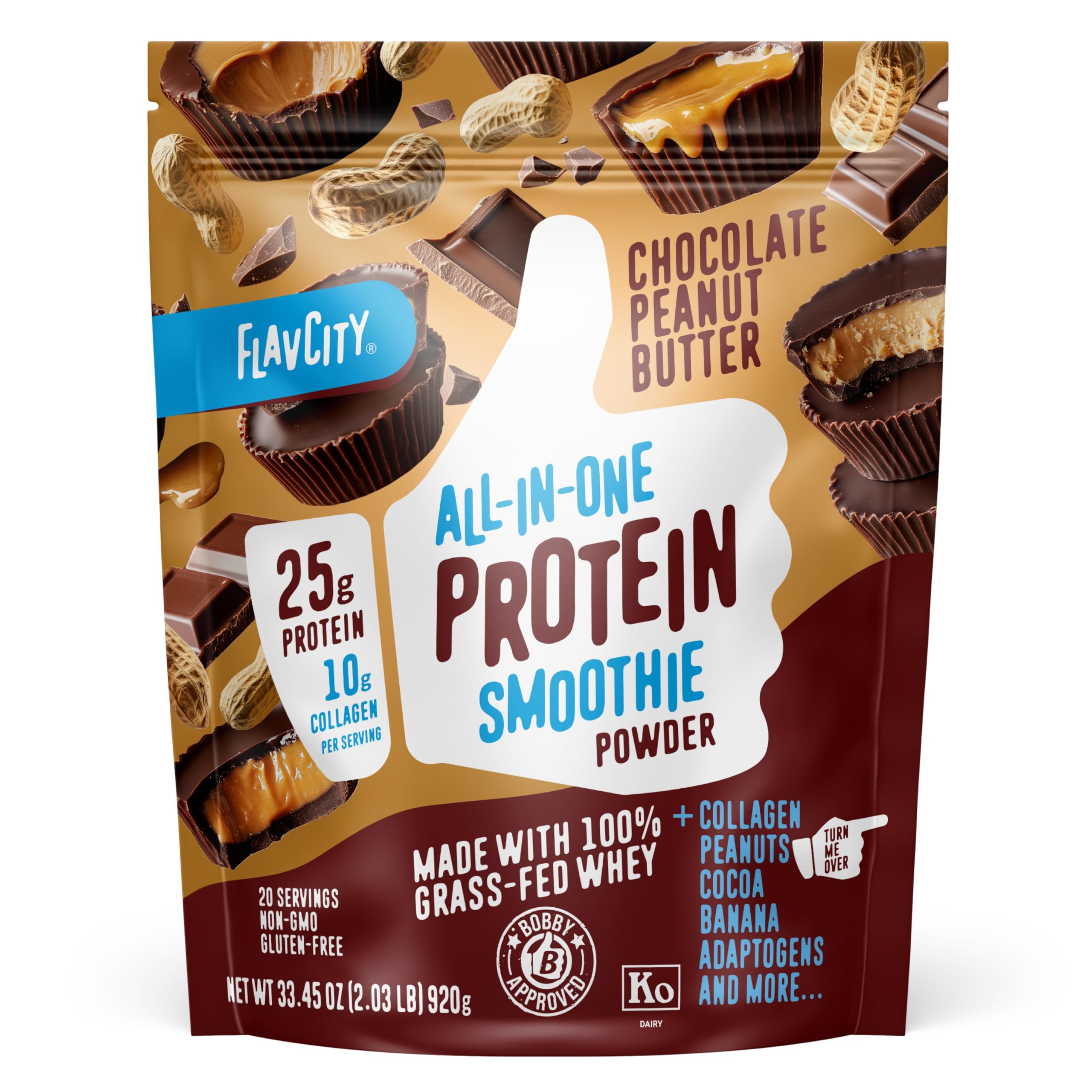
FlavCity All-in-One
Key Features
- Protein source: Grass-fed whey
- Servings per tub: 20
- Protein per serving: 0.88 oz
- Collagen per serving: 0.35 oz
- Price: Premium
This is the most expensive tub we recommend, and by a wide margin per serving. The pitch is that you’re buying three products in one: 25 grams of protein from grass-fed whey, 10 grams of collagen peptides, and a functional mushroom blend, all in a scoop you can shake in water with no blender involved.
The shake itself is the best part of the package. Chocolate peanut butter comes out rich and creamy with none of the chalk that haunts plant powders, and it’s the smoothest thing in this guide by a comfortable distance.
The extras are where your own judgment matters more than ours. Collagen peptides are there for skin, hair, and joints rather than for muscle, and a mushroom blend is a supplement inside a supplement — the amounts aren’t spelled out, and an undisclosed blend is the kind of thing to be conservative about while pregnant. FlavCity does state third-party testing, which is more transparency than most here offer.
Our read: if you were already going to buy collagen and a mushroom supplement separately, folding them into one good-tasting scoop is a reasonable trade. If you want protein and nothing else, you’re paying a premium for ingredients you never asked for — and per serving, it’s the priciest pick in this guide.
Pros
- 25g grass-fed whey plus 10g collagen
- Richest, creamiest texture here
- States third-party testing
Cons
- Highest price per serving in this guide
- Mushroom blend amounts aren’t disclosed
One scoop of grass-fed whey, collagen, and mushrooms — the premium choice if you want the extras built in, not if you just want protein.
How We Tested Protein Powders for Pregnancy
We started by reading every ingredient panel before we mixed anything, filtering out powders with proprietary blends, caffeine, added herbs, or a protein number that depended on a two-scoop serving. We also noted added sugars, sugar alcohols, gums, fillers, fiber, probiotics, and whether the protein came from dairy or plants. From there we narrowed a longer list to 14 powders and tested them for six months.
Each powder got used in the same three places: a 7 a.m. smoothie with oat milk and half a banana, a 3 p.m. shaker cup with plain water, and a small bedside glass on queasy first-trimester mornings. We timed how long it took to disperse, checked for clumps and grit at the bottom of the cup, and noted whether the texture turned chalky or slick. We drank them plain enough to judge flavor and aftertaste, then logged bloating, cramps, and how long we stayed full.
We calculated cost per serving instead of cost per tub, counted actual servings per container, and compared grams of protein per scoop rather than the flashy number on the front. The powders that moved forward were the ones we could mix without a blender, digest without a heavy stomach, and reach for again the next day.
How to Choose a Protein Powder for Pregnancy
The powder that works is the one you can finish, so protein density and an honest label come first, but taste and texture decide whether the tub empties or expires.
Look at Protein Per Scoop, Not Per Tub
Your provider sets your daily protein target, and most pregnant people land somewhere around 70 to 100 grams a day. A powder is there to close a gap, not to carry the whole number. That makes grams per scoop the first thing to check: a 30-gram scoop covers nearly half the low end in one go, while a 20-gram scoop asks for two servings on a day when food is already a struggle.
Scoop size cuts both ways. Smaller scoops mix into less liquid and go down easier when your stomach is compressed and unenthusiastic; bigger ones mean fewer servings in the tub and a faster restock. Before you decide a tub is a bargain, divide by servings rather than by pounds.
Whey or Plant? Start With Your Stomach
Whey is a complete protein, mixes thin, and is usually the cheapest route to a lot of grams. It’s also dairy, and lactose tolerance has a way of changing during pregnancy. If milk has started to sit heavily, a whey shake will too, no matter how good the flavor is.
Plant blends reach a complete amino acid profile by combining sources — peas with brown rice and chia is the classic pairing — and they bring fiber along, which helps when regularity is a daily project. The trade is texture: plant powders are where grit and chalk show up, and some carry more sweetness than the label suggests. If you’re dairy-free by choice or by force, shop plant and blend with milk and frozen fruit rather than water alone.
Read the Label Like You’re Suspicious
Protein powders are sold as supplements, which means the label isn’t reviewed before it ships the way a food label is. That raises the value of two things: a short, fully disclosed ingredient list, and independent testing. Blends are the quiet trap — a fifty-superfood or functional-mushroom panel usually doesn’t say how much of anything is in the scoop, and in pregnancy fewer unknowns is the better bet.
Check sugar and sweeteners on the same pass. One gram of added sugar per serving is nothing; a dozen is a dessert with a health claim. Sugar alcohols and a heavy fiber load can also turn a shake into a stomach ache if you’re new to them. If a brand publishes a third-party testing certificate, count that in its favor — FlavCity is the one here that states testing outright.
Taste and Texture Decide Whether You Finish the Tub
A powder you dread is a powder that expires. Nausea and food aversions can make a flavor you loved last month unbearable, so start with the smallest size you can find. Chocolate hides off-notes better than vanilla; cold and thin goes down more easily than thick and creamy; and an unflavored powder lets you add protein to savory food on days when a sweet shake is unthinkable.
Texture is the other half. Grit is most common in plant powders and least common in whey, and no flavor can rescue a shake that feels like drinking sand. Blending with milk and frozen fruit does more than extra shaking ever will, and a shaker with a metal mixing ball beats the plastic grate that comes in the tub.
Frequently Asked Questions
Do I need to ask my OB before adding a protein powder?
Worth a mention, yes — bring the label to your next appointment or send a photo through the portal. It matters most if you have gestational diabetes, blood pressure concerns, or any kidney condition, and it’s a good moment to confirm your daily protein target.
Keep taking your prenatal vitamin separately; a protein powder doesn’t stand in for it, and the two do different jobs.
Can I mix protein powder into hot food or bake with it?
Yes, with a little care. Stir whey into oatmeal or pancake batter off the heat rather than boiling it, because high heat makes it clump and turn grainy. Plant powders survive baking better but can go gritty in thin liquids.
An unflavored powder is the most forgiving in savory dishes — a flavored shake in a soup tastes exactly as odd as it sounds.
How long does an open tub last?
Check the servings line rather than the tub size. The picks here run from 14 to 26 servings, so at a scoop a day you’re looking at roughly two to four weeks.
Store it sealed in a cool, dry cabinet — not the refrigerator, where condensation turns powder into bricks — and write the open date on the lid so you’re not guessing later.
Final Verdict
The deciding advantage is density. Premier Protein’s 30 grams per scoop means one small, genuinely good-tasting shake covers close to half a day’s protein on the days a full meal isn’t happening. If dairy is out, Orgain’s plant powder is the closest thing to a default: complete protein, zero sugar, real fiber, and a texture you can improve with milk and a frozen banana.
And if your stomach has been running the show since week six, spend the extra on EarthChimp — no sugar alcohols, live probiotics, and the smoothest plant shake here. The rest of the list exists for specific jobs: an unflavored scoop for savory food, and a premium all-in-one for anyone already buying collagen.
