This post contains affiliate links. We may earn a small commission when you buy through our links — at no extra cost to you.
For the first few months, a bassinet is the piece of gear you touch more than any other — usually half-awake, in the dark, with one hand. What you need from it is narrow and specific: it holds your baby safely at arm’s reach, it lets you get to them without fighting a zipper at 3 a.m., and it doesn’t swallow the bedroom you’re already sharing. A good one makes those overnight weeks quieter for everyone in the room; the wrong one hands you a wobble, a stuck wheel, or a folding job you have to wrestle through before coffee.
I’ve assembled more of these on bedroom floors than I’d like to admit, and the differences show up almost immediately. My team and I spent six months living with 11 bassinets — beside our own beds, in a small apartment, and on a weekend trip to a grandparent’s house — and the pattern was consistent. Here’s the thing first-time buyers learn the hard way: the side panel matters more than the canopy. A zipper that drops the wall quietly, one-handed, buys you more sleep than any rocking setting on the market. Below are the ones that earned their floor space.


Best for Everyday Bedside Use
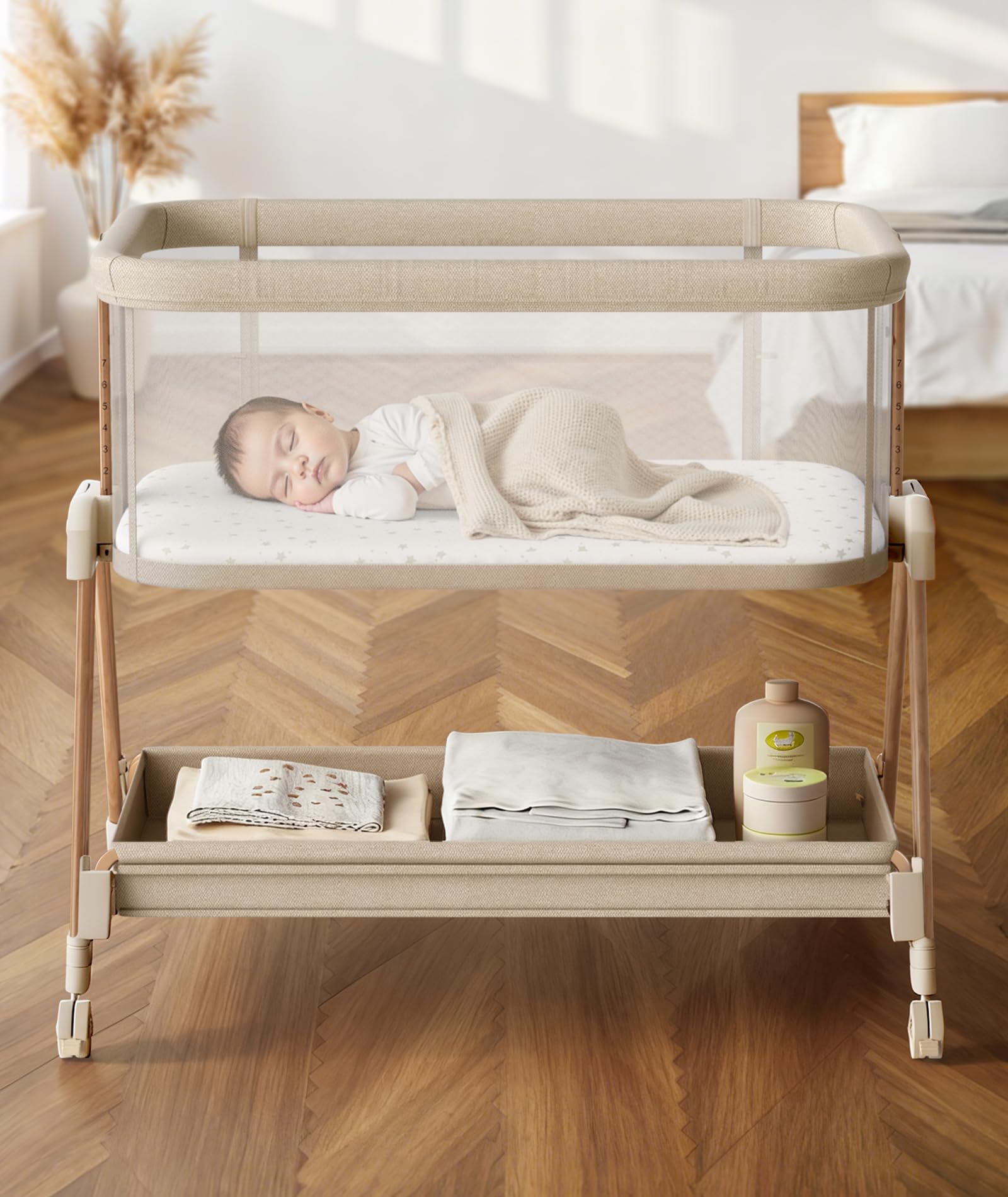
Fodoss 3-in-1 Bedside Bassinet
Key Features
- Storage: Under-basket and side pocket
- Dimensions: 34"L x 22"W x 35"H
- Weight limit: 19.8 lb
- Height settings: 7
- Price: Midrange
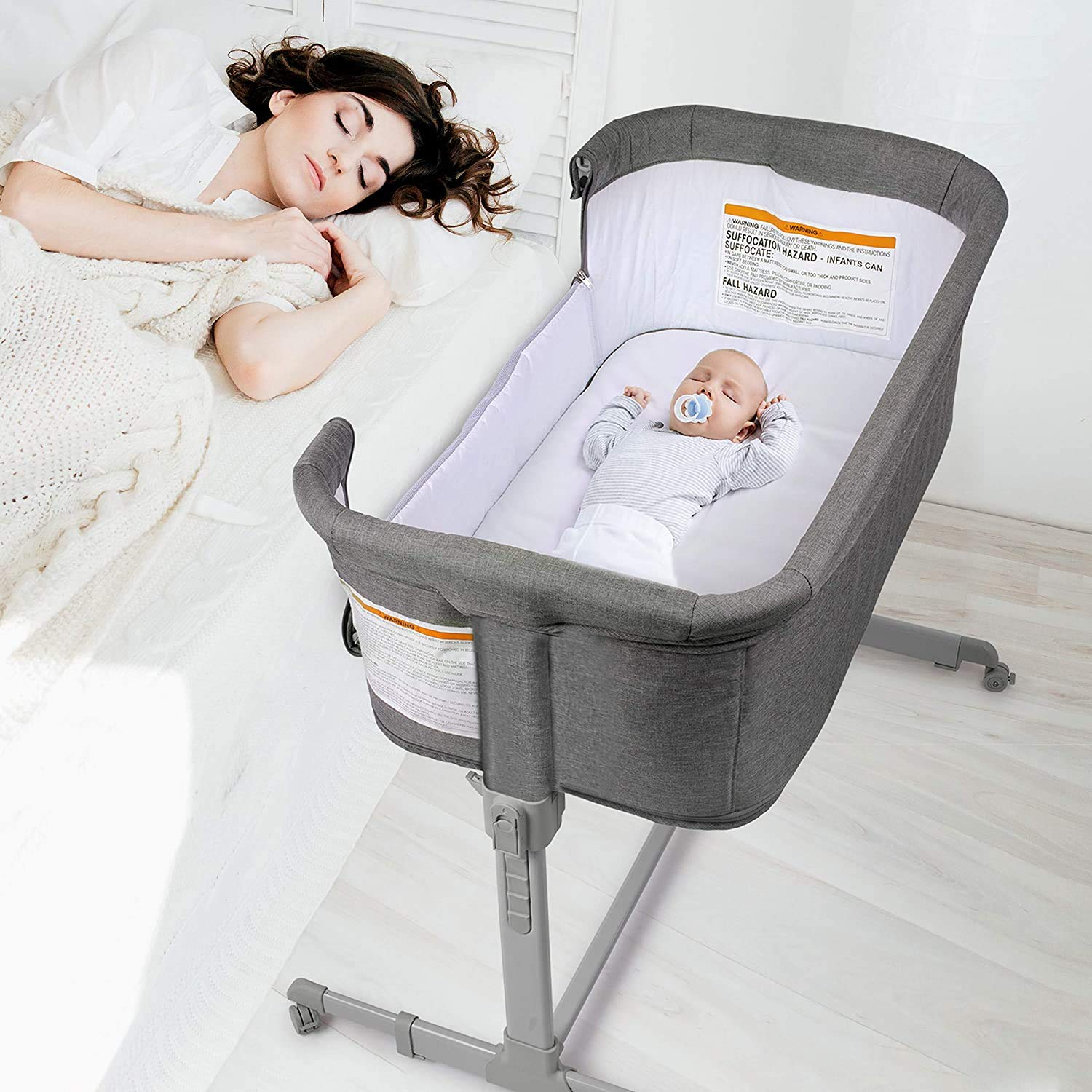
Seven height settings and mesh on all four sides is the pairing that earns this one the top spot. The frame adjusts through enough range to meet a standard mattress, the panels are mesh from the mattress up on every side, and the footprint is 34 by 22 inches — wide enough that a newborn isn’t pressed against the ends, compact enough to slot into the gap beside a queen bed. We kept coming back to how little it asks of you: the basket underneath takes a night’s diapers and wipes, the side pocket holds a pacifier and a burp cloth, and the locking wheels stay put until you want them to move.
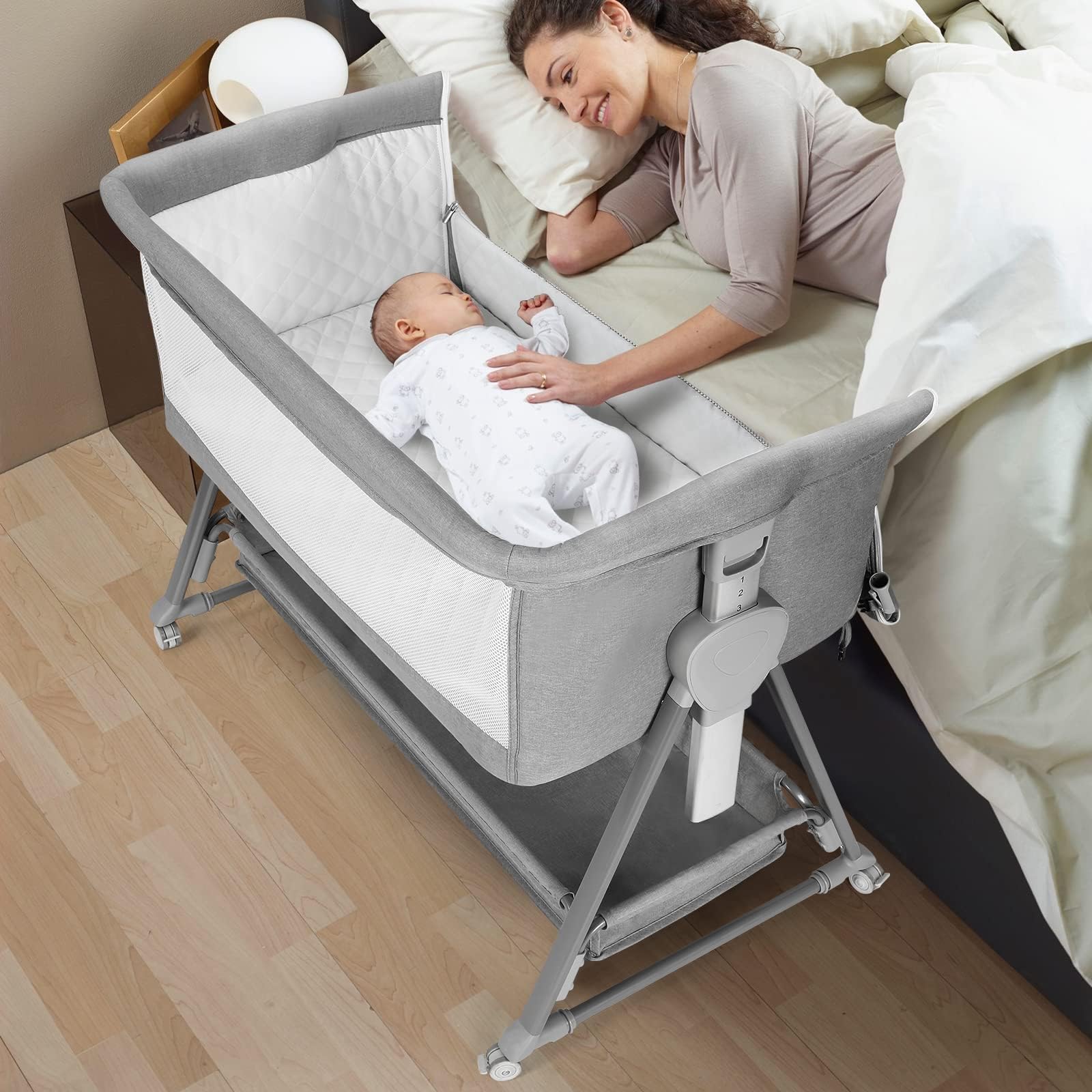
Setup is the part we expected to resent and didn’t. It goes together quickly and feels rigid once the base is squared, and the drop side lowers quietly rather than with a zip you have to fight. That’s the difference between a bedside sleeper you use every night and one you stop bothering with at 3 a.m. The mattress sits flat, the sheet tucks under, and the mesh means you can check on a sleeping baby from the pillow without turning on a light.
The care instructions are the small annoyance: the fabrics are hand wash only, so a middle-of-the-night spit-up means spot cleaning until morning. Two fitted bassinet sheets solve most of it, and we’d suggest buying them at the same time as the bassinet rather than after the first accident. It also works standalone, so it moves to the living room once the bedside phase ends.
Pros
- Seven height settings to match most beds
- Full mesh on every side for airflow
- Under-basket and side pocket for night essentials
Cons
- 19.8-pound limit is low for this group
We make the Fodoss 3-in-1 our default pick: it lines up with most beds, walls the baby in mesh on every side, and keeps a night’s supplies within reach.
Best for Tall Beds
Milliard Bedside Bassinet Sleeper
Key Features
- Dimensions: 35.5 x 20.5 x 41 in
- Weight limit: 20 lb
- Bed height fit: 23 to 31 in
- Storage pockets: 4
- Price: Premium
The number that matters on the Milliard is 23 to 31 inches: the range of bed heights it is built to sit against, measured from the floor to the top of your mattress. If your bed is tall — a thick mattress on a platform, a frame you have been bending double to reach into — this is the one that lines up. The sleep surface measures 35.5 by 20.5 inches and the mesh walls run down both sides.
We noticed the height range first and the composure second. Set near the top of its adjustment and strapped to the bed with the included straps, the Milliard sits still, and the four pockets on the outside mean wipes and a spare diaper live on the bassinet rather than on your nightstand. It is the pick we point tall-bed buyers to, and the one for anyone who does not want to bend at night.
The casters are the compromise. They are small and they drag on carpet and rugs; on a hard floor it rolls fine, and if it lives in one spot the wheels stop mattering at all. Assembly takes one person a few minutes and the instructions are clear enough to follow half asleep.
Pros
- Adjusts to fit beds 23 to 31 inches high
- Four outside pockets keep supplies off the nightstand
- Bed straps included for a fixed bedside position
Cons
- 20-pound weight limit caps use for bigger babies
If your mattress top sits high off the floor, this is the bassinet we hand you: 23 to 31 inches of bed height, strapped down and steady.
Best for Travel and Storage
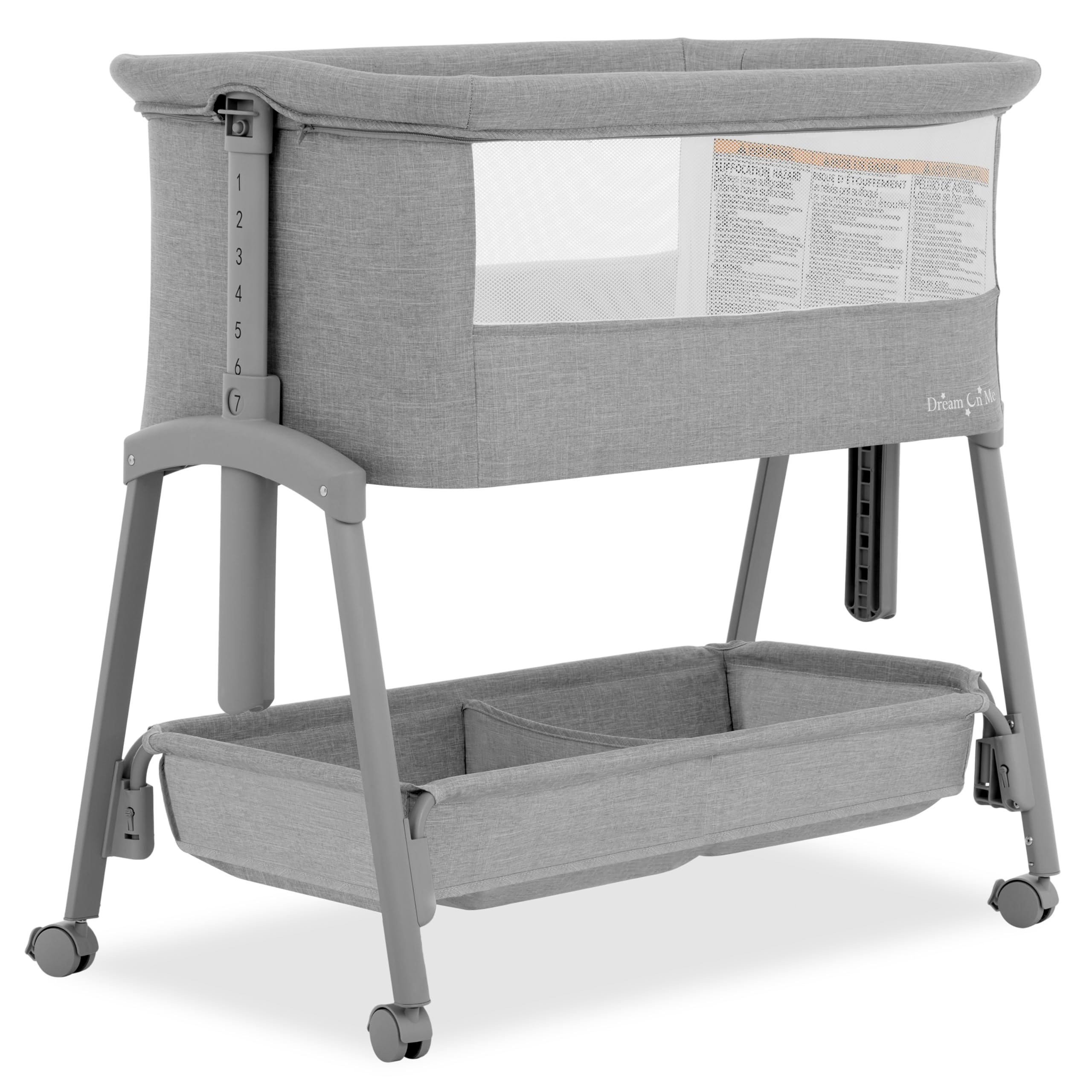
Dream On Me Calypso Bassinet
Key Features
- Height range: 27.56 to 35.83 in
- Weight limit: 25 lb
- Product weight: 18.9 lb
- Folded thickness: 2.76 in
- Price: Midrange
Folded, the Calypso is 2.76 inches thick. That is the whole pitch: it collapses flat enough to slide behind a door or into a closet, comes with a carry bag, and weighs 18.94 pounds — light enough for one person to move, not a one-hand carry. For a small apartment, a grandparent’s house, or a car trip at the holidays, that changes how often the bassinet actually gets used.
The adjustment range is unusually wide, 27.56 to 35.83 inches over seven stops, so it lines up with everything from a low platform bed to a tall one. Assembly is tool-free, the sides are mesh, and the 25-pound weight limit is generous for a bassinet this size. The mattress pad is a standard thin bassinet pad; put a fitted sheet on it and do not add anything else.
Where we land: this is the bassinet for people who will actually fold it. If it is going to sit in one spot for six months, the Fodoss or the Milliard gives you more for the money. If it is going in the car twice a month, the flat fold is worth the compromise, and the carry bag keeps the frame out of the trunk’s mess.
Pros
- Folds to 2.76 inches with a carry bag
- Seven height stops from 27.56 to 35.83 inches
- Tool-free assembly and a 25-pound limit
Cons
- Fabrics are hand wash only
We recommend the Calypso to anyone who will actually fold it up: 2.76 inches flat, a carry bag, and seven height stops.
Best for Tight Budgets
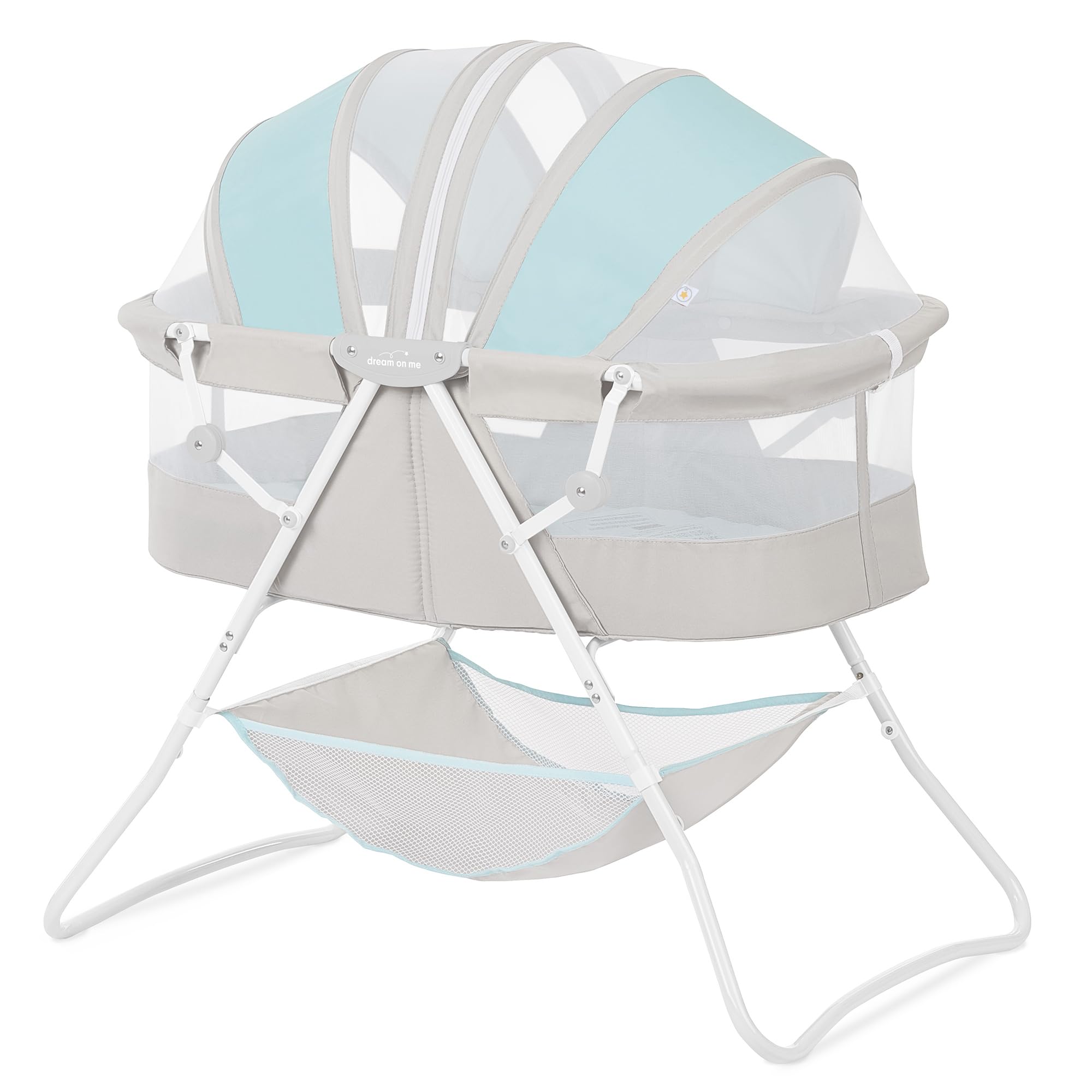
Dream On Me Karley Bassinet
Key Features
- Canopy: Double mesh
- Storage: Under-seat basket
- Weight limit: 25 lb
- Product weight: 12.4 lb
- Price: Budget
The canopy is what makes the Karley recognizable — a zipped mesh dome over the sleep area that turns a bassinet into something you can park on a porch or under a tree. At 12.4 pounds it is the lightest pick here, it folds flat in seconds, and the double mesh keeps air moving while it keeps mosquitoes and curious cats out. For summer naps outdoors, nothing else on this list does the same job.
It is also the least expensive bassinet here, which is why it is our budget pick rather than a novelty. The 25-pound weight limit is higher than the top pick’s, the frame is aluminum, and the storage basket underneath is big enough for a day’s diapers. If you want one bassinet that lives by the bed and travels to the backyard, this covers both for less than the bedside sleepers cost. We came away thinking of it as the summer bassinet.
The canopy does not come off, though, so every entry is through the zipped side, and there is no drop panel for a bedside reach. That is the trade: this is a portable bassinet with a tent, not a bedside sleeper. Set it beside the bed and you will be standing up at every feed. The 1-inch mattress pad is thin, so a fitted sheet and nothing else is the right call.
Pros
- Lightest pick here at 12.4 pounds
- Zippered double-mesh canopy for outdoor naps
- 25-pound weight limit at the lowest price here
Cons
- Zipper is stiff when new and needs two hands
Our budget pick earns it on weight and price: 12.4 pounds, a 25-pound limit, and a zippered canopy that makes outdoor naps possible.
Best for Bedroom Looks
BabyBond Bedside Crib
Key Features
- Mesh: Full surround
- Incline: 3 to 7 degrees
- Dimensions: 36.5 x 21.5 x 34.5 in
- Height settings: 6
- Price: Premium
Most bassinets look like baby gear. The BabyBond looks like furniture: a beige mesh bed on wood-grain legs, with a frame that reads as deliberate rather than plastic. That matters more than it sounds — a bassinet sits in your bedroom for months, in your line of sight from the pillow, and this is the one here that does not need hiding behind a chair.
Underneath the finish it is a capable bedside sleeper. Six height settings, a drop side that rolls down for night feeds, mesh all the way around, and a storage shelf that takes a stack of diapers. It is one of the larger footprints here at 36.5 by 21.5 inches, and the mattress and sheet come with it.
There is also an incline, adjustable between roughly 3 and 7 degrees, aimed at reflux and spit-up. Use it for supervised settling, not overnight: a baby sleeping unattended belongs on a flat surface, and the bed returns to level in seconds. The compromises are the price, the highest in this group, and the fact that you are paying part of it for how the thing looks. We are fine with that trade, because the drop side and the height range hold up on their own.
Pros
- Wood-grain legs and beige mesh look intentional
- Six height settings with a drop-side panel
- Full mesh surround plus under-shelf storage
- Adjustable 3-to-7-degree incline for reflux
Cons
We point style-conscious buyers to the BabyBond: wood-grain legs, a full mesh bed, and a drop side that works, at the top of this group’s price range.
Best for Low Beds
Cowiewie Bedside Bassinet
Key Features
- Base: Pyramid
- Storage: XL under-basket
- Height range: 16.7 to 21.54 in
- Weight limit: 30 lb
- Price: Budget
At its tallest the Cowiewie reaches 21.54 inches, at its lowest 16.7. That is low, deliberately so. This is the bassinet for a platform bed, a mattress on the floor, a futon, or the couch you have been told not to fall asleep on with a newborn. Beside a standard-height bed you would be reaching down; beside a low one it is the only pick here that lines up.
The pyramid base is the other half of the story. It is a wide four-sided footprint that keeps the center of gravity low, all four casters lock, and the storage basket underneath is the biggest in this group. The mattress is a firm 3D pad with layers you can take out and wash, and the frame folds flat for storage. At 30 pounds the weight limit is the highest here.
On arrival, put it on a hard level floor and check that all four points sit flat before you trust it — the base can lean when it is not squared, and a lean in a bassinet is not something to shrug at. Level and locked, it is steady. For a low bed and a small room, we have not found a better fit here.
Pros
- Fits floor-level and platform beds
- 30-pound weight limit, the highest here
- XL under-basket storage and locking wheels
Cons
- Caps at 21.5 inches, too low for standard beds
Buy the Cowiewie if your bed sits low — 16.7 to 21.54 inches, a pyramid base, and the highest weight limit here.
Best for Room to Room
KoolerThings 3-in-1 Bassinet
Key Features
- Wheels: Four, with brakes
- Dimensions: 33 x 20 x 33 in
- Weight limit: 24 lb
- Height settings: 5
- Price: Premium
KoolerThings sells this as three things in one: bassinet, bedside sleeper, and a low playpen for later. The useful part is the capacity — a 33-by-20-inch footprint, a 24-pound weight limit, four braked wheels, and a carry bag. It is the bassinet here that keeps working as a downstairs day bed once your baby outgrows overnight use.
Five height settings, a side panel that zips down, mesh walls, and a mattress included with the frame. Setup is quick, one person can handle it, and the frame feels planted once the brakes are on.
The weak spot is mechanical: the wheels lock securely but stick when you roll, so getting around a corner means unlocking and relocking. That is a small thing in a room where the bassinet stays put and a real annoyance in a house where it moves every day.
Our take: this is the pick for a two-story house, where the bassinet lives upstairs at night and gets wheeled or carried down for naps. It costs more than the Fodoss for a similar footprint, and the extra money buys the higher weight limit and the playpen mode. If it is never going to move, the savings are elsewhere.
Pros
- 24-pound limit and a 33-by-20-inch footprint
- Converts to a playpen for later months
- Four braked wheels plus a carry bag
Cons
- Drop-side zipper stops short of the full panel
We like the KoolerThings for a two-story house: a 24-pound limit, a 33-by-20-inch footprint, and a frame that converts to a playpen.
Best for Nursery Soothing
Delta Children Rocking Bassinet

Key Features
- Sleep area: 18 x 34 in
- Mattress pad: 1 in, washable
- Weight limit: 15 lb
- Certification: JPMA / ASTM
- Price: Midrange
This is a bassinet for the nursery rather than the bedside: a rocking base, an adjustable canopy, two plush toys, and a battery module that adds vibration, music, and a nightlight. Push it and it sways; retract the casters and it rocks, drop them and it stays put. For a parent who wants the classic setup — bassinet in the corner, nightlight on, music playing — it is the only pick here that does all of it.
The sleep area is 18 by 34 inches with a 1-inch mattress pad that is removable and machine washable, which makes it the easiest one here to keep clean. It is JPMA certified to the ASTM standard, and the frame is steady once assembled.
Assembly is fiddly, and the electronic module is the part we trust least. It runs on four AA batteries that are not included, and the vibration, music, and nightlight are the features to treat as a bonus rather than a reason to buy. Test the music button the day it arrives.
The hard limit is 15 pounds, the lowest here — for a big baby that is a few months, not six. This is a short-term bassinet bought for the rocking and the look, and if you want one that lasts until the crib, the Milliard or the Calypso is the better buy.
Pros
- Rocking base with retractable locking casters
- Machine-washable 1-inch mattress pad
- Nightlight, vibration, and music module
- JPMA certified to the ASTM standard
Cons
- 15-pound limit, the lowest in this group
The Delta is for a nursery and a smaller baby: rocking, vibration, and a nightlight, with a 15-pound limit that ends the run early.
How We Tested Bassinets
We started with research: hundreds of owner reviews, current safe-sleep guidance on firm mattresses and mesh sides, and spec sheets compared on footprint, height adjustment, and packed size. Filtering by price and by what each one actually folds down to left us with 11 bassinets, which have been in our bedrooms for six months.
Each was assembled solo, from sealed box to standing, with a stopwatch running. We logged which ones needed a second pair of hands and which went up quietly while a baby was already asleep in the next room. Then we used them the way they get used: lying in bed at night, reaching over with one hand to see whether the side panel unzipped smoothly or snagged halfway; settling a weighted doll inside and giving a push to see whether the rocking kept going or stalled out after a few seconds; running vibration on its lowest setting to hear whether it was a hum or a rattle.
Sturdiness got a deliberate shake — frame, legs, and rim — plus a check that the base slid under the bed frame and still left a walkable path to the door. We rolled each one across carpet, hardwood, and a door threshold to see which wheels tracked straight and which had to be lifted over every seam.
For portability and foldability, we broke each model down, carried it room to room, and packed it into a car trunk for a weekend away, timing the fold and noting whether the carry bag actually fit everything back inside. After weeks in the room, we judged appearance in daylight — fabric, seams, whether it read as furniture or as equipment. Sheet fit and washability got checked along the way, since those are the parts you deal with every few days.
How to Choose a Bassinet
One measurement decides more bassinet purchases than any other: the distance from your bedroom floor to the top of your mattress. Get that wrong and nothing else on the spec sheet rescues the purchase.
Measure your bed before anything else
Height adjustments get quoted two different ways, and the difference matters. Milliard publishes the bed heights it fits, 23 to 31 inches measured from the floor to the top of the adult mattress. Calypso publishes the sleeper’s own height range, 27.56 to 35.83 inches, and Fodoss and KoolerThings state only the number of settings. A published bed-height fit is the easiest number to shop with; a setting count tells you how finely you can tune, not how high the thing goes.
The trap is assuming adjustable means it reaches your bed. A bassinet that stops at 21.5 inches, like the Cowiewie, is exactly right beside a floor mattress and useless beside a standard bed. Measure, write the number down, then compare it against the listing.
Flat and firm, with mesh on every side
A newborn sleep surface should be flat and firm, with a thin pad and a fitted sheet — no topper, no positioner, no blanket. The pads on these bassinets are thin by design. If a listing talks up a plush mattress, read that as a styling choice rather than a comfort upgrade, and don’t add anything to soften it.
Mesh earns its place twice: it moves air, and it lets you see a face from the pillow without getting up. Full-surround mesh, as on the Fodoss and the BabyBond, is what you want to look for. Incline settings, like the BabyBond’s 3 to 7 degrees, belong to supervised settling, not overnight sleep.
Drop sides, wheels, and the 3 a.m. test
A bedside sleeper earns its price at 3 a.m.: a panel that opens toward your bed, a height that puts the baby at your eye level, and a pocket for wipes within reach. Decide up front whether you want the bassinet strapped to your bed frame — the Milliard includes straps — or free-standing, because a strapped bassinet stops being portable.
The trap is a drop side that only opens partway. A panel that unzips a short distance is a panel you will stop using, so check the length of the opening rather than the fact that one exists. Same with wheels: four casters that lock hard are worth more than six that skate across a rug.
Weight limits decide how long you own it
Limits across this group run from 15 to 30 pounds, and that spread is the difference between a bassinet you use for a couple of months and one that lasts most of the first year. The Delta’s 15 pounds suits a small baby; the Karley and Calypso give you 25; the Cowiewie’s 30 is the most generous here.
The trap is buying for the newborn phase alone and forgetting how fast the next one arrives. A big, fast-growing baby reaches a low ceiling quickly, and then you are shopping again in the fourth month.
Folding, footprint, and small rooms
If the bassinet will travel or live in an apartment, folded size and weight matter more than any feature. The Calypso folds to 2.76 inches with a carry bag; the Karley is 12.4 pounds and folds in seconds. Both are easy to stash when the grandparents visit and easy to take with you when you visit them.
Set up, though, a bassinet still claims floor space — up to 37 inches long and 27 inches wide among these picks. Measure the gap beside the bed and the width of the doorways it needs to pass through, not just the closet it will disappear into.
Frequently Asked Questions
Can I skip the bassinet and put the crib in my bedroom?
You can, and some parents do. A bassinet earns its place when a crib will not fit beside the bed: the bassinets here run roughly 33 to 37 inches long and 20 to 27 inches wide, so most take up a fraction of a crib’s floor space. If your room has space for a full crib, put the money into a better crib mattress instead.
What sheets fit these bassinets?
Standard bassinet sheets are sized for sleep areas of about 18 by 34 inches, which covers the Delta and most of the rectangular picks here; oval bassinets take oval sheets, so match the shape before ordering. Buy two fitted sheets with the bassinet. Never improvise with a larger sheet or a blanket, because loose fabric is the thing to keep out of a newborn’s sleep space.
Where should the bassinet go in the bedroom?
Beside the bed, on a level floor, clear of blind and curtain cords, lamps, heaters, and anything a toddler sibling can reach from a standing position. Leave room to walk around it — the widest pick here is 27.38 inches across, so plan on roughly a three-foot strip. And keep it where you can see the baby from the pillow, since that visibility is what you paid for.
Final Verdict
Buy the Fodoss 3-in-1 first. It lines up with most beds, wraps the baby in mesh on every side, holds a night’s supplies within reach, and rolls and locks where you need it — the least fuss of anything here.
If your mattress sits high, the Milliard fits beds from 23 to 31 inches, which the Fodoss cannot promise; if it sits low, the Cowiewie drops to 16.7 inches. Measure before you buy, because that number, not the price, decides whether the bassinet ends up used every night or folded in a closet.
