This post contains affiliate links. We may earn a small commission when you buy through our links — at no extra cost to you.
A rocking horse is one of the few toys that earns its floor space for years — a wobbly first ride around 12 months, a full gallop at 3, then a second life in a younger cousin’s nursery. The trick is finding one that survives all three stages. The wrong pick tips on hardwood, plays a tinny tune at a volume that follows you into the kitchen, or sheds its plush coat by February — and then you’re the person who gave a gift that got quietly retired.
I’ve bought two of these as presents and watched both get ridden into the ground. Over the past six months, my team and I have lived with 11 rocking horses at home, running from small plush animals to curved wooden rockers, and the differences showed up fast. Size is the thing most shoppers get wrong: a rocker sized for a 1-year-old turns into a tripping hazard once your kid hits 3, while an oversized model can feel unsteady to a small toddler on day one.
The picks below are the ones that stayed in rotation after the novelty wore off — the ones kids climbed onto on their own, not the ones we had to coax them toward.


Best for First Toddler Ride
Little Tikes Rocking Horse Blue
Key Features
- Assembly: No assembly required
- Material: Plastic
- Age Range: 12 months – 3 years
- Weight Capacity: 50 lb
- Price: Budget
The first thing we noticed about the Little Tikes horse is how little there is to do before a child can ride it: it comes out of the box in one piece, with no bolts, brackets, or straps to thread. For a first rocking horse, that matters more than it sounds. The molded seat sits low, the wide plastic base feels planted, and the 7.5-pound body is easy to shift from playroom to patio.
The plastic body is the practical choice for a household that will also be wiping up snacks and accidents. A damp cloth handles most messes, and there is no plush nap to trap crumbs. The molded seat and handles are shaped for small bodies, and the open sides make it easy to lift a child on and off. It feels like a toy that can live outdoors for a season and come back inside without much ceremony.
At 33 inches long and 17.5 inches high, it fits in a corner and is easy for a toddler to climb on. The 12-month-to-3-year range is the real boundary; older preschoolers will look and feel too big for it. That short window is the main reason to look elsewhere if you want a rocking horse that lasts from first birthday to kindergarten.
Pros
- Arrives fully assembled
- Wide base feels stable for new walkers
- Wipe-clean plastic for indoor or outdoor use
- Low seat is easy to climb
Cons
- Hard, unpadded seat
- Awkward to store between uses
We recommend the Little Tikes horse as the easiest first rocking horse for a 1- to 3-year-old: it arrives assembled, wipes clean, and has a low, stable seat that lets a toddler climb on without help.
Best for Interactive Play
VTech Prance and Rock Learning Unicorn
Key Features
- Age Range: 12 months – 3 years
- Batteries: 2 AAA required
- Dimensions: 13.54 x 22.01 x 18.54 inches
- Ride Modes: Rocker and ride-on
- Price: Budget
The feature that separates the VTech unicorn from a classic rocking horse is the base: it flips from curved rockers to a ride-on set of wheels as a child grows. We like that kind of handoff because it stretches one toy across the toddler stage, and the motion sensor adds songs and phrases when a child rocks or rolls. Setup is simple, and the 5.6-pound body is light enough to move between rooms.
Our verdict is that this is the pick for a family who wants entertainment built in, not just a quiet ride. The Learning and Adventure modes give the unicorn more to do than most rocking horses here, and the color and imagination prompts are a nice fit for a 1- to 3-year-old. We did not expect the songs to be as engaging as they are, though the rocker-to-ride-on switch is the feature that earns its place.
The plastic is wipeable, and the footprint is compact for a playroom. Two AAA batteries are required, and the demo set will not last; plan on fresh batteries if the sounds are the draw. The 12-month-to-3-year range is clear, and the low body makes it easy to lift out of the way.
Pros
- Converts from rocker to ride-on
- Motion-activated songs and phrases
- Learning and Adventure modes
- Light 5.6-pound body
Cons
- Shorter rocking arc than a classic horse
We recommend the VTech unicorn for the family who wants songs, motion, and a ride-on mode in one toddler toy; it is compact, wipeable, and far more engaging than a plain rocking horse.
Best for Nursery Decor
labebe Pink Unicorn Rocking Horse
Key Features
- Material: Wood
- Age Range: 6 months – 3 years
- Dimensions: 25 x 14 x 27 inches
- Weight Capacity: 150 lb
- Price: Midrange
The labebe unicorn is the one we reach for when the rocking horse has to look as good as it plays. The plush body is fully stuffed, the wooden base is already attached at the factory, and the three-sided seat gives a small rider a backrest and side rails rather than a flat perch. In a nursery, it reads as a soft animal first and a toy second, which is exactly the point.
The seat belt and high sides are the practical reason to choose it for a 6-month-old who is just sitting up. A strap can keep a wobbly baby from sliding forward, and the padded seat is kinder to bare legs than molded plastic. We also like that the wooden rockers give a gentle, contained arc; this is not a horse that invites wild galloping.
Our verdict is that the labebe is worth the premium for a first-birthday gift or a decor-minded nursery. The wooden base gives a gentle, contained rock, and the high sides and belt make a wobbly sitter feel more secure. It is not the rocking horse we reach for when a household wants zero fuss; this is a piece you keep indoors and treat a little carefully.
Pros
- Soft plush seat with high sides
- Safety belt for wobbly sitters
- Gentle wooden rocking motion
- Nursery-ready finish
Cons
- Cover is spot-clean only
- Heavier than plastic rockers at 11 pounds
We recommend the labebe unicorn for a first-birthday gift or a nursery where the rocking horse doubles as decor; it is soft, secure, and beautifully finished, though it needs gentle care.
Best for Older Toddlers
Radio Flyer Chestnut Riding Horse
Key Features
- Age Range: 2-6 years
- Item Weight: 23.6 lb
- Ride Sounds: Walk, trot, gallop
- Weight Capacity: 60 lb
- Price: Premium
The Radio Flyer Chestnut is the closest thing here to a playground spring rider. Instead of curved wooden rockers, it uses a steel X-frame and covered springs, so the motion is a bounce as much as a rock. The plush coat, yarn mane, and carrot accessory make it feel like a pony that has wandered into the playroom, and the EZ Climb step is a thoughtful touch for a 2-year-old who wants to get on without being lifted.
Our verdict is that this is the pick for an older toddler or preschooler who wants a bigger, more theatrical ride. The three sound levels respond to walk, trot, and gallop speeds, which gives the horse a sense of momentum that a simple rocking horse cannot match. The 60-pound capacity and 2-to-6-year range also mean it will not be outgrown as quickly as the 12-to-36-month models on this list.
The flip side is assembly. The Chestnut is the most involved build in this group, and the long neck bolts are easier with two sets of hands; give yourself a clear hour rather than starting it at bedtime. Once together, it feels like a piece of playground equipment, which is the point.
Pros
- Spring bounce plus rocking motion
- Sounds change with walk, trot, gallop
- EZ Climb step for independent mounting
- Fits ages 2 to 6 with 60-pound capacity
Cons
- Heavy at 23.6 pounds
- Large 36-by-41-inch footprint
We recommend the Radio Flyer Chestnut for families with a 2- to 6-year-old who wants a bouncy, sound-rich ride and has room to leave it out; it is the most engaging big-kid rocking horse here.
Best for Small Playrooms
Qaba Kids Rocking Horse with Bear
Key Features
- Sound: Realistic horse sounds
- Dimensions: 25.5 x 10.25 x 21.75 inches
- Item Weight: 5.3 lb
- Weight Capacity: 66 lb
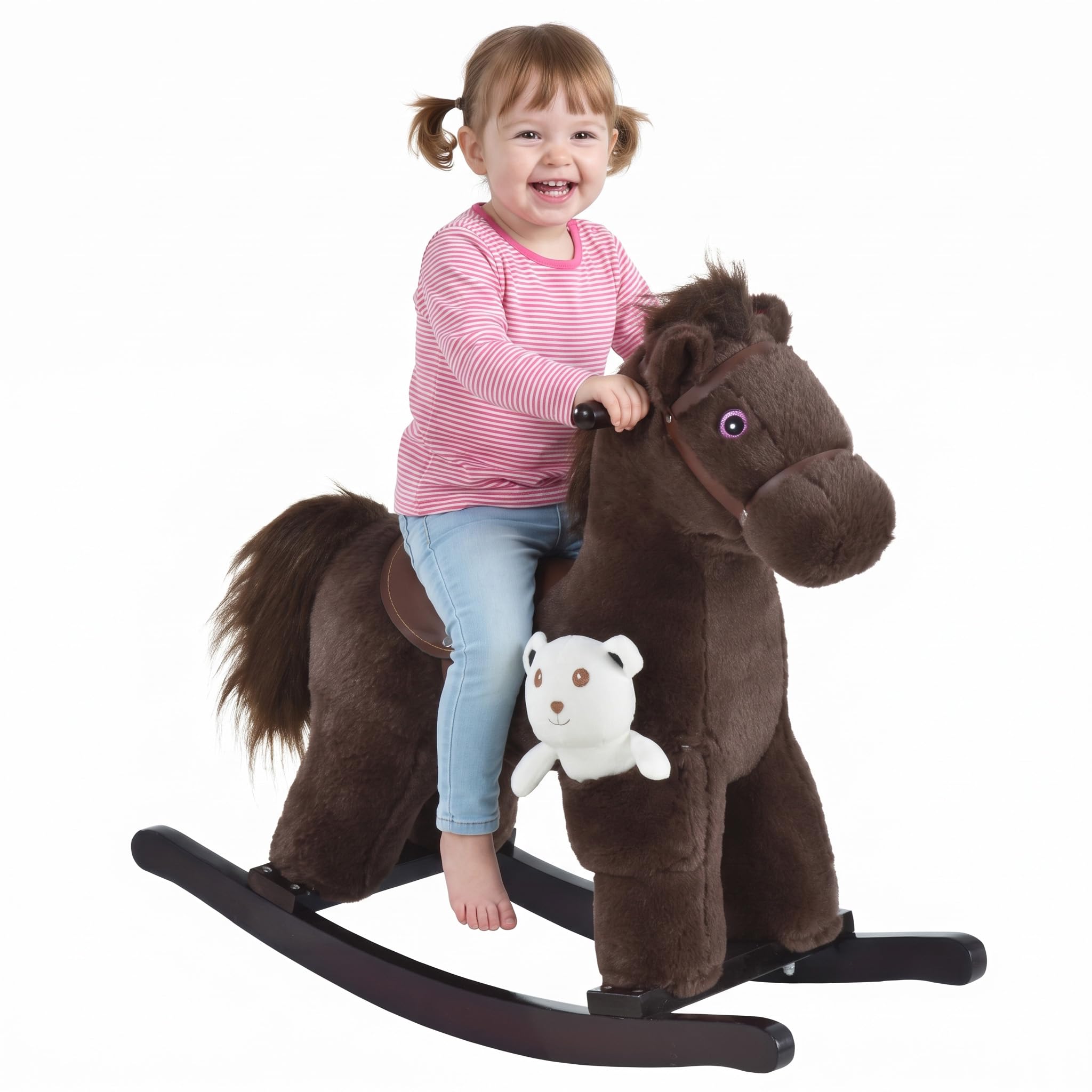
The Qaba horse with the little bear in its pocket is the lightest plush rocking horse here, at 5.3 pounds. That sounds like a small detail until you are carrying it from the living room to a bedroom with one hand while holding a toddler with the other. The 25.5-inch length and 21.75-inch height also make it a better fit for a small apartment than the bigger spring and wooden models.
The seat is scooped rather than flat, with a back and sides that help a young toddler stay centered. It is low enough for a young toddler to climb on with a handhold, and the plush body is soft without feeling overstuffed. The sound module is the extra: a press on the ear brings neighs and gallops, and the bear is a nice small-world toy that stays attached.
Our verdict is that this is the best low-fuss plush option for a toddler who is too big for a baby bouncer but not ready for a spring horse. It is easy to move, easy to climb on, and the 66-pound capacity gives it more room than the 12-to-36-month plastic rockers. The age guidance is inconsistent, though: one part says 18 months to 3 years, another says 36 months and up, so check the current label before buying for a child under two.
We keep this one indoors. The plush and the sound module do not belong in a sandbox, and the light body is easy enough to move that there is no reason to leave it out. In a nursery or playroom, it is a friendly, compact rocking horse that does not dominate the room.
Pros
- Light enough to move one-handed
- Scooped seat with back and sides
- Realistic horse sounds
- Compact footprint
Cons
- Sound module can stop working
- Plush surface is spot-clean only
We recommend the Qaba plush horse for a small playroom or a toddler who needs a lighter, more portable rocking horse; it is soft, compact, and easy to climb on.
Best for Older Riders
Qaba Realistic Sounds Rocking Horse

Key Features
- Age Range: 3-9 years
- Dimensions: 28 x 11 x 23.6 inches
- Item Weight: 4 lb
- Weight Capacity: 88 lb
- Price: Budget
The Qaba dark brown horse is the one we point to when the rider is past the toddler stage but still wants a rocking horse rather than a bike. The 88-pound capacity and 3-to-9-year age range make it the broadest fit here, and the plush body with electronic neighs and gallops gives a 5- or 6-year-old more to play with than a simple wooden rocking horse. We recommend it for an older child who will use it as a pretend-play horse, not as a rough-and-tumble climbing frame.
At 4 pounds, it is light enough to move, and the solid metal frame and wooden base give it a traditional silhouette. The saddle is padded, the ears trigger sounds, and the 28-inch length is manageable in a bedroom. The horse looks more realistic than the cartoonish plastic rocking horses, which is part of the appeal for a school-age child.
The catch is size. The 23.6-inch height and 28-inch length run small for the top of the age range, and a tall 5-year-old may be cramped. The build also asks for some care: assembly is straightforward, but the horse is not as planted as the heavier spring models, and the plush body should stay indoors. Treat it as a lighter-duty rocking horse for a child who fits it.
Pros
- Broad 3-to-9 age range
- 88-pound weight capacity
- Realistic look with sound effects
Cons
We recommend the Qaba dark brown horse for an older child who wants a pretend-play pony and fits a lighter-duty rocking horse; it has the widest age and weight range here.
Best for Dinosaur Lovers
ROCK MY BABY Green Dinosaur Rocking Horse

Key Features
- Music: Ear-activated lullabies
- Age Range: 12-36 months
- Seat Height: 10.23 inches
- Weight Capacity: 66 lb
- Price: Midrange
The green dinosaur is the pick for the child who has already rejected a horse. The shape is fun, but the more useful feature is the chair-like seat: it has a padded back and sides, so a 1-year-old sits in it rather than balancing on top. The plush body is soft, the wooden rockers are exposed at the bottom, and the whole thing looks like a nursery toy rather than a fairground ride.
The built-in lullabies are triggered by squeezing the ears, which is a clever way to put the interaction within a toddler’s reach. The 66-pound capacity and 12-to-36-month range are standard for this class, and the 10.23-inch seat height is low enough for a small rider to get on with a hand. We like that the music is optional; the rocking horse works as a plain rocking toy when the sound is off.
Assembly is straightforward, and the wooden base is easy to line up. The seat is on the snug side for a bigger 3-year-old, and the plush body is best kept indoors. We do not count on the music as the main attraction; the rocking and the seat are what make it useful.
Our verdict is that the dinosaur is a strong alternative for a dinosaur-obsessed toddler, especially one who needs the security of a seat back. It is not the most durable-feeling rocking horse here, and the plush will show snacks, but it is a fair trade for the cozy shape. If you want a rocking horse that can be handed down after three kids, choose the wooden labebe or the plastic Little Tikes instead.
Pros
- Chair-like seat with back and sides
- Plush dinosaur shape
- Ear-activated lullabies
- Low 10.23-inch seat height
Cons
- Cover is not removable
We recommend the dinosaur rocking horse for a toddler who wants a cozy seat and a playful shape; it is soft, secure, and easy to climb on, though the plush needs careful cleaning.
Best for Nursery Gifts
JOLIE VALLÉE Cow Rocking Horse

Key Features
- Assembly: Two rockers to attach
- Age Range: 6 months – 3 years
- Dimensions: 24 x 11 x 20 inches
- Weight Capacity: 150 lb
- Price: Midrange
The JOLIE VALLÉE cow is the nursery-decor pick: a brown plush cow on a wooden base, with a seat belt and a backrest, sized for a 6-month-old to a 3-year-old. The 150-pound capacity is the headline, but the more relevant number for a baby is the low seat and the three-sided shape, which let a sitter settle in without a stack of pillows.
The cow is mostly assembled at the factory; you attach the two wooden rockers and tighten the hardware. We like that the plush is soft without being a deep-pile lint trap, and the seat belt is a useful extra for a 9- or 10-month-old who is still finding their balance. The wooden base gives a gentle rock, not a springy bounce.
The 24-by-11-by-20-inch footprint is small enough for a nursery corner, and the 9.2-pound body is easy to shift. The seat belt is a support, not a restraint you can leave a baby in unattended; stay within arm’s reach while a new sitter is on it. The finish is smooth enough to keep in a bedroom, and the cow shape is the kind of thing that gets comments before a child is old enough to ride.
Our verdict is that the cow is the best choice here for a nursery where the rocking horse is also decor, and for a baby who is sitting but not yet walking. It is soft, sturdy, and more elegant than the plastic options, and the seat belt adds a measure of security. The 150-pound capacity is generous, but the ride is sized for a small child; think of it as a first rocking horse, not a hand-me-down for a school-age kid.
Pros
- Seat belt and backrest for sitters
- Smooth wooden rocking base
- Nursery-ready cow design
Cons
- Plush cover is not removable
We recommend the cow rocking horse for a nursery where the ride is also decor, and for a baby who is sitting but not yet walking; it is soft, sturdy, and more elegant than plastic.
How We Tested the Best Rocking Horses
We started by pulling every rocking horse we could find that was rated for kids from about 6 months up through the preschool years, then trimmed the list by reading the reviews people write after a few months of ownership and checking listed weight capacities, seat heights, and how much assembly each one required out of the box. That left 11 units: stuffed plush animals, curved wooden rockers, and a couple of spring-mounted hybrids. Six months of testing gave us enough time for the first wave of toddlers to outgrow the smallest seats and for every plush coat to take a real beating.
Testing happened where these toys actually live — a living room rug, a stretch of hardwood, a carpeted nursery, and one grandparents’ house with a step down into the den. We watched how each horse moved: how far it rocked before the base lifted, whether it scooted across the floor, and how much effort a 2-year-old needed to keep it going on carpet versus wood. We checked seat height against each kid’s leg reach and footrest position, and noted how much floor space each one claimed when parked against a wall.
For build quality, we leaned hard on the handholds, tugged at every seam, and rechecked the joints and screws after each week of riding. On the musical models, we sat through the same loop more times than I care to count, listening for tinny speakers and noting whether the volume could be lowered or the sound shut off without hunting for a screwdriver. At the six-month mark we compared notes on which horses kids still climbed onto unprompted — the closest thing to a fun score we have — and which had already been banished to the basement.
How to Choose a Rocking Horse
The right rocker depends on the rider’s stage: age and weight set the limits, and the seat, motion, and cleanup decide how happy the horse is in your home.
Start With Age, Weight, and Seat Support
Rocking horses are not one-size-fits-all. A 6-month-old who is just sitting needs a low seat with a back and sides, while a 3-year-old wants more room and a higher weight limit. Check the stated age and weight range before anything else, and treat a seat belt as a helper for a wobbly sitter, not a babysitter. A 50-pound limit is common for plastic toddler models; spring and wooden horses often go higher, but the seat still has to fit the child.
Put the child on the seat before you commit. Their feet should reach the footrests or hang naturally, their hands should find the handles, and they should be able to get off without a leap. If the seat back hits the back of the knees or the child has to perch on the edge, move up or down a size.
Choose the Motion: Curved Rockers, Springs, or Convertible
A curved wooden or plastic base gives a predictable back-and-forth rock and is the easiest motion for a new toddler. A spring-mounted horse adds bounce and a bigger sense of motion, which suits a 2- to 6-year-old who has already found their balance. Convertible models switch from rockers to wheels; they stretch the useful life, but the rocking arc is often shorter than a dedicated horse.
The trap is the word rocking in the title. Some ride-on ponies have wheels and no rockers at all, so they move forward rather than back and forth. Look at the base in the photos: two curved runners or a spring frame means a rocking horse; four wheels means a ride-on toy.
Match Materials to Your Cleanup Routine
Plastic is the easiest to live with: it wipes clean, tolerates a patio, and does not trap crumbs. Plush and wooden horses are warmer and more furniture-like, but the fabric needs spot cleaning and the base should stay indoors. If a model has songs or neighs, count the batteries as part of the purchase and check whether the sound can be switched off.
We prefer a sound feature as a bonus, not the reason to buy. A rocking horse has to work when the batteries die, and a plush seat has to be comfortable enough for a child to want to sit on it without the music.
Plan for Assembly, Floor Space, and Storage
Assembly ranges from none at all to a two-person job. A one-piece plastic horse is ready out of the box; a spring horse with a long neck bolt can take a clear hour and a second set of hands. Measure the floor space with the horse’s full rocker length, not just its seat, and leave clearance in front and behind so it cannot hit a wall or a sibling.
Compact in a listing means it fits a small playroom, not that it folds into a closet. If the horse will live in a shared room, check its length and weight, and decide where it goes before it arrives. A lighter model is easier to shift for vacuuming; a heavier spring horse is more of a permanent fixture.
Frequently Asked Questions
Can a rocking horse be used on carpet?
Yes, but the pile changes the ride. Low-pile carpet or a firm rug usually lets curved runners move smoothly and gives the floor a little protection. Deep shag can make the base dig in and rock unevenly, so test the horse in place; if it feels sluggish or tips, move it to a hard, level surface.
Can a rocking horse go outside?
A plastic model such as the Little Tikes can go on a patio or lawn, but bring it in after play; sun and weather age plastic. Plush and wooden horses belong indoors. Choose a flat spot away from steps and driveways, and wipe the base before it comes back inside.
What should I check before buying a used rocking horse?
Inspect the runners for cracks, the seat and straps for fraying, and the frame for loose bolts. Replacement straps are not universal, so a broken buckle is a reason to pass. Check the model’s current age and weight rating, and clean the surfaces before a child uses it.
Final Verdict
We keep coming back to the Little Tikes Blue Rocking Horse because it solves the first rocking horse decision with the least fuss: it arrives ready to ride, wipes clean, and has a low, stable seat for a 1- to 3-year-old. If your child is closer to 3 or wants a bouncier, sound-and-motion ride that will last into the preschool years, the Radio Flyer Chestnut is the upgrade we recommend; it takes real assembly and a permanent corner, but the spring base and interactive play justify it.
