This post contains affiliate links. We may earn a small commission when you buy through our links — at no extra cost to you.
There’s a look a toddler gets eleven minutes into a restaurant dinner, right when the crayons give out. I’ve been on both sides of it — the parent digging through the diaper bag and the diner at the next table pretending not to notice. A busy book is the honest fix: a binder of matching, tracing, and Velcro activities that gives small hands a job and buys everyone some quiet.
They all look nearly identical online. What separates a good one is what the photos never show: whether the Velcro still grips after a month, whether it arrives ready to hand over or dumps an evening of peeling and sticking on you, and whether marker wipes off so tracing pages work twice. We’ve spent four months living with 14 of them — planes, waiting rooms, my own kitchen table — and the gaps are real.
One thing worth knowing: harder isn’t better. The books that hold a toddler start simple and climb toward tracing, and they keep the pieces on the page. Below are the ones worth the shelf space.

Best for Ages 3 to 5
Momo & Nashi Busy Book
Key Features
- Setup: Pre-assembled, spare fasteners included
- Age range: 3 to 5 years
- Activities: 14 themes
- In the box: Book, carry box, replacement parts
- Price: Midrange
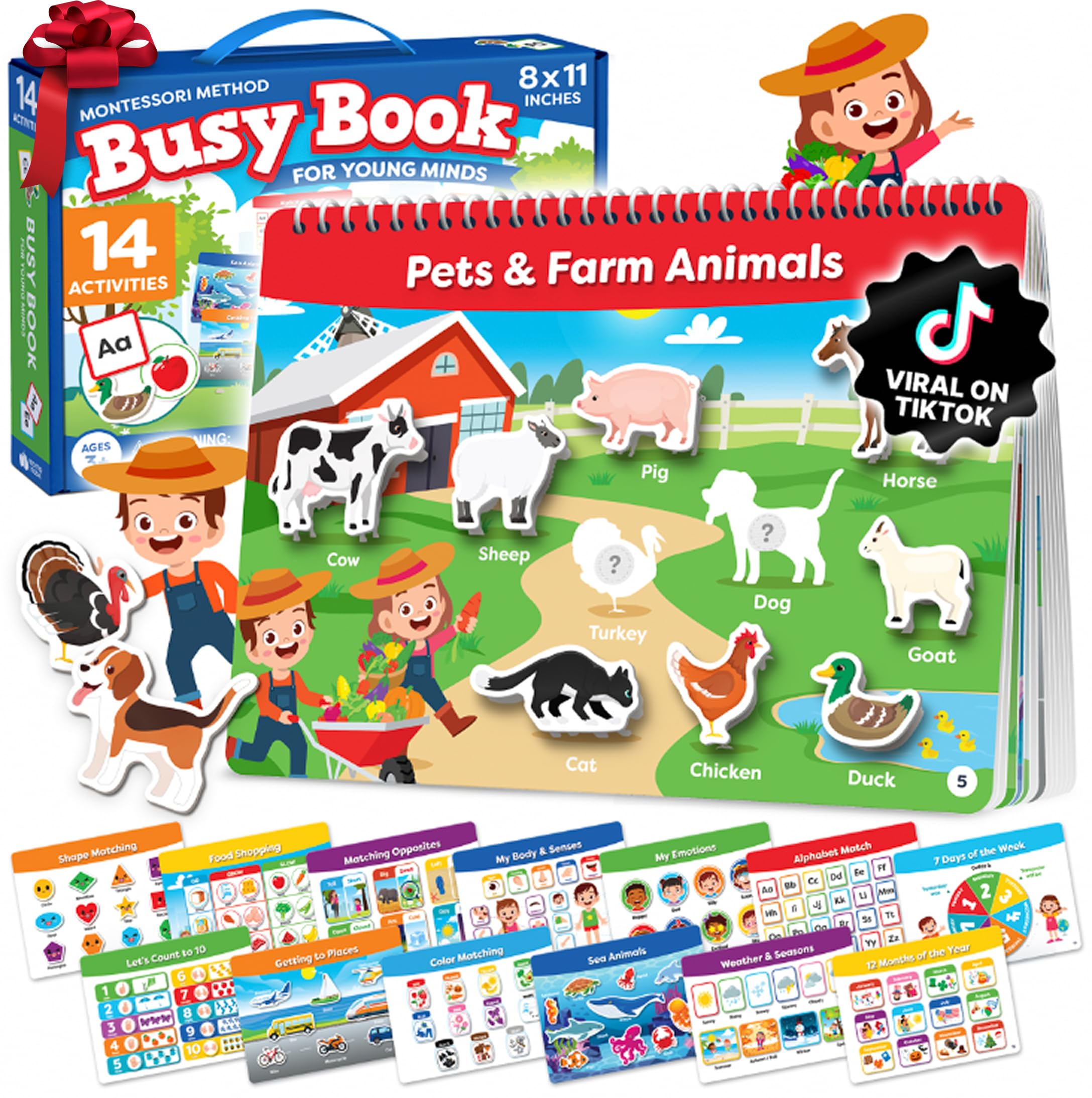
Our top pick arrived finished. Every piece was already fastened to its page, a spare set of hook-and-loop dots came in the box, and the book plus its carry box came out of the packaging ready to hand to a child. That is the whole reason it wins: several books here arrive as a stack of pages, a pile of loose cards, and a sheet of dots, and the adult does the assembly before anyone plays.
Fourteen activities cover letters, counting, colors, shapes, animals, and matching, on pages that wipe clean of whatever a child had for breakfast. The test that mattered once it went into a bag was whether pieces stay where they belong, and they do: a finished page comes out of a tote with its pieces still on it. That is the difference between a book that travels and one that reaches the restaurant with half of itself in the bottom of your bag.
Content-wise it fits roughly two to four. A four-year-old who already knows the alphabet will work through all fourteen pages in a sitting and move on, so this is not the one for a child tracing letters; it is the one for a child still learning them. It also costs less than the other fully assembled book here, which makes it the easier of the two to hand over as a gift.
Pros
- Ready to use straight out of the box
- Pieces stay on their pages in a bag
- Spare fasteners included for worn pieces
- Wipe-clean pages handle sticky hands
Cons
- Fewer activities than the biggest books here
We recommend it for most families: it opens ready to use, the pieces stay put in a bag, and the content lands squarely with a 2- to 4-year-old.
Best for Toddlers under 3
hahaland Farm Busy Book
Key Features
- Pages: 10 pages, 20 activities
- Theme: Farm
- Material: Fabric
- Age range: 12 months to 3 years
- Price: Premium
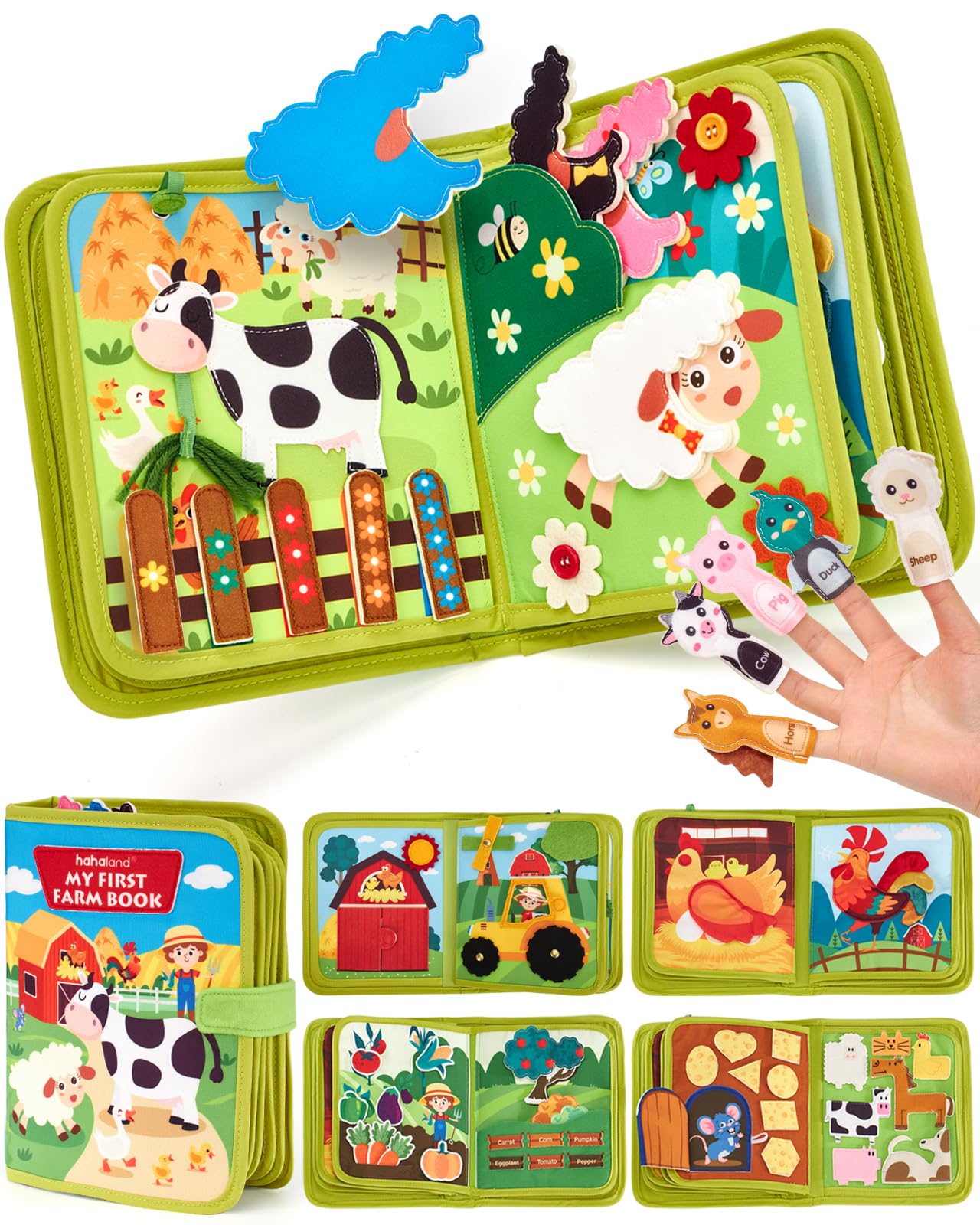
Ten fabric pages, 20 activities, and a stated range of 12 months to 3 years: this is the only book here built for a child who might chew the pages. The mechanisms are part of the cloth, including laces, buttons, and velcro vegetables, so there are no loose cards to lose and nothing small enough to worry about with a younger sibling in the room.
The finger puppets are the part we kept coming back to. They turn a one-step matching page into a conversation, which is why this book still gets picked up after the novelty of sticking things down wears off. A farm theme runs through every page, giving a 20-month-old something familiar to name, and the whole thing folds flat enough for a diaper bag without a separate case.
It is simple on purpose, and simple has a ceiling. Nothing here progresses to letters, tracing, or counting much past early matching, so by three and a half most children have seen the whole book. If your child is already writing letters, buy a workbook instead; if they are still working out how a zipper moves, nothing here is better suited.
Pros
- No loose pieces to lose or choke on
- Finger puppets stretch the play
- Laces, buttons, and velcro built into the pages
- Folds flat for travel
Cons
- Simpler content than the paper books here
We hand this one to the under-three crowd: sewn-in parts, nothing to lose, and enough farmyard detail to hold a 1-year-old on a plane.
Best for Older Preschoolers
QUOKKA Montessori Busy Book
Key Features
- Setup: Fully assembled, 178 elements
- Themes: 15
- Weight: 1.5 lb
- Dimensions: 11.02 x 7.87 x 2 inches
- Price: Premium
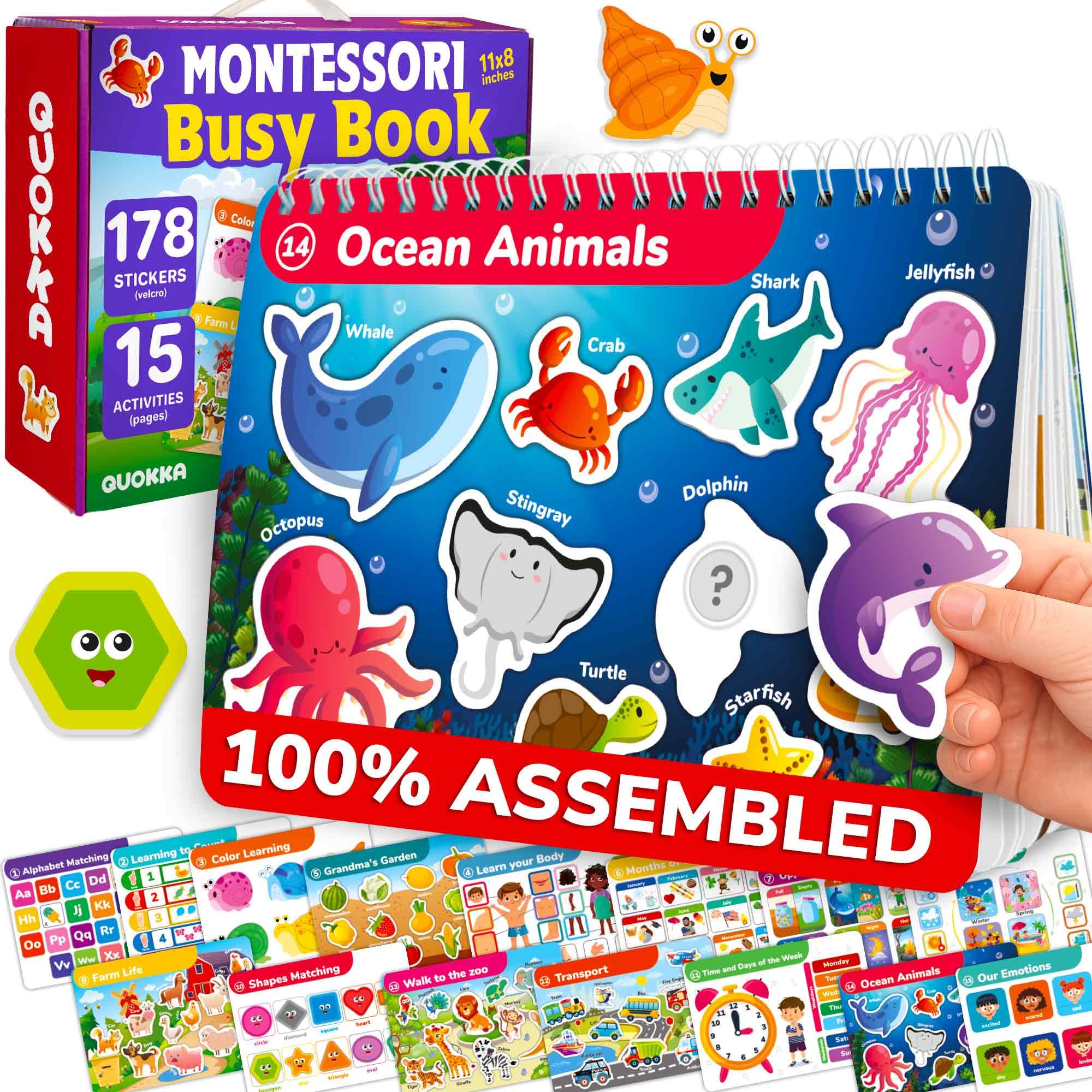
This turns up as finished as our top pick does, and it is aimed a year or two older. Fifteen themes, 178 elements, and roughly two inches of thickness add up to a book a four- or five-year-old can keep finding new pages in, which is exactly what the simpler matching books stop doing once the animal pages have been solved twice.
The breadth is the point: alphabet, numbers, weather, days of the week, colors, and body parts, each on its own spread with rounded corners and thick card stock. Pieces sit down firmly and the pages do not bow when a child presses to peel one off. It is also the only book here with a stated 30-day warranty against manufacturing defects.
The age range on the box runs to ten, which is generous. By seven or eight the content sits beneath most children, whatever the label promises. Between three and six it is strong, and a younger three will want an adult on the first pass through each page before the printed guides make sense.
Pros
- Arrives fully assembled with 178 pieces attached
- Broadest theme spread among the assembled books
- Thick card stock and rounded edges
- Stated 30-day defect warranty
Cons
- Bulky for a diaper bag at 1.5 pounds
Our pick for a four- or five-year-old: it is the fullest, best-finished book here, and the extra themes keep a preschooler busy past the first week.
Best for Handwriting Practice
ALIANFLY Tracing Workbook
Key Features
- Pages: 51 dry-erase pages
- Format: Spiral-bound
- Markers: 8 markers and 1 eraser
- Dimensions: 11 x 7.8 x 0.8 inches
- Price: Budget
There is nothing to match in this one. It is a spiral-bound workbook of 51 wipe-clean pages with eight dry-erase markers and an eraser, and its job is the step after matching: lines and curves first, then letters A to Z, numbers, letter-case matching, and simple counting games on paper.
As a handwriting warm-up, we rate it above everything else on this list. The pages are the size of a sheet of paper, the spiral lies flat on a table, and a three- or four-year-old can trace a letter, wipe it out, and go again without an adult resetting anything. The marker comes off the laminate cleanly and lifts out of a shirt sleeve, which is the first thing any parent of a preschooler wants to know.
It is a table book rather than a lap book. Markers need caps and a supervising eye, and the eraser can leave a grey smear on a page that has been written and wiped several times. Buy it alongside a matching book instead of in place of one: this is the one that comes out on a rainy afternoon, not the one that rides in the car seat.
Pros
- 51 wipe-clean pages with 8 markers and an eraser
- Spiral binding lies flat for tracing
- Ink wipes off the page and out of fabric
- Progresses from lines to letters and numbers
Cons
- Tracing only, with no matching or fastening
Buy it for the child ready to hold a marker: it is the best tracing practice here, as long as a matching book is already on the shelf.
Best for Tight Budgets
MORECOLL Preschool Workbook
Key Features
- Pages: 62 reusable pages
- Weight: 1.7 lb
- Activities: 16
- Dimensions: 8.26 x 11.22 x 0.66 inches
- Price: Budget
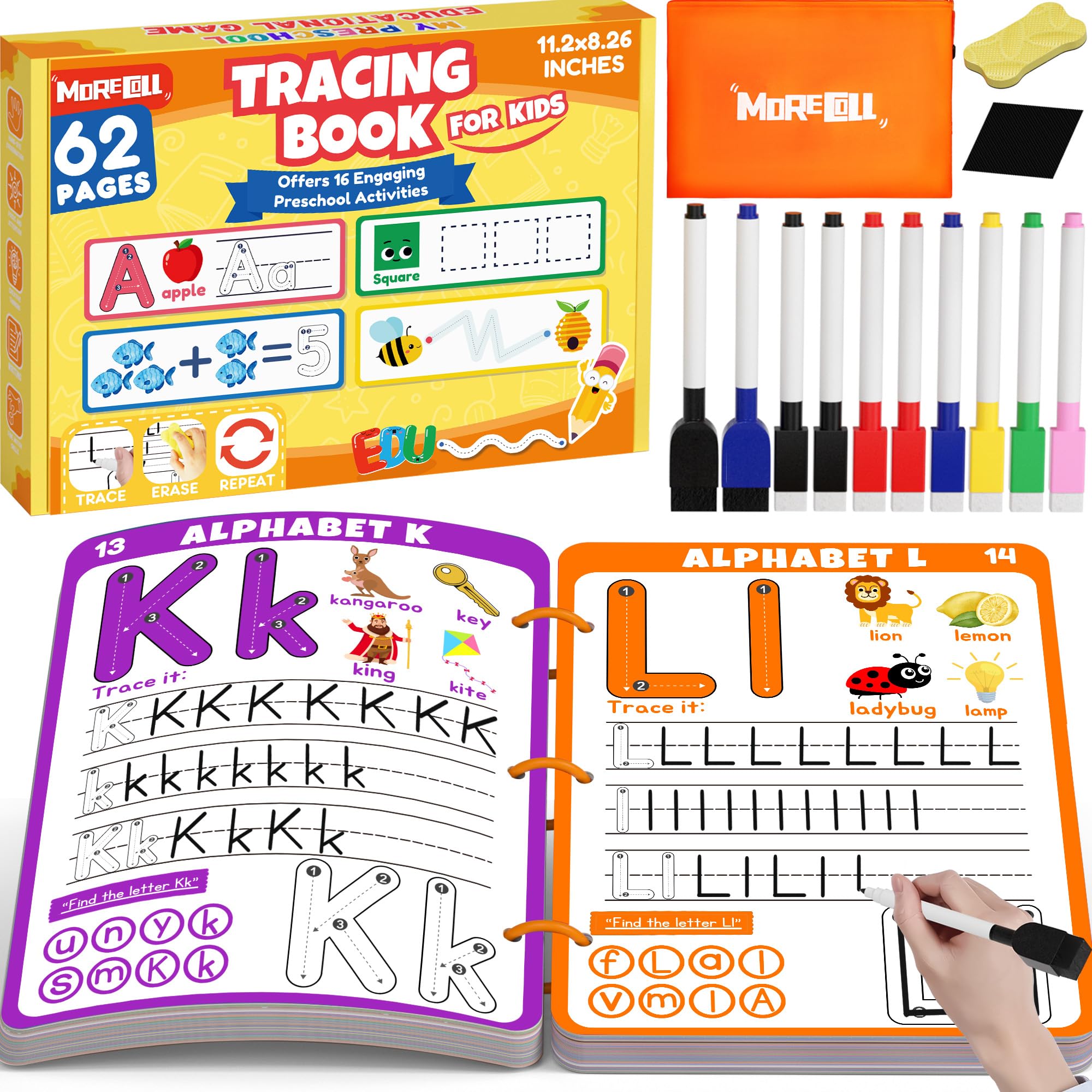
The cheapest book here also carries the highest page count of any of them: 62 reusable pages covering letters, numbers, shapes, colors, animals, name practice, and a weekly planner. The name page is the standout, since a four-year-old who can find their own name on a page stays with a workbook longer than one practicing a stranger’s.
The format is the same wipe-clean workbook idea as ALIANFLY’s, and it handles the same way: thick pages, clean erasing, and ink that lifts off the laminate without a fight. Content is aimed at three- to five-year-olds, and a child heading into kindergarten who is working on letter formation gets the most out of it.
What it gives up is hands-on play. There is nothing to fasten, peel, or match, so it will not hold a toddler the way a velcro page does; this is a sit-down-with-a-grown-up book. For the least money on this list you get the longest run of tracing practice, and that is a fair trade for a family that already owns a matching book.
Pros
- 62 reusable pages, the most here
- Wipes clean and repeats indefinitely
- Name practice and weekly planner pages
- Lowest-priced book in this group
Cons
- Marker colors can differ from the photos
Our budget pick: the most tracing pages here for the least money, and a sensible buy when a matching book is already on the shelf.
Best for Activity Variety
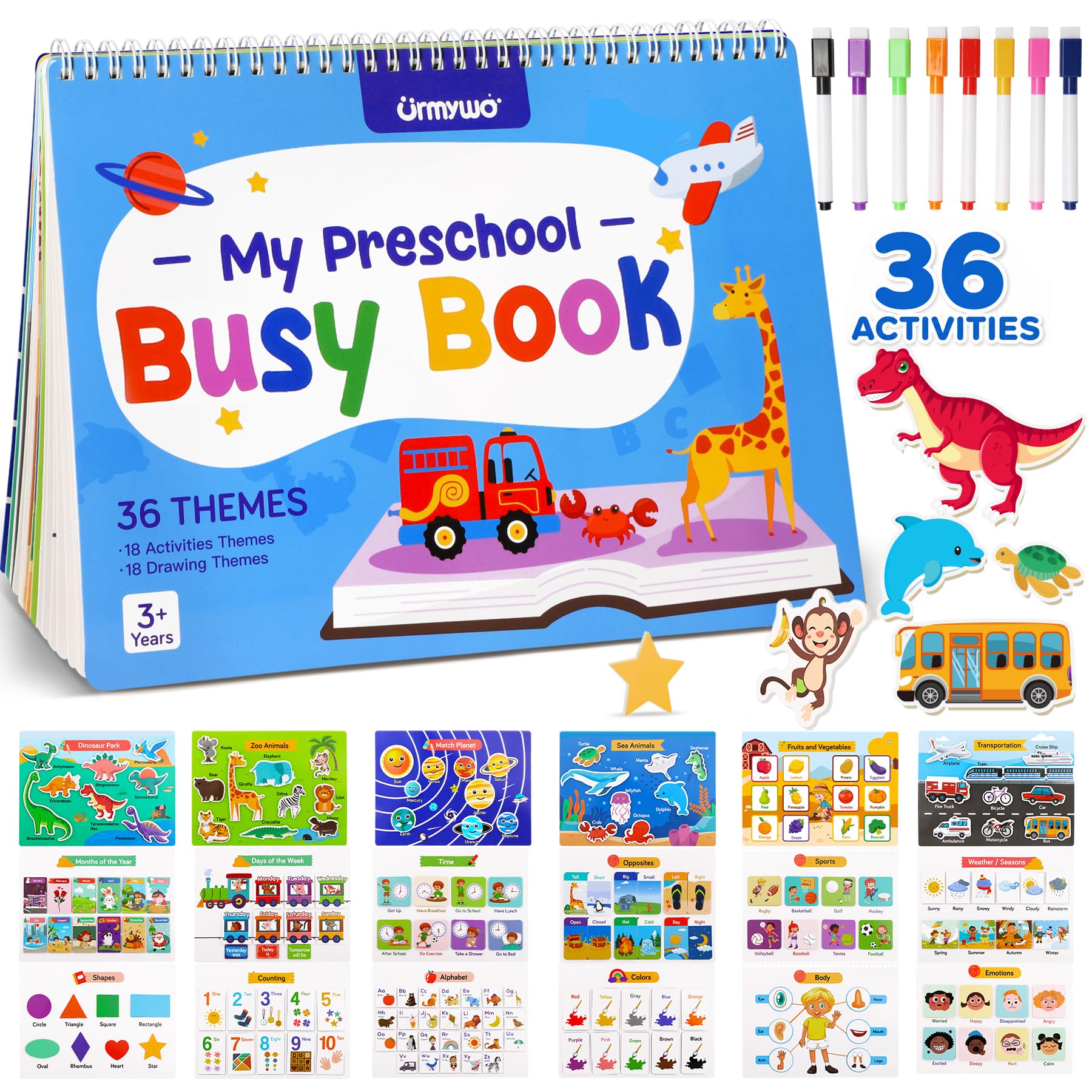
URMYWO 36-Activity Busy Book
Key Features
- Themes: 18
- Weight: 1.8 lb
- Activities: 36 total: 18 matching, 18 tracing
- Dimensions: 10.9 x 7.8 x 0.8 inches
- Price: Budget
Thirty-six activities is the highest count here, split evenly between 18 matching pages and 18 for tracing, coloring, and mazes. That combination is what makes it useful for a child who has outgrown matching on its own but is not ready to sit with a pure workbook: a peel-and-stick page, then a marker page, then another peel-and-stick.
The printed guides are the detail that makes it work. Every piece sits inside a faint outline on its page, so a three-year-old who cannot read the label still knows where the duck goes, and an adult can see at a glance what has gone missing. The pages are thick, spring-bound, and wipe clean, and the binding lets the book lie flat on a table.
Its limit is the age floor. The themes run to days of the week, months, and weather, which a two-year-old has no use for, so in practice this is a three-and-up book. For a family that wants matching and writing in a single purchase, though, it does more than anything else on this list at the price.
Pros
- 36 activities across matching and tracing
- Printed outlines show where each piece goes
- Thick wipe-clean pages with spring binding
- Covers 18 themes in one book
Cons
- Hundreds of fasteners to attach before use
Our pick for variety: matching and tracing in one book, provided you are willing to spend an evening with the fastener sheet first.
Best for Matching Plus Tracing
Huijing Montessori Busy Book

Key Features
- Themes: 15
- Material: Paper
- Age range: 3 years and up
- Writing pages: 14
- Price: Midrange
Set this beside our top pick and the difference is content, not concept: 15 themes plus 14 drawing and writing pages, so one book covers matching and marker work. What you give up is the finishing. The hook-and-loop dots arrive on a sheet and go on by hand, which is an evening of work before a child can use the book.
The theme list is unusually wide for the money: numbers, alphabet, food and drink, fruits, animals, rainbow, colors, shapes, size discrimination, transportation, weather, the week, seasons, holidays, and planets. Planets and holidays are the pages that get a second look from a four-year-old, and the drawing pages underneath give the book a longer life than pure matching would.
Paper is where it gives ground. The pages and the cards holding the pieces are card stock rather than laminated board or cloth, and the piece edges soften where they are peeled off and pressed back. It is a book that rewards a child who uses it at a table; it is not the one to hand a toddler who drags things around by a single page.
Our take: this is the best value on the list for matching plus tracing inside one cover, as long as you are willing to do the fastening first. Keep a zip bag for the pieces that work loose, because some of them will.
Pros
- 15 themes plus 14 drawing and writing pages
- Widest topic list in this group
- Covers matching and marker work in one book
Cons
- Fasteners arrive loose and go on by hand
- Cards soften and fray with heavy use
Worth it if you want matching and tracing in one book and do not mind the setup: the widest theme list here for the content you get.
Best for Thick Pages
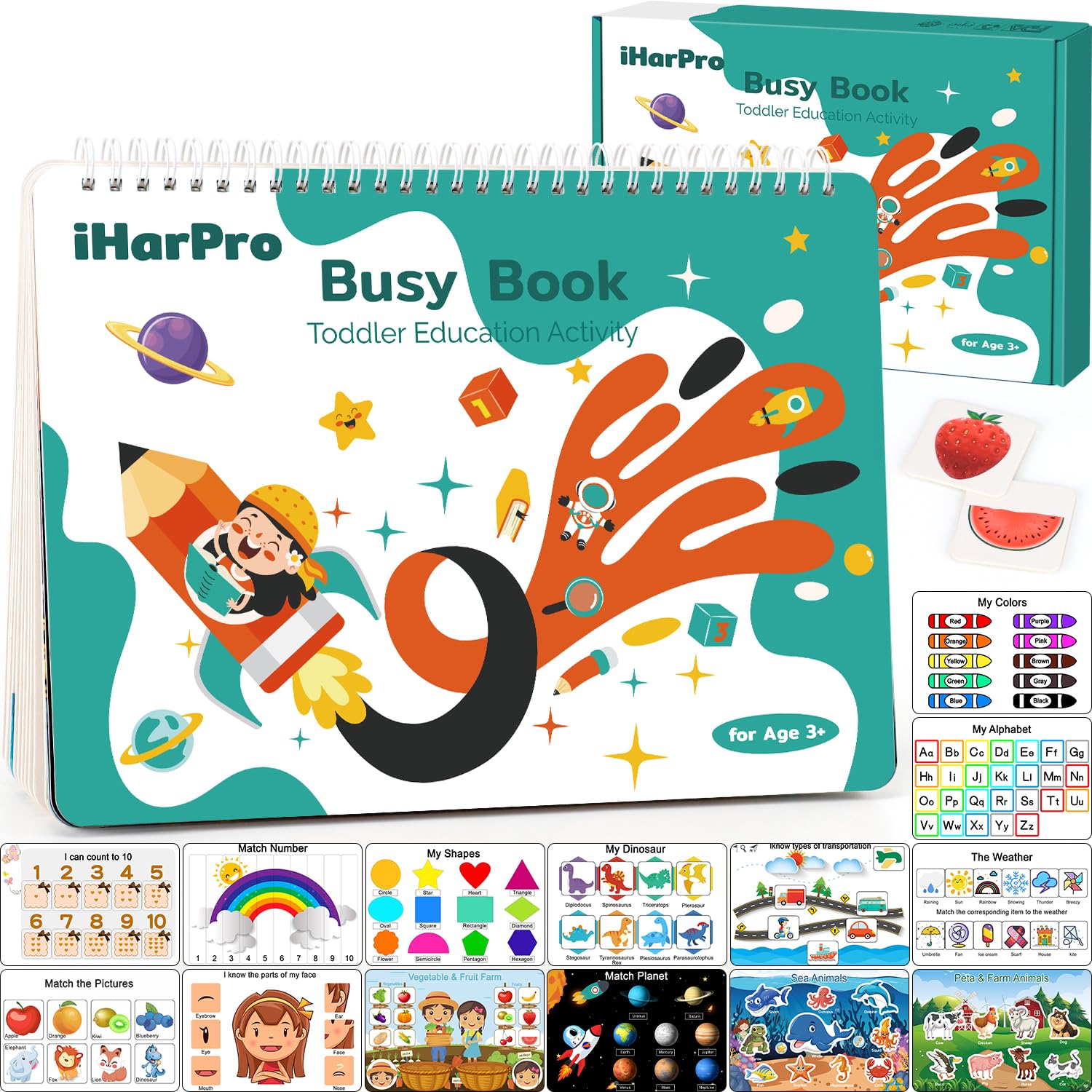
iHarPro Laminated Busy Book
Key Features
- Pages: 14 double-laminated pages
- Extras: Storage box and card bag
- Themes: 14
- Dimensions: 12.2 x 9.8 x 1.9 inches
- Price: Budget
The evening we spent on this book was the evening we spent sticking hook-and-loop dots onto pieces. The pages come bound and the artwork is ready, but the fasteners for the loose pieces go on by hand, a couple of hundred of them, and until that job is finished a child cannot use the book at all.
What you get for the effort is 14 double-laminated pages with reusable stickers that peel and re-stick instead of tearing, plus a storage box and a small bag for the loose cards. The theme spread, from alphabet and numbers through dinosaurs, transportation, weather, fruits and vegetables, planets, animals, and sea animals, covers more ground than most here.
The human body organs page is an odd choice for a preschool book and also the one that starts the longest conversation. In practice it suits a four- or five-year-old best, because the matching is dense and each page carries a lot at once, and the storage box matters more than it sounds once the pieces are loose.
Our verdict: the pages themselves are the thickest laminated card here, and the price sits with the cheapest books in this group. Spend the evening and you have a book that takes daily handling in stride; skip it, and one of the assembled books above is the better buy.
Pros
- Thick double-laminated pages
- Reusable peel-and-restick pieces
- Storage box and card bag included
- Priced with the cheapest books here
Cons
- Every piece fastener goes on by hand
Worth the setup evening: 14 laminated, reusable pages at a budget price, and the sturdiest pages in this group.
How We Tested the Busy Books
We built the shortlist from books preschool teachers recommend, parent-group threads, and bestseller lists, then filtered by age range, page count, and whether the pieces arrive preassembled. Page count alone tells you little — a 10-page book kept my kid busier than a 30-page binder — so we judged content by the number of activities, the artwork, and whether the difficulty actually climbs, not by the theme count on the box.
Fourteen books came home with us and stayed for four months. They went on airplane tray tables, into restaurant booths, into the back seat on the way to daycare, and onto the kitchen table during the ten minutes after nap when everyone needs a reset. I timed assembly out of the box, since some arrive ready to hand over and others hand you a sheet of Velcro dots and expect you to peel and stick every one.
After two weeks of daily handling, I counted how many pieces were still attached and how well the Velcro held, then wiped the tracing pages with a baby wipe to see whether marker came off or ghosted. I noted which books my kid reached for unprompted on day twelve, which told me more about engagement than any claim on the box, and whether the activities climbed from matching to letters or repeated one skill a dozen times. Quality showed up at the binding and the punched holes: torn pages, loose rings, corners that curled.
Value came down to reuse. A book that wipes clean and keeps its pieces earns its price; a one-and-done doesn’t. We checked what came in the box — markers, a storage bag, spare Velcro — whether you could add a child’s name or family photos, and whether the art and color palette looked like a toy or a worksheet.
How to Choose a Busy Book for Toddlers
The biggest difference between these activity books is not the page count. It is how much of the work is left for you before a child can use one.
Assembly Is the Real Divide
Some books here arrive ready to hand over, and some arrive as a kit: bound pages, loose cards, and a sheet of hook-and-loop dots you apply yourself, often a few hundred of them. The kit costs less and takes an evening. Read the listing closely, because a book can call itself preassembled when only the pages are bound and every piece still needs fastening. If you are buying for someone else’s child, finish the job before you wrap it.
Which side you land on depends on timing. A book headed for a birthday next week, a flight on Friday, or a grandparent’s house should arrive assembled. A book for your own child, with a free evening and a lower price in mind, is fine as a kit. Just plan on the first session being yours rather than theirs.
Match the Format to the Skill, Not the Age on the Box
The age ranges here are loose, with one book on this list claiming 3 to 15 years and another 0 to 6, so shop from what your child already does. Under three, choose fabric with integrated parts: nothing loose, nothing to fasten, nothing to swallow. Around three, matching pages with removable pieces take over. By four, tracing and writing pages are what hold attention, and a plain marker workbook starts to make sense.
Buying up is the common mistake. A four-year-old who has known the alphabet for a year will finish a 14-theme matching book in one sitting and never return to it, and a two-year-old handed a 62-page tracing workbook will color two pages and walk off. When you are between stages, buy the book that does both, with matching on one page and tracing on the next.
Matching Pieces or a Marker? Two Different Jobs
Hook-and-loop matching builds fine motor control, sorting, and visual discrimination, and it corrects itself: a piece fits one outline and no other. It also works on a lap, in a car seat, and in near silence. Marker work builds grip, pressure, and stroke order, which is what handwriting needs, but it requires a table, capped pens, and someone nearby.
For a three-year-old the useful answer is usually both, with different jobs. Matching travels; tracing stays home. If you are buying only one and your child already holds a pencil reasonably well, the workbook gets used for longer. If they are still working on pincers and patience, the matching book wins.
Pages, Pieces, and What Survives a Toddler
Page material decides how long a book still looks new. Laminated card stock and stitched fabric wipe clean and come out of a tote intact; thin paper cards bend and fray at the corners where pieces peel off, and that wear shows up fastest on the books carrying the most pieces.
Count the pieces before you buy. A 178-element book means 178 things to keep track of, and a zip pouch or the maker’s carry box is what stops the drift into the couch cushions. Spare fasteners in the box are worth scanning for as well, since they turn a worn piece back into a working one instead of a lost one.
Frequently Asked Questions
Are busy books safe for a 1-year-old?
Check the age on the listing before anything else. Books with removable hook-and-loop pieces are labeled for 3 and up because those pieces are small parts and a choking risk for a child who still mouths things. For a 1-year-old, buy a fabric book with sewn-in or integrated parts, like the hahaland farm book, and save the piece-based books for a child past the mouthing stage.
Do the dry-erase markers stain clothes?
The markers sold with these workbooks are dry-erase, and the ink sits on top of the laminated page instead of soaking in. It lifts out of shirts and pants far more easily than a permanent marker, and it comes off the page with a dry eraser. Cap the markers between uses, and skip wet wipes on the pages, which push ink into the edges.
Do busy books actually teach a toddler anything?
The matching pages do real work on visual discrimination, sorting, and fine motor control, and the tracing pages rehearse the strokes that handwriting needs later. What they do not do is teach themselves. A two-year-old gets the most from an adult naming pieces during the first few passes; a four-year-old gets more from the writing pages than from another round of matching animals.
Final Verdict
Our pick for most families is the Momo & Nashi book. It arrives assembled, the pieces stay on their pages when the book is thrown in a bag, and the content fits the two-to-four-year-old this category is really built for.
If your child is still under three, the hahaland farm book is the better match: fabric, integrated parts, nothing to lose. And if handwriting is the goal rather than matching, ALIANFLY’s tracing workbook does more for a pencil grip than any page of velcro animals.
