This post contains affiliate links. We may earn a small commission when you buy through our links — at no extra cost to you.
There’s a specific look a backyard birthday takes on around 2 p.m.: four kids airborne in a castle, one adult crouched by the blower, everyone quietly watching the seams. A bounce house turns an ordinary Saturday into an event, and it’s easy to get wrong — a floor that sags, a slide that pancakes under a second-grader, a blower that never quite fills the tubes. The right one holds its shape for hours, keeps a mixed-age crowd busy, and packs into a bag one person can carry.
What I wish someone had told me before my first one: the blower matters more than the castle. A weak blower gives you a soft floor and kids colliding; a cheap one whines at a pitch that follows you back inside. We’ve inflated, staked, jumped in, and repacked 12 of them over six months, and the differences showed up fast.
Below are the ones that stayed firm, stayed upright with four kids in them, and felt worth owning rather than renting by the hour.


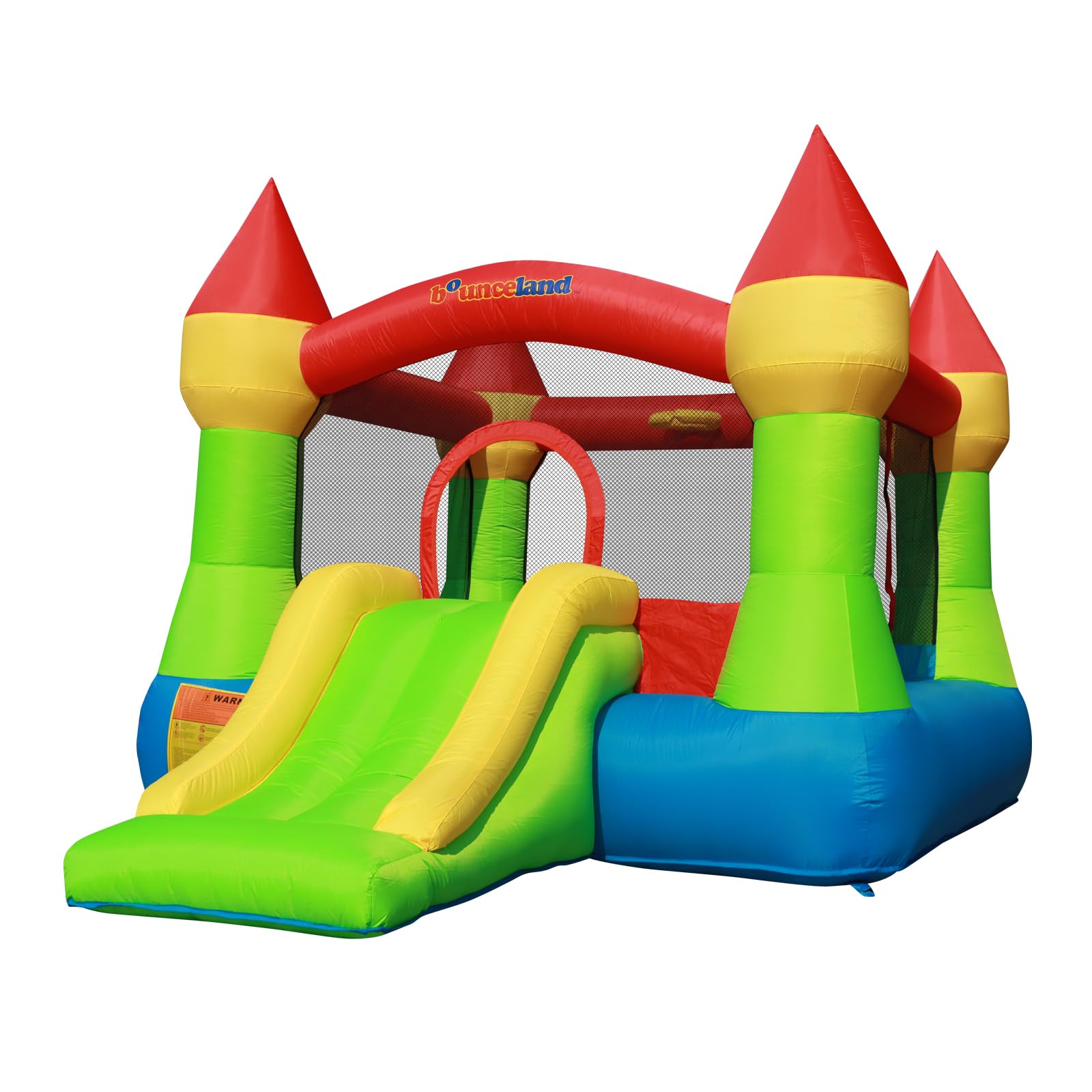


Best for Most Families
Blast Zone Magic Castle
Key Features
- Jumpers: 3
- Age range: 3 to 12 years
- Weight limit: 300 lb
- Inflated size: 11 x 8.5 x 8 ft
- Price: Midrange
Setup is the first test, and this one passed it on a driveway: blower hooked on, house up, stakes into the corners, all before the kids had their shoes off. The netting wraps the whole jump area, so nothing about it depends on a kid deciding not to climb. Even the blower surprised us — it runs at a pitch you can talk over, which is not true of every house here.
What makes it our pick is how little you have to think about it. Three jumpers and 300 pounds covers a pair of 8-year-olds plus a smaller sibling, roughly 11 by 8.5 feet of footprint fits a two-car driveway or a decent lawn, and the vinyl shell with reinforced stitching keeps its shape when everyone lands in the same corner. At 8 feet tall it clears a garage ceiling. It does not clear a living room.
There is nothing to play with but the floor. No slide, no hoop, no ball pit — where the Step4Fun 5-in-1 gives you five activities in less space, the Magic Castle gives you one big, uncluttered room. We count that as a feature for mixed ages: no queue for the slide, no argument about whose turn it is in the ball pit. If your kids need a route to follow, this is the wrong house.
One behavior to plan around indoors: on a hard floor the castle creeps, drifting an inch or two toward whichever wall the kids bounce at. The stakes only help in grass. Put it on carpet, or accept that you will nudge it back between sessions.
Pros
- Three jumpers and a 300-pound limit
- Blower is quiet for its size
- Reinforced seams hold their shape
- One adult, a couple of minutes
Cons
- No slide, hoop, or ball pit built in
Our default pick for most families: 300 pounds of capacity, fully netted walls, and a blower quiet enough to hold a conversation over.
Best for Toddler Playdates
Little Tikes Jump ‘n Slide
Key Features
- Blower: Heavy-duty with GFCI
- Jumpers: 3 to 5
- Weight limit: 250 lb
- Inflated size: 12 x 9 x 6 ft
- Price: Premium
A shoe cubby is the detail that tells you who this house is for. It is sewn onto the outside wall, so muddy sneakers come off before anyone climbs in, and it is the kind of thing you only appreciate after a winter of indoor bouncing. The walls are 6 feet tall, low enough that an adult standing alongside can see the whole jump floor — a real advantage over the towering castles.
Little Tikes rates it for three to five jumpers and 250 pounds, the highest jumper count of any 12-by-9 house here, and the polyester shell is double-stitched at the seams. The blower is the part we trust most: heavy-duty, with a GFCI plug on the cord, which is the protection you want on a wet lawn. Inflation is quick by the standards of this group, and one adult can manage it.
Where it gives ground is at the front panel, the sliding section kids climb through, where seams can separate after a season of steady use. Keep it dry, patch a pulled seam early, and it behaves like a several-season toy rather than a permanent fixture. It is also a 39-pound bundle once packed, so it lives where you set it up rather than commuting from the basement every weekend.
Pros
- Fits three to five small kids at once
- Six-foot walls you can see over
- Shoe cubby keeps the house floor clean
- GFCI plug on a heavy-duty blower
Cons
- 250-pound limit really means toddlers
The house for a yard full of toddlers: five small jumpers, walls low enough to see over, and a GFCI plug on the blower for wet grass.
Best for Slide on a Budget
ACTION AIR C-9745
Key Features
- Jumpers: 3
- Age range: 3 to 10 years
- Weight limit: 250 lb
- Inflated size: 12 x 9 x 6.1 ft
- Price: Midrange
This is the least expensive way here to get a full-size castle with a slide, and standing next to it you cannot tell where the money was saved. Twelve feet long, nine wide, a bit over 6 feet tall, with a slide off one end and mesh on three sides. It is the shape most families picture when they hear bouncy castle.
Three kids and 250 pounds is the rating, which in practice means two 8-year-olds and a smaller sibling. The seams weep a little the whole time it is up, and that is the design rather than a defect: a constant-air house stays firm because the blower keeps pushing air in and the stitching lets some out. Ours held steady through an afternoon. Put a tarp underneath if it is going on concrete or pavers, because the base scuffs first.
Longevity is the trade. The fabric is ordinary polyester for the category, tears after a few hard sessions are the thing to plan for, and the 90-day warranty will not cover a summer of heavy use. Buy it as the house for the years when your kids are small and a slide matters more than a decade of service, and the price makes that an easy call.
Pros
- Full-size castle with a slide
- Fits under a garage ceiling
- Fast inflation, one-person setup
- Lowest outlay of the full-size picks
Cons
- Polyester shell can tear with hard use
The value pick: a 12-by-9 castle with a slide, a 6-foot ceiling that fits a garage, and an outlay well below the premium houses.
Best for Hoop and Slide
Bounceland Castle Bouncer
Key Features
- Blower: UL certified
- Jumpers: 3
- Weight limit: 250 lb
- Inflated size: 12 x 9 x 7 ft
- Price: Midrange
The way in and out needs sorting before anyone gets in. This castle’s entrance is an opening rather than a tunnel, and it sits about two feet off the ground, which means a small kid can tumble backward out of it if the flap hangs loose. Tie the flap up and the problem disappears. It is a two-second fix that is not in the product photos.
Past the door, it is the tidiest 12-by-9 castle in this group. The hoop mounts inside the jump area instead of hanging over an opening, the slide is short enough for a 3-year-old to manage alone, and the PVC-coated fabric with double-to-quadruple stitching is a step up in construction from plain polyester. The blower is UL-listed, which matters more than the marketing around it.
It runs loud. Every constant-air blower does, but this one sits at the noisy end, and if the house goes up beside a patio the adults will be raising their voices. Push it to the far end of the yard and the noise stops mattering.
For a household of young kids in a yard that can spare 12 by 9 feet, this is the one we hand to a grandparent: certified, simple, and built to take a season of birthdays. The hoop and slide are what sell it. The stitching is what keeps it around.
Pros
- Hoop and slide in a compact frame
- ASTM-tested house with a UL blower
- Stitched seams that hold their shape
Cons
- Blower runs loud
- 250-pound limit caps it at young kids
A certified, tidy 12-by-9 castle for 2-to-6-year-olds, with a hoop and slide and seams that hold — just tie the entrance flap up.
Best for Big Groups
Blast Zone Big Ol Bouncer
Key Features
- Jumpers: 6
- Bounce floor: Commercial vinyl
- Weight limit: 600 lb
- Inflated size: 12 x 15 x 7 ft
- Price: Premium
Six kids, 600 pounds, and nothing inside to fight over. The Big Ol Bouncer is a big open room with no slide, no hoop, and no ball pit, and for a party that turns out to be exactly right — a mixed group of 4-to-9-year-olds can cycle through all afternoon without a queue forming anywhere.
The bounce floor is commercial vinyl, the material rental units use, and you can feel the difference underfoot: less trampoline snap than the cheaper houses, more of a solid surface that does not bottom out when four kids land together. At roughly 12 by 15 feet and 7 feet tall, it is a yard house or a gym house, not a living-room one.
Moving it is the price. Deflated, it is a heavy bundle that two adults handle more comfortably than one, and staking a footprint this size takes longer than inflating it. The case for owning one this big is frequency: if it goes up most weekends through the summer, nothing else here entertains as many kids at once. If it comes out twice a year, save your money.
Pros
- Six jumpers and a 600-pound limit
- Commercial vinyl bounce floor
- Open floor means no queue
Cons
- Heavy to move and store
- Needs a big, flat yard
The party pick: six jumpers, 600 pounds, and a commercial vinyl bounce floor that takes a full afternoon of kids without complaint.
Best for Small Rooms
ACTION AIR 9309Y Toddler Bouncer
Key Features
- Jumpers: 2
- Age range: 3 to 4 years
- Weight limit: 90 lb
- Inflated size: 5 x 7 x 4.6 ft
- Price: Budget
Next to the 12-by-9 houses, this one looks like a footstool: 5 feet by 7, 4.6 feet tall, rated for two kids and 90 pounds. That is the entire point. It is the only house here that goes up in a living room with the coffee table pushed aside and still leaves you room to walk around it.
The window it serves is roughly 18 months to 4 years. At 4.6 feet the walls sit below eye level, so you can stand at the kitchen counter and still see the jump floor, and a tumble from the top of a bounce is a short one. Setup is a one-person job of a couple of minutes, and at just under 19 pounds it moves between rooms without a second thought.
The blower is loud for a house this small, and it runs the entire time kids are in it — in a living room that means the television on pause. Set it up in a basement or a spare room rather than the room where you watch things, and the noise stops being the story. The size cuts both ways too: by kindergarten, most kids are done with it. Buy it for the toddler years and hand it down.
Pros
- Fits a living room or basement
- Low walls keep kids in view
- Just under 19 pounds
Cons
- Rated only for ages 3 to 4
The small-space answer: 5 by 7 feet, two toddlers, 90 pounds, and it goes up in a couple of minutes in a room you already have.
Best for Activity Variety
Step4Fun 5-in-1 Bounce House
Key Features
- Blower: 370W, ETL listed
- Jumpers: 3
- Weight limit: 300 lb
- Inflated size: 9.3 x 8.2 x 5.4 ft
- Price: Midrange
Slide, basketball hoop, dart target, ball pit, jump area: five activities in about 9 by 8 feet, plus 40 soft balls in the box. The ball pit is the difference between a bouncer and an afternoon — it is shallow, walled off from the jump floor, and it gives a 2-year-old somewhere to be while the 6-year-old bounces.
Step4Fun is also one of the few here that spells out its testing: ASTM F963-16/17 and CPSIA on the house, an ETL-listed 370-watt blower, and a 300-pound limit across three kids that is generous for the size. The dart target is mostly a novelty — another way to throw the same soft balls at fabric — but it costs you no floor space.
Two practical notes. The slide ends at ground level, so a mat or a thick rug under the exit saves knees on a patio. And the carry bag is a snug fit, with the last few inches taking patience and a second pair of hands. For the money, this is the most play per square foot in the group, and the one that keeps a 2-year-old and a 6-year-old busy at the same time.
Pros
- Five play zones including a ball pit
- ASTM and ETL certified house and blower
- 300-pound rating for three kids
- Only about 9 by 8 feet
Cons
- Nylon seams can pull with hard use
The activity-per-dollar winner: a slide, hoop, dart board, and 40-ball pit in a footprint small enough for a side yard.
Best for Older Kids
Hongcoral Bounce Castle

Key Features
- Jumpers: 6
- Weight limit: 400 lb
- Inflated size: 12.7 x 8.3 x 7.2 ft
- Shell material: 840D/420D oxford
- Price: Premium
By 7 or 8, a plain bouncer has about ten minutes of novelty left in it. This one gives them a route: obstacle poles to weave through, a long slide, a small trampoline section, and a ball pit, so there is somewhere to go after the first twenty jumps. Of everything here, it is the one built for the kid who announces they are bored.
The numbers are strong for the footprint: 400 pounds across six jumpers in about 12.7 by 8.3 feet, a shell of 840D and 420D oxford cloth, and mesh on three sides. Ten stakes come in the box, twice what most of these include, which matters on a breezy afternoon. The blower fills it fast enough that setup never becomes the reason not to bother.
Watch the dimensions. That 12.7 feet is the length of the whole course, and the slide, obstacles, and pit all eat into it, so the jumping floor is smaller than a plain 12-by-9 castle’s. For a 6-year-old and a 9-year-old, that is a fair trade for the extra play. For three kids under 5, an open floor uses the same lawn better.
The heavier oxford shell is the reason we are not worried about the seams, and a course this quick to inflate actually gets used on ordinary weeknights instead of being saved for birthdays. Give the carry bag a pass, though: it is sized for the house, not the blower, so the two travel separately.
Pros
- Four play zones for older kids
- 400 pounds across six jumpers
- Ten ground stakes included
- Heavier 840D/420D oxford shell
Cons
- Jump floor is smaller than the length suggests
- Blower will not fit in the carry bag
For kids who have aged out of plain bouncing: a slide, obstacle poles, a trampoline, and a ball pit in a course that fits a normal yard.
Best for Large Yards
Bounceland Party Castle

Key Features
- Jumpers: 5
- Sun roof: Removable
- Weight limit: 500 lb
- Inflated size: 16 x 13 x 10.3 ft
- Price: Premium
Ten feet of height buys something specific: room for a 10- or 11-year-old to get real air without folding up, and space for the sun roof that clips over the top. This is the one in the group that grows with a family instead of being outgrown in two summers, and it is also the one your neighbors will see from the end of the street.
Sixteen by 13 feet of footprint, 500 pounds, five kids at a time, a hoop inside, a slide at the entrance, and a removable roof that takes the worst of the afternoon sun off the jump floor. The blower is UL-listed, and the PVC-coated terylene shell is stitched double to quadruple at the load points.
Nothing else here gives five kids this much air, and that is what the extra money buys — along with a roof that makes the jump floor usable at 2 p.m. in July. Set it where the afternoon shade lands anyway, because ten feet of vinyl in full sun gets uncomfortable inside even with the roof on. Inspect the cross-member seams after each use: that is where a house under 500 pounds of kid starts to go.
Pros
- Five jumpers and a 500-pound limit
- Removable sun roof
- Hoop and slide included
- Ten feet of height for big kids
Cons
- Needs 10 feet of clearance — yards only
- Cross-member seams are the wear point
The big-yard choice: 16 by 13 feet, 500 pounds, five kids at once, and a sun roof that keeps the jump floor usable in July.
Best for Weight Capacity
YARD Bounce House

Key Features
- Jumpers: 3 to 4
- Jump deck: 20 in high
- Weight limit: 400 lb
- Inflated size: 12 x 9 x 8 ft
- Price: Midrange
Start with the tie that holds the blower into the inflation tube. On this model it can slip, and when it does the walls soften while kids are still inside. Check the knot before every session and again if the house starts to look tired — five seconds of habit that takes the one real risk out of the picture.
Everything else is quietly good. Four hundred pounds is more than any other 12-by-9 house here, the jumping surface sits 20 inches off the ground so there is genuine air under the bounce, and the 370-watt blower is UL-listed alongside an ASTM-tested shell. Three or four toddlers fit comfortably. Two 8-year-olds fit well.
It is a garage-and-yard house. At 8 feet tall it is not going in a living room, and 12 by 9 feet of footprint is a real slice of a two-car garage, which is exactly where it fits best on a rainy weekend. For the flat space, you are getting more capacity than the cheaper castles in this group offer, and that is the reason to choose it.
Pros
- 400-pound limit, most in its size class
- Raised 20-inch jump deck
- UL blower and ASTM-tested shell
Cons
- Tight carry tote
The capacity leader among the 12-by-9 houses: 400 pounds, a raised 20-inch jump deck, and a UL-listed blower at a mid-range price.
What Six Months of Bouncing Taught Us
We started with research: every bounce house we could find that included its own blower, filtered by footprint, price, and what came in the box — stakes, a storage bag, a GFCI plug, repair patches. Anything too big for a standard yard or too cramped for two kids to bounce side by side got cut. That left 12 units, which we inflated and lived with for six months.
Setup came first. I timed each one solo with a stopwatch from bag to fully firm, then again with a seven-year-old helping, because that’s the real condition. I noted where seams strained, whether stakes went into hard summer ground without bending, and how much of the floor went soft underfoot after an hour of steady jumping.
Noise got its own pass: I held a normal conversation next to the blower, then walked to the far end of the yard to hear whether it carried through a closed window. Stability we tested less politely — kids hanging off the walls, two adults stepping in, one breezy afternoon that turned into a stress test. Airflow showed up in the small things, like whether the tubes stayed drum-tight at hour three or slowly softened.
Durability is a slower read: six months of inflate, jump, wipe down, deflate, and repack, watching for stretched seams, hairline pinholes, and zippers that stopped gripping. We weighed value against what actually arrived — a bag that fits, patches that stick, extras like a hoop or ball pit that kids still used past the first ten minutes. And we watched how children moved through each one, because entry height, mesh fine enough to see through, and a slide that doesn’t dump kids off the side decide whether it gets used twice or all summer.
How to Choose an Inflatable Bounce House
The right bounce house is the one that fits the flat ground you actually have and the kids who will actually use it, not the one with the longest feature list.
Start With the Space You Can Give It
Height is the constraint people forget. A 12-by-9 castle runs 6 to 8 feet tall, which clears a garage ceiling and usually nothing indoors; a 10-foot castle is yard-only. Measure the ceiling before you assume indoor use, and leave a couple of feet clear at the hose end for the blower. For a living room or a basement, the honest size is the ACTION AIR 9309Y at 5 by 7 feet.
The ground matters just as much. Every house here anchors with stakes, so a lawn or a patch of soil is the easy setup. On a driveway, a patio, or a gym floor, stakes are useless and you need sandbags or water weights at all four corners, plus a tarp to keep the base from scuffing.
Read Weight Limits, Not Just Jumper Counts
A 250-pound house rated for three kids and a 600-pound house rated for six are not describing the same purchase. The first is a toddler house; the second is a party house. Divide the total limit by the number of kids you expect, and check whether the maker also lists a per-child cap — Bounceland, for example, specifies under 100 pounds per child on its 12-by-9 castle.
Age ratings are the other half of the story. A 90-pound, two-jumper house is being honest about a 3-to-4-year-old window, and there is nothing wrong with that if that is the window you are in. If a 10-year-old will be bouncing, you need height and capacity together.
Expect the Seams to Breathe
Every house on this list uses a constant-air blower that runs the entire time and pushes air in faster than the stitching lets it out. That is why the walls stay firm, and it is why you will feel a steady weep at the seams of a brand-new house. It is not a defect, and patching it is the wrong repair.
What you are really buying with the blower is noise. A 370-watt unit is audible across a yard and loud in a room, so put the house at the far end of the lawn rather than beside the patio where the adults sit, and expect to pause the television indoors.
Protect the Floor and the Stitching
Most wear starts underneath. A tarp over concrete, pavers, or gravel keeps the base from scuffing and stops grit from grinding into the seams when the house is folded. Shake it out before you pack it, every time.
Store it bone dry. A house folded damp comes out of storage smelling like a basement, and long stretches of direct sun are what turn vinyl stiff. Repair patches ship with every pick here; a small tear is a ten-minute job if you get to it before it spreads, and a replacement house if you don’t.
Decide What the Extras Are Worth
A slide, a hoop, and a ball pit add play value but eat floor space. A five-activity house at 9 by 8 feet has less jump area than a plain castle of the same footprint, and an older kid notices. Extras pay off when ages are mixed and the 3-year-old needs something to do that isn’t jumping.
If everyone is between 5 and 9, buy the plain, well-stitched house and put the money into capacity. Then check the bag: on several of these the carry tote is sized for the house and the blower has to travel separately.
Frequently Asked Questions
Do I have to stake a bounce house down?
In grass, yes. Every pick here ships with stakes, and an unstaked house will walk across the lawn as kids bounce toward one side. Drive them at an angle through the tabs at each corner. On a driveway or a wood floor the stakes are useless, so use sandbags or water weights instead and keep the house against a wall. Never leave one inflated and unattended in wind.
How do I dry a bounce house before storing it?
Reinflate it in the sun for a few minutes after it has been hosed down or rained on, wipe the walls with mild soap and water, and let the whole thing air-dry completely before folding. Fold loosely rather than pressing it flat, and store it in a dry garage or closet rather than a damp shed. A mildew smell is the sign you folded it early, and it does not wash out easily.
What kind of extension cord does the blower need?
A heavy-gauge outdoor cord — 12-gauge for a 50-foot run — plugged into a GFCI-protected outlet. Several blowers here are rated at 370 watts, which a light-duty indoor cord will not carry comfortably. Keep the connection off the ground and out of puddles, and don’t share the circuit with anything else while the house is up.
Is buying a bounce house worth it compared with renting?
It comes down to how often it goes up. If it will be inflated most weekends through the summer, owning wins inside the first season or two. If it comes out for one birthday a year, rent and skip the storage problem. Be honest about the effort, too: a 12-by-9 house is a one-adult, ten-minute job once you know it, and a 16-foot castle is a two-adult job.
Final Verdict
After setting up all ten, the Blast Zone Magic Castle is the one we point most families to. It has the capacity for a real playdate, the seams to survive one, and a blower that doesn’t end every conversation in the yard. It is also the least fussy house here to own, which counts for more than any single feature on a Saturday morning.
Two situations call for something else. If the guest list regularly runs past four kids, the Blast Zone Big Ol Bouncer’s six-jumper, 600-pound floor is the better buy. And if the house is going in a living room or a basement, drop down to the ACTION AIR 9309Y — a full-size castle in a small room is just furniture you can’t walk around.
