This post contains affiliate links. We may earn a small commission when you buy through our links — at no extra cost to you.
The day the harnessed seat comes out is usually the day the shoulder belt starts sawing at your kid’s neck. A backless booster fixes that by lifting a kid a few inches so the car’s lap and shoulder belt land on the hip bones and collarbone instead of the stomach and throat. The hard part is picking one: they all look alike on the shelf.
I’ve spent six months with 14 of them cycling through my back seat and a rental car on a weeklong trip. What separates a good one isn’t padding or cup holders; it’s belt fit and how little thought it demands at 7:45 a.m. One inflates, which sounds like a gimmick until you’re folding it into a carry-on.
A backless booster also has no latch, so the seat belt buckle becomes the whole user experience — if the shell covers the receiver, you’re the person holding up the drop-off line. The picks below are the ones that held up to daily abuse, kept the belt where it belonged, and stayed comfortable enough that nobody slumped, while still being light enough to hand off between cars without a fight.


Best for Everyday Family Car
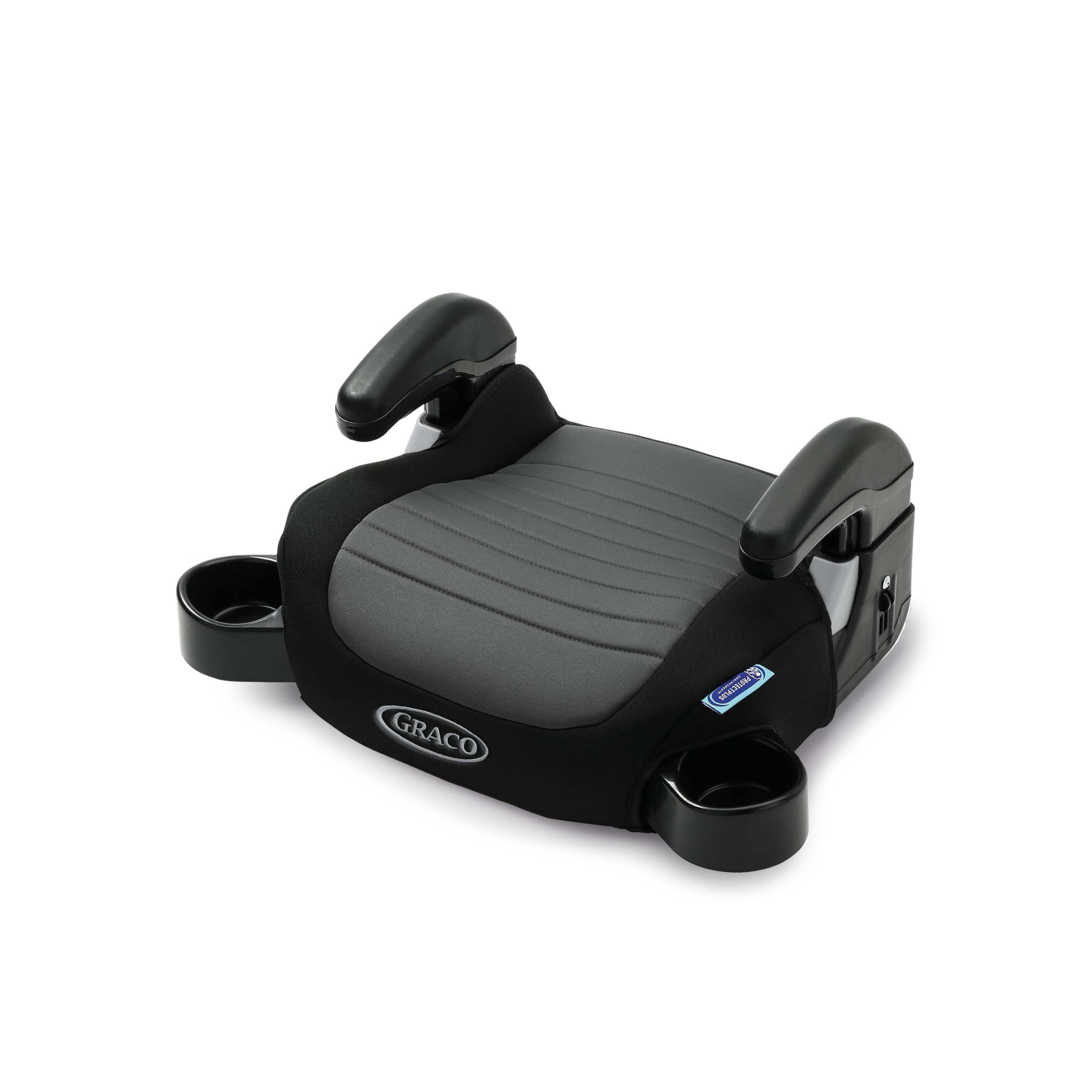
Graco TurboBooster 2.0 Backless
Key Features
- Cup holders: Two, hideaway
- Seat weight: 4.4 lb
- Child height range: 43–57 in
- Child weight range: 40–100 lb
- Price: Midrange
The two features we use every single day are the least dramatic ones: the armrests adjust up and down, and the cup holders push back into the shell when nobody’s drinking. Fixed armrests and two permanent plastic cups are how a back seat that should hold three ends up holding two.
At 40 to 100 pounds and 43 to 57 inches, the TurboBooster covers roughly ages four to ten, and at 4.4 pounds a kid can carry it out to the other car without help. We think it’s the right first backless booster for most families: the belt path is unobstructed, the shoulder belt runs cleanly across the collarbone rather than the neck, and there’s nothing to adjust between riders.
What it doesn’t do is attach to the vehicle. With no LATCH, an empty TurboBooster slides on leather and can tip forward when you brake. Buckle the seat belt across it whenever it’s empty — that one habit keeps it in place and stops it from becoming a projectile in a crash.
The 100-pound ceiling is the real limit here. A big seven-year-old can outgrow it before they’re ready to give up a booster entirely, and in a back seat already carrying two car seats, the Cosco’s 15.5-inch shell slots in where this one won’t.
Pros
- Armrests adjust for a clean belt path
- Hideaway cup holders reclaim seat width
- 4.4 pounds, easy to hand between cars
- Covers roughly ages 4 to 10
Cons
- No LATCH, so the empty seat slides
- 100-pound limit caps the booster years
Our default pick for most families: clean belt routing, armrests that adjust, and cup holders that disappear when you need the width back.
Best for Three Across
Cosco Topside Backless Booster
Key Features
- Width: 15.5 in
- Seat weight: 2 lb
- Child height range: 43.4–57 in
- Child weight range: 40–100 lb
- Price: Budget
Two pounds and 15.5 inches wide is the entire argument. The Topside is the lightest and narrowest hardshell seat in this group, and in a compact back seat that already holds one or two car seats, that difference is the difference between a third child riding in the middle and a third child staying home.
We hand this one to grandparents and to the family with three kids in a row, because it moves like a backpack and leaves the buckle stalks reachable. There’s real padding in the seat, and the low, flat shell keeps the lap belt where it belongs once it’s threaded.
The armrests sit lower than most, though, so the lap belt passes underneath them rather than over, and a smaller rider may need a hand getting it seated the first few times. Check it yourself before you pull out: lap belt low across the hips, shoulder belt over the middle of the shoulder, nothing twisted.
Where it isn’t the answer is a five-hour drive with a kid who complains about hard seats — the Chicco’s foam is worth the extra heft for that. For the school run and the third row, this is the seat that quietly does the job.
Pros
- Two pounds, easy to stow and carry
- 15.5 inches wide, fits three across
- Lowest price in this group
Cons
- No cup holders at all
- Cover is hand-wash only
The seat to buy when the back seat is already full — the lightest and narrowest here, and the least expensive way to get three kids in a row.
Best for Long Road Trips
Chicco GoFit Backless Booster
Key Features
- Width: 17 in
- Cup holders: Two, dishwasher-safe
- Seat weight: 5 lb
- Child weight range: 40–110 lb
- Price: Premium
Padding is what you’re buying. The GoFit has a contoured, double-foam seat, and the difference shows up around hour three of a drive, when kids in thinner boosters start shifting and the belt drifts with them. It’s the seat we take when the trip is long enough for comfort to matter.
It’s rated to 110 pounds and 44 to 57 inches, the highest weight limit of the hardshell seats here, and the details are built for travel: a carry handle molded into the shell, two cup holders that come out and go in the dishwasher, a machine-washable pad, and armrest covers that pop off. At five pounds it’s heavier than the Graco, which is the honest cost of all that foam.
One thing to know: this version of the GoFit has no LATCH, and Chicco sells a Plus model that does. Without it, the seat slides while a kid climbs in, so hold it steady with one hand and buckle the belt across it when it’s empty. That’s a habit, not a defect — the vehicle belt still does all the restraining.
For a two-minute school run, that padding is a luxury. For a family that spends real hours on the road, it’s the reason to pick this one over the Graco, and the extra weight only matters on the days you’re carrying it between cars.
Pros
- Contoured foam that holds up on long drives
- Carry handle makes it easy to move
- Dishwasher-safe cup holders, washable pad
Cons
- Five pounds, the heaviest hardshell here
- Priciest seat in this group
Worth the extra money if your kids spend real time in the car — the foam padding and washable parts make long drives easier on everyone.
Best for Two Cars
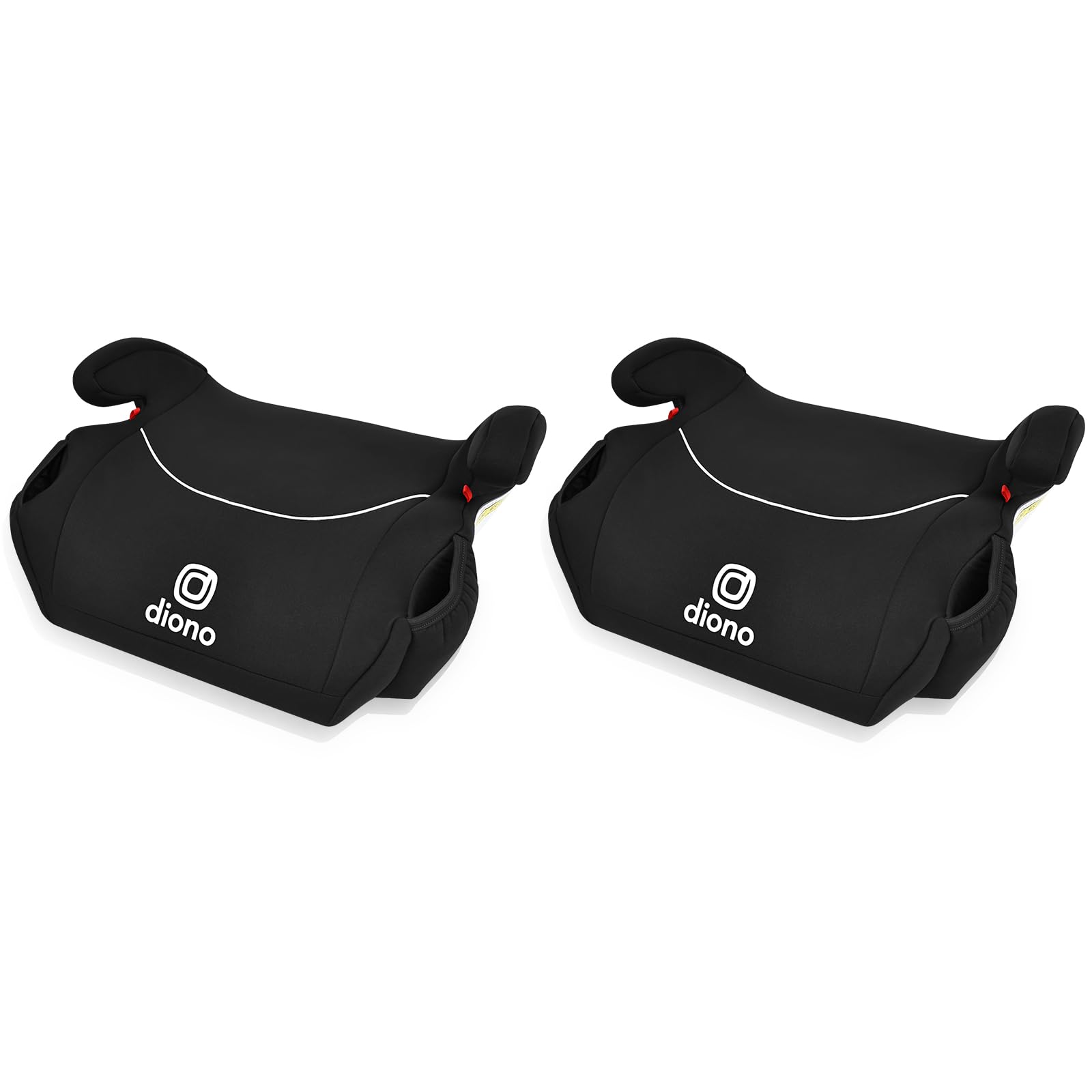
Diono Solana Backless Booster (2-Pack)
Key Features
- Width: 16.9 in
- Seats included: Two
- Child height range: 38.2–63 in
- Child weight range: 40–120 lb
- Price: Midrange
The Solana comes as a pair, and that’s the whole idea: one box covers both cars, or the second row plus the spare that lives in the trunk for school pickup. If you only need one seat, you’re buying a spare whether you planned to or not.
Those two seats go from 40 to 120 pounds and up to 63 inches, the widest range in this group — a tall kid gets years more out of it than out of the 100-pound seats. Diono sells it as an eight-year booster, the covers come off for the washing machine, and each seat has two soft cup holders that lie flat when they’re empty. The pair weighs a little over six pounds.
For two cars and a big kid, this is the best value here and it isn’t close. The catch is width: at 16.9 inches the Solana is wider than the Cosco and nearly the Graco’s equal, so it slides between two car seats in some back rows and blocks the third buckle in others. Measure between your buckle stalks before you count on it for a third child.
Pros
- Two seats in one purchase
- 120 pounds and 63 inches, longest range here
- Covers come off for machine washing
Cons
- No LATCH connectors
The value pick for two vehicles and a tall kid — a 120-pound, 63-inch range no other hardshell here matches, in a box that covers both cars.
Best for Travel and Rideshare
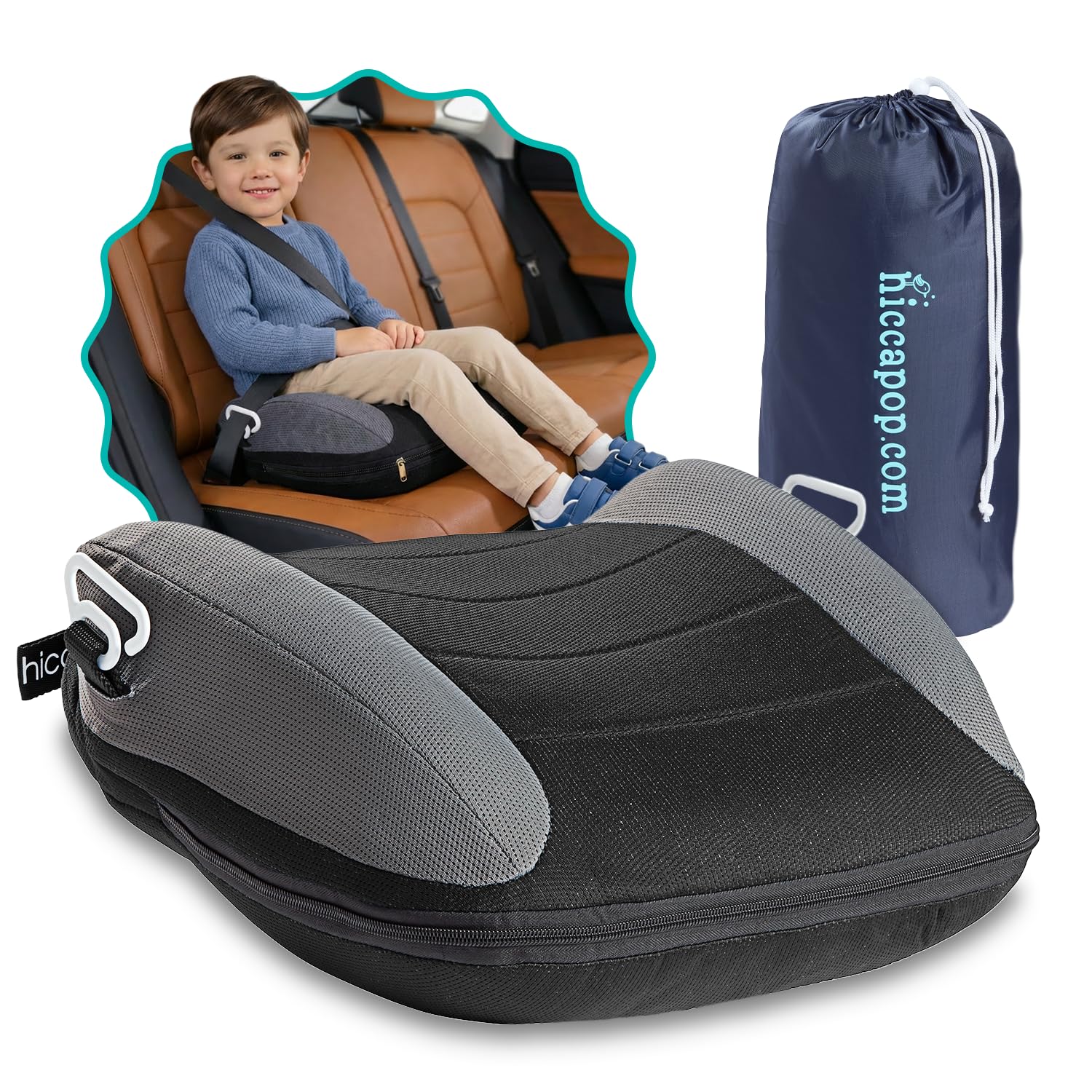
Hiccapop UberBoost Inflatable Booster
Key Features
- Width: 14.5 in
- Seat weight: 1.3 lb
- Child height range: 43–62 in
- Child weight range: 40–110 lb
- Price: Midrange
Rental counter, taxi line, the friend’s car after school: the UberBoost is the seat that turns any of those into a proper ride for a kid who has outgrown a harness. It inflates by mouth in a few breaths, weighs 1.3 pounds, packs down into a bag, and stands about four and a half inches tall once it’s firm.
It’s rated 40 to 110 pounds and 43 to 62 inches, meets FMVSS 213b, and has a non-skid base made to hold on leather, vinyl, and cloth rather than skating across a smooth bench. At 14.5 inches wide it’s the narrowest seat here, so three kids across the back of a small car is genuinely possible.
The trade is structure. There are no armrests and the cushion is air, so it has to be inflated before each trip rather than living in the car. That makes it a travel seat, not the one you leave installed — inflate it at home, check it’s still firm when you come back to the car, and keep a hardshell for the daily run.
Pros
- Inflates in a few breaths, packs into a bag
- 1.3 pounds, light enough to carry all day
- 14.5 inches wide, narrowest here
Cons
- Needs inflating before every use
- Soft air cushion instead of a hard shell
The one to pack for a rental car or a week at grandma’s — a real belt-positioning booster that folds into a bag and weighs next to nothing.
Best for Third-Row Backup
Baby Trend Protect Slim Backless Booster

Key Features
- Width: 17 in
- Seat weight: 4 lb
- Child height range: 44–57 in
- Child weight range: 40–100 lb
- Price: Midrange
Forty-four inches is where the Protect Slim starts, the same as the Chicco and a touch above the Graco and Cosco, so a four-year-old who clears the 40-pound mark on the scale but not the height mark isn’t ready for it. That’s the first thing to check, and it’s worth reading off the label on the seat rather than the box.
Past that threshold it’s an easy seat to live with: belt-positioning guides for the lap and shoulder belts, two cup holders, cushioning that holds up for the school run, and armrests that lift out of the way when a kid climbs in and out. Four pounds means it moves between cars without a fuss.
Where it lands for us is the third row of a larger vehicle or the second car — the places where a booster just has to work. It doesn’t beat our top pick at anything in particular, and the armrests that lift are the one trick the Graco doesn’t have. For a kid who climbs out with a backpack in each hand, that’s worth more than any figure on this page.
Pros
- Armrests lift out of the way for entry
- Belt-positioning guides for both belts
- Four pounds, easy to move between cars
Cons
- 17 inches wide despite the Slim name
Worth it if your child already clears 44 inches — a comfortable, straightforward booster that’s a fair match for a roomy back seat.
How We Tested 14 Backless Boosters
We started by rounding up every backless booster we could find rated for kids from about 40 to 100 pounds, then cut the list to 14 based on height and weight limits, seat width, whether the cover came off for machine washing, and whether there was a shoulder belt guide or clip. We bought across price tiers on purpose: a backless booster does one job, and the inexpensive ones are often perfectly good at it.
Testing ran six months and mostly happened where these seats actually live — the back seat of a compact sedan and a three-row SUV, the drop-off line at 7:45 in the morning, and a weeklong trip with a rental car and a hot parking lot in July. One test kid was just over the 40-pound minimum; the other was closer to 60. We also did the grandparent handoff, moving each seat between two cars in the same afternoon, and checked three-across fit in the sedan.
At each step we looked at where the belt actually landed: whether the shoulder strap crossed the collarbone or crept toward the neck, and whether the lap belt sat low on the hips or rode up over the stomach when a kid slouched. We had each kid lean forward and settle back to see if the belt guide kept the strap in place, and we reached for the buckle receiver a hundred times to see whether the booster blocked it. We weighed every seat on a kitchen scale and carried it one-handed from the driveway to the garage, timed the swap between cars, and set a full water bottle in each cup holder to see what tipped. Covers went through the wash, and the inflatable got blown up and deflated a dozen times, then left inflated overnight to see whether it held.
How to Choose a Backless Booster Seat
A backless booster is the simplest car seat you’ll buy, and two things decide whether it works: where the belt lands on your child, and how much room the seat takes on the bench.
Start With Belt Fit, Not the Seat
A backless booster has one job: raise your child so the lap belt crosses the hips instead of the belly, and the shoulder belt crosses the middle of the shoulder instead of the neck. Nothing on the seat restrains your child — the vehicle belt does. That makes the vehicle itself part of the purchase. A backless booster leaves your child’s head against whatever the back seat provides, so look behind them before you buy: if there’s no head restraint and the seat back is low, you want a high-back booster instead.
Sit your child in the seat you’re considering with the belt buckled before the return window closes. You’re checking that the lap belt sits low and flat across the thighs, that the shoulder belt isn’t sawing at the neck, and that the buckle isn’t buried under the booster’s armrest.
Width Is the Number That Decides Three Across
Seat width separates backless boosters faster than anything else. The Cosco Topside is 15.5 inches, the Diono Solana 16.9, and the Graco, Chicco, and Baby Trend all measure 17. That inch and a half is often the difference between three kids in a row and a third child riding in the way back. Measure between your buckle stalks rather than across the whole bench, since the buckles are what the booster has to leave reachable.
Treat a name like Slim as marketing until you’ve seen the number. What matters is the shell’s width plus the shape of your bench and the length of your buckle stalks — a narrow seat on a deeply contoured seat can still be awkward to buckle.
Seat Weight, Handles, and the Car-to-Car Shuffle
If the booster lives in one vehicle, weight barely matters. If it moves weekly between a grandparent’s car and yours, it matters more than padding. The Cosco Topside is two pounds and the Hiccapop UberBoost is 1.3, both light enough for a child to carry; the Chicco GoFit is five pounds and adds a molded carry handle to make up for it. Decide who does the carrying. A seat a kid can move themselves gets used, and one that needs an adult to unclip and haul tends to stay where it was put.
What LATCH Actually Does on a Backless Booster
LATCH on a backless booster does not restrain your child. It holds the empty seat so it doesn’t slide or tip between rides; the vehicle belt does all the work once someone is sitting in it. Several good boosters skip LATCH entirely, and that’s fine as long as you buckle the seat belt across the empty seat. The trap is assuming the LATCH version is safer for your child — it isn’t, and paying for it buys convenience, not protection.
Be honest about whether you’ll remember to buckle an empty seat. If the answer is no, a model with LATCH connectors is worth having; if you’ll do it anyway, spend the difference on padding or a carry handle.
Inflatable Boosters: Buy for the Trip, Not the Year
An inflatable booster earns its place in a carry-on or under a stroller, and it has one failure mode that matters: air. A seat that has gone soft no longer lifts your child into the belt’s path, so inflate it at home and squeeze it before you strap it in. The Hiccapop UberBoost packs down small and takes a few breaths to fill. Keep a hardshell for daily driving, where a seat that holds its shape without being checked is one less thing to think about.
Frequently Asked Questions
When can my child move from a harness to a backless booster?
Once they meet the seat’s minimums — usually four years old, 40 pounds, and about 43 inches — and can sit still with the belt correctly placed for the whole ride. Height and weight are the easy part. If your child slouches, tucks the shoulder belt under an arm, or unbuckles on the highway, a harness is the better choice for a few more months. Read the limits off the label on the seat itself, since packaging and listings sometimes disagree.
Can you use a backless booster on an airplane?
No. A booster needs a lap-and-shoulder belt, and airplane seats give you a lap belt only, so there’s nothing to position your child against. Pack the booster for the rental car at the other end instead. The Cosco Topside and the Hiccapop UberBoost both pack small enough to travel in a carry-on.
Do I need to spend more for a safe booster car seat?
No. Every booster sold in the U.S. has to meet the same federal standard, FMVSS 213, so the gap between a budget seat and a premium one is padding, cup holders, a carry handle, and LATCH connectors — not crash protection. Shop on fit first: the belt has to land in the right place on your child and the shell has to work with your bench. Then pay for the conveniences you’ll actually use.
Is a backless booster ever okay in the front seat?
No. Kids should ride in the back until at least 13, and a backless booster in front of a passenger airbag is the worst version of that mistake. If the back seat is full, the answer is a narrower seat — the Cosco Topside is 15.5 inches wide — or a second trip.
Final Verdict
The Graco TurboBooster 2.0 is the seat we point most families to: it covers roughly ages four to ten, the belt routes cleanly, and the armrests and cup holders adapt to a crowded back seat. If you routinely carry three kids in a row, the two-pound Cosco Topside is the better tool for that job, and the Chicco GoFit is the one to take on a long drive.
For travel days, the Hiccapop UberBoost lives in a bag and weighs 1.3 pounds — but inflate it at home and check it’s still firm before you strap a kid in.
