This post contains affiliate links. We may earn a small commission when you buy through our links — at no extra cost to you.
My nephew once got the cabinet under the sink open and had a bottle of drain cleaner out for inspection before anyone crossed the kitchen. That’s the trick of childproofing: the locks you notice are working, and the ones a toddler defeats are the ones you were counting on. A magnetic lock hides the mechanism inside the cabinet, so there’s nothing on the door to pick at — it doesn’t budge until you press a magnet against the exact spot you remember and no one else does.
We’ve lived with 14 sets across four months — under sinks, in bathroom vanities, on the drawer where the scissors live — and the difference between a lock that holds and one that ends up in a junk drawer comes down to two things: how the latch is attached, and whether the magnet reaches through the door you actually have. Cheap adhesive gives up in a hot kitchen; a weak key leaves you hunting for the sweet spot.
The picks below run from no-drill installs to the screw-down kind, and every one keeps the hardware out of sight.


Best for Whole Kitchens
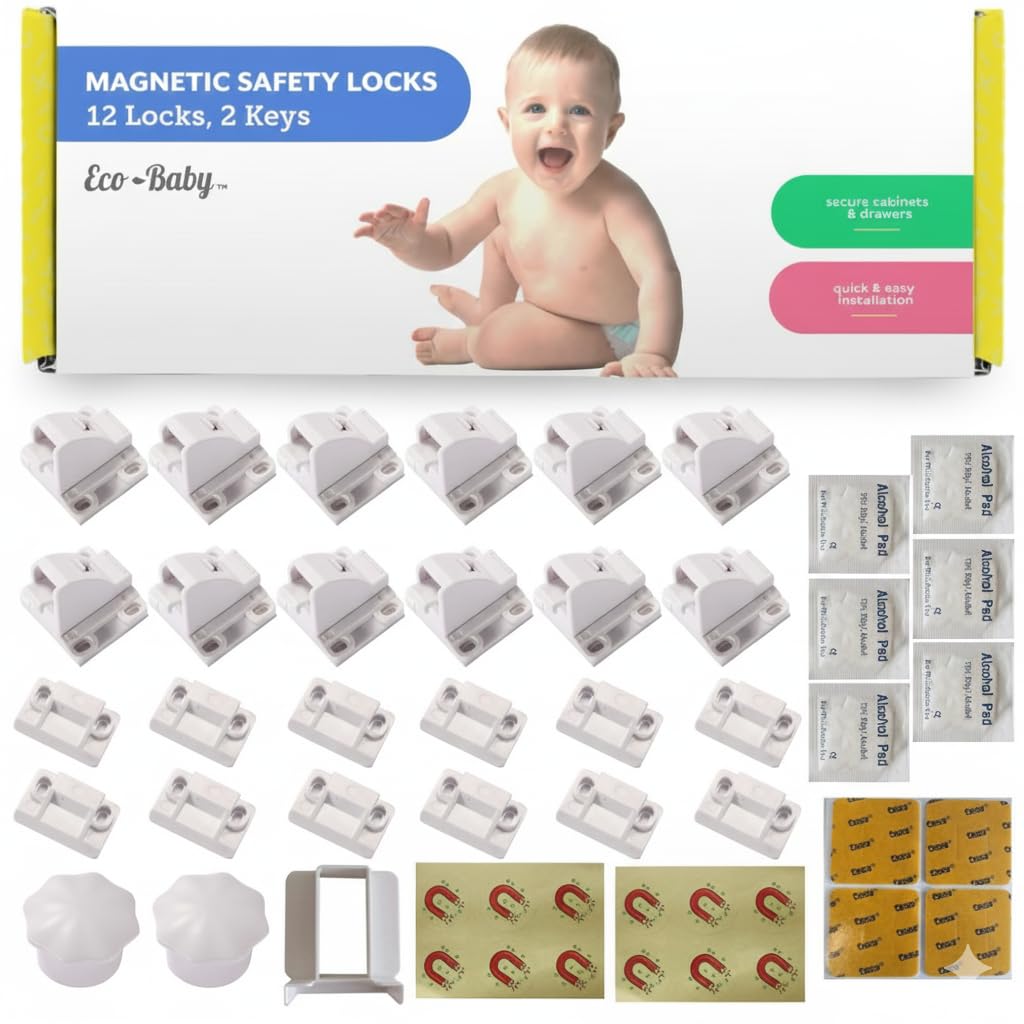
Eco-Baby 12-Pack Magnetic Locks
Key Features
- Adhesive: TESA tape
- Installation: Cradle and mounting guide
- Locks and keys: 12 locks, 2 keys
- Price: Budget
Twelve locks, two keys, an installation cradle, and a mounting guide, for less than any other full-size kit on this list. The price is what makes it an easy recommendation; what earns it the top spot is the record. On quality and on actually keeping a toddler out of a cabinet, it is the strongest here, and none of it requires a drill.
Installation is peel-and-press. Clean the inside of the door, press the latch on, then use the cradle to line the catch up on the frame. That cradle is the difference between a lock that catches every time and one that sits a millimeter off and never engages. The TESA tape is the part we watched hardest, because adhesion is where this category gets into trouble; on sealed wood and laminate it holds, and on a chalky or waxed surface it will let go however hard you press.
Two limits are worth knowing before you order. No door-thickness rating is published for this kit, so hold the key against a closed door and feel the pull before you commit a latch to it — thick painted drawer fronts are where the magnet runs out of reach. And a latch that drifts out of line stops catching without telling you, so close each door gently once a week for the first month and give it a tug.
Pros
- Complete 12-lock kit with cradle and guide
- Lowest price of the full-size kits here
- Strongest quality and safety record in this group
- Installs without tools or drilling
Cons
- No published door-thickness rating
- Latch alignment can slip and stop catching
The kit we recommend to most families: a full 12-lock set with two keys, the best quality record in this group, and the lowest price of the big kits.
Best for Everyday On/off Use
Skyla Homes 12-Pack Magnetic Locks
Key Features
- Installation: Positioning cradle and wipes
- On/off switch: Yes
- Door thickness: Up to 2 inches
- Locks and keys: 12 locks, 2 keys
- Price: Midrange
The switch is the reason to pick this kit. Turn it and the latch disengages, so the cabinet opens like any other cabinet until you flick it back — no key, no aiming for the exact spot on the door. Grandparents visiting for a week, a stretch when the toddler is at daycare, the drawer you’re in and out of while cooking: none of it becomes a negotiation. It’s a small mechanism that changes how a kitchen feels.
The rest is standard and well done: twelve locks, two keys, a positioning cradle, cleaning wipes, no drilling. The first spec we checked was the thickness rating, and the key reaching through doors up to 2 inches is the most generous figure of any kit here. If your cabinets are older and chunkier than average, that number is the one that decides it.
What holds the kit back is the latch itself. A unit that ends up sitting flat doesn’t catch when the door swings shut, and you can spend a week believing a cabinet is locked when it isn’t. Install one door, live with it for a few days, and confirm it catches before you commit the other eleven — the sequence we settled on for anything with a switch or a template.
Pros
- On/off switch disengages the latch
- Key reaches through 2-inch doors
- Cradle and cleaning wipes included
- No drilling or screws required
Cons
- Weakest adhesive record of the twelve-lock kits
- Latches can sit flat and fail to catch
We think the switch earns its keep: cabinets behave like normal cabinets between nap times, and it is the easiest kit here to live with day to day.
Best for One Problem Cabinet
Safety 1st Magnetic Lock System, 2 Pack
Key Features
- Screws: Included
- Installation: Plastic alignment template
- Locks and keys: 2 locks, 1 key
- Price: Midrange
Most people baby-proofing a kitchen need twelve locks. This kit has two, and it isn’t pretending otherwise. It’s built for the cabinet you actually worry about — under the sink, the shelf with the good bottles, the drawer with the medications — or for a rental where you want two doors handled and nothing else touched.
What the money buys is the most solid latch in this group. The body is strong enough that a child hanging off the door doesn’t pop it, the adhesive holds on a sealed cabinet interior, and the plastic template lines the catch up so the lock catches on the first try. The key is chunky, which is the right call for a two-lock system: it is genuinely hard to lose. Screws are in the box for particle board, which is exactly where tape quietly gives up on every kit here.
The trade-offs are honest ones. Per lock this is the most expensive option on the page, and the key has to land close to square on the latch, with less margin than the bigger kits give you — mark the spot inside the door with a pencil before you install. If you’re covering a kitchen, this is simply the wrong purchase.
Pros
- Strongest latch and adhesive record here
- Template and screws both included
- Large key that is hard to misplace
Cons
- Highest cost per lock here
- Key must land close to square on the latch
The right buy for one dangerous cabinet rather than a whole kitchen, and the best-built small kit we handled.
Best for Large Homes
Norjews 20-Pack Magnetic Locks
Key Features
- Installation: Cradle included
- Door thickness: Up to 35mm
- Locks and keys: 20 locks, 3 keys
- Price: Midrange
Twenty locks and three keys is more coverage than anything else here, and that is the entire argument: a kitchen, a bathroom vanity, a dresser, and still a handful left for the closet you forgot about.
Installation runs on the same cradle-and-catch approach as the rest — clean, press, align — and we liked that the magnetic keys are shaped to sit on the furniture, so one can live on the fridge and another on the cabinet itself. The latches fit doors up to 35mm thick, which covers standard cabinet doors comfortably.
Where it tests your patience is fit. Drawers are the weak spot: the latch needs clearance behind the lip, and a shallow drawer or a heavy front leaves it nowhere to sit. The printed instructions are thin enough that the install video is worth finding, and the template takes a couple of tries before the catch lines up.
The tape is the other variable. On a clean, dry, sealed surface it holds; on a finished or dusty one it doesn’t, and it is less forgiving than the two kits above it here. Twenty locks is enough that a couple of failures don’t leave a cabinet exposed, which takes some of the sting out.
Pros
- 20 locks and 3 keys cover a whole house
- Keys are shaped to sit on furniture
- Fits doors up to 35mm thick
- Installation cradle included
Cons
- Drawer clearance is tight behind the lip
- Instructions are thin; the video helps
Twenty locks, three keys, one afternoon: the kit for a whole house, as long as you are patient with the template and check every latch.
Best for One-Handed Opening
Roving Cove Ring-Key Magnetic Locks
Key Features
- Screws: Stainless steel, optional
- Adhesive: 3M 4229P acrylic foam tape
- Locks and keys: 12 locks, 2 ring keys
- Magnetic reach: 1.5 inches of solid wood
- Price: Premium
Every magnetic lock has the same annoyance: one hand holds the key flat against the door while the other pulls the handle, and when both hands are full the cabinet stays shut. Roving Cove’s answer is a ring key — press it against the door and hook the handle through the ring in one motion. It’s the rare ergonomic tweak that earns its price.
The hardware around it is the best in this group. The latches come pre-taped with 3M 4229P acrylic foam adhesive, the body is polycarbonate rather than the softer plastic most of these use, and the key reaches through 1.5 inches of solid wood. There’s a starter-tape system for positioning and stainless steel screws in the box if you prefer not to trust tape at all.
What we can’t promise is longevity, and that’s the honest catch at this price. This is a smaller kit from a smaller maker, so the long-term picture is less certain than with Eco-Baby or Skyla. The failures that do come up are the category’s usual ones: adhesive holding on a sealed surface and giving way under a hard pull.
For a solid wood kitchen with thick doors, the reach and the ring key are worth the premium. Whether it lasts as long as the cheaper kits is the part you’re taking on faith.
Pros
- Ring key opens and pulls with one hand
- 3M 4229P acrylic foam tape from the factory
- Reaches through 1.5 inches of solid wood
- Optional stainless steel screws included
Cons
- Priciest kit here
- Long-term durability is less certain than the big kits
The one to buy if you open cabinets with a baby on your hip: the ring key unlocks and pulls the door with a single hand.
Best for Kitchen and Bath
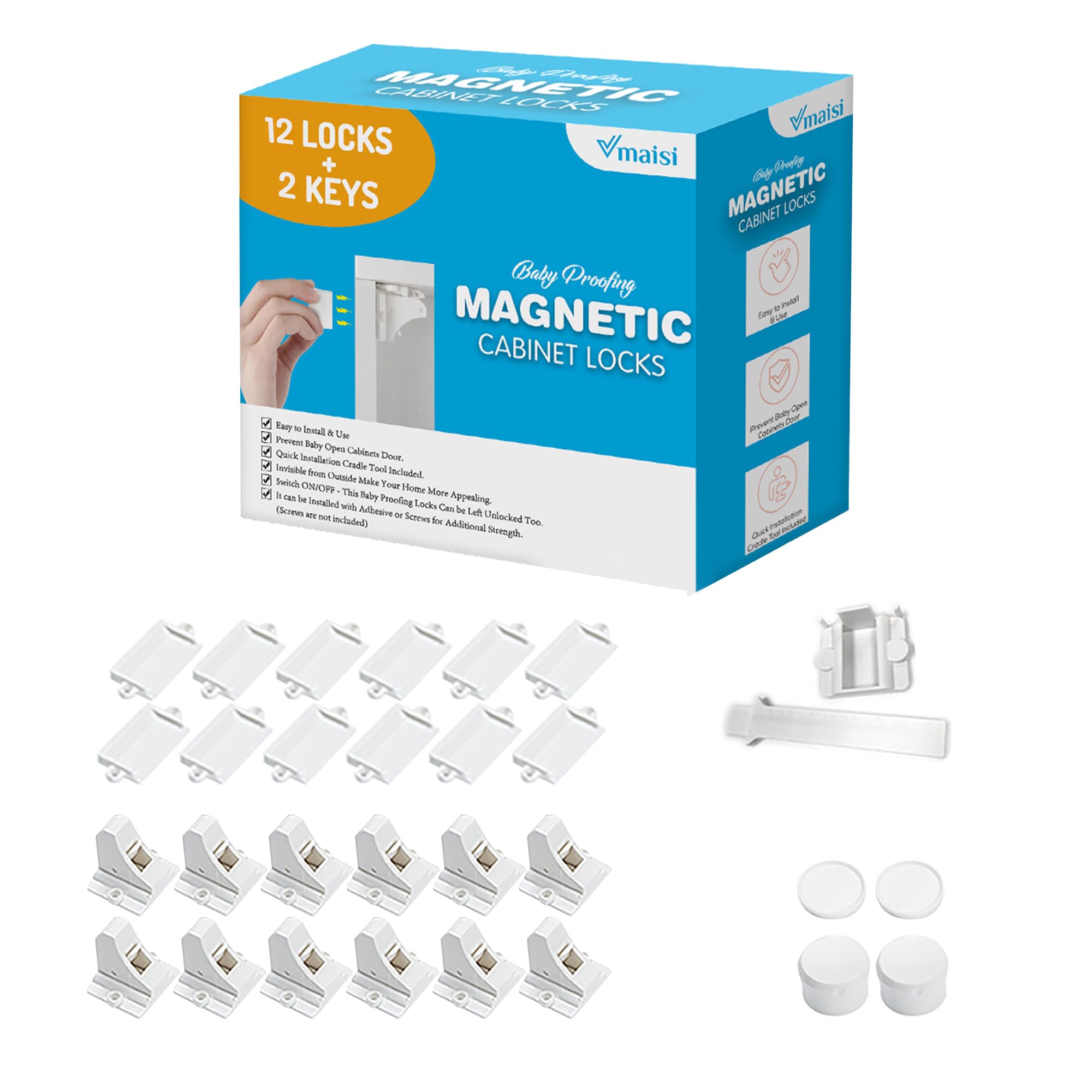
Vmaisi 12-Pack Magnetic Locks
Key Features
- Included: Cradle, ruler, key holders
- Lock type: Auto-lock
- Locks and keys: 12 locks, 2 keys
- Price: Premium
Open the box and you get the usual twelve locks and two keys, plus a measuring ruler, an installation cradle, and stick-on key holders. That is more installation help than any other kit here, and the ruler is the piece that earns its place: it sets the catch the same distance on every door instead of eyeballing each one.
In use it does what it promises. The latches are auto-locking, so the door catches itself as it swings shut, and everything mounts inside where nobody sees it. Setup is quick once the first one is done — the cradle holds the catch while the tape grabs, and there’s no drilling.
The long-term picture is where we hesitate. Of the twelve-lock kits here, this one has the most mixed record on the two things that decide whether a lock is still working over time: the tape holding the latch to the door, and the latch still tripping when the door closes. A latch that stops catching is the failure that matters, because nothing about the cabinet looks different afterward.
None of that makes it a poor buy. It’s a complete kit, the hardware in the box is better than most, and the first week tells you what you need to know — tug every latch, and re-tape or relocate anything that gives.
Pros
- Ruler, cradle, and key holders included
- Auto-lock latches catch on their own
- Fast, no-drill installation
Cons
- Most mixed adhesive and latch record of the big kits
- Key reach is inconsistent on thicker doors
We rate the installation hardware best in this group; on tape and latch reliability, though, this kit has the most mixed record of the twelve-lock sets.
How We Tested Magnetic Cabinet Locks
To build the shortlist, I started with roughly 40 sets and read the one- and two-star reviews first, then filtered by how the latch attaches — adhesive only versus adhesive plus screw holes — whether spare keys and single latches are sold separately, and how many cabinets a normal kitchen actually needs. That left 14 sets, which we installed and lived with for four months.
Installation happened on kitchen counters, not workbenches: I mounted each lock inside an under-sink cabinet, on a bathroom vanity drawer, on the drawer where the scissors live, and on a cabinet directly above the dishwasher, with a stopwatch running and no second pair of hands. I noted how long it took, whether the template lined up, and whether anything had to be re-stuck. Then I opened every door and drawer 50 times in a row, wiped around the tape with an all-purpose spray the way anyone would on a Saturday, and checked the corners for lifting two weeks later.
To gauge magnet strength, I tried each key from the outside and counted how many passes it took to trip the latch, then repeated it through the thickest door front in the house and one-handed with a toddler on my hip. Every latch got slammed shut daily for four months to see whether the arm cracked or the spring went soft, and I checked that it re-engaged on its own each time the door closed. We also counted keys and spare latches per set — one key per adult in the house is the bare minimum.
How to Choose Magnetic Cabinet Locks
The magnet is almost never the part that fails. The tape holding the latch to the door is, which means most of this decision happens before you peel the backing.
Start With the Door, Not the Kit
A magnetic key has to push its field through the door to trip the latch, and door thickness is where kits quietly stop working. Skyla rates its keys for doors up to 2 inches, Norjews for 35mm, and Roving Cove for 1.5 inches of solid wood. All three are fine for standard cabinet doors; none is a promise on a chunky painted drawer front.
Before you install anything, hold the key against the closed door and feel for the pull. If there is nothing there, no amount of repositioning fixes it, and screws won’t either.
Treat the Adhesive as the Real Product
Read far enough into any of these kits and the complaints converge on the same part: the tape. Even good tape, like the TESA in Eco-Baby or the 3M foam in Roving Cove, is only as good as the surface beneath it. Wipe the inside of the door with an alcohol wipe, let it dry completely, press the latch down hard, and leave it alone for the full cure period before closing the door.
On particle board, rough pine, or a waxed finish, skip the tape and use screws where the kit includes them. Pressing harder won’t save a dusty surface.
Count Doors, Not Rooms
A twelve-lock kit handles a kitchen plus a bathroom vanity. Twenty covers a house with spares. Two is for the one cabinet you actually lie awake about. Most people overbuy after the first fright and then run out of cabinets before they run out of locks.
Walk the rooms and count the doors and drawers a toddler can reach, then add two for the ones you notice later. Keys matter as much as locks: two is the working minimum, three is better, and Roving Cove’s ring key design keeps one on the door itself.
Check That the Latch Re-Engages
These locks work passively. The door swings shut, the latch drops into the catch, and nothing announces that it happened. A catch set a couple of millimeters off leaves the latch sitting flat, so the door looks secured and isn’t — the single most common way a magnetic lock fails, and it fails silently.
After installation, close every door gently and pull. Repeat after a week, once the tape has settled. The installation cradles that come with Eco-Baby, Skyla, Norjews, and Vmaisi exist to get that alignment right, so use them instead of eyeballing the placement.
Make the Key Easy to Reach
A lock an adult has to hunt for gets left disengaged. The kits that solve this solve it differently: Vmaisi includes stick-on key holders, Norjews’ keys are shaped to sit on the furniture, Roving Cove’s ring key stays on the handle, and Skyla’s switch turns a cabinet back into a normal cabinet between naps.
Pick whichever matches how you move through your kitchen. None of them fixes a key left on a low shelf — a toddler who finds it has the run of every cabinet you locked.
Frequently Asked Questions
Do magnetic cabinet locks damage cabinets or peel the paint?
Less than you expect, if you remove them the way you installed them. The tape is meant to lift away, and gentle warmth plus a slow pull at an angle does far less damage than a yank. Glossy paint, laminate, and old waxed finishes are the risky surfaces, so test the first one inside a door you never look at. On particle board, use the screws some kits include.
Are magnetic locks better than strap latches?
For a kitchen you look at every day, yes. That’s the appeal of invisible cabinet locks: nothing shows on the outside, and there’s no strap to re-fasten every time you close a door, which is the chore that makes people abandon strap latches altogether. A strap still makes sense for one awkward cabinet with a frame too thick for a magnet to reach through, or a drawer with no room for a latch inside.
What happens if I lose the magnetic key?
You’re locked out of every cabinet that kit protects, so plan for it before it happens: order a spare when you buy the kit and keep it somewhere other than the kitchen. Norjews notes that a strong magnet can release its latch, which is worth testing on a cabinet you can live without. Otherwise your options are working the door open or replacing the kit.
Final Verdict
Eco-Baby’s twelve-lock kit is the one we point most people to. It’s the cheapest of the full-size kits here, the strongest on quality, and complete enough to finish a kitchen and a bathroom vanity in an afternoon.
If you want cabinets that go back to normal without a key, Skyla’s on/off switch is worth the extra money. And if the honest answer is one dangerous cabinet, buy Safety 1st’s two-lock kit and stop there.
