This post contains affiliate links. We may earn a small commission when you buy through our links — at no extra cost to you.
A toddler bed is a bridge—not quite a crib, not quite a big-kid bed—and the right one can make the leap out of the crib feel like a promotion instead of a free fall. I still remember the first night we swapped the crib for a low frame, my kid grinning while I quietly calculated the distance to the floor. Over the past six months, we’ve put 12 toddler beds through real bedtimes and nap times, and the differences that matter are rarely the ones on the box.
The beds children gravitate toward—canopy frames, character prints, bright plastic—aren’t always the ones that feel sturdy or hold a standard crib mattress without a gap. We paid attention to both, and noted which ones were genuinely a good value after a few months of use.
The picks below are the ones that held up to our test homes—safe, sturdy, and still fun enough that bedtime didn’t turn into a negotiation.

Best for Crib-To-Bed Switch
Delta Children Minnie Mouse Toddler Bed
Key Features
- Mattress fit: Standard crib mattress
- Weight limit: 50 lb
- Assembled dimensions: 53.94 x 29.13 x 26.18 inches
- Safety certification: JPMA certified
- Price: Budget
The cheapest of the three beds here, and still the one we reach for first. Under the printed character panels sits a steel frame, and the bed as a whole is rated to 50 pounds; the footprint runs about 54 by 29 inches, narrow enough to slot into a room that also holds a crib and a dresser. It takes a standard crib mattress, so the move out of the crib is a mattress lift rather than a second purchase — which is the entire point of a transition bed.
What we paid attention to while assembling it was how little it asks of you. The panels are labeled, the hardware comes sorted, and one adult gets from box to bed without a second pair of hands — worth something when the new bed is meant to be ready before bedtime. The deck sits low, so a small toddler steps in and out unaided, and the two attached rails cover the sides while leaving the foot open, which is exactly the gap a child uses at 6 a.m.
Rail attachment is the one place to slow down. The bolts need to go in square, and the mattress should sit tight against both rails before you call it finished — a thin mattress leaves daylight at the rail edge, and that gap is what you’re checking for. The theme is the other trade-off: the decals go on by hand, they’re the first thing to lift at the corners, and a character bed is outgrown in taste long before it reaches 50 pounds.
Pros
- Lowest price of the three beds here
- Steel frame under the plastic shell
- Straightforward one-person assembly
- Low deck a toddler can manage alone
Cons
- Plastic character panels won’t suit every room
- Decals are hand-applied and lift at the edges
We recommend it to most families: it’s the least expensive bed here, the simplest to assemble, and its steel frame takes a toddler’s weight without complaint.
Best for Wood-Look Nurseries
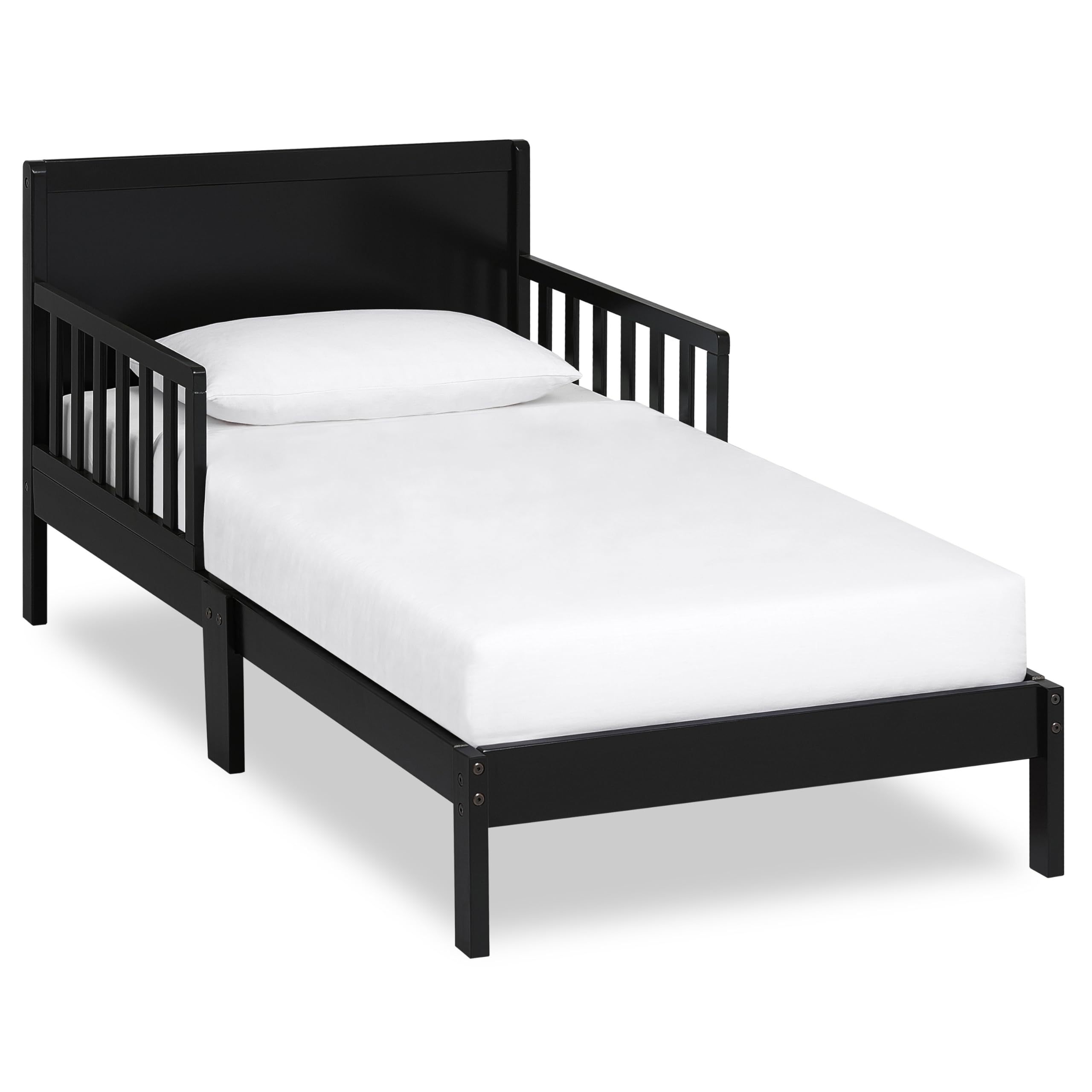
Dream On Me Brookside Toddler Bed
Key Features
- Weight limit: 50 lb
- Certifications: GREENGUARD Gold, BSA verified
- Frame material: New Zealand pinewood
- Assembled dimensions: 53 x 29 x 28 inches
- Price: Midrange
Pine instead of molded plastic is the whole argument for the Brookside, and it makes a convincing one. The frame is New Zealand pinewood with a water-based finish, GREENGUARD Gold and BSA verified, measuring 53 by 29 by 28 inches — the same footprint as the Delta plastic bed, an inch or two taller at the headboard. At 19 pounds it’s still light enough to drag out of the way when the room gets vacuumed.
The detail we keep coming back to is one the photos don’t show: center legs under the platform. A toddler who flops down in the middle of the bed puts their weight on the weakest point of any slat frame, and that extra support is what keeps the platform from bowing over a couple of years of it. The side rails are reinforced and run the length of the sleep area, and the deck sits low enough that a 2-year-old steps in rather than climbs.
Assembly is the friction. There are more fasteners than on the plastic bed, and the instructions ask you to leave every screw loose until the whole frame is together — do that and it settles square; skip it and you’ll be backing bolts out later. Get it right and the payoff is a bed that reads as furniture: it’s the one here that will still look at home when the nursery turns into a room with a desk in it.
Pros
- Solid pine with a non-toxic water-based finish
- Center legs support the middle of the platform
- GREENGUARD Gold and BSA verified
- Priced close to the plastic bed
Cons
- Wood slats can give way under a jumper
- More fasteners and a longer build than the plastic bed
Our wood pick, and the one to choose if the room calls for real furniture — pine, GREENGUARD Gold, and center legs, for close to what the plastic bed costs.
Best for Princess-Themed Rooms
Delta Children Disney Princess Canopy Toddler Bed

Key Features
- Mattress fit: Standard crib mattress
- Weight limit: 50 lb
- Frame material: Plastic
- Assembled dimensions: 53.94 x 29.13 x 55.12 inches
- Price: Premium
The canopy is why this bed costs more than the plastic Delta, and it’s also the part that causes trouble. The support poles are thin, the fabric top is light, and the arch doesn’t stay upright the way the product photos suggest. If yours droops, the practical fix is to take the canopy off and keep the frame — the bed doesn’t depend on it, and what you’re left with is a plain toddler bed.
As a bed, it does the job. Plastic over metal, 53.94 by 29.13 inches, a standard crib mattress, two guardrails and a low deck: the same brief as the Minnie bed, with more personality and a higher price. What struck us while building it is how much more of it there is — more parts, poles that aren’t clearly labeled, and instructions that leave you sorting pieces by length. Budget an afternoon rather than an hour, and don’t plan it for the night the crib comes down.
One placement note before you order: at 55 inches to the top of the canopy, it stands roughly twice as tall as the other two beds, so it wants a wall clear of a low shelf or a window. And the phase is short — the canopy is the part that sells the bed and the first part to stop mattering. What’s left when it does is a perfectly ordinary toddler bed, which is either the smartest thing about it or the reason to buy the cheaper one.
Pros
- Canopy and 3D accents carry the theme
- Takes a standard crib mattress with two rails
- Canopy comes off, leaving a plain bed
Cons
- Canopy poles are flimsy and the top won’t stay up
- More parts and a longer build than the others
Our advice is to buy it for the canopy and accept the frame: underneath it’s a standard plastic toddler bed, and the top is the part that needs a plan.
How We Tested Toddler Beds
We started by researching the toddler beds that show up most often in parent forums and retail best-seller lists, then narrowed to 12 models across price points and styles—wooden frames, plastic character beds, and canopy designs—that use a standard crib mattress. We assembled each one in a real bedroom or nursery, timing how long it took with one adult and noting whether the instructions matched the hardware.
For six months, families on our team used them for bedtime, naptime, and the early-morning hours when a toddler decides the day has started. We watched how kids climbed in and out, whether the low-to-floor design actually reduced tumbles, and how the safety rails felt when a child rolled against them. We also checked mattress fit by pressing a standard crib mattress into each frame and running a hand around the edges for gaps.
Sturdiness and stability got tested the way toddlers test things: we pushed, leaned, and let kids flop. We noted if a bed wobbled when a child sat down hard, whether the frame creaked after a week, and if the finish held up to a wipe-down. Appearance and enjoyment were judged at drop-off—did the theme make bedtime easier, or did it feel like a decal that would peel? Value came down to whether the bed still felt solid and looked good after months of use, not just on day one. We also measured each footprint against a typical toddler room and checked that the bed didn’t crowd the walkway.
How to Choose a Toddler Bed
Almost every toddler bed is built around the crib mattress you already own, so what you’re really choosing is the frame under it, the rails above it, and how much assembly you’re willing to take on.
Start With the Mattress, Then the Frame
Toddler beds take a standard crib mattress, roughly 52 by 28 inches, and none of the beds here include one. That’s the good news: the mattress from the crib usually moves straight over, which is why the switch costs far less than it looks. Check two things before you order — that the listing says crib mattress rather than twin (titles blur the two), and whether the platform is slats or a solid deck.
Slats let the mattress breathe and are the norm on wooden frames. On a slat platform, a heavy toddler landing in the same spot every night is where sagging starts, which is why extra center support is worth looking for.
What Two Guardrails Actually Cover
Two attached rails cover the sides and leave the foot open, which is the point: your child needs somewhere to climb in. What matters is how tight the rail sits to the mattress. Push the mattress hard against both sides before you tighten anything, then look for daylight at the rail edge. A mattress narrower than the frame, or a thin one, leaves a gap a leg can slip through overnight.
This is also the reason we stay away from thick mattress toppers on a toddler bed. They raise the sleep surface and shrink the effective height of the rail, which turns a certified bed into a bed with a lower barrier.
Height, Weight, and the Real Lifespan
Every bed here is rated for 15 months and up and 50 pounds, and the decks sit low enough that a 2-year-old steps in rather than climbs. That same low deck is what makes them feel cramped by age 5. Weight is usually the limit that arrives first, height second; a tall 4-year-old on a 53-inch frame starts to look folded.
If your child is already close to the weight limit, or is tall for their age, go straight to a twin and skip this stage entirely — a toddler bed you replace in a year is the more expensive route.
Assembly and the Loose-Screw Rule
These ship flat, and none of them are hard, but the pine and canopy beds take noticeably longer than the molded plastic one. The single technique that prevents most wobble: thread every bolt finger-tight, get the frame square, then tighten in a cross pattern from corner to corner. Several of these beds say as much in the instructions and it is easy to skip.
Build it in the room where it will live. A 53-inch frame gets around a hallway, but a tight stair landing is much easier to negotiate before the headboard and rails go on.
Materials and Certifications Worth Paying For
JPMA certification means the bed was tested to the ASTM and CPSC standards for toddler beds; GREENGUARD Gold covers VOC emissions; Baby Safety Alliance verification is a third-party check on lead and phthalates. Finishes matter more than usual here because the rails sit at mouth height.
Molded plastic wipes clean and shrugs off spills; pine looks like furniture and chips if you drag it across a floor. Printed decals are the first thing to look worn, and they’re applied by hand, so take your time smoothing them down.
Frequently Asked Questions
How long can my child use a toddler bed?
The number that ends a toddler bed is 50 pounds, not a birthday. All three beds here share that limit, and most children reach it somewhere between ages 4 and 6. Height usually runs second: a tall child starts to look folded on a 53-inch frame before they hit the weight.
When either happens — weight first for stockier kids, height first for lanky ones — move to a twin.
Is a toddler bed safe for a child under 15 months?
Not the beds on this page; every one is rated for 15 months and up. If a younger toddler keeps climbing out of the crib, drop the crib mattress to its lowest setting and clear the crib of anything that could serve as a step before you change furniture.
If they’re still getting out, a mattress on the floor in a childproofed room is the safer stopgap than a raised bed with rails.
Will a toddler bed fit through a doorway?
The frames here run about 29 to 30 inches wide and roughly 54 inches long, so an assembled bed clears a standard interior door. The turn is the problem, not the door: a hallway corner or stair landing is much easier before the rails and headboard go on.
If the room sits at the end of a tight hall, build it in place. The plastic Delta bed is the lightest of the three at 16 pounds, so it’s the one you can shift afterward.
How is a toddler bed different from a crib conversion?
If your crib converts, the conversion rail kit does the same job as the beds here — same mattress, same low height — usually for less than a new frame. Check the crib’s manual and price the kit before you shop.
A standalone bed makes sense when the crib isn’t convertible, when a second child needs the crib, or when the kit costs as much as a new bed.
Final Verdict
For most families the Delta Children plastic toddler bed is the answer: least expensive, least fuss to build, and a steel frame that shrugs off a jumping 2-year-old. Nothing else here is easier to live with in the first month.
Choose the Dream On Me Brookside when the nursery is meant to look like a room rather than a theme park — you pay a little more and spend longer with the screwdriver, and the pine, GREENGUARD Gold finish, and center legs earn both. The canopy bed is for the child who has asked for a princess bed by name; take it on with the canopy treated as decoration, not structure.
