This post contains affiliate links. We may earn a small commission when you buy through our links — at no extra cost to you.
The first month of walking is a series of small defeats: a baby pulls up on the coffee table, lets go, sits down hard, and looks at you like you planned it. A push toy moves at their speed; a pull toy gives them somewhere to go once they’re steady, and the good ones stay in rotation for a year. The bad ones are behind the couch by day two.
I’ve watched plenty of these get abandoned mid-hallway, so our questions were practical: how long is the string, does it tip when a 10-month-old leans on it, will the wheels roll across a rug without dragging. My team spent six months with 14 push and pull toys in living rooms, hallways, and on the sidewalk out front.
The surprise was how little the lights and music mattered. Toddlers went back to the toys that clattered or wobbled or followed them across the room, and several rated for 12 months were duds at 12 and favorites at 20. Age labels are a starting point, not a promise, and we tested each pick at both ends of its range.



Best for First Walkers
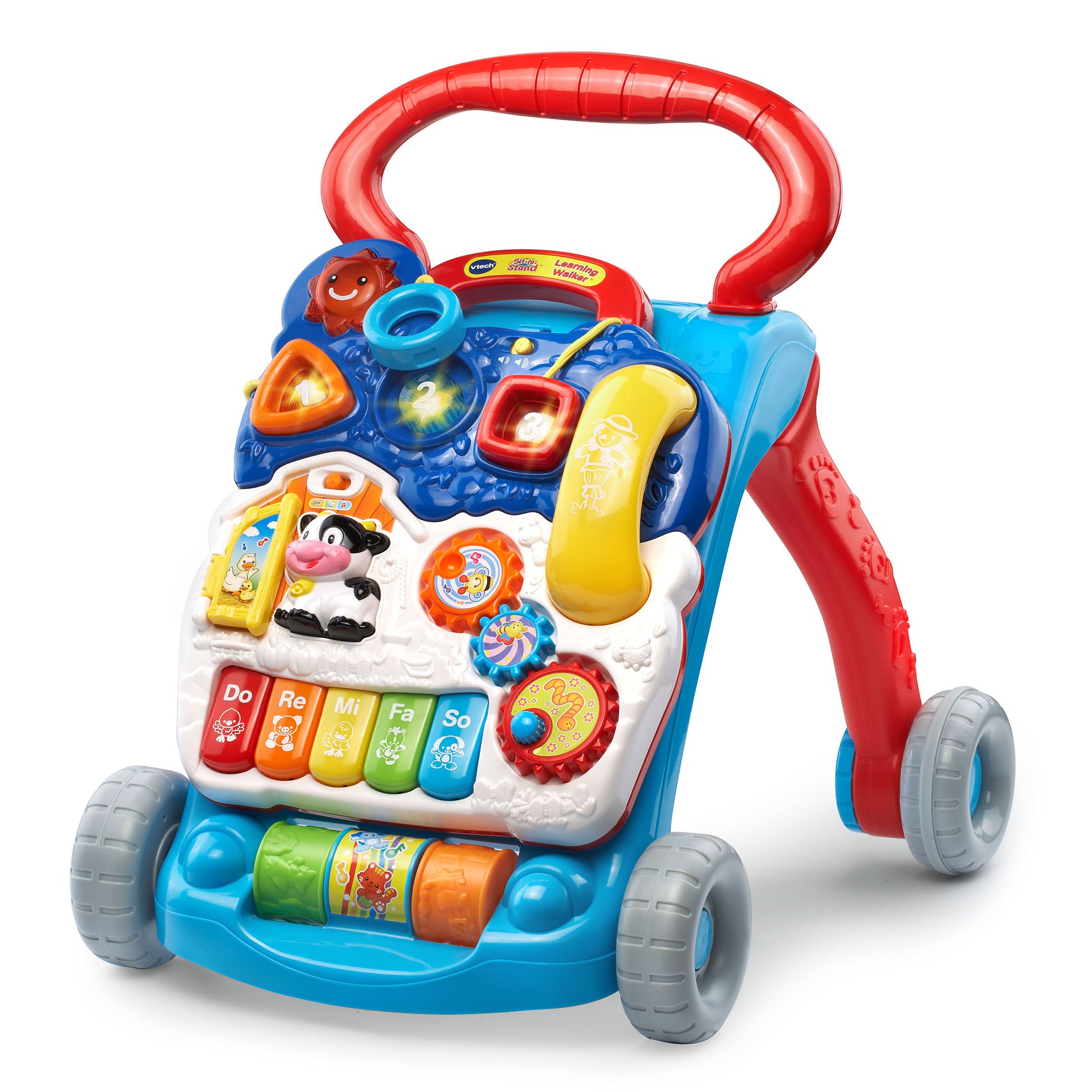
VTech Sit-to-Stand Learning Walker
Key Features
- Age Range: 9 Months – 3 Years
- Dimensions: 16.5"L x 14.2"W x 18.1"H
- Max Weight: 35 lb
- Item Weight: 4.6 lb
- Price: Midrange
The removable activity panel is the feature that keeps this walker useful after the first steps. It lifts out for a baby who can sit up, then goes back into the frame for push-along play, so the toy changes with the child instead of being outgrown in a month. We appreciate that kind of flexibility in a category full of one-note toys.
As a first walker, the two-speed control is what earns it the top spot. The four-wheel base and wide stance give a cruising baby something to lean into, and the handle sits at a comfortable height for small hands. We tested it on low carpet and hard floor and found it tracks steadily on both, which makes it easier to move between rooms without changing toys.
The activity panel is not just a collection of lights. Five piano keys, a telephone handset, shape sorters, and spinning rollers give a seated baby several different reasons to reach and press, and the sounds respond without needing a screen. Assembly is simple, and the 9-month-to-3-year range covers sitting, cruising, and early walking. It is a large plastic toy that will live in the middle of the floor for a while, so measure your space before you commit.
Pros
- Removable activity panel grows with baby
- Two-speed control for early walkers
- Four-wheel base tracks on carpet and hard floor
- Packed with sit-and-play activities
Cons
- No pull-along play
For most babies, this is the push toy we recommend first: a stable walker with a removable activity panel that keeps working after walking starts.
Best for Sit-And-Play Learning
Laugh & Learn Smart Stages Walker
Key Features
- Age Range: 6 Months – 3 Years
- Activities: 7 hands-on activities
- Dimensions: 4.7"L x 18.07"W x 16.14"H
- Learning Stages: 3
- Price: Midrange
Three Smart Stages levels are the reason this walker can stay interesting after the novelty of pushing wears off. The toy moves from first words and sounds to colors, shapes, numbers, and Spanish words, and the seven hands-on activities give a baby something to do while standing or sitting. We like that the learning content changes with the child instead of staying fixed.
The four-wheel base and easy-grasp handle are set up for a baby who is already pulling up and cruising. The panel is busy in the way a good activity center should be, with piano keys, a nose button, a roller, and a flip page. We found the sit-and-play mode earns its place before walking starts; it is the push mode that needs more attention.
It is a better choice for songs and buttons than for a shaky first step. The learning stages give it a longer life than most activity walkers, and the Spanish words are a nice bonus for families who want them. If your baby is still finding their balance, go with a walker that has adjustable speed; if they are already cruising, this one keeps them busy.
Pros
- Three learning stages with 75+ songs
- Seven hands-on activities
- Four-wheel base and easy-grasp handle
- Teaches Spanish words alongside English
Cons
- Free-rolling wheels on smooth floors
A musical walker for families who want sit-and-play learning first; it suits a baby who already cruises and has a grown-up nearby.
Best for 2-In-1 Wagon
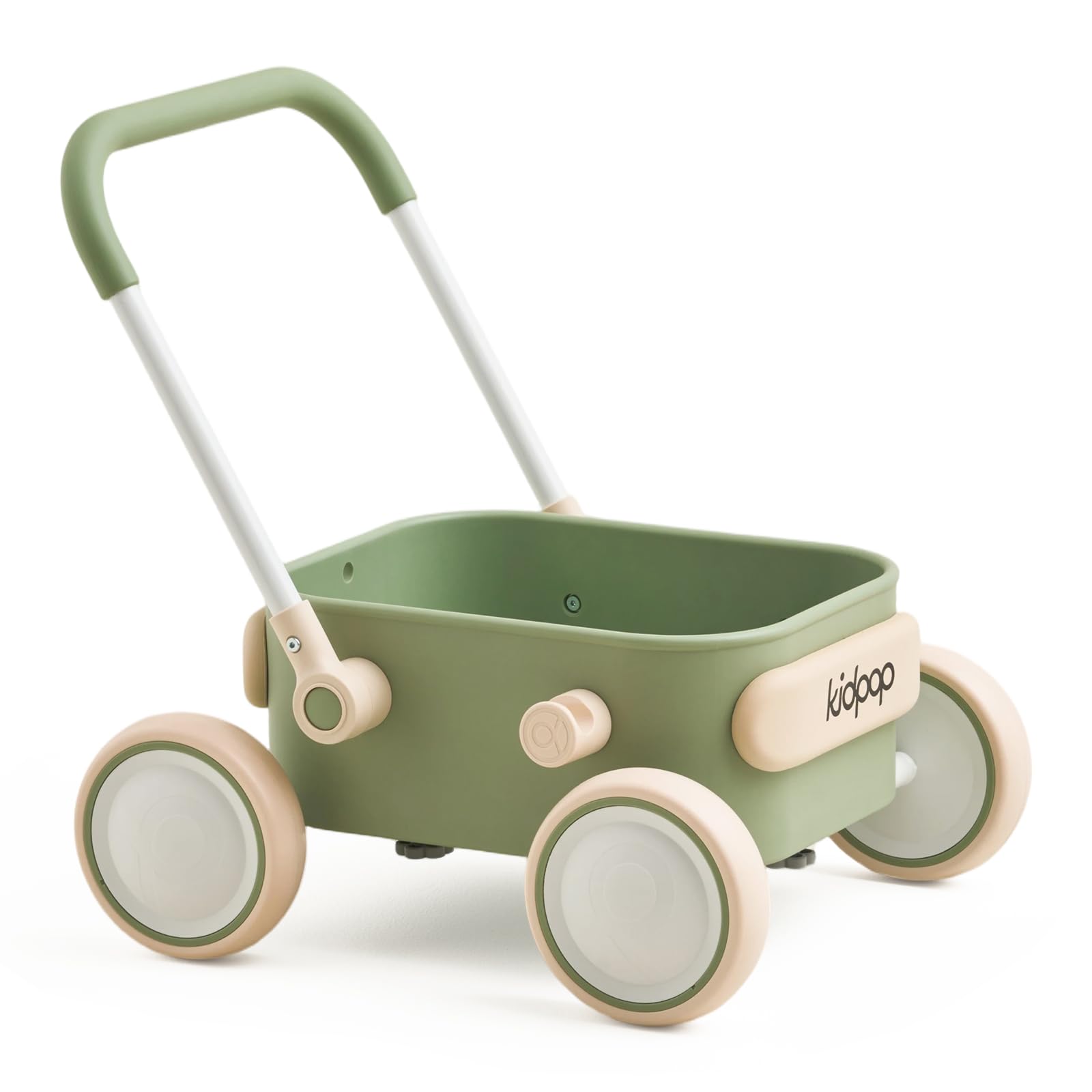
Kidpop PULA 2-in-1 Wagon
Key Features
- Folding: One-click folding design
- Age Range: 7 Months – 4 Years
- Dimensions: 19.7"L x 16.1"W x 18.9"H
- Item Weight: 9.9 lb
- Price: Premium
The one-click folding design is the detail that makes this wagon easy to live with. It collapses for storage or the back of a car, and the low-gravity body and enclosed wheels are built to keep a beginning walker from tipping sideways. We appreciate that it does not look like a baby toy; the green finish is calm enough to leave by the door.
As a push toy, the non-slip handlebar and EVA wheels give it a smooth roll on pavement and indoors. As a pull wagon, the same body gives a toddler a place to toss a snack or a few toys, and the 7-month-to-4-year range means it can stay in service long after first steps. The wide hopper is generous enough for a small haul of books or park toys.
The trade-off is assembly. The main body goes together quickly, but the wheel fittings take more force than the rest of the build, and a rushed job can leave a wheel loose. Check each wheel before the first ride. It is a better fit for a family that wants one sturdy piece for indoors and outdoors than for someone who wants a toy to tuck into a diaper bag.
Pros
- Folds with one click for storage
- Sturdy low-gravity body resists tipping
- Converts from push walker to pull wagon
- Quiet EVA wheels for indoor and outdoor use
Cons
- Heavier than smaller pull toys
A sturdy 2-in-1 wagon for families who want one push toy that converts to a pull wagon for park trips and grows through preschool.
Best for Pull-Along Character
Toy Story Slinky Dog Pull Toy
Key Features
- Material: Metal
- Age Range: 18 Months – 4 Years
- Dimensions: 10.5"L x 4.75"W x 7.25"H
- Stretch Length: 5 to 14 inches
- Price: Budget
Five inches is compact enough to park on a shelf; fourteen inches is the part that makes a toddler chase it. The spring body stretches and slinks as it is pulled, and the floppy ears and green collar make it instantly recognizable to any Toy Story fan. It is a simple pleasure in a category full of batteries and buttons.
The leash is attached and ready to pull, and there are no batteries to replace. We found the stretch action is the star; it moves differently from a rigid pull toy, which keeps a toddler’s attention on the chase rather than on a screen. The metal spring feels substantial, and the 18-month-to-4-year range gives it a long run.
It is a character toy first and a walking aid second. The leash is for gentle pulls, not for steadying a new walker, and a toddler who yanks sideways will get a different reaction from the spring than from a rigid toy. It is best on smooth floors, where the stretch can do its work.
Pros
- Stretches from 5 to 14 inches
- No batteries required
- Recognizable Toy Story character
Cons
- Can topple on deep carpet
The pull-along we recommend for Toy Story fans and families who want a quiet, battery-free toy that stretches and slinks behind a toddler.
Best for Wooden Pull Play
Hape Walk-A-Long Puppy
Key Features
- Material: Wood
- Age Range: 12 months and up
- Dimensions: 8.66"L x 3.62"W x 6.38"H
- Item Weight: 1.32 lb
- Price: Midrange
No batteries, no songs, no flashing lights: the appeal here is a wooden puppy that moves when a child pulls it and then waits quietly until the next walk. The FSC-certified wood and non-toxic finish give it a different feel from the plastic toys here, and the simple shape leaves room for pretend play.
The head bobs and the tail wags as it rolls, which gives a toddler a reason to look back and keep pulling. We like the weight of it; at 0.6 kg it feels solid without being too heavy for a small hand. The 12-month-and-up range and the 8.66-by-3.62-by-6.38-inch body make it a good fit for a first pull toy in a small apartment.
It is happiest with a steady, short pull on low carpet or hard floor. This is a pull toy, not a stability aid for a new walker, and it does not steer around corners the way a wide-based push toy does. That is a fair exchange for a toy that will look good on a shelf and never need a battery.
Pros
- Battery-free wooden construction
- FSC-certified wood and non-toxic finish
- Moving head and wagging tail
Cons
- Can tip when pulled fast
A wooden pull puppy for families who want quiet, battery-free play and a toy that looks good between uses; it rewards a gentle toddler.
Best for Pretend Calls
Fisher-Price Chatter Telephone
Key Features
- Dial: Numbers 0-9
- Age Range: 12 months and up
- Dimensions: 6.3 x 7.68 x 4.21 inches
- Item Weight: 14 oz
- Price: Budget
The rotary dial is the detail that makes this phone worth handing to a toddler. It introduces numbers 0 through 9, the eyes move up and down as it rolls, and the ringing sound gives a first pretend call a satisfying payoff. It is a classic for a reason, and it does not need a screen to hold attention.
At 12 months and up, it works as a sit-and-dial toy before it works as a pull toy. We found the handset and chunky body are easy for small hands, and the 14-ounce weight is light enough to carry from room to room. The pull cord is short, though, so a taller toddler will mostly carry it or pull it a few steps rather than trail it behind.
Think of this as a pretend phone that can be pulled across a rug, not a walking companion for the sidewalk. The play pattern is open-ended, the nostalgia is real, and it is one of the least expensive ways to add a pull toy to the toy box. Just set expectations around distance.
Pros
- Rotary dial teaches numbers 0-9
- Eyes move and ringing sound rewards play
- Lightweight and easy for small hands
Cons
- May not survive rough handling
A classic pull phone for budget-minded families; the rotary dial and ringing sounds make it a natural first pretend toy for a toddler.
Best for Interactive Push Play
VTech Pull and Sing Puppy

Key Features
- Age Range: 6 months – 3 years
- Batteries: 2 AAA batteries
- Dimensions: 3.94 x 7.87 x 6.69 inches
- Item Weight: 14.2 oz
- Price: Budget
The cord is the first thing to know about: it is short, short enough that a walking toddler cannot trail the puppy far behind. That makes the pull-along label a stretch. It works better as a push-along companion or a sit-and-press toy, and that is how it earns its place.
The rest of the puppy is built for floor play. Three colorful buttons teach numbers, colors, and body parts, the nose lights up with the sounds, and the plastic body has a friendly, chunky shape. At 6 months to 3 years, it can start as a sitting toy and move to pushing.
The two AAA batteries are included for demo use, so plan on fresh ones for regular play. The sounds are clear without being piercing, and the light-up nose gives a baby a clear response every time they press. It is a floor toy that rewards cause and effect.
It is the one for a baby who loves buttons and a caregiver who wants a familiar puppy sound in the living room. The push-and-press play is strong enough to carry it. It is not the quiet wooden companion; it is the electronic friend for a baby who wants a reaction.
Pros
- Three buttons teach numbers and body parts
- Light-up nose and sounds reward play
- Works as a sit-and-press or push toy
Cons
An interactive push-and-pull puppy for babies who love buttons and sounds; treat the short cord as a push-toy handle, not a long leash.
How We Tested the Best Push and Pull Toys
We started with about 40 toys and cut the list to 14 by dropping anything with a recall history, a string we could wrap twice around a wrist, or a price that made no sense for something a toddler would chew. We also kept the range wide: at least one option for a 7-month-old just pulling up, one for a 3-year-old hauling things around the yard.
Testing happened in the least controlled environment available, which is exactly the point: my living room, my hallway, a low-pile rug, the driveway, and the sidewalk out front. We measured every string, cord, and leash at full stretch and watched how close a determined 1-year-old could get it to their mouth. Each toy got weighted at the handle and pulled on by a child leaning full body weight into it, then sent across hardwood, carpet, and a door threshold to see whether the wheels skidded, spun, or stalled.
Enjoyment is the hardest thing to score, so we counted rather than guessed: which toys came back out on day three, which got picked up during week six, which ones a toddler dragged to a parent. We handed each one to kids at both the young and old end of its stated age range and noted the ones a 1-year-old loved but a 3-year-old ignored, and the reverse.
Quality got less gentle treatment. We dropped them, wiped them with a damp cloth, and checked screws, seams, and wood joints after a month of daily use. For value, we counted required batteries, timed assembly, and noted whether a two-in-one actually converted between push and pull without a fight.
How to Choose Push and Pull Toys
The right push or pull toy matches the stage your child is in now, not the stage you hope to reach next month.
Start With Stability, Then Add Features
For a baby who is pulling up, a wide four-wheel base and a handle at about waist height matter more than a long list of songs. A walker that rolls too freely can slide out from under a new walker; a two-speed switch or locking handle gives you a slower setting to practice with. We prefer a walker with a low center of gravity and wheels that stay in contact with the floor. The VTech Sit-to-Stand’s two-speed control is the kind of detail that makes that stage easier.
Match the Motion to the Milestone
Push toys do one job; pull toys do another. A push walker gives a cruising baby something to hold while they build confidence, while a pull toy asks a more confident walker to look back and coordinate a hand behind them. A sit-and-play panel can bridge the two: the VTech panel lifts out for floor play, and the Smart Stages walker has three learning levels. Start with push play, then add a pull toy when your child is steady on their feet.
Look Closely at Wheels and Cords
Wheel material changes where a toy works. Rubber or EVA wheels roll more quietly and absorb bumps, while hard plastic wheels can skitter on smooth floors and drag on deep carpet. Pull cords need a Goldilocks length: long enough for a toddler to hold behind them, short enough that it does not loop around a neck or wrap around furniture. A short cord turns a pull toy into a carry toy, which is fine for a phone or a small puppy but not for a trail-behind walker.
Plan for Noise, Batteries, and Storage
Electronic walkers add songs and lights, but they also add batteries, volume, and a reason to keep the toy in the living room. A wooden pull toy or a spring dog needs no batteries and can live on a shelf without flashing at you. If floor space is tight, look for a folding wagon or a compact pull toy; the Kidpop wagon folds with one click. Decide which trade-off you can live with before you buy.
Frequently Asked Questions
Do push toys actually help babies learn to walk?
They give a baby a stable thing to hold while practicing balance, stepping, and steering, but no toy teaches walking on its own. Short supervised sessions on a clear floor are more useful than long ones. Start when your child can pull to stand and stop when they seem tired or frustrated; the VTech Sit-to-Stand’s two-speed control is a good fit for that stage.
How long will my child use a push or pull toy?
Many children start push play around 9 to 12 months and keep pulling toys until age 3 or 4. A walker with a detachable panel can become a seated activity center, and a 2-in-1 wagon can switch from push to pull. The VTech Sit-to-Stand is rated 9 months to 3 years; the Kidpop wagon runs 7 months to 4 years.
How do I clean a push or pull toy?
Wipe plastic toys with a damp cloth and mild soap, then dry them before storage. For wooden toys like the Hape puppy, use a barely damp cloth and dry immediately so the wood does not swell. Keep battery compartments closed and never submerge an electronic walker or the VTech puppy.
Final Verdict
For most families, the VTech Sit-to-Stand Learning Walker is the one to buy first: its removable panel and two-speed control make it a better bridge from sitting to walking than the other picks here. If you want a toy that converts to a pull wagon for park trips, choose the Kidpop PULA. If you want a quiet classic pull-along, the Hape puppy is the one we reach for.
