This post contains affiliate links. We may earn a small commission when you buy through our links — at no extra cost to you.
A pretend grocery store is one of the cheapest afternoons you can buy: beep the scanner, punch the keypad, announce a total, swipe the card, hand over the change. The fantasy dies fast, though, when the drawer grinds shut with a nickel-sized coin wedged behind it, the scanner arm snaps off in week two, or the whole thing takes forty minutes and a screwdriver to assemble before anyone can play. Those are the failures I notice first now, not the box art.
My team spent four months with 14 toy cash registers, from chunky retro models with a single coin slot to full self-checkout stands with conveyor belts and a shelf of play food. The pattern that emerged: the ones kids return to are the ones that hold up to being played with badly — drawers yanked, coins shoved in backward, cards used as teething toys.
One thing worth knowing before you shop — a keypad that actually does the math costs a little more but stretches the toy from age three to age seven, while sound volume is the spec nobody prints on the box and every parent ends up caring about. The picks below are the ones that survived our test kitchen, sorted by who they suit best.


Best for All-Around Play
Learning Resources Calculator Register
Key Features
- Size: 11.4 x 9.8 x 6.3 inches
- Power: Solar-powered calculator
- Age range: 3 years and up
- Pieces included: 73
- Price: Midrange
Solar power is the detail that made this our default. The calculator runs off a panel instead of batteries, so the part that turns pretend prices into real arithmetic never dies in the middle of a game or sends you hunting for a screwdriver. The drawer still makes its ka-ching, the card scanner still beeps, and the receipt pad still takes orders, but the math is the reason to buy this one.
Inside the box there are 73 pieces, including 30 bills printed at actual size, 40 plastic coins, a credit card, and an activity guide. Actual-size money is the detail we appreciate most. Bills scaled to real currency are what let a kid line up four quarters against a dollar and see the relationship, and that is the difference between a register that teaches and one that just beeps.
The drawer is the part to watch. It is spring-loaded and pops open with real force, so coins scatter and a kid sitting right in front of it can take a bump. Hold the drawer back for a 3-year-old for the first few sessions and the habit sticks; older kids learn to catch it. Some units also stop working within the first weeks, and the drawer and the buttons are where it happens.
Against the rest of this list, the LeapFrog counts coins out loud and the Learning Resources Teaching Register names them, but neither hands a kid a calculator this easy to use or money this close to the real thing. Ours has spent more time as a take-out window than as a grocery store, which is the test that matters: the thing gets picked up, not shelved.
Pros
- Solar-powered calculator, no batteries to replace
- Working calculator with kid-sized buttons
- 73 pieces with actual-size bills and 40 coins
- Card scanner, receipt pad, and ka-ching drawer
Cons
- Spring-loaded drawer pops hard and spills coins
We recommend this as the default toy cash register: a real calculator, solar power, and full-size play money that turns counting practice into a game.
Best for First Register
Fisher-Price Retro Cash Register
Key Features
- Size: 7.7 x 10.25 x 7.75 inches
- Coins: 6 plastic coins
- Action: Crank rings bell, opens drawer
- Age range: 2 years and up
- Price: Midrange
A crank, a bell, a coin ramp, and a drawer. That is the whole machine, and for a 2-year-old it is exactly enough: turn the handle, the bell rings and the drawer opens, and the six coins roll down the ramp one at a time. We like it because a toddler can run every part of it without help, which is not true of a register with a keypad and a scanner.
It is also the smallest thing here, about ten inches wide and two pounds, so it lives on a shelf and comes down when it is asked for. The body feels solid in the hand, and the 1975 styling is why grandparents buy it. What we do not love is the price for what is inside: it costs more than several of the electronic registers in this guide, and the play value is a bell and six coins. The drawer spring is the part to watch, because that is what fails when something fails. For a first register for a 2-year-old, we still think the trade is right.
Pros
- Crank-and-bell action a toddler can run alone
- Six chunky coins and a coin ramp
- Compact and light enough to carry
- 1975 styling that grandparents recognize
Cons
- Drawer spring is the weak point
- Costs more than several electronic registers here
Our pick for a first register: a crank, a bell, and six coins a 2-year-old can work alone, in a compact toy that gets carried from room to room.
Best for Counting Practice
LeapFrog Count Along Register
Key Features
- Age range: 2 to 4 years
- Batteries: 3 AAA required
- Pieces included: 20
- Phrases and songs: 50+
- Price: Midrange
The coin slot is the reason to buy this one. Every coin a kid drops in gets counted out loud, and the Total button tells them how many to feed in for the item they are ringing up. For a 2- or 3-year-old that is a real task with a real answer, and the chatter is attached to something the kid did rather than to a button that plays a song.
Everything else is preschool-sized and friendly: 8 food pieces, 10 coins, a shopping card, and more than 50 phrases and songs about colors, numbers, and counting. It is rated 2 to 4, and that band is honest, because a 5-year-old will outgrow the curriculum long before the plastic wears out. It is also loud, with the volume running high even on the lower setting, which is worth knowing if the playroom shares a wall with a bedroom. The three AAA batteries in the box are demonstration cells, so buy a spare set before the first play session.
The flaw to know about is the coin path. Coins can slip past the drawer and disappear behind it, and once one is wedged in the wrong place the drawer stops closing flush. It is fixable, by tipping the register forward and shaking, but it is part of ownership. Even so, nothing else in this guide turns counting into a game this directly: the register asks, the kid answers, and the coins are the answer.
Pros
- Counts each coin out loud as it drops
- Total button prompts how many coins to insert
- 50+ phrases and songs about numbers and colors
- Comes with 8 food pieces, 10 coins, and a card
Cons
- Coins can slip behind the drawer
- Volume runs high even on the lower setting
This is the register we hand a 2- to 4-year-old: it counts every coin out loud and makes numbers, colors, and counting part of the game.
Best for Self-Checkout Play
Little Tikes Self-Checkout Stand
Key Features
- Size: 16.63 x 14 x 8 inches
- Scanners: Flatbed and handheld
- Age range: 2 years and up
- Store screens: 3 interchangeable
Every other register in this guide puts a kid behind a counter. This one puts them where they actually stand at the supermarket, swiping items across a flatbed scanner and reaching for the handheld one when something will not read. There is a keypad that takes the included debit card, a slot for bills, and change that comes out the side, which is the detail kids notice first.
What we think makes it last is the three monitor screens. Swap the grocery screen for the hardware or the clothing one and the same stand becomes a different store, which is the kind of small change that buys another twenty minutes of play. The box backs that up with bills, coins, a debit card, a hand scanner, and a few play groceries, so there is stock to ring up on day one.
It is rated for 2 and up, which makes it the most capable toddler-friendly electronic register here, and size is the trade. At 16.63 by 14 by 8 inches and 4.6 pounds it wants a low table or a shelf of its own rather than a spot in the toy bin, and the loose stock is worth a small basket beside it.
Pros
- Flatbed and handheld scanners
- Three interchangeable store screens
- Debit card, bills, coins, and play groceries included
- Change dispenses out the side
Cons
- Needs a table or shelf of its own
For the kid who watches you self-checkout, this is the one: a flatbed scanner, a handheld scanner, and three store screens to swap when play stalls.
Best for Full-Store Play
Melissa & Doug Fresh Mart
Key Features
- Assembly: Required, instructions included
- Material: Wood
- Age range: 3 to 6 years
- Play features: Conveyor, scanner, card swipe, drawer
- Price: Premium
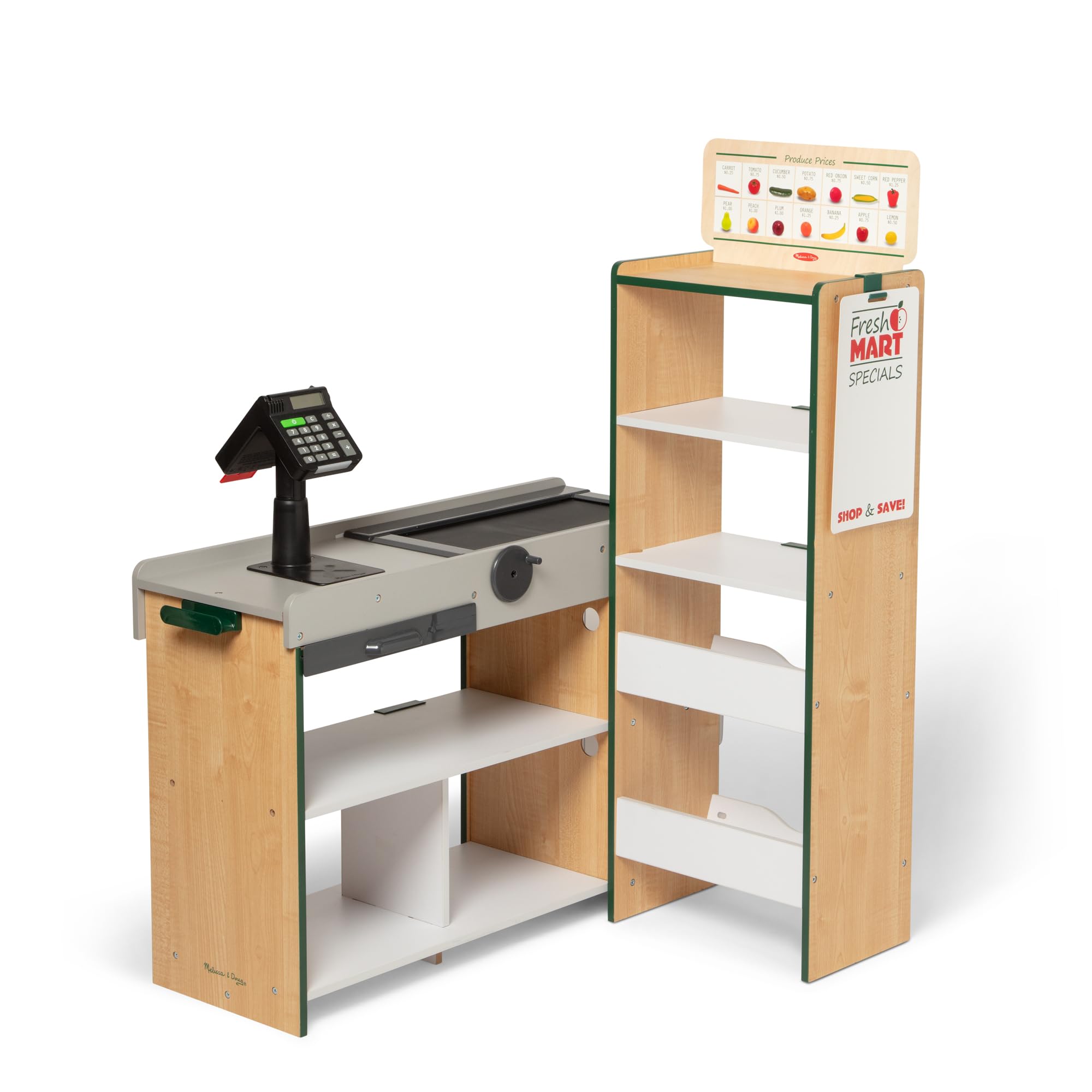
This is not a register you keep in a bin. Built, the Fresh Mart is a wooden grocery store with shelves, a checkout counter, and a hand-cranked conveyor belt, and it wants a corner of a playroom plus the better part of an hour with the instructions to get there. Measure the spot before you order, and plan for two people to move it once it is assembled.
What you get for the space is the most complete store in this guide. Kids stock the shelves, load the conveyor, crank items toward the scanner, swipe the bank card, punch the keypad, and open the drawer: the whole sequence, in order, the way it happens at the store. The conveyor is what makes it a store rather than a counter, and it is the part that keeps a second kid interested in playing shopper.
Two things to plan for. It ships with a bank card, a sign, and shelf labels, but no play food and no play money, so the first shop needs groceries from your kitchen or a separate set. And the moving parts carry the risk: the fridge door is plastic on an otherwise wooden build, and the conveyor and the scanner are where these get damaged. At the top of this guide’s price range, that is worth knowing.
None of it changes what this is: the one toy here that turns checkout into a whole store, and the one a 4-year-old and a 6-year-old can play together without an adult narrating. If you have the floor space and you are buying for a household rather than one kid, it earns the money; if the playroom is small, the Little Tikes stand gives you a similar sequence in a fraction of the footprint.
Pros
- Hand-cranked conveyor that moves the play forward
- Working scanner, card swipe, keypad, and cash drawer
- Shelves and labels for stocking, not just checkout
- Solid wood construction
Cons
- No play food or play money included
- Plastic fridge door and conveyor are the fragile parts
We recommend it for a playroom with a corner to spare: a wooden store with a working conveyor, scanner, and drawer, minus the food you will need to buy.
Best for Budget Gifts
Bluey Cash Register Playset
Key Features
- Size: 5.16 x 11.73 x 5.91 inches
- Sounds: Beeps, music, Bluey phrases
- Includes: Scanner, credit card, Dollar Bucks
- Age range: 3 years and up
- Price: Budget
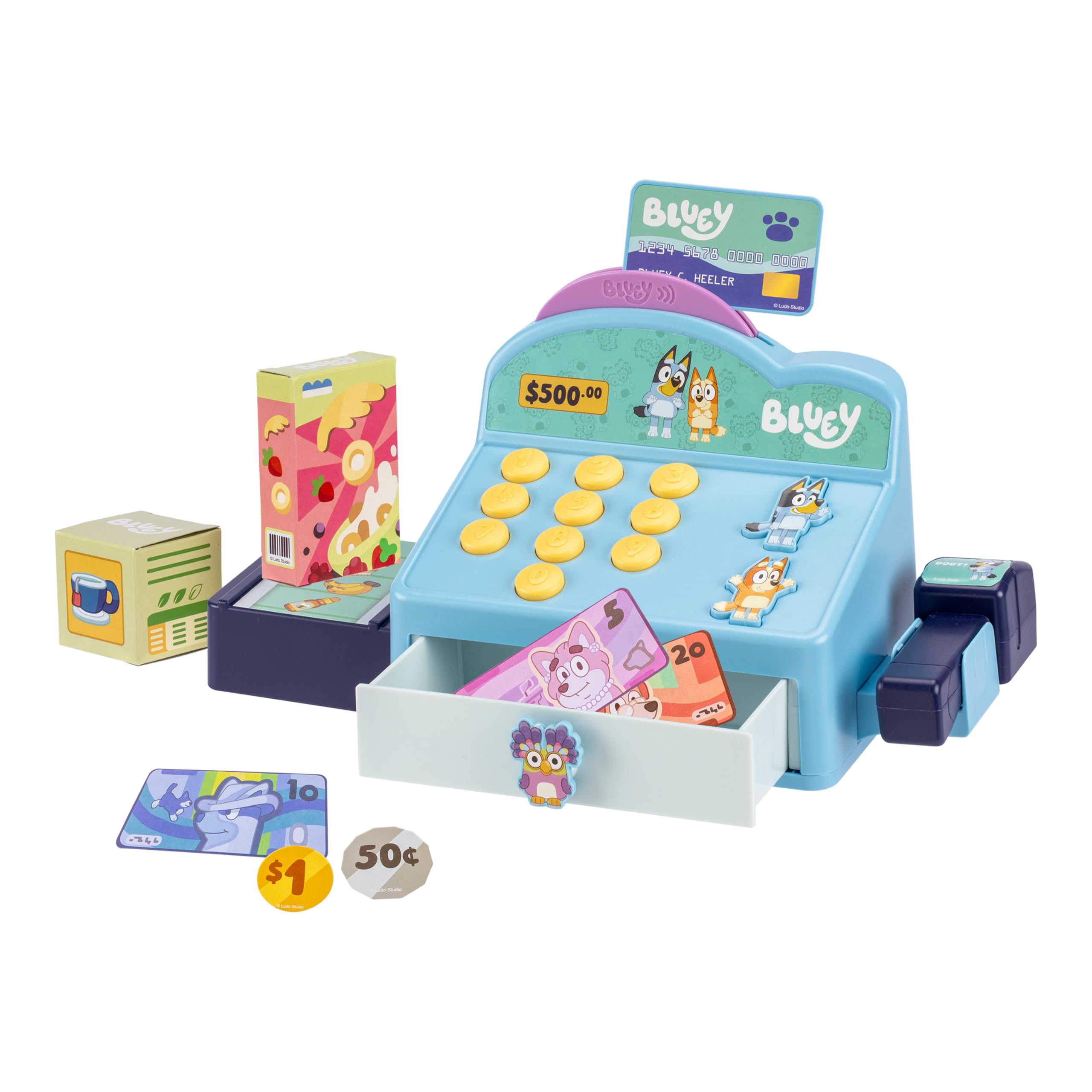
It still does the thing we think a 3-year-old wants: press a button and it beeps, run the detachable scanner over a box and it responds, press Bluey or Bingo and you get a phrase or a bit of music. It comes with Dollar Bucks, a toy credit card, and a drawer to keep them in, and the whole register is about a foot wide, small enough for a kid to carry under one arm.
What you give up is the math. There is no calculator, no coin counting, and no coin slot, and the money is a few Dollar Bucks plus a card, so this is spending play rather than number practice. The scanner comes off, which is the fun part and also the part that gets lost behind the couch. For a first register, a gift, or a Bluey household, none of that matters much: the drawer holds the money, the pieces are few, and cleanup takes ten seconds.
Pros
- Least expensive register in this guide
- Detachable scanner that responds to items
- Bluey and Bingo phrases plus music
- Storage drawer keeps the Dollar Bucks together
Cons
- No calculator or coin counting
- Detachable scanner can go missing
Our budget pick: beeps, Bluey phrases, a working scanner, and a storage drawer, for less than any other register in this guide.
Best for Coin Recognition
Learning Resources Teaching Register

Key Features
- Size: 14.4 x 10.1 x 8.1 inches
- Assembly: 5 minutes
- Age range: 3 years and up
- Batteries: 3 C required
- Price: Midrange
This is the only register in our set that names the coin you drop in. Insert a quarter and it says quarter; feed in a handful and it adds them up, and the built-in games turn that into a quiz about change. For a kindergartner working on money at school, that is a different job than pretending to scan groceries.
The rest of it is a full pretend counter: a scanner, a scale for produce, a drawer, and a voice that talks as kids play. It runs on 3 C batteries, it measures 14.4 by 10.1 by 8.1 inches, and setup takes about five minutes, so it is playable the same afternoon it arrives.
The caveat is the sensor. Coin identification is the feature that makes this one worth its higher price, and it is also the part that stops working; when the reader goes, the games go with it and you are left with an ordinary talking register. We think it is still the right buy for a 5- or 6-year-old who is learning coins, because nothing else here names them, but go in knowing that the best feature has a lifespan.
Pros
- Names each coin as it is inserted
- Built-in games that quiz on change
- Scanner, produce scale, and talking drawer
- Quick five-minute setup
Cons
- Coin-recognition sensor can stop working
- Takes 3 C batteries
It earns its place in our list for a kindergartner learning coins: it names each one and quizzes change, as long as the coin sensor holds up.
Best for Disney Fans
Minnie Mouse Marvelous Market
Key Features
- Size: 7.5 x 24.5 x 21.5 inches
- Features: Conveyor, scanner, card machine, fridge
- Age range: 3 to 8 years
- Play food pieces: 38
- Price: Premium
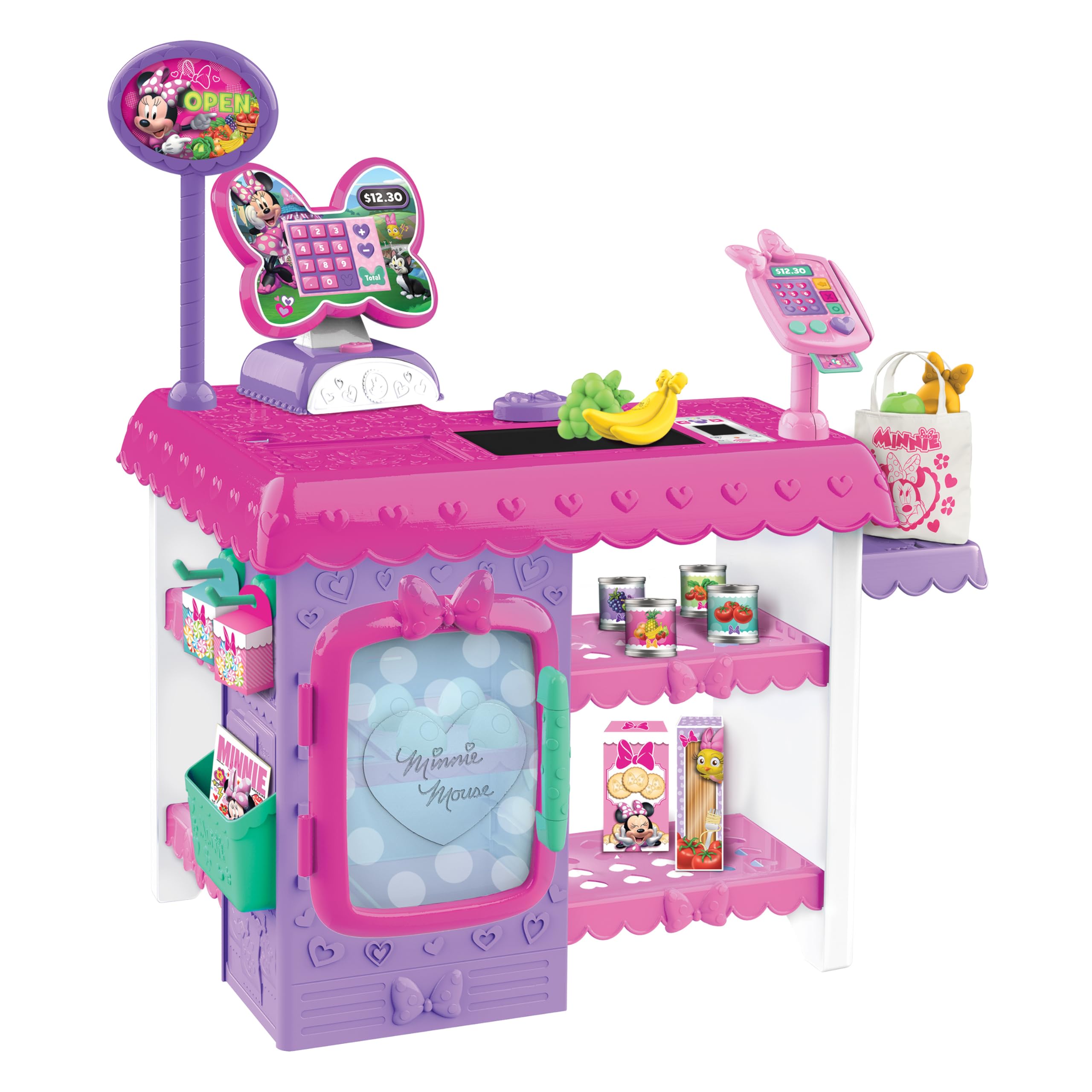
The detailing is what gets a Minnie kid. The stand is molded and printed with the bows, the signage, the produce bins, and a pull-out cash drawer and card machine sized for small hands. It is a bright, busy-looking toy, and it looks in person the way it looks in the listing, which is not true of everything in this category.
It is also a fuller shop than a tabletop register: 38 play food pieces including apples, oranges, bananas, and grapes, a shopping basket, a reusable grocery tote, a play fridge, and a kid-powered conveyor that feeds the scanner. The register makes real cash-register sounds alongside Minnie phrases, and the tote swallows the loose pieces when play is over.
Size is the thing to check. It measures 7.5 inches deep, 24.5 wide, and 21.5 tall, which puts the counter at a comfortable height for a 3-year-old and low for a 5-year-old. If your kid is on the tall side, set it on a low table and it plays at a better level.
The plastic is the honest catch. Under all that surface detail it is an ordinary lightweight build for a toy near the top of this guide’s price range, and it feels it when you lift it. We still think it is a good birthday present for a Disney kid who wants a whole market rather than a register, because the 38 food pieces and the tote are what keep the play going after the sounds stop being new.
Pros
- 38 play food pieces plus basket and tote
- Kid-powered conveyor and play fridge
- Electronic register with Minnie phrases
- Detailed Minnie styling throughout
Cons
- Lightweight plastic for the price
- Smaller than photos suggest
We recommend it as the Disney gift: a full market with 38 food pieces, a tote, and a talking register, if you can accept lightweight plastic.
How We Tested Toy Cash Registers
We started with a list of more than 40 registers and cut anything whose listed age range didn’t fit the kids doing the testing, anything that was really a shape sorter with a drawer stuck on the side, and anything with so many small accessories that half would be gone by the second week. That left 14, which we tested over four months with a 3-year-old, a 6-year-old, and a rotating cast of neighborhood kids.
Each register was assembled cold — box open, instructions face down — with a Phillips screwdriver and a timer running, and we noted which ones needed an adult, which needed a screwdriver, and which clicked together while the kid waited. Then it moved into the playroom grocery store: a low shelf of play food, a basket, and a chair for the cashier. Registers stayed there two weeks at a stretch and were used the way kids actually use them, which is constantly and without mercy.
Coins got fed through the slot over and over until something jammed, and we recorded how hard it was to retrieve them and whether the drawer still opened afterward. We filled each drawer with play money and opened and closed it 30 times, listening for grinding and checking whether the contents slid out with the drawer or spilled into the body of the toy. On the electronic models, we scanned the same item repeatedly to see if the sensor kept up, tapped the pretend credit card until it stopped beeping, and ran the volume at its highest setting in a small room. For the ones claiming to teach, we checked whether the keypad math matched the total shown and whether a kid could correct a mistake alone.
Durability got its own pass: each register was dropped from counter height onto hardwood, the scanner arm was twisted in both directions, and the buttons were pressed with a thumb, a knuckle, and a flat toddler palm. Value came down to how many included pieces were still in use after the first week.
How to Choose a Toy Cash Register
The register your kid keeps playing with is the one whose buttons do something they can control, so decide how much machine you want before you fall for a big playset.
Tabletop Register or Play Stand
Both formats do the same pretend job and ask different things of your house. A tabletop register lives on a shelf and comes out for play; a stand or a full market becomes part of the room. The tabletop models here, including the Learning Resources calculator register, the Bluey set, and the Fisher-Price Retro, are the low-commitment choice, and any of them pairs with a play kitchen you already own.
A stand buys you the shopper-and-cashier game, shelves to stock, and a reason for two kids to play at once, and it costs floor space and usually an hour with a screwdriver. Photos flatter playsets, so look at the assembled dimensions rather than the box shot and pick the corner before you order.
Match the Register to Your Kid’s Age
Age grading does two jobs: it tells you what a child can understand and it warns you about small pieces. At 2 and 3, choose chunky, forgiving designs with few parts. The Fisher-Price Retro and the Little Tikes stand are both rated for 2 and up, and neither requires a kid to read anything.
From about 4, the calculator and the counting coin slot start to pay off, which is where the Learning Resources calculator register and the LeapFrog earn their place. At 5 and 6, coin identification and realistic money matter more than songs. Buying a year ahead is fine; buying three years ahead usually means a toy that sits.
How Much the Register Actually Does
Interactive on a box can mean anything from a speaker that beeps to a calculator that does arithmetic. Sort the sets by what the buttons deliver: the cheap ones beep and play phrases, the mid-range ones add a working calculator or a coin slot that counts, and the top adds coin identification, the only feature that teaches denominations rather than quantity.
Our advice is to pay for the calculator before you pay for the songs. A working calculator gets used for years; a phrase button wears out its welcome in a month. Coin recognition is the one feature worth a premium, as long as you accept that the sensor behind it is also the first thing to fail.
Power, Volume, and the Parts That Move
Three power arrangements show up here: a solar panel, standard batteries, and a hand crank. We favor solar, because there is no battery door and nothing to replace, and the crank is its equal in a toy for a 2-year-old, where the mechanism is the play. If a listing says batteries are included, read the wording; demonstration cells are common and they die early.
Volume matters more than most listings admit, since these toys talk into rooms with hard floors. Then look at the moving parts, because that is what breaks: the drawer first, then the scanner, then a conveyor. A drawer that pops open on a spring scatters coins; a drawer that needs a firm pull defeats a small kid.
Play Money and What Else You Need
Play money is where these sets differ most. The best of them print bills at actual size and include enough coins to make change, and the Learning Resources calculator register ships with 30 bills and 40 coins, which is enough for real counting practice. Paper bills crease and tear, so a set with plastic coins and a card will outlast one that is all paper.
Check the included list before you order, because plenty of sets arrive with a register and a card but nothing to sell. If the shelf is empty on the first morning, the play stalls before it starts.
Frequently Asked Questions
Is a toy cash register worth it if we already have a play kitchen?
A play kitchen gives a kid a shop; a register gives them the transaction, which is the part with counting, turn-taking, and the line they have been waiting to say out loud. The two combine well: put a tabletop register at the end of the kitchen counter and the whole setup becomes a cafe or a grocery.
Start with a tabletop model and a few empty boxes to sell, then upgrade to a stand only if the play holds. The stand is the second purchase, not the first.
Are the coins a choking hazard for toddlers?
The coins are the smallest pieces in any of these sets, and they are a big part of why most registers here are graded 3 and up. If your child is 2, or still puts things in their mouth, choose a set graded for 2 and up, such as the Fisher-Price Retro or the Little Tikes stand, and supervise the coins rather than leaving them loose in the drawer.
Check the age grade on the box before you buy, not the age of the kid in the product photo.
How do I keep all the little pieces from disappearing?
Lean on whatever storage the toy already has. The Bluey register keeps its Dollar Bucks in a drawer, and the Minnie Marvelous Market includes a reusable grocery tote that swallows its 38 food pieces, which is the difference between a set that stays complete and one the playroom floor absorbs.
Otherwise, set a shallow bin beside the register: bills and coins in one, food in another. Fewer loose pieces, in our experience, means more play and less searching.
Final Verdict
Our default is the Learning Resources Pretend & Play Calculator Register. A working calculator, actual-size bills, and solar power beat a louder speaker every time, and it is the register we hand a 3- or 4-year-old without a second thought.
If the kid in question is 2 and still learning to turn a handle, go with the Fisher-Price Retro. If the playroom has a corner going spare, the Melissa & Doug Fresh Mart turns the same game into a store.
