This post contains affiliate links. We may earn a small commission when you buy through our links — at no extra cost to you.
A marble run looks like a guaranteed win — a box of tubes and a bag of marbles, and gravity handles the rest. Then it comes home, the tower folds at the third level, a marble jams inside a curve, and the instructions turn out to be a wordless diagram that makes the whole family feel slow.
That gap between what’s on the box and what happens on the living room floor is what my team spent six months chasing. We built, bumped, rebuilt, and raced 14 marble runs with testers ranging from 3 to 11 years old, and the sets that held up were the ones where the pieces actually stayed joined and the marbles never stopped moving.
A few things you only notice after living with these: a motorized elevator changes the whole experience, because the run keeps going instead of waiting for a kid to hand-feed marbles to the top, and glow-in-the-dark marbles turn a daytime toy into an after-dinner one. Magnet strength matters more than piece count, too — weak magnets drop track the second a marble passes. The picks below reflect all of it.




Best for First Full Set
National Geographic Glow Marble Run
Key Features
- Pieces: 80
- Marbles: 15 glow-in-the-dark glass
- Storage: Storage bag and marble pouch
- Recommended age: 8 years and up
- Price: Midrange
The first thing we did with this set was charge the marbles under a lamp and turn the lights off, and the glow earns its place in the name: 15 glass marbles in six colors, each one lighting the track as it goes. What kept us coming back is how much run you get for a middle-of-the-road price. Eighty pieces, five bases, and joints snug enough that a bumped table doesn’t end the build.
Five bases matter more than they sound. A marble maze fails at the bottom, and five feet on the ground let you build wide instead of tall, which is the shape that survives a kid reaching across it. The glass marbles carry real weight into the curves and hold their momentum through the turns; the glow fades over a run and needs another charge, but the rolling doesn’t.
The storage bag and the small marble pouch decide whether this lives on a shelf or underfoot, and the learning guide gives a parent something to do besides rebuild, with experiments on motion that turn a rainy afternoon into something. It’s also the set to start a collection with, since the brand’s motorized lift is built to add onto it.
Pros
- 80 pieces on five stabilizing bases
- 15 glass glow marbles in six colors
- Storage bag and marble pouch included
- Motorized lift kit adds on later
Cons
- Glow fades and needs recharging
We recommend this as the default marble run: a snug 80-piece build, glass marbles with real momentum, and a storage bag, at a price that leaves room to add the motorized lift later.
Best for Huge Builds
Marble Genius Extreme Set
Key Features
- Pieces: 300
- Build app: Step-by-step guidance and challenges
- Recommended age: 4 years and up
- Clear track pieces: 181
- Price: Premium
If the top pick is a marble run for a family, this is one for a builder: 300 pieces, 181 of them clear track, in a 6.3-pound box. Nothing else here builds as tall or as wide, and nothing else here costs as much.
We think the size is worth it for the right kid and a mistake for the wrong one. At this scale the joints carry real load, and tube ends are where a hard knock shows first, so a tall build that loses one connector takes the whole run down with it. Assembly past the first few levels turns into an adult project, which is fine in a household that builds together and less fine on Christmas morning.
What you’re buying is headroom: funnels, spinners, and enough clear track to run a marble across a room, plus an app that walks through builds step by step and hands out challenges once the plans run out. For a dedicated 8-to-12-year-old, that’s a toy with years in it. For a first set, buy smaller.
Pros
- Largest piece count here at 300
- App-guided builds and challenges
- Clear track shows the marble the whole way
Cons
- Tube ends can crack under hard knocks
- Big builds need adult hands at the start
Buy it when the build is the point: this is the most ambitious set here, and we think the extra money is worth it for a dedicated builder who wants a run that fills the floor.
Best for Older Builders
GraviTrax Starter Set
Key Features
- Pieces: 122
- Building guide: Instruction and construction plan booklet
- Recommended age: 8 years and up
- Price: Premium
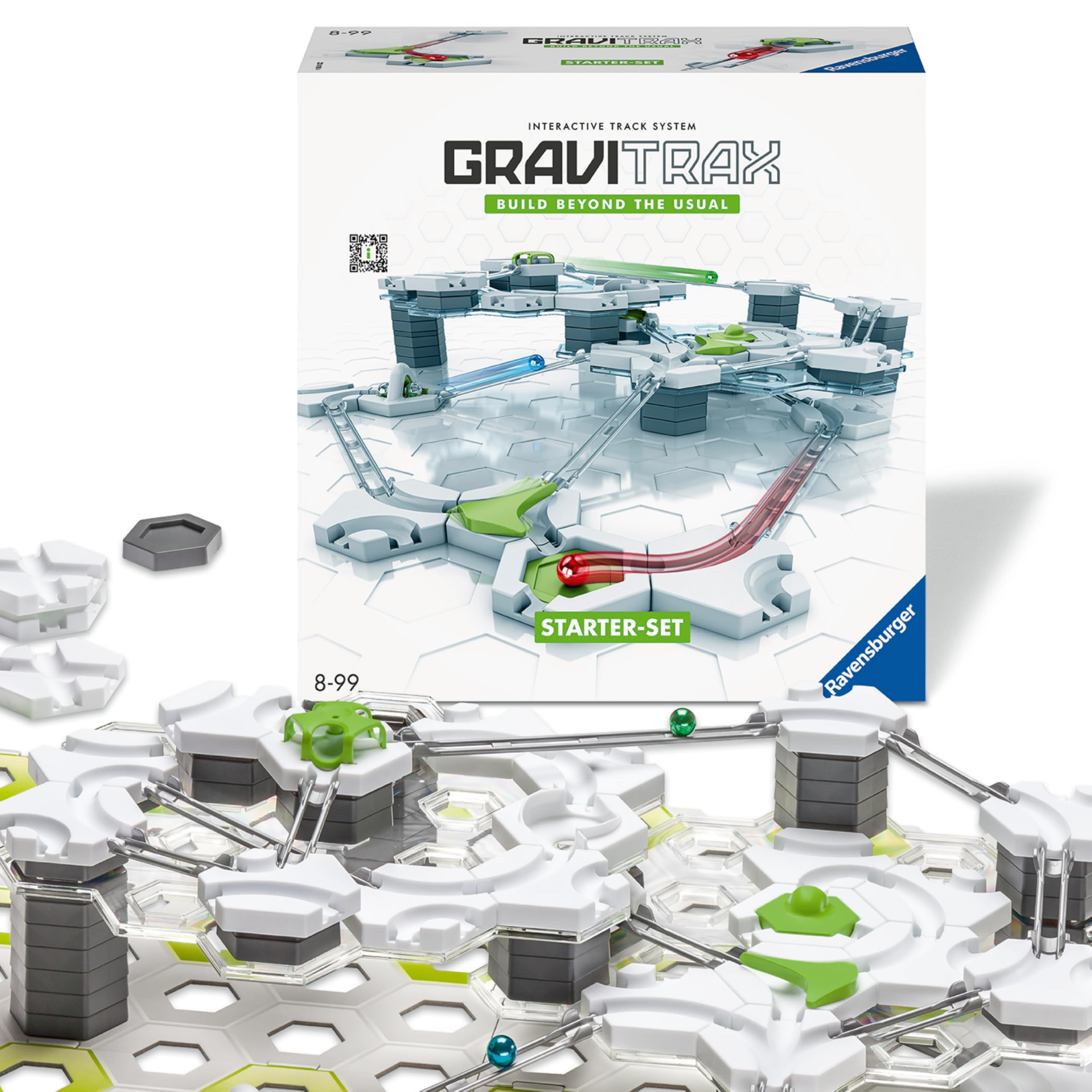
This is the one for the kid who takes things apart to see how they work. GraviTrax is less a tube-and-marble toy than a small engineering kit: 122 pieces, marbles routed by gravity and magnets, and a construction booklet that hands you a plan before you start inventing your own.
What we like is that failure is part of the design. A marble that stalls tells you the slope is wrong, so building and debugging become the same activity, and that’s what holds an older kid at the table once a simpler set has already been solved. The pieces feel solid in the hand, and the line is built to grow with add-on sets.
The catch is scale. 122 pieces doesn’t stretch far once you’ve built the plan in the booklet, so treat this as a first chapter rather than a whole library, and plan for the fact that a kid who loves it will want more of it. The 8-and-up rating is about patience as much as difficulty.
Pros
- Gravity and magnets make every build a puzzle
- Construction booklet gives a starting plan
- Solid pieces built to be rebuilt
Cons
- 122 pieces runs out fast; add-ons cost more
- Rewards reading before the first run
For an 8-to-12-year-old who likes figuring things out, this is the set we point to: trial and error is the toy here, not a setback.
Best for Younger Kids
Marble Mania 162-Piece Set
Key Features
- Pieces: 162
- Marbles: 36 glass and 36 plastic
- Storage: Storage tub included
- Recommended age: 4 to 8 years
- Price: Midrange
The plastic tub is why this set earns a place. Ninety building pieces and 72 marbles go back in the box in about a minute, with no sorting and no knotted bag, and that one decision is the difference between a toy that comes out on a Tuesday and one that stays in the closet because nobody wants to deal with it.
The build suits the 4-to-8 crowd: pieces press together with a firm push rather than a hard snap, the guidebook walks through four different runs, and clear track lets a smaller kid watch where the marble went. Two kinds of marbles ship in the box, 36 glass and 36 plastic, and we ended up liking that more than we expected. The plastic ones are slower and survive being dropped; the glass ones give the run real speed.
Where it gives ground to the top pick is ceiling. Ninety building pieces makes a good tabletop run, not a floor-crossing one, and the action pieces are thinner on the ground than on the bigger sets here. For a 5-year-old who wants to do the building, that’s the right amount of toy.
Pros
- Storage tub makes cleanup a one-minute job
- 36 glass and 36 plastic marbles included
- Pieces press together without a hard snap
Cons
- Tall builds topple with a bump
- 90 building pieces caps the run’s size
The set we hand to a 5-year-old: pieces that go together without a fight, two kinds of marbles, and a tub that makes putting it away the easy part.
Best for Toddlers
Bmag Magnetic Marble Run
Key Features
- Sound: Happy Birthday bell
- Pieces: 73
- Connection: Magnetic tiles
- Recommended age: 3 years and up
- Price: Budget
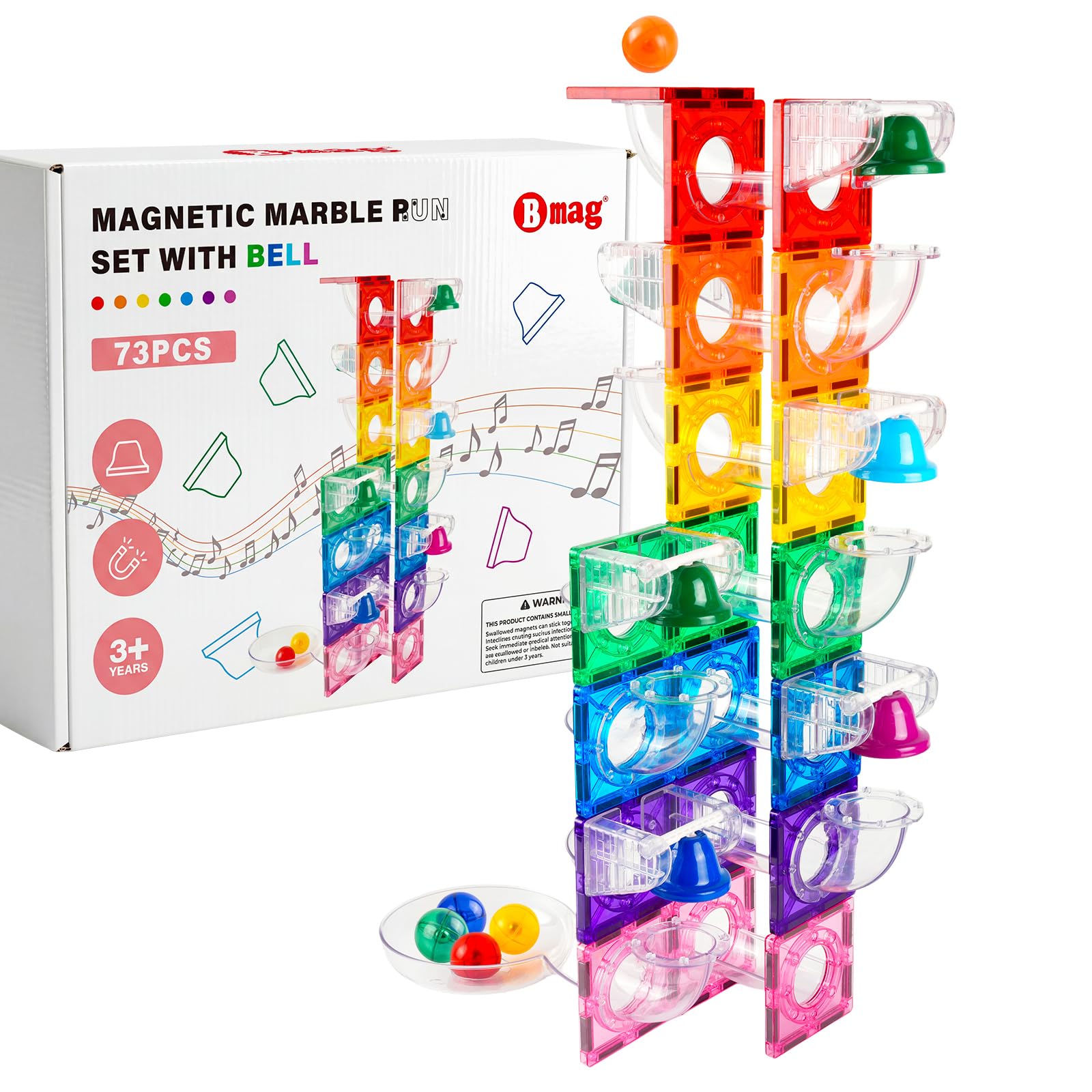
A marble rolls through the bell at the bottom of this track and plays Happy Birthday. For a 3-year-old that’s the whole pitch, and it works: the melody gives a reason to send the same marble round again instead of wandering off to something else.
The magnets do the rest. Pieces hold to each other rather than clicking, so a bumped tower tends to stay up and a preschooler can rebuild without the fine-motor precision a snap-together tube set demands. Seventy-three pieces is a deliberate ceiling: enough for a chunky tower with curved tunnels and a funnel, small enough that a kid can find every piece again.
We rate it the best of these for the 3-to-5 range, and it’s the budget entry in a category that gets expensive fast. The bell is a reward loop, so you will hear that melody a great many times, which is the trade for a marble run a preschooler can operate without you.
Pros
- Bell plays Happy Birthday as marbles pass
- Magnetic joints tolerate clumsy hands
- Rated for ages 3 and up
Cons
- Magnet joints can slip under a tall tower
Our pick for the youngest builders: magnets forgive clumsy hands, the bell keeps a 3-year-old looping marbles, and it’s the least expensive set in this guide.
Best for Hands-Off Looping
JOYIN Motorized Elevator Set
Key Features
- Lift: Motorized elevator
- Pieces: 236
- Track pieces: 176
- Recommended age: 3 years and up
- Price: Midrange
The motorized elevator is why anyone picks this set over a cheaper tube run. Marbles climb back to the top and the loop keeps going without a kid standing over it with a fistful of marbles. Everything else is in service of that trick: 236 pieces, 176 of them track, with glow-in-the-dark marbles for running it after dark.
Once it’s up, the frame is steadier than most here. We moved ours from the floor to a table without a rebuild, which is more than we can say for the tall towers in this guide, and the glow marbles make the whole thing worth doing with the lights off.
Getting there is the work. The printed steps are thin for a build this size, so plan on an adult evening with the picture on the box, ideally before the kid sees it.
And the lift is the part most likely to let you down: when the motor quits, the loop stops and you’re back to dropping marbles by hand. The set underneath survives that, since it’s still a full 236-piece run, so we treat the elevator as a bonus rather than a foundation.
Pros
- Motorized elevator keeps marbles looping
- 176 track pieces and glow marbles
- Frame holds together when moved
Cons
- Printed steps are thin for the piece count
The elevator is the argument: it’s the only set here that keeps a marble moving without a hand, and there’s a proper 236-piece run underneath it.
Best for Tile Collectors
PicassoTiles Magnetic Marble Run

Key Features
- Pieces: 100
- Marbles: 5 steel marbles
- Material: BPA-free ABS plastic
- Recommended age: 3 years and up
- Price: Midrange
Two magnetic sets are on this list and they do different jobs. The Bmag is a marble run held together by magnets; this is a magnetic tile kit you turn into a marble run, 100 pieces of squares, slopes, funnels, and U-turns, with five steel balls.
For a house that already has magnetic tiles on the floor, that’s the appeal: the new pieces join what’s already there, so a run gets built into the side of a castle instead of next to one. It’s forgiving too, since magnets hold where a snap connector would pop, and the standard sizing means the collection grows rather than sitting in a drawer.
Where it lands for us is a good second marble run and a fussier first one. The tiles are structure as much as track, so a room-spanning build is mostly frame, and vertical walls are where the magnets get tested. Ours held fine for a tabletop run and got fiddly once we pushed the height. Buy it to extend a tile collection, not to introduce the idea of a marble run.
Pros
- Adds to an existing PicassoTiles collection
- Five steel balls included
- Magnetic builds survive a bump
Cons
- Tiles are as much frame as track
- Magnet hold weakens on tall walls
A smart add-on for a magnetic-tile household and a fussier first marble run for everyone else: we recommend it as a second set, not a starter.
Best for Growing a Collection
National Geographic Motorized Set

Key Features
- Lift: Motorized spiral lift
- Pieces: 150
- Compatibility: Adds to National Geographic marble runs
- Recommended age: 8 years and up
- Price: Midrange
Watching the spiral lift carry a marble up and tip it back onto the track is the moment this kit makes sense. The lift rises almost 20 inches, tall enough that the marble arrives at the top with real speed, and the run feeds itself instead of waiting for a hand.
It’s the top pick’s sibling and shares its track, so a family that already owns the glow set can combine the two into something taller and self-running. On its own it’s a 150-piece kit: 106 construction pieces, a 14-piece spiral lift, 30 marbles, and a storage bag.
Away from the lift it’s a straightforward set that builds what the box shows. The 8-and-up rating feels right, too: the lift rewards a kid who will sit with instructions, while a 5-year-old mostly wants to watch it go.
So buy it as the second purchase, once a kid is already hooked, rather than the first one. The lift is the fussiest mechanism in this guide, and a family starting out gets the same track and the same learning curve from the glow set without a moving part to babysit.
Pros
- Motorized spiral lift runs the loop hands-free
- Combines with the glow-in-the-dark set
- 30 marbles and a storage bag included
Cons
- Lift can stall or come apart mid-cycle
This is the top pick’s motorized sibling: the same track with a lift on top, and a loop that runs itself as long as the lift cooperates.
How We Tested Marble Runs
We started by pulling every marble run sold in the U.S. that we could get our hands on and sorting them by age range, piece count, connection type, and whether the set offered any way to get marbles back to the top. Sets that shipped with no assembly guidance, or with marbles that couldn’t be replaced, got cut early. That left 14 sets, which we tested over six months.
Testing happened where these toys actually live: living room floors, kitchen tables, a rug in a basement. An adult built each set solo the first time and we clocked it, then handed the thing to kids ages 3 through 11 and got out of the way. We watched for the moments that decide whether a set comes back out of the closet — a marble stalling in a curved tunnel, a tower wobbling when someone leaned on the table, pieces that needed a hard shove to snap together.
Stability got a deliberate hip-check to the table, and we counted the pieces that came off. For magnetic strength, we built the tallest drop each set allowed and watched for track that slid apart under a marble’s weight. Motorized elevators ran a full hour to see whether they kept lifting or started skipping. Durability meant a week of normal abuse, plus timing how long cleanup into the storage bag or tub took. Fun we measured the only way that counts: whether the kids asked for it again on day three and day thirty, unprompted.
How to Choose a Marble Run
A marble run lives or dies on two things a product photo can’t show: whether the joints hold while a marble is moving through them, and how much of the build your kid can manage without you.
Match the set to the builder
The age on the box is usually about patience, not safety. Snap-together track with small connectors suits 4-to-8-year-olds who have an adult nearby for the first build; planning-heavy systems such as GraviTrax are aimed at 8 and up; magnetic sets are the ones that work at 3, because the pieces grab instead of needing a firm push.
The trap is buying the largest box. Three hundred pieces is a better gift for the child who finishes a small build and asks for more than for the one still learning to seat a connector. Start where the kid is, not where the box art is.
Joints, bases, and staying upright
A marble maze fails at the bottom. A wide footprint on a hard floor survives a bump; a tall spire on carpet doesn’t, whatever the photo on the box suggests. Snug connectors and a few broad base pieces matter more than the total piece count, which is why the five bases on our top pick count for as much as its track.
Build low and wide the first few times and let height come later. Keep the whole thing off rugs, too: a marble needs a level surface to keep the momentum it built up on the way down.
Glass, plastic, or steel marbles
Glass marbles are heavy and carry speed through curves, which is why they feel better in a tall run. Plastic is lighter, slower, and survives being stepped on, which makes it the right choice when a toddler is in the house. Steel balls belong to magnetic-tile sets and won’t roll properly in a gravity track at all.
If you need spares, buy the same type the set shipped with, and keep glass marbles up and away from anyone still putting things in their mouth.
Manual restart or motorized lift
A motorized elevator turns a marble run into a loop you can watch hands-free, and for some kids that’s the difference between ten minutes and an hour of play. It also adds the one component that can stop working and take the fun with it.
If the loop is what your kid wants, buy the motorized set and treat the lift as a bonus rather than the foundation. If you want the toy to still work in three years, a manual run has nothing to break.
Storage decides how often it comes out
A run that takes twenty minutes to assemble and has no home gets assembled once. A bag is better than nothing; a rigid tub is better than a bag, because pieces go in without sorting and the lid closes on the mess.
When two sets cost about the same, the one that ships with real storage is the better buy. It’s the least glamorous line on the spec sheet and the one that decides whether the toy gets a second afternoon.
Frequently Asked Questions
Can you connect two different marble run brands?
Rarely. Track diameters, connector shapes, and marble sizes differ from maker to maker, so one brand’s tube usually won’t lock into another’s frame, and a marble that fits one track can jam in another.
Stay inside a brand to build bigger: the National Geographic glow-in-the-dark set and its motorized spiral lift are made to combine, GraviTrax grows within its own system, and buying a second copy of the same set is the safest way to double the pieces.
Why does my marble keep stopping halfway down?
Check three things in order: whether the base is on a hard, level floor, whether every connector is pressed fully home, and whether the last drop before the stall is steep enough to give the marble momentum.
Nine times out of ten it’s the surface or an unseated joint. Carpet, a table with a wobble, or one loose tube will stop a marble that runs perfectly on the kitchen floor.
Do marble runs need batteries?
Only the motorized ones. A manual set needs nothing but a flat surface, which is part of why they hold up: there’s no motor to fail and nothing to recharge.
If you’re buying a set with a lift, put the batteries in and test the mechanism before you wrap it. A motorized run that won’t run on the morning it’s opened is a hard sell to a kid.
Final Verdict
One set here earns the default recommendation: the National Geographic glow-in-the-dark run. It builds snug enough to survive a bumped table, stores in its own bag, and its glass marbles carry real weight into the curves. When your kid wants more, the same brand’s motorized lift adds onto it instead of replacing it.
Change the pick when the builder changes. A 10-year-old who wants to engineer rather than assemble is better served by GraviTrax, and a three-year-old who just wants to send a marble round again should start with the Bmag magnetic set.
