This post contains affiliate links. We may earn a small commission when you buy through our links — at no extra cost to you.
The tricky thing about kids’ board games is that one box has to work for everyone at the table at once. A game simple enough for a preschooler loses a 9-year-old by round two, and anything with real strategy tends to end with the youngest player in tears. The best ones split the difference: rules you can explain in a minute, choices that still feel like choices, and pieces sturdy enough to survive being packed, dropped, and played on the rug.
The age range on the box is a starting point, not a promise, and the player count rarely tells you whether a game works with two kids and one adult. Over four months, my team and I played 16 kids’ games at after-school kitchen tables, on rainy Saturdays, and through a week with grandparents in the house. The keepers were the ones someone asked for again the next day, and the ones whose tiles, blocks, and cardboard still held up after all that. What earned a permanent spot on the shelf is below.



Best for Early Readers
Zingo
Key Features
- Cards: 6 double-sided
- Tiles: 72 double-sided
- Players: 2 to 6
- Age range: 4 to 10 years
- Price: Premium
Flip a card and the game changes. One face is pictures, the other is words, and that single decision is why Zingo is the game we hand to most families. A four-year-old who cannot read yet plays the picture face while a second grader plays the word face, same rules, same zinger, nobody spotting anybody points. The box says four to ten, and that is an honest span.
A round works like bingo with a mechanical dealer. Someone slides the zinger, two tiles drop into view, and players cover the match on their card. First to fill a card wins. Because the zinger doles out the tiles, no adult sits there holding a deck, and because a tile is either on your card or it is not, a pre-reader can beat a grown-up on the picture level without help.
The word level is the reason it stays in rotation. Matching a printed word to the same word on a card is quiet reading practice a kid will happily do for an hour, and the 72 double-sided tiles mean the same handful of words does not come up every game. We also like that the two levels are not separate games, so a younger player can drop into a round already in progress.
Two things to know before you buy. Tiles jam in the zinger now and then and need a firm wiggle to free, which is annoying at the wrong moment but never fatal. It is also the most expensive game on this list, and the money buys you the two reading levels and a table that seats six.
Pros
- Two levels let pre-readers and readers play together
- Seats up to six at one table
- Word side builds real reading practice
- Fast rounds that hold a four-year-old
Cons
- Tiles can jam in the zinger
- Most expensive game in this set
Buy this one if your kids are four to eight and you want a single game that a pre-reader and a reader will both ask for again.
Best for Preschoolers
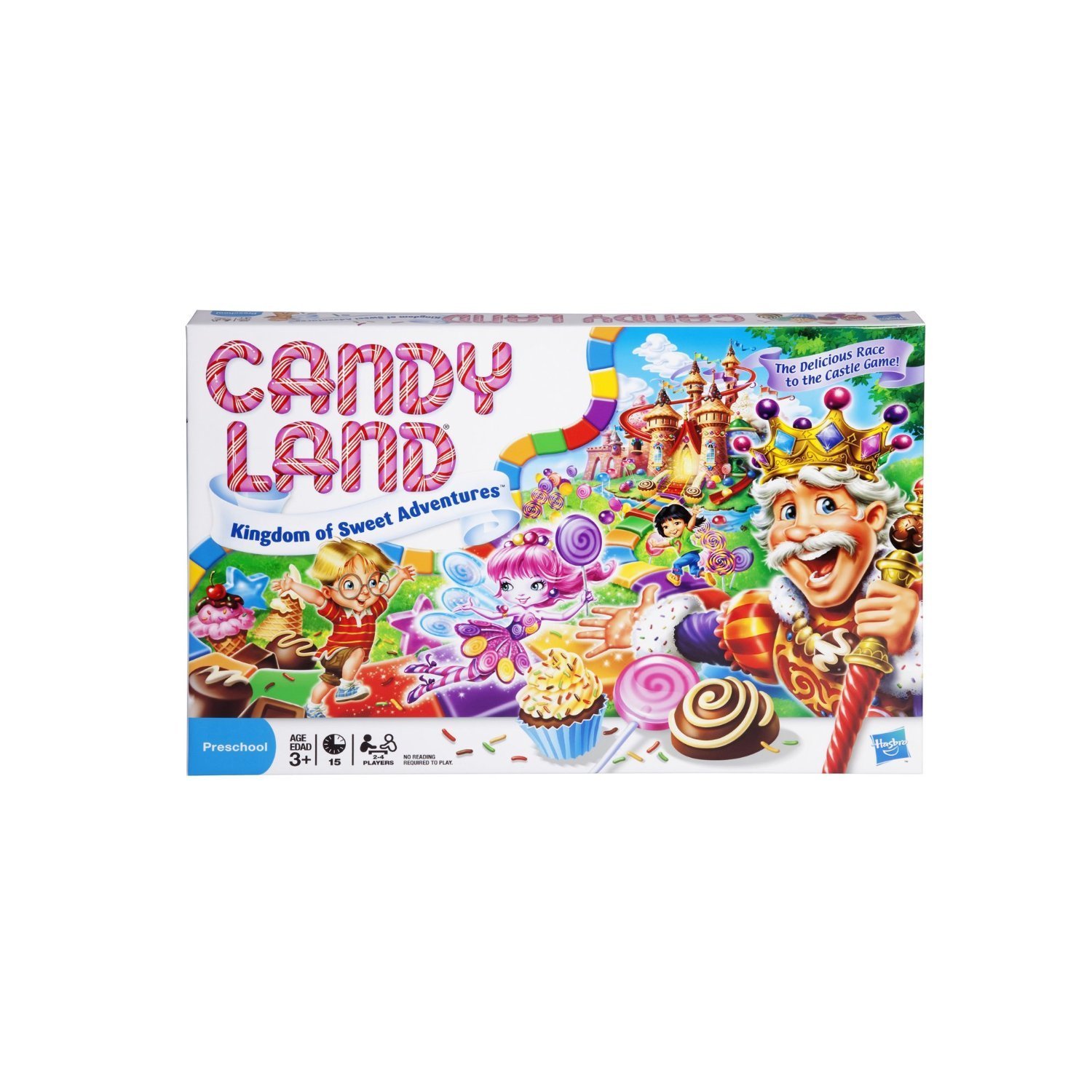
Candy Land
Key Features
- Players: 2 to 4
- Contents: Board, 4 pawns, card deck
- Age range: 3 years and up
- Playing time: 15 minutes
Candy Land asks almost nothing of a child: no reading, no arithmetic, just matching the color on a card to the next space on the path. Four pawns, one deck, a race to the castle. That is the entire game, and it is why a three-year-old can sit at the same board as a six-year-old and a grandmother and genuinely have a shot.
There is no decision to make. You draw, you move, someone wins. We think that is exactly right for the age it is built for. A preschooler who wins about half the time learns that a loss is survivable, and the sportsmanship lesson is the point rather than a side effect. It is the only game here where the adult holds no advantage at all.
The arc still works: the character cards that send you back down the path land like a plot twist every single time, and a bad run of draws does not ruin an afternoon because the game is nearly over by then. Fifteen minutes is the listed playing time, and that is about right. This is the game for the slot before dinner, not a long game night.
Pros
- No reading or math required
- Teaches turn-taking and good sportsmanship
- A full game fits in about fifteen minutes
Cons
- Thin board and light pawns
- Cards are stiff and awkward to shuffle
Hand it to a three-year-old who cannot read yet and they are playing within a minute, winning and losing like everyone else at the table.
Best for Family Game Night
Sorry!
Key Features
- Cards: 45
- Pawns: 12
- Players: 2 to 4
- Age range: 6 years and up
- Price: Budget
Candy Land and Don’t Break the Ice put adults and children on equal footing by design. Sorry! is the first game here where a six-year-old can genuinely outplay you. Cards drive every move, and choosing which pawn to advance, and whether to spend a card sending a sibling back to Start, is a decision the child owns.
That threat is the whole appeal. Opponents can knock a pawn off the board, and the first few games involve coaching a child through the injustice of it before the mechanic turns into the reason they ask to play again. We watched that flip happen faster than we expected, and it is the most useful thing the game teaches.
The box seats four, with a dozen pawns and 45 cards, which makes it the most reliable four-player game in this group after Jenga. Setup is a minute: unfold, deal, pick a color, go. Three people can play it too, which matters in households where the fourth chair is a toddler.
The build is the trade-off. Thin board, light plastic, and a fold across the middle that looks like a crack the first time you open it and is not one. What you are paying for is a four-player race where the lead changes hands three times before anyone gets home, and at this price that is the right trade to make.
Pros
- Four players from a single box
- A real decision on every card
- The knockback card is the drama kids return for
Cons
- Thin board and light plastic pieces
With kids six and up and more than two of them, this is the family-night pick: four players, real choices, and a revenge card everyone roots for.
Best for Two Players
Connect 4
Key Features
- Discs: 42
- Players: 2
- Age range: 6 years and up
- Ways to play: 3
- Price: Budget
You can teach Connect 4 in one sentence: drop a disc, line up four. The grid stands on two plastic legs, a slider bar at the bottom dumps every disc at once, and a round lasts exactly as long as two people are willing to sit still.
The strategy underneath is real. We like that there is blocking, baiting, and the diagonal that wins a board that looked lost. A child’s play visibly improves with repetition, and an adult does not have to play badly for the kid to win. It is also the fastest game here to reset, which matters more than it sounds when a five-year-old wants another round immediately.
This is the best two-player game in the group for a six- or seven-year-old, and one of the least expensive routes to a game that gets played weekly. The discs are chunky enough for small hands, the third play variant gives you something to graduate into, and the whole thing breaks down to a grid and two legs for storage.
Pros
- Teach it in one sentence
- Real strategy that kids grow into
- Resets in seconds for another round
- One of the least expensive games here
Cons
- Two players only
- Legs and slider bar are the weak parts
The two-player game we recommend first: a rule you can teach in a sentence, a round that ends before attention does, and real strategy underneath.
Best for Young Kids
Don’t Break the Ice
Key Features
- Mallets: 2
- Players: 2 to 4
- Age range: 3 years and up
- Ice blocks: 32 small
- Price: Midrange
Two plastic mallets and a penguin on a block of ice. Don’t Break the Ice is the rare preschool game that hands a three-year-old a physical job, and we forgave it a lot the first time we watched a small kid take a swing. Tap out a block, do not drop the penguin. That is the rule, and it is why this one gets pulled out by children who cannot yet sit through a card game.
Setup is the chore: 32 small ice blocks press into a plastic frame, four legs snap on, and the penguin gets balanced on top before anyone picks up a mallet. An adult will do that part for the first several plays. Our fix was a zip-top bag for the blocks instead of the box, which cut the setup time enough that the game stayed out on the table.
What it teaches is quiet and useful: aim, control, and the patience to take one careful tap instead of three fast ones. Rounds are short enough that nobody checks out, and the moment the frame gives way is the payoff every child is playing for. It is also the easiest game here to hand to a visiting grandparent with no explanation.
Pros
- Gives a three-year-old something to do with their hands
- Rounds end before attention does
- Nothing to read and nothing to explain
Cons
- Legs pop loose when the table gets bumped
Buy it for the three- or four-year-old who wants to hit something: a mallet, thirty-two blocks, and a crash that lands at exactly the right moment.
Best for Mixed-Age Groups
Jenga
Key Features
- Blocks: 54 hardwood
- Players: 1 or more
- Storage: Tube with handle
- Age range: 6 years and up
- Price: Midrange
Fifty-four hardwood blocks and a cardboard sleeve to square them up, all of it in a tube with a handle. Jenga is the least complicated thing on this list and the one that survives a car trip, a picnic table, and a box of mixed ages.
We like it best of the games here for a table that spans generations. There is nothing to read, the turn order is whoever is next, and the difficulty sets itself: a five-year-old pulling a loose block and a grandparent pulling a load-bearing one are playing the same game. It also plays solo, which is more useful than it sounds on a rainy afternoon.
The stacking sleeve is the underrated part. It squares the first three levels so the tower starts true, which is the difference between a game and a pile of blocks, and losing it means rebuilding the base by eye every time. Play on a hard, flat surface; carpet is the enemy of a straight tower.
Pros
- No reading and almost no rules
- Scales from five-year-olds to grandparents
- Tube with a handle for storage and travel
- Plays solo
Cons
- Blocks run small for a floor-size tower
- Tube takes more shelf space than the game needs
For a table with a five-year-old at one end and a grandparent at the other, this is the game we reach for: no reading, almost no rules, and a crash that ends it for everybody.
Best for Tweens and Up
Rummikub
Key Features
- Players: 2 to 4
- Material: Plastic tiles
- Age range: 8 years and up
- Price: Midrange
Eight and up is the highest age rating on this list, and Rummikub earns it, not because the rules are complicated but because the game is about rearranging a shared table of numbers, and that takes a particular kind of patience.
The idea is rummy with tiles. Numbered tiles in four colors go down as runs or groups, players can break apart what is already on the table to make room for their own tiles, and the first person to empty their rack wins. Two to four players, a rack each, and a table everyone is allowed to touch on their turn.
What the age gate buys you is a game where nobody has to ease off. An adult plays at full strength and a nine-year-old still wins sometimes, because the draw does some of the balancing and the tile layout rewards planning over speed. We think it is the one here most likely to still be on the shelf when the kids are teenagers.
The cost is drama. There is no tower to knock down and no card that sends a sibling back to Start, and the first few games with a younger child involve a fair amount of help reading the table. Buy it when the oldest kid is eight or nine and you want something the adults suggest first. The plastic tiles and light racks are honest at the price, and the game underneath them is very good.
Pros
- Adults can play at full strength
- The draw keeps a younger player in it
- Holds up into the teen years
Cons
- Eight-and-up shuts out younger siblings
Wait until someone in the house turns eight, then buy it: this is the game that keeps adults and kids at the same table without anybody easing off.
Best for Older Kids
Battleship

Key Features
- Players: 2
- Age range: 7 years and up
- Playing time: 30 minutes
- Ships and planes: 12
- Price: Midrange
Battleship comes as two self-contained plastic cases, one per player, each with its own grid and its own peg supply. That is what makes it work across a room, on a couch, and between two kids who need a break from each other.
Ten ships and two planes per side, called by coordinate, marked with red pegs for hits and white for misses. The planes add targets the older version did not have, and the whole thing runs about thirty minutes, long enough to feel like an event and short enough that a seven-year-old stays in it.
The deduction is the draw, and we like that almost none of it is luck. Reading a grid, tracking what you have ruled out, holding a theory long enough to test it: it is the one game here that rewards keeping quiet about what you know. The plastic is thin and the pegs are small enough that a bumped table ends the round, so treat it as a car and restaurant game rather than an heirloom.
Pros
- Two separate cases, no shared board
- Real deduction and grid reading
- Planes add a second kind of target
Cons
- Labels come as a sheet you apply yourself
- Two players only
For an eight- or nine-year-old who likes puzzles more than racing, this is the two-player pick: real deduction, a private board, and half an hour that goes fast.
How We Chose and Tested the Best Board Games for Kids
We started by rounding up the games that come up again and again in parent groups and on classroom shelves, decades-old classics sitting next to newer award winners, then filtered by age range, player count, and price so the group covered two-player games, full-table games, and boxes a 4-year-old could open with minimal help. Anything that needed an adult to assemble or sticker a pile of pieces before the first play got flagged.
That left us with 16 games, which we played over four months. Testing happened where these games actually live: the kitchen table on weekday afternoons before dinner, the living room floor on rainy Saturdays, a sleepover with a 5-year-old and an 8-year-old, and a week with grandparents in the house, where the mix of ages at the table was widest. We played each one at least three times, and tried two-player versions separately from four-player ones.
At the table, we timed how long it took to explain the rules to a kid who had never seen the game, then watched whether anyone needed a refresher on the second play. We kept a running tally of which boxes got requested again without prompting and which sat untouched once the novelty wore off. Assembly got its own pass: we punched out cardboard, applied stickers, and checked how pieces held up after a weekend packed in a tote bag, with blocks tossed back in the box, tiles dumped on the floor, and cards shuffled by sticky hands. We also noted each game’s table footprint and box size, since a sprawling board on a small table is its own kind of problem.
How to Choose Board Games for Kids
The game that actually gets played is the one the youngest child at the table can join, so start there and work up rather than buying for the oldest kid in the house.
Start With the Reading Level, Not the Age
The age on the box is a rough guide. The reading requirement is the hard line. Candy Land and Don’t Break the Ice ask a child to match a color or swing a mallet, so a pre-reader is fully in the game from the first turn. A game that hides its instructions or card text from a four-year-old turns that child into a spectator while an adult reads their move aloud, and that is where family board games quietly die.
If the youngest player is three or four, buy the game with pictures on the cards. Add a word-based game such as Zingo once letters start to stick, and keep both on the shelf so the older child is not stuck playing the baby game forever.
Count the Players Before You Buy
Two-player games and family games are different products, and the box tells you which one you are holding. Connect 4 and Battleship are strictly two-player. Sorry!, Candy Land, and Jenga seat four or more. In a house with three kids, a two-player box guarantees an argument over who sits out on the next round.
Our approach: buy one game that seats four for the household and one two-player game for the child who wants a rivalry. That covers both jobs without a shelf of near-duplicates.
Decide How Much Luck You Want
A pure-chance game is not a design failure at three. It is the reason a preschooler can win. Candy Land involves no decisions at all, which is exactly why it works before a child can plan a move. Around six, you want cards or discs that create choices: the blocking in Connect 4 and the pawn management in Sorry! are the bridge.
By eight, a child can hold a rack of numbered tiles and rearrange a shared table, which is where Rummikub starts. Fighting that progression gets you a game nobody wants to play.
Expect Lighter Cardboard Than You Remember
Mass-market editions of the classics are thinner than the copies you grew up with: lighter boards, lighter plastic, and cards that arrive stiff and bent slightly out of shape. That is the category rather than one company’s failing, and it is worth adjusting expectations instead of hunting a vintage box on a resale site.
What matters is the part that moves. A slide bar, a spinner, a set of plastic legs, a zipper of tiles: that mechanism takes all the wear, so check it before you commit and store games flat so the board is not carrying the weight of everything on top of it.
Frequently Asked Questions
Do these board games need batteries or a phone?
No. Every game here runs on hands: cards, discs, tiles, wooden blocks, and one plastic zinger. That is part of the appeal if you are trying to get a kid off a screen for half an hour.
If a box mentions an app, a QR code, or a charging cable, you are looking at a different kind of product, and one where the phone usually has to be present for the game to work at all.
How do you keep all the pieces from getting lost?
Count on the way out and on the way back. Connect 4 has 42 discs, Don’t Break the Ice has 32 small blocks and two mallets, and Sorry! has 45 cards, so a missing piece is usually discovered mid-game rather than at the end.
A zip-top bag per game, labeled with the count, takes a minute and ends the argument. Keep the bag inside the box and the box on a high shelf between plays.
How long should a game run for a four-year-old?
Ten to fifteen minutes of actual play is the window at that age, which is why Candy Land’s listed 15 minutes works and a long strategy game does not. Look for a game where every turn moves you forward along a track so a child can see the finish coming.
If a round is dragging, end it early and call it a draw. At four, the goal is a finished game, not a fair one.
Final Verdict
Zingo is the game we hand to most families. Two difficulty levels mean a four-year-old and a seven-year-old can play the same round, six people fit at the table, and a round is over before anyone gets bored. That combination is why it edges out the classics here.
If your situation is different, it is different in a specific way. A three-year-old who cannot read yet belongs at Candy Land. A house where the youngest is already eight should skip both and go to Rummikub, the game in this group most likely to still be getting played when the kids are teenagers.
