This post contains affiliate links. We may earn a small commission when you buy through our links — at no extra cost to you.
A coloring book looks like the safest few dollars you can spend on a kid — until the marker hits page three, the ink soaks through, and your toddler is coloring the back of the same dinosaur twice. Thin paper is the quiet flaw in this category: it turns a 300-page book into 150 usable ones and a restaurant dinner into a negotiation. The right book fixes that, and buys you a quiet half hour in a booth, on a plane, or in a waiting room.
I’ve watched a lot of kids ignore a lot of coloring books, and the ones they come back to share three things: pictures big enough for a small grip, themes they already care about, and paper that survives markers. We put 16 books through three months of kitchen-table afternoons, restaurant waits, and one very long drive, with crayons and markers both.
Page count and price told us less than we expected. What mattered was how much of each book was actually usable, and whether anyone asked for it a second time.



Best for Everyday Coloring
Crayola Epic Book of Awesome
Key Features
- Pages: 288
- Included: Two animal sticker sheets
- Age range: 3 years and up
- Trim size: 7.75 x 10.75 inches
- Price: Budget
Most kids’ coloring books are gone in a weekend. This one is a season. The Epic Book of Awesome runs 288 pages, pulled from four Crayola collections, so the art shifts from goofy creatures to sloths to cats every dozen pages instead of settling into one look. It is a standard 7.75-by-10.75-inch trim with a foil-stamped cover and two sheets of animal stickers bound inside.
That volume is why it is our top pick. Nothing in it is a worksheet or a licensed character, which means it does not expire when a show does, and a four-year-old and a seven-year-old can work out of the same book without negotiating over the last page of their favorite character. We also like that the illustrations genuinely vary, with different creatures and different levels of detail, rather than one animal repeated nearly three hundred times.
The cost of all those pages is weight. At just over 14 ounces it is a table book, not a purse book, so it lives in the car or on the kitchen counter and comes out on rainy afternoons. The sticker sheets are bound into the middle of the volume, which is worth knowing before a kid discovers them halfway through and starts working backwards.
Two things to check before you buy. The pages are reprinted from four collections Crayola already sells, so if you own any of those, expect repeats. And the art is animals and creatures only, with no vehicles, letters, or characters, which makes it a poor fit for the child whose entire personality is currently a cartoon dog.
Pros
- 288 pages across four different art collections
- Unlicensed animal art that outlasts a TV phase
- Two animal sticker sheets included
Cons
- Reprints four existing Crayola books, so expect overlap
- Animal art only, no characters, letters, or vehicles
We recommend the Epic Book of Awesome as the default buy: 288 pages of animal art, stickers included, and no licensed character for a kid to outgrow.
Best for Preschoolers
Crayola PAW Patrol Coloring Book
Key Features
- Pages: 288
- Theme: PAW Patrol characters
- Included: Two sticker sheets
- Trim size: 7.75 x 10.75 inches
- Price: Budget
Thick black outlines are the difference between a three-year-old finishing a page and abandoning it, and this book has them. The lines are heavy enough that a wobbly hand still lands inside them, which is why we hand this one to the youngest colorers in the house. It is a 288-page volume with two sheets of character stickers, in the same thick format as Crayola’s other big books.
The perforated pages matter more than they sound. Being able to tear out one sheet at a time means two kids can work from the same book without negotiating, and a finished picture can go on the fridge instead of staying buried at page 200. Each sheet carries a single illustration rather than a collage, so there is no half-finished clutter in the margins, and the stickers peel easily enough for toddler fingers to manage alone.
The honest limit is the theme. Two hundred eighty-eight pages is a great deal of one show, and a child who moves on to dinosaurs leaves most of it blank, though in a house with two fans that arithmetic flips entirely. Use crayons, colored pencils, or markers here; the paper is heavy enough that color does not strike through.
Pros
- Bold outlines sized for young colorers
- Perforated pages for sharing or display
- Paper holds up to markers and crayons
- Two sticker sheets of show characters
Cons
- Not built for paint or watercolor
If your three- or four-year-old is deep in PAW Patrol, this is the book we point to: big outlines, tear-out pages, and enough sheets to last months.
Best for Bluey Fans
Bluey: Big Backyard
Key Features
- Pages: 64
- Trim size: 8.44 x 10.75 inches
- Reading age: 2 years and up
- Price: Budget
Bluey: Big Backyard is a real book rather than a novelty. It comes from Penguin Young Readers at 64 pages, 8.44 by 10.75 inches, with scenes and characters taken straight from the show. The reading age starts at two and the grade range runs preschool through first, which matches what we see: a two-year-old can land color in the big empty spaces while a five-year-old works the grass and the background details.
The pages are not uniform, and that is the point. Some spreads are deliberately simple, one or two characters against white space. Others carry more furniture, more plants, more to fill in. That spread keeps the book in step as a child’s grip improves, instead of being finished in one sitting and forgotten.
Where it earns its place is familiarity. A toddler who will not sit still for a generic animal book will sit still for Bluey, and that motivation does more work than any design feature. It is also a low-stakes way to find out whether the coloring habit sticks at all before you invest in a thicker volume.
Pros
- Real Bluey scenes, not generic art
- Simple and detailed pages in the same book
- Light, bag-friendly trim
Cons
- Slim 64 pages, with no stickers or extras
For a toddler who only wants Bluey, this is the one: genuine show scenes, a mix of easy and detailed pages, and a slim shape that travels well.
Best for Toddlers
ABC Coloring Book
Key Features
- Pages: 120
- Trim size: 8.5 x 11 inches
- Reading age: 2 to 4 years
Hand a two-year-old a standard coloring book and most of the crayon ends up outside the lines, which is fine until the kid notices. This book is built for that stage: one large picture per page, one large letter, and shapes simple enough that a first-timer can fill one without help.
The content runs to 120 pages of animals, birds, vehicles, fruits, and toys, printed at 8.5 by 11 inches. It works as a teaching tool as much as a coloring book, because there is something to talk about on every page while the crayon moves: the letter, the name of the animal, the color of the truck.
The large format is the trade-off. This is a desk book that stays home, not something that slides into a diaper bag, and that is fine once you accept it as the kitchen-table coloring book rather than the one that goes to restaurants.
Where it stops: a five-year-old wants finer lines, background detail, and characters, and the simple outlines here start to look babyish next to a detailed book. Up to about age four, though, nothing else in this group sets a beginner up as well.
Pros
- Big, simple shapes a toddler can fill
- One letter and object per page for talking through
- 120 pages of varied subjects
Cons
- Letter-size book that stays at home
For a two- or three-year-old’s first coloring book, we pick this one: big shapes, a letter on every page, and a hundred-plus familiar objects to name.
Best for Travel and Restaurants
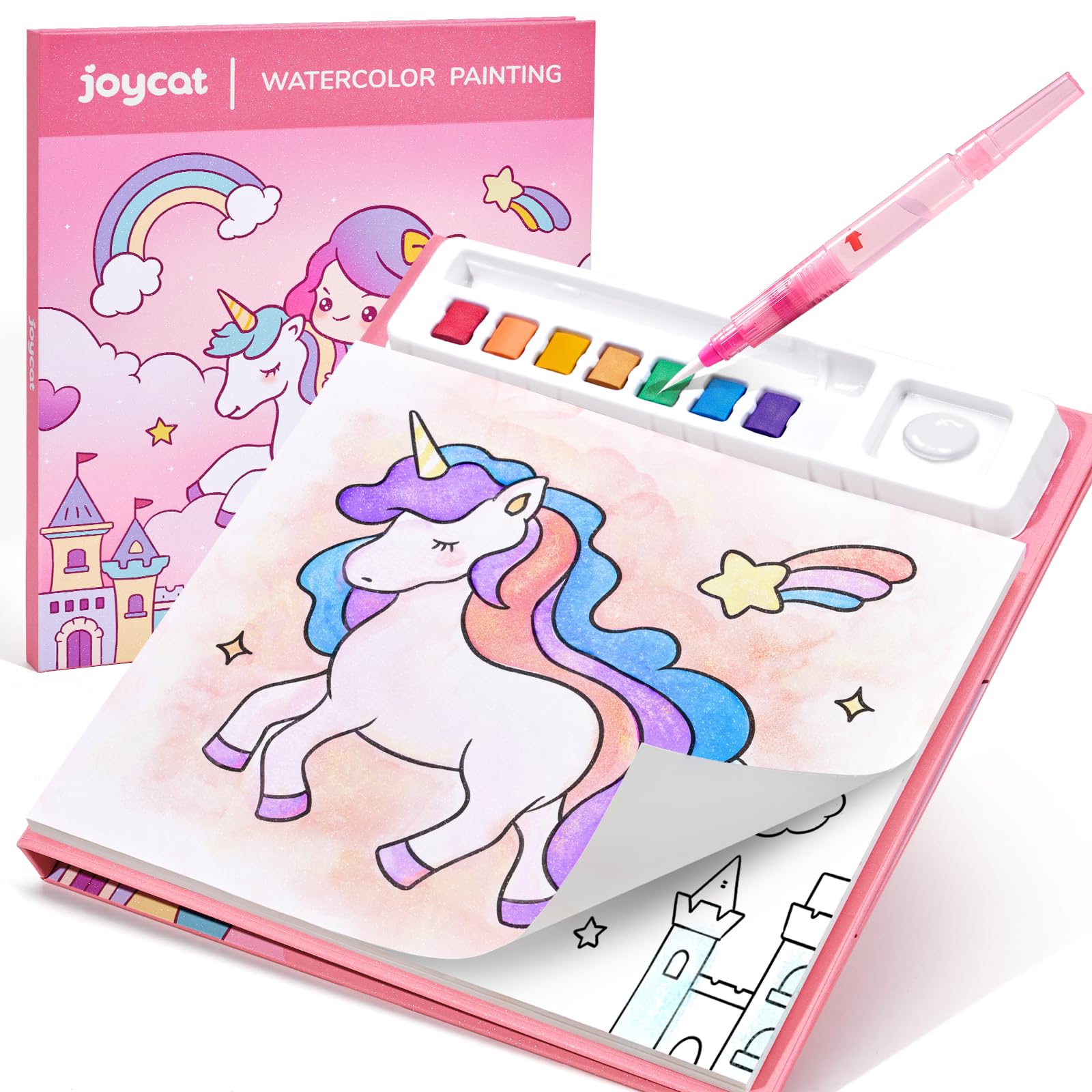
JoyCat Paint with Water Book
Key Features
- Pages: 20
- Extras: Tear-out cut lines
- Format: Paint with water
- Included: Brush and paint
- Price: Midrange
A tray table, a restaurant table, and a lap are all bad places for a cup of water, which is the entire argument for a paint-with-water book. JoyCat’s version packs 20 pages, a brush, and the paint itself into one package: the color sits in the sheet, so a child brushes water across it and the picture comes up. No cup, no palette, no puddle to mop.
What stands out in use is how much of the mess has been engineered out. The paper is thick enough that color does not bleed through to the sheet underneath, the paint dries quickly, and a stray mark wipes off a table without drama. Each page has a cut line, so finished work tears out cleanly instead of leaving a ragged edge.
Twenty pages is the honest limit, and it is worth planning around. This is not the book you hand a kid for a rainy afternoon at home; it is the one that lives in the bag for the flight, the waiting room, and the long lunch. Treated as a disposable treat rather than a permanent addition to the shelf, it makes complete sense.
Pros
- No cup, palette, or cleanup
- Thick paper resists bleed-through
- Cut lines make pages easy to tear out
- Dries fast and wipes up easily
Cons
- Only 20 pages of painting
This is our pick for restaurants, planes, and anywhere a water cup would be a mistake: the paint is in the page and the mess stays there.
Best for Gifts
ZICOTO 3-Book Set
Key Features
- Books: 3
- Pages: 44 per book
- Extras: Perforated pages
- Trim size: 7.09 x 8.46 inches
- Price: Midrange
Where Crayola gives you one enormous book, this set gives you three small ones: princess, unicorn, and mermaid, each about 44 pages and each 7.09 by 8.46 inches. That is a deliberate trade. Smaller pages, but a child gets to pick a theme each time, and three books split neatly between siblings or between home and the car.
The paper is the surprise. The sheets are printed on both sides, which usually means marker sinks straight through onto the next picture, and here it does not. Pages are perforated so finished ones can come out for the fridge, and difficulty shifts from page to page, which means a four-year-old and a seven-year-old can work out of the same book without one of them giving up.
As a present, this is the set we reach for when we do not know the child well. Three themes cover most current obsessions, the books read as a gift rather than a bargain pad, and nothing about them feels flimsy in the hand. If a kid is used to a full-size coloring book, though, expect them to notice the smaller page.
Pros
- Three themes in one set
- Heavy paper that resists marker bleed
- Perforated pages for display
- Mixed difficulty across pages
Cons
- Smaller pages than a standard coloring book
- Perforations can tear raggedly
When you need a gift and do not know the child’s current obsession, this set is our pick: three themes, sturdy paper, and a size that suits a backpack.
Best for Party Favors
BenLouis Mini Coloring Books

Key Features
- Books: 24
- Pages: 6 per book
- Trim size: 6.7 x 4.7 inches
- Price: Midrange
Nobody buys this pack for the family coffee table. It is 24 mini books in 12 designs, six pages apiece, at 6.7 by 4.7 inches, and it exists for the goodie bag, the classroom party, and the wedding reception table where a kid needs something to do for ten minutes.
Judged as a party purchase rather than a shelf purchase, it holds up. There are 72 little pictures across the set, the animals and simple scenes are cute without being babyish, and the variety means a class of kids does not end up with two dozen identical books. The books are stapled and light, and they come through a backpack or a purse without shedding pages.
Two practical notes. The art is printed on both sides of each sheet, so keep these to crayons and colored pencils rather than markers, which will strike through to the next picture. And count the stack before you fill the bags, since 24 is right for a classroom and more than a small birthday party needs.
Pros
- 24 books in 12 different designs
- Right size for goodie bags and purses
- Holds together in a bag
Cons
- Six pages per book, one sitting each
- Small pages limit detail
Buy this pack for party favors and classroom handouts: twenty-four small books, twelve designs, sized to fit a goodie bag and survive a purse.
Best for Superhero Fans
Spider-Man Coloring Book Set

Key Features
- Books: 2
- Pages: About 80 each
- Trim size: 8 x 10.75 inches
- Price: Budget
Part of this bundle is not coloring. The two books carry about 80 pages each, and a good share of those are mazes, puzzles, and games rather than pictures to fill in, which is worth knowing before you buy it for a child who only wants to color.
For the right fan, that mix is a feature. The action scenes are what a six-year-old wants from Spider-Man: figures in motion, buildings to fill in, a villain to work on. The books run 8 by 10.75 inches, a regular size rather than a jumbo one, which is exactly right for smaller hands and for a backpack.
Two caveats worth knowing. Styles vary, so you do not choose which two books arrive, and the paper is uncoated with pages that read slightly off-white rather than bright white. Crayons and colored pencils are the safe tools here, and they take color well on that stock.
Where it earns its place is the fan who will not sit still for generic art. Two books, action on nearly every spread, and puzzle pages for the moments when coloring loses its grip: that is a better bet for a Spider-Man devotee than a thicker book they never open.
Pros
- Two books in one bundle
- Action scenes Spider-Man fans want
- Puzzle pages for variety
- Standard trim that fits a backpack
Cons
- You do not choose which two designs arrive
For the Spider-Man fan who will not sit still for generic art, this two-book bundle is our pick, as long as you want puzzles mixed in with the coloring.
How We Tested the Best Coloring Books for Kids
We started with the books that keep surfacing in the best-selling and highest-rated listings for kids roughly 3 to 8: big page-count compendiums with stickers, licensed character titles, water-reveal sets, and the small bulk packs sold for party favors. We filtered out anything with a vague page count or no listed age range, then bought 16 of them and spent three months handing them to kids we know.
Testing looked like real life. Books went into backpacks and diaper bags, sat on kitchen tables after school, and came out during restaurant waits and a six-hour drive. Each one got the same treatment: crayon on one page, washable marker on another. We colored a solid block of dark color, then flipped the page to see how much had bled through and whether the picture on the reverse was ruined. We also looked at the printing itself — crisp outlines, art that doesn’t look muddy or recycled, and pages that are more than filler.
For the water-reveal sets, we counted how many pages a kid could paint before the pen ran dry and whether the pages dried back to blank for a second round. The mini bulk packs got checked against a favor bag and a backpack bottom, since that’s where they end up. The fat compendiums we tested for sprawl: whether the spine lies flat on a table and whether a 4-year-old can hold one steady without an adult. We timed engagement in minutes — who wandered off after five, and who asked for the same book the next day.
Value came last and got the most argument. We divided the price by the pages a kid could actually use, not the number printed on the cover, because the difference between those two numbers is where most of these books lose their money.
How to Choose a Coloring Book for Kids
The word giant on a coloring book cover almost always describes the page count rather than the page size, and getting that straight before you order saves a lot of disappointment.
Match the line weight to the hand holding the crayon
A two-year-old needs big shapes, few of them, and heavy black outlines. A six-year-old wants background, detail, and figures in motion. The ABC Coloring Book is built for the first case, with one large picture and one large letter on each page, while the ZICOTO set shifts difficulty page by page and suits a house where a four-year-old and a seven-year-old color side by side.
Buying too advanced is the more common mistake. A book full of fine lines reads as failure to a small child rather than as a challenge, and it tends to get abandoned half-colored.
Page count, page size, and what giant really means
Crayola’s 288-page books measure 7.75 by 10.75 inches, which is an ordinary trim that happens to be unusually thick. You are buying volume, not poster-sized art, which makes them home-and-car books; at around 14 ounces, one in a backpack is noticeable.
The other end is a mini like the BenLouis pack at 6.7 by 4.7 inches, sized for a purse and good for roughly one sitting. Decide where the book will live before you decide how big it should be.
Paper weight decides what you can color with
Crayons work on anything. Markers need heavier stock, and art printed on both sides of a sheet means one that soaks through takes the next picture with it. If your kid is a marker kid, either buy books that hold up, like the PAW Patrol pages and the ZICOTO set, or slip a sheet of scrap paper underneath.
For paint, skip paper coloring books entirely and buy a paint-with-water title, where the color is printed into the page and there is no cup to knock over.
Licensed characters or open-ended art
A favorite show is the strongest motivator there is, and a Bluey or PAW Patrol book will get colored in when a generic animal book sits untouched. The trade is shelf life, since licenses expire with the phase.
Our approach is one of each: an unlicensed book like the Epic Book of Awesome that survives a changing obsession, plus one character book bought in the middle of the craze rather than ahead of it.
Extras, sets, and what you are really paying for
Stickers, perforation, and puzzle pages all dilute the page count you thought you were buying. Perforation earns its place if finished work goes on the fridge or gets split between siblings, and sticker sheets are useful currency on a long drive.
Activity pages are the one extra to be careful with: a maze is not a picture to color. With sets, check the page count per book rather than the total, because three slim books can carry less art than one thick one.
Frequently Asked Questions
What is the difference between a coloring book and an activity book?
An activity book mixes mazes, puzzles, dot-to-dots, and games in with the coloring pages, so the same page count buys less actual art to color. The Spider-Man bundle here is a coloring-and-activity set, which is good value if your kid enjoys puzzles and frustrating if all they want is pictures.
Before comparing two books on price, look at how much of each is pure coloring rather than a game.
Are the pages perforated so they can be torn out?
It varies by book. The PAW Patrol pages and the ZICOTO set are made to tear out, and JoyCat’s painting sheets have a cut line. Where perforation is not mentioned, assume a standard bound spine and plan on cutting finished pages free with scissors.
If you intend to hang pages up or split one book between two kids, check for perforation before you order.
How many coloring books should I buy at once?
Two is plenty: one thick book that stays home and one small book that lives in the bag. A 288-page volume keeps most kids going for months, and a second large book tends to sit untouched until the first is finished.
If you have two children close in age, buy two different books rather than two copies of the same one.
Final Verdict
The Crayola Epic Book of Awesome is the one we point most families to first: 288 pages of varied animal art, two sticker sheets, and no licensed character that a child can outgrow. It is the safest single purchase in a category where taste changes fast.
If your colorer is two or three and still learning to hold a crayon, the ABC Coloring Book does more good. If the house is currently all Bluey all the time, buy Bluey. Everyone else can wait until the phase announces itself.
