This post contains affiliate links. We may earn a small commission when you buy through our links — at no extra cost to you.
The day my daughter figured out how to crawl, our living room became a list of hazards. What I wanted was ten minutes — to answer the door, fold laundry, drink coffee while it was still hot — without wondering what she’d found under the couch. That’s the real job of a baby play fence: not a cage, just a defined patch of floor where a baby can pull up, tip over, and try again.
A fence only works if it stays where you put it. One that skids across hardwood or bows when a toddler leans on the rail is worse than nothing, because you stop trusting it and go back to hovering. We’ve spent the past seven months setting up, shaking, folding, and living with 12 play yards — six-panel enclosures, mesh-sided yards with zippered doors, models that come with their own mat — and the gate is what you’ll touch fifty times a day, so a sticky latch or a zipper that catches on fabric wears you down faster than any wobble. The picks below are the ones that held up to all of it.

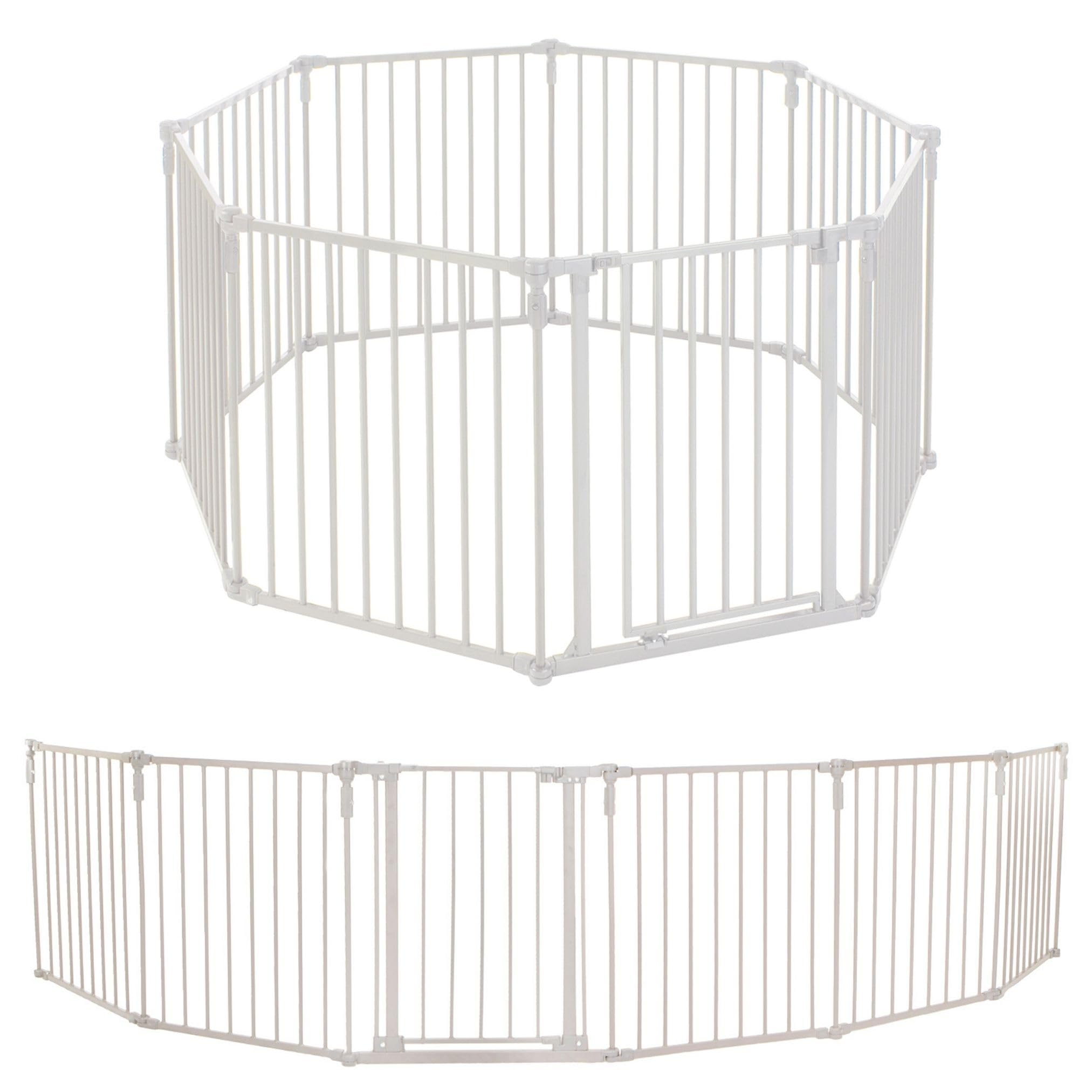



Best for Everyday Indoor Use
Evenflo Versatile Play Space
Key Features
- Weight: 16.9 lb
- Age Range: 6 to 24 months
- Floor Area: 18.5 sq ft
- Folded Size: 17.25 inches (w) x 3.75 inches (l) x 13.875 inches (h)
- Price: Midrange
Six hinged plastic panels that collapse like a fan — that one design decision is why this is the play fence we point most families toward. Opened into a hexagon it gives you just over 18 square feet of floor, which is enough for a crawler, a basket of toys, and an adult sitting cross-legged in the corner. When the visit is over, it folds into a shape you can stand behind a door.
Setup asks nothing of you but unfolding. The panels arrive joined, the hinges hold where you put them, and you can pull the same six pieces into a rectangle against a wall or a smaller square when the room needs to be a room again. Nothing to drill, no brackets to lose. At 16.9 pounds it’s light enough that one adult moves it from living room to kitchen without thinking about it.
Light cuts both ways. On a hard floor a determined shove can slide the panels out of square, especially when the pen is set in one long straight run; close it into a shape with angled corners and it holds itself much better, and a rug underneath settles it further.
Set against the metal Superyard, you trade some rigidity for a pen you can carry with one hand. For a baby from about six months to first steps, that’s the trade worth making.
Pros
- Folds flat enough to store in a closet
- Just over 18 square feet of floor
- No tools, brackets, or drilling
- Light enough for one adult to move
Cons
- Ships without a floor mat or padding
For most families this is the play fence to buy: over 18 square feet, no tools, and a fold-flat shape that disappears into a closet between visits.
Best for Climbers and Shovers
Toddleroo 3-in-1 Metal Superyard
Key Features
- Height: 30 in
- Panels: 8
- Weight: 40.8 lb
- Floor Area: 18.5 sq ft
- Price: Premium
Eight metal panels, 30 inches tall, and 40.8 pounds of play yard. The weight is the first thing you notice and the reason the thing doesn’t budge — a 2-year-old can hang off this fence with his feet off the floor and it stays where you put it.
That rigidity is worth paying for once your child is old enough to test the walls, which is somewhere around 18 months, and it’s why we rank this above every plastic pen here for that stage. The gate latch clicks when it locks, opens with one adult hand, and swings shut behind you, and the skid-resistant pads keep the ring from walking across hardwood.
It also does three jobs. Freestanding, it’s a hexagonal pen; mounted in a doorway, it’s a gate; and with the included hardware kit it becomes a barrier that runs up to 199 inches across a wide opening or around a fireplace. In taupe metal it reads more like furniture than a baby product, which matters when it’s parked in the middle of the room for a year.
What it won’t do is travel. Eight metal panels don’t collapse into a bundle the way plastic ones do, so this is a pen you assemble, place, and leave for the season.
Pros
- Thirty inches tall; resists leaning and climbing
- Self-closing gate latch opens one-handed
- Converts to a 199-inch wall-mounted barrier
- Skid-resistant feet protect hard floors
Cons
- Priciest pick in this group
- Wall-mount kit requires drilling
The pick for a toddler who leans, climbs, and rattles the rails: 30 inches of metal that stays exactly where you set it.
Best for Crawlers and Sitters
Mloong Playpen with Mat
Key Features
- Floor Mat: Included
- Dimensions: 59.06 x 59.06 x 26.77 in
- Floor Area: 24.2 sq ft
- Shell Material: Waterproof Oxford
- Price: Midrange
Most play fences sell you four walls and leave you to solve the floor. This one arrives with a mat, and the sides are waterproof Oxford cloth over a steel frame, so a spit-up or a ground-in cracker is a wipe rather than a load of laundry.
The mesh runs the full way around, which means you can see the entire floor of the pen from the kitchen door and a baby can see you back. Suction cups underneath hold the base down on hardwood and tile, and the corner joints were reworked to stop the splitting that soft-sided pens usually develop at the seams.
For the crawl-to-cruise stretch, roughly six to fourteen months, this is the pen we reach for first. The mat solves the floor at the same time as the walls, the cloth is genuinely wipeable with a damp cloth and dish soap, and the whole thing is light enough to reposition when the couch needs to come back.
Height is what to weigh. At 26.77 inches the walls are a comfortable step-over for an adult and a hurdle a tall 2-year-old will eventually clear, so think of this as a baby pen rather than a fence for a preschooler.
Pros
- Mat included, so the floor is solved
- Waterproof cloth wipes clean
- Mesh on all sides for full visibility
- Suction cups hold it on hard floors
Cons
- Not foldable; storage means taking it apart
If a mat in the box and wipe-clean sides would spare you two purchases, this is the pen we point to for the crawling months.
Best for Travel and Parks
Regalo My Play Portable Play Yard
Key Features
- Sides: Mesh
- Width: 48 in
- Height: 27 in
- Age Range: 6 to 24 months
- Price: Budget
Mesh on all four sides changes the pen from the inside: a baby can see the room, you can see the baby, and neither of you is looking through plastic slots.
This is the play yard that leaves the house. The frame folds in one motion, it’s light enough to carry with a diaper bag in the other hand, and setup is a matter of pulling the sides up until they lock. We like it most at a grandparent’s house or on a blanket at the park, where a 48-inch square is exactly the territory a crawler wants.
The floor is a washable nylon sheet stretched over the folding frame with no padding of its own, and the bars that let it collapse sit just beneath that sheet. Grass and carpet make the padding question disappear; on a hard floor, put a rug or a play mat underneath before you set a baby down to crawl.
At 48 inches square it’s one of the smaller enclosures here — right for one baby and a basket of toys, tight once they’re walking and want to circle.
Pros
- Folds flat and travels easily
- Washable nylon floor wipes clean
- Mesh sides for airflow and sightlines
- Sets up in seconds without tools
Cons
- Mesh and frame joints can tear or snap
The one to throw in the trunk: mesh sides, a washable floor, and a fold-flat frame that sets up anywhere you can find a patch of shade.
Best for Small Rooms
Toddleroo Superyard Duo 6-Panel
Key Features
- Height: 26 in
- Panels: 6
- Floor Area: 18.5 sq ft
- Weight Limit: 40 lb
- Price: Budget
Compared with the metal Superyard, this is the same idea done in plastic for a fraction of the money: six panels, 18.5 square feet, and the same clicking hinges that only bend one direction. That lock-only-one-way design is the reason we keep it on the list for a small room on a tight budget — you can hear when a joint is locked, so there’s no guessing at the end of the run.
It’s also the cheaper of the two pens here that ship with a wall-mount kit. Run it across a doorway or around a wood stove and it becomes a barrier instead of a ring; the panels are UV-resistant for outdoor use, the grip feet hold without scratching, and it’s made in the United States.
There’s no gate in the run. Getting in means stepping over a 26-inch wall or lifting a panel out — nothing for most adults, a genuine annoyance for anyone with a bad knee, and worth deciding before you buy, because you’ll do it twenty times a day.
The plastic at the connectors is where these pens eventually crack, and a split connector is more than cosmetic when a child is leaning on it. Run a hand around the joints whenever you reshape the pen, and retire a panel that’s giving.
Pros
- Six panels plus a wall-mount kit
- Hinges click audibly when locked
- UV-resistant panels for outdoor use
- Grip feet hold without scratching floors
Cons
- Stiff joints make reshaping fiddly
A six-panel play yard with the wall-mount kit included — the cheapest way into a Superyard, as long as you don’t need a gate.
Best for Busy Toddlers
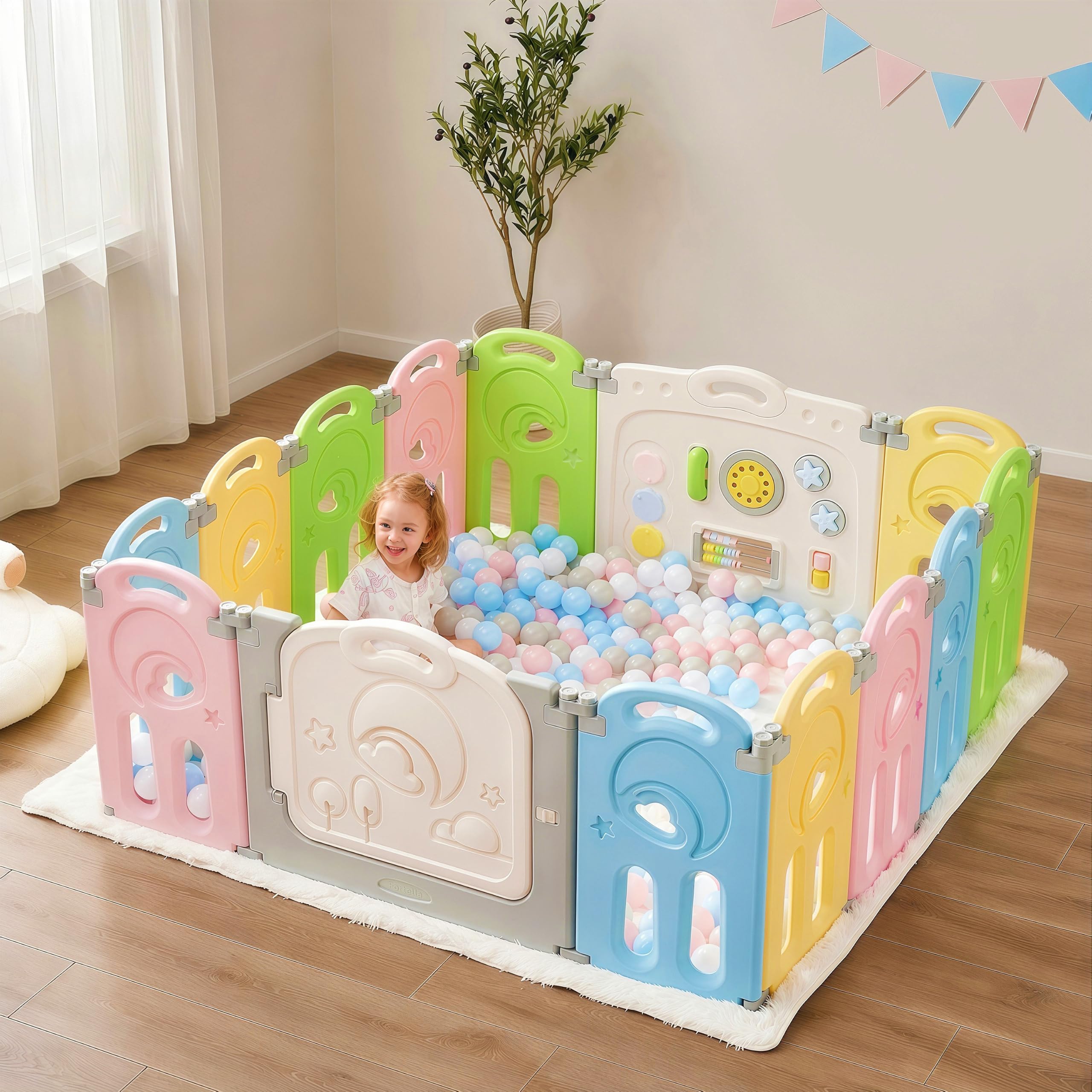
Fortella Cloud Castle 14-Panel
Key Features
- Height: 24.4 in
- Panels: 14
- Age Range: 6 months to 3 years
- Floor Area: 25 sq ft
- Price: Premium
One panel of this pen is a door, and the back of that door is a whiteboard. Next to it sits an activity wall with five sensory toys, which is the whole reason to pick this over the plain 14-panel pens it otherwise resembles.
The rest is solidly thought out: 14 panels covering about 25 square feet, with removable sections so you can shrink the enclosure to fit a smaller room. It comes out of the box assembled — unfold, arrange, tighten the hinges with the included tool, done — and the safety-lock door gives you a proper entry point instead of a step-over.
For a toddler of about one to three who’s past the sitting-and-crawling stage and needs something to do, we think the activity wall earns its keep; it’s the difference between a cage and a corner of the room they want to be in. The hinges are the maintenance item, since they work loose as the pen gets shoved and leaned on — keep that little tightener clipped to a panel rather than buried in a drawer, and give the corners a twist every few weeks.
Pros
- Whiteboard door and five sensory toys
- About 25 square feet of floor
- Unfolds assembled, no tools to build
- Removable panels resize the enclosure
Cons
- 24.4-inch walls are low for a climber
- Thirty pounds to move between rooms
The pick for a toddler who needs a reason to be in the pen: a whiteboard door, five sensory toys, and 25 square feet to use them in.
Best for First Playpen
Hiaksedt 50×50 Mesh Playpen
Key Features
- Frame: Alloy steel, ABS joints
- Height: 27 in
- Weight: 8.4 lb
- Floor Size: 50 x 50 in
- Price: Budget
This is the least expensive full-size enclosure here, and it’s a 50-inch square of mesh on an alloy steel frame — no tools, no drilling, and about 27 inches of wall between your baby and the rest of the room.
All four sides are mesh, so the playpen reads as a window rather than a box, and there’s a zippered door a crawling baby can learn to use on their own instead of being lifted in and out. It’s light enough to move from the living room to the kitchen, and it comes apart into tubes and panels when you want it out of the way.
Fifty inches is a real amount of floor for the money — enough for a sitter with a pile of toys and for an adult to lean against one wall — and the fabric wipes clean after a snack. Four suction cups hold the base down instead of letting it skate across tile.
The joints are the weak point. The plastic connectors on the tube frame can crack if the pen is dragged or leaned on hard, and once one goes the frame loses its shape; that’s the difference between this and a pen you hand down to a second child. For the first year, though, it does the job at a price that makes a second one for upstairs feel reasonable.
Pros
- Least expensive full-size pen here
- Mesh on all four sides
- Zippered door for crawl-in access
- Sets up without tools
Cons
- No padding under the fabric floor
- Suited to sitters and crawlers, not climbers
A lot of enclosed floor for the least money here — the pen we suggest for the crawling months, as long as you don’t expect it to survive a climber.
Best for Pet-Free Floor Time
ZEEBABA 47×47 Playpen with Mat

Key Features
- Height: 26 in
- Weight: 9.3 lb
- Floor Mat: Included
- Floor Size: 47 x 47 in
- Price: Budget
At 47 inches across this is the smallest square here, which is the point: it tucks into a corner of a living room that a 59-inch pen would swallow whole, and it still leaves a baby room to roll, sit, and reach for toys.
A mat comes with it, cut to fit, so the floor is handled on arrival. The door unzips, which lets a crawler come and go instead of being lifted in and out all day, and the mesh sides keep the dog’s nose off the play mat — worth something in a house where both live in the same room.
Set against the Mloong, you give up about a foot on each side and the heavier Oxford cloth; what you keep is the mat, the zippered entry, and a footprint that fits a small apartment.
For one baby and not much spare floor, the trade works out: you get the mat, the door, and the sightlines without surrendering the whole room.
Pros
- Mat included in the box
- 47-inch footprint fits small rooms
- Zippered door a crawler can use
- Mesh sides keep pets off the mat
Cons
- Thin mat over hardwood floors
- Zipper is the first part to fail
For a small apartment with limited floor, the mat and the zippered door make this an easy yes — the footprint is the feature.
How We Tested Baby Play Fences
We started by reading through hundreds of customer reviews and pulling every play yard that kept coming up, then narrowed by price, panel count, footprint shape, and whether the enclosure included a gate, a floor mat, or wall-mount hardware. Twelve units got bought and brought home. Testing ran seven months, from the first wobbly crawl through pulling up, cruising, and a lot of leaning on rails.
Assembly came first. I timed each setup solo, once with the instructions face down and once with them right side up, and noted whether panels clicked together cleanly or needed two hands and a knee. Then I checked whether the footprint actually fit the room it was headed for — a six-panel hexagon in a narrow corner, a rectangular fence along a wall — and whether the floor mat lay flat or curled at the edges. Each one stayed up in a living room for weeks, so I also got a long look at how it read next to actual furniture.
Sturdiness got tested the way babies test it: I leaned on the top rail with roughly the weight of a 25-pound toddler, shook every panel joint, and watched what happened over weeks of daily use. I noted hinge pins that worked loose, feet that scuffed hardwood or slid on carpet, and mesh that bagged out after being grabbed. Several went out on a patio for a few afternoons and came back in for a wipe-down.
The gate and door hardware took the hardest workout. I opened and closed each one one-handed with a baby on my hip, fifty reps at a time, paying attention to latches that wanted a second hand and zippers that snagged the fabric at the corners. Then I folded each one, carried it to another room, and weighed value by what came in the box versus what I’d have to buy separately.
How to Choose a Baby Play Fence
The right play fence is the one matched to the child you actually have — a sitter needs floor space and a wipeable surface, a 2-year-old needs a wall that does not move when they lean on it.
Measure the Floor You’re Willing to Give Up
Panel count is a poor guide to size. Six plastic panels on the Evenflo cover the same 18.5 square feet as eight metal panels on the Toddleroo Superyard, and a 14-panel Fortella tops out around 25. What you’re shopping for is the assembled footprint, so start with the floor: a 47- or 50-inch square still leaves a walkway in a small living room, while a 59-inch pen takes the room over.
Then add room for yourself. For the first six months you’ll be sitting inside that fence more than the baby is, so an enclosure you can’t fold your legs into is the wrong one no matter how it scores on paper.
Height Decides the Age, Weight Decides the Peace of Mind
The panels here run from 24.4 to 30 inches. Under about 26 inches, a tall 2-year-old can hook a leg over the top edge; a 30-inch metal wall is what holds up to a child who leans, climbs, and rattles the rails. Weight tracks the same story — 40.8 pounds of Superyard doesn’t walk across a hardwood floor the way a 17-pound plastic ring can.
Our advice: if your baby is still sitting and crawling, buy light and save the money. Once they’re walking and testing boundaries, the heavier pen is the one that lets you leave the room.
Gate, Zipper, or Step-Over
You’ll open this thing twenty times a day, so entry is not a detail. A walk-through gate with a self-closing latch earns its price if you’re carrying laundry or a bottle through; a zippered door lets a crawler get in and out under their own steam; a 26-inch wall you step over is fine at 30 and miserable at 70.
Check before you buy, too. One six-panel Superyard has no door in the run at all, and you only discover how much that matters after the first week of lifting a panel out with one hand while holding a baby.
Plastic Panels, Mesh, or Metal
Plastic panels wipe clean, go outdoors, and take a bump without tearing — the easiest material to live with if the pen stays in one room. Mesh packs flat, lets air through, and lets a baby see the whole room, but it puts the floor close to the ground and the fabric is the part that gives out first. Metal is heavy, stable, and looks like furniture rather than a baby product.
Match the material to the job rather than the price. A pen that travels should be mesh; a pen that stays up for a year should be panel or metal.
The Things That Aren’t in the Box
Most of these ship without a floor covering, and a mat is what makes tummy time on hardwood work — only two picks here solve it for you. Budget for one either way.
Plan for upkeep as well. Hinges on folding plastic pens work loose and need retightening with a small tool that is easy to lose, so keep it clipped to a panel. And run a hand around the connectors whenever you reshape the pen: cracked plastic at a joint is the way cheap pens fail, and it fails while a child is leaning on it.
Frequently Asked Questions
Do I need to anchor a play fence to the wall?
No. Every pen here stands on its own, and the wall-mount kits that come with the two Superyards are optional — they’re for turning the panels into a long barrier across a wide opening or around a fireplace. If you use one, it means drilling into a stud, so pick the spot before you start.
For a freestanding pen, a closed shape with angled corners and grip feet on the floor do the anchoring.
Can a baby play fence go outside?
Yes, with a caveat apiece. Plastic panels handle grass and pavement, and the Superyard Duo’s panels are UV-resistant so they keep their color. Mesh pens like the Regalo My Play work fine for a picnic, but the fabric sits straight on the ground, so bring a blanket for underneath.
Bring any of them back inside afterward — sun and damp are harder on hinges, fabric, and joints than a living room is.
How do you clean a play fence?
Plastic panels take warm soapy water and a rag, plus a vacuum in the corners where crumbs collect. Mesh and Oxford cloth want a damp cloth and mild soap — the Mloong’s sides are meant to be wiped, not scrubbed — and should air-dry fully before you fold them.
If the pen has a removable fabric floor, like the Regalo My Play, that panel comes out and washes separately.
Final Verdict
For most families, the Evenflo Versatile Play Space is the play fence to buy: just over 18 square feet, no tools to lose, and a fold-flat shape that gets it out of the room when guests arrive. If your toddler leans, climbs, and rattles the rails, step up to the 30-inch Toddleroo metal Superyard, which does not move.
And if you want the floor solved in the same purchase, the Mloong brings the mat and wipe-clean sides — that’s the difference between setting a crawler down and hunting for a rug first.
