This post contains affiliate links. We may earn a small commission when you buy through our links — at no extra cost to you.
The first night away from home is where the fantasy falls apart. You’ve packed the sound machine, the lovey, the exact sippy cup — and then you’re standing in a rental at 9 p.m. realizing the promised crib is a thin pack ‘n play pad and your toddler is one good roll from the floor. A toddler travel bed fixes that: something low to the ground, contained on all sides, and light enough that you’ll actually bring it instead of leaving it in the trunk.
We’ve spent six months with 12 of them — inflatables with safety bumpers, folding cots, soft fold-out floor beds, and full travel cribs — and the differences come down to things the listing photos can’t show. Fast inflation is nice; staying inflated until morning is the point. Format matters more than features: an inflatable eases a kid out of a crib, a cot suits a 3-year-old who just needs somewhere familiar to flop, and a travel crib is for the child who still needs walls.
The picks below cover all three, and I’ll flag which ones held up to my testers and where each one is actually worth the money.



Best for Most Families
Hiccapop Inflatable Travel Bed
Key Features
- Weight: 8 lb
- Sleep surface: 62"L x 39"W x 11"Th
- Weight capacity: 310 lb
- Safety enclosure: 4-sided bumpers
- Price: Midrange
The four-sided bumper is the first thing we noticed, and it is the reason this bed works for a toddler who rolls. The vinyl walls rise high enough to feel like a boundary without turning the bed into a cage, and the 62-by-39-inch sleep area gives a 2- or 3-year-old room to stretch out. We inflated it on a hotel-room floor and liked that a standard crib sheet tucked around the mattress instead of sliding off.
At 8 pounds, the Hiccapop is light enough to carry in one hand with the travel bag, and the electric pump gets it up quickly. The 310-pound capacity means the bed is not the thing your child outgrows first. Our caveat is air retention: seams and valves can leak over time, so inflate it at home before a trip and check the seams and valve. For most families, that is a manageable trade-off for a bed that feels secure from the first night.
Pros
- Four-sided bumpers help contain rollers
- Fits standard crib sheets
- Packs to 8 pounds with travel bag
- 310-pound capacity leaves room to grow
Cons
- Wide 39-inch footprint needs floor space
- Electric pump is US-only
For most families, this is the toddler travel bed we recommend first: four-sided bumpers, standard crib-sheet sizing, and an 8-pound pack that fits in the trunk.
Best for Quick Sleepovers
Regalo My Cot
Key Features
- Setup: No assembly; fold-and-go
- Weight: 6.3 lb
- Dimensions: 48 x 24.5 x 9 inches
- Weight capacity: 75 lb
- Price: Budget
At a fraction of the price of the inflatable beds here, the Regalo My Cot is the one we grab for a quick sleepover at Grandma’s. It unfolds in seconds—no pump, no valve, no deflation dance—and the 6.3-pound frame folds flat enough to store behind a sofa. The 48-by-24.5-inch canvas sleep area is low to the ground, which makes it easier for a toddler to climb in and less scary if they roll out.
The trade-off is the sleep surface. The canvas is taut over a metal frame, so it feels more like a camp cot than an air mattress; a fitted crib sheet helps, but a child who needs plush cushioning will notice the firmness. The frame is rated to 75 pounds, and we like that there is nothing to inflate or lose.
For the money, it is the easiest travel bed here to hand to a grandparent or toss in a trunk. It is not the bed for a child who needs a soft, enveloping surface, but it is the one we reach for when setup speed matters more than cushioning.
Pros
- No assembly or pump required
- 6.3-pound frame folds flat
- 75-pound capacity
- Low profile makes rolling out less scary
Cons
- Canvas and corner posts can wear with heavy use
The Regalo is our budget pick for quick sleepovers: it sets up in seconds, folds flat, and handles 75 pounds, though the canvas sleep surface is firm.
Best for Firm Floor Sleep
Liftoza Sandwich Travel Bed
Key Features
- Fill: High-density foam
- Cover: Machine washable
- Dimensions: 48 x 22 x 6.5 inches
- Certification: CPC-certified
- Price: Midrange
The liftoza is the pick for a toddler who hates the bouncy, air-filled feel of an inflatable. It is a slab of high-density foam with raised edges, a washable cover, and no valve to leak. We unrolled it and gave it the full two days to expand; after that, the foam felt firm enough to support a toddler without swallowing them. The CPC certification is a meaningful detail for a product that spends the night at floor level.
The integrated rails are the quiet advantage. They are part of the foam, so there is no bumper to inflate or reattach, and the cover zips off for the washing machine. At 48 by 22 inches, we see it as best for ages 1 to 3; a tall 4-year-old will look cramped. It also does not pack as small as an inflatable, so it is more of a car-trip bed than a fly-and-fold one. For a familiar floor bed at Grandma’s, that trade-off makes sense.
We like the liftoza most as a bridge between a crib and a real bed. It gives a toddler a defined sleep space without the height or the bounce of an air mattress. The catch is the first-use wait and the size; if you need a bed for a 4-year-old or a child who moves a lot, the Hiccapop is the more flexible choice.
Pros
- Firm high-density foam surface
- Integrated raised edges contain rolls
- Machine-washable cover
- CPC-certified
Cons
- Cover is not waterproof
For a toddler who needs a firm, familiar floor bed, the liftoza is our foam pick: no inflation, raised edges, and a washable cover, provided your child fits its 48-inch length.
Best for Longer Stays
Graco Travel Dome LX
Key Features
- Modes: Bassinet, changer, playard
- Weight: 37 lb
- Dimensions: 41.5 x 27.75 x 29.25 inches
- Weight capacity: 50 lb
- Price: Premium
The Travel Dome LX is the playard we choose when the trip includes a baby and a toddler. It combines a raised bassinet, a full-size infant bassinet, a diaper changer, and a toddler playard on one frame. We set it up as a bedside bassinet and liked that the changing pad sits at waist height, so late-night changes happen without a separate station.
The 50-pound toddler playard limit gives it a longer runway than most inflatables, and the full-size bassinet is easy to see into from across a room. The frame feels solid once it clicks together, and the carry bag makes it manageable for a car trip. The changing table is the one part we watch: it can tilt toward the play area, so we keep a hand on the baby during changes instead of trusting it hands-free.
It wants a dedicated corner and a trunk with room to spare. But for a grandparent’s house or a long road trip with two children, the combination of bassinet, changer, and toddler bed earns its space.
Pros
- Five modes cover baby and toddler
- Changing pad sits at waist height
- 50-pound toddler playard limit
- Folds with carry bag
Cons
- 37-pound frame is heavy for air travel
- Wide footprint needs a dedicated corner
The Travel Dome LX is our pick for longer stays with a baby and a toddler: bassinet, changer, and 50-pound playard in one, with the caveat that 37 pounds is a car-trip commitment.
Best for Older Toddlers
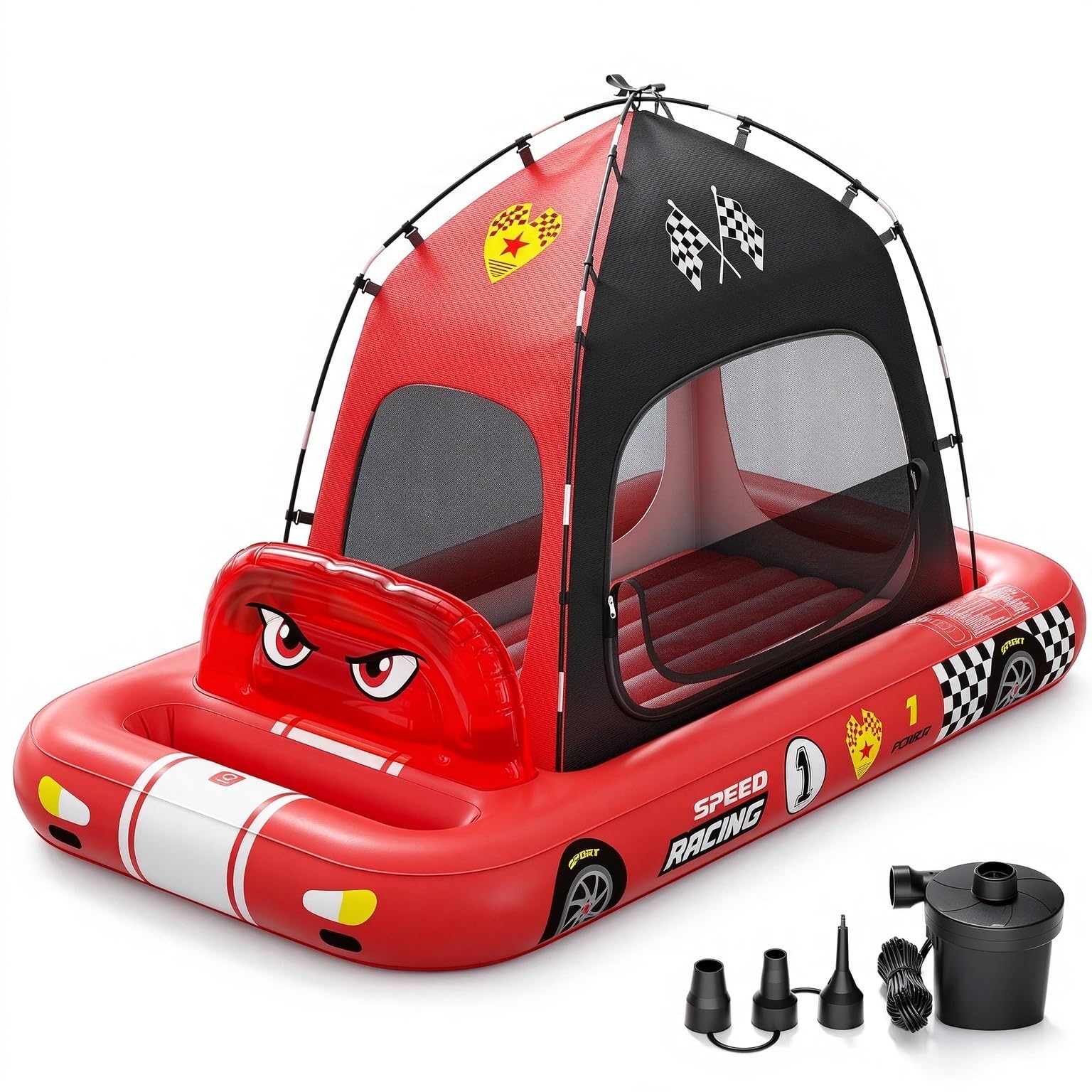
QPAU Tent Travel Bed
Key Features
- Ages: 3 years and up
- Weight: 9.3 lb
- Included: Tent and electric pump
- Dimensions: 78 × 43 in
- Price: Budget
The QPAU looks less like a travel bed and more like a small base camp, which is exactly why older toddlers take to it. The inflatable mattress has raised edges, and the detachable tent clips onto poles above the bed. We set it up in a living room and the tent changed the bedtime negotiation: it gave the bed a purpose beyond sleep. The race-car shape and red color make it feel like a toy, not a piece of travel gear.
The electric pump fills the mattress quickly, and the tent attaches without tools. The play area is roomy enough for a child to sit up with a book or a few stuffed animals. The raised edges define the space, but they are not as high or as padded as the four-sided bumpers on the Hiccapop. This is a bed for a preschooler who wants a fort, not for a 2-year-old who needs a deep containment wall.
The open play area reflects that this is for a preschooler, not a younger toddler. A child who still rolls toward the edge or treats the tent as a climbing frame is not ready for this bed. For a child who can follow a bedtime routine, the tent is a genuine incentive to climb in.
As a second bed for a child who is excited by the tent, the QPAU is a lot of fun. It is not the default travel bed we hand to every family, but it is the one we bring out when novelty is the difference between a bedtime battle and a child who climbs in on their own.
Pros
- Detachable tent makes bedtime fun
- Roomy play area
- Fast electric pump included
- Raised edges define the play zone
Cons
- Large 78-inch footprint
- Ages 3 and up limits younger toddlers
The QPAU is our fun pick for older toddlers: a roomy inflatable with a detachable tent that makes bedtime feel like play, as long as you have the floor space.
Best for All-In-One Kit
Sleepah Inflatable Travel Bed
Key Features
- Weight: 9 lb
- Dimensions: 61"L x 40"W x 12"Th
- Weight capacity: 300 lb
- Safety enclosure: 3 safety bumpers
- Price: Midrange
The Sleepah arrives as a complete kit—bed, pump, pillow, patching kit, and carry case—which makes it the easiest inflatable to hand to a grandparent. The 61-by-40-inch bed has three safety bumpers, a removable inner mattress, and a 300-pound capacity. It fits standard crib sheets, and the whole set packs into one bag, so there is less to forget.
We like the three-sided bumper for a child who is learning to stay in bed; it gives a clear edge. The pump is quick, and the included pillow is a nice touch for a sleepover. The trade-off is durability: seams and valves are the weak points on this type of bed, so we inflate it at home before a trip and keep the patch kit in the bag.
For a family that wants one bag with everything, the Sleepah is a practical choice. It is not as sturdy-feeling as our top pick, and the seams need more watching, but it costs less and still gives a toddler a familiar bumper bed. We see it as a close alternative for occasional trips, not the one we choose for a two-week road trip.
Pros
- Complete kit includes pump and patch kit
- Fits standard crib sheets
- 300-pound capacity
- Three safety bumpers
Cons
- Three-sided bumper leaves one side lower
The Sleepah is our all-in-one inflatable pick: pump, pillow, patch kit, and carry case in one bag, with three-sided bumpers and a 300-pound limit for bigger toddlers.
Best for Air Travel
Guava Lotus Travel Crib

Key Features
- Weight: 11 lb
- Dimensions: 45.5 x 31.5 x 25.5 inches
- Carry format: Backpack carry case
- Weight capacity: 15 lb
- Price: Premium
The zippered side door is what makes the Guava Lotus our air-travel specialist. You can unzip the side, sit on the edge, and soothe a child without lifting them over a rail, then zip it closed for sleep. At 11 pounds, the Lotus carries like a backpack, and the 3D Z-fold collapses into a package that fits in an overhead bin on many domestic flights.
We carried it on our back through an airport and appreciated the side door when laying a sleeping baby down. The aluminum frame feels light but stable, and the mattress is firm and flat. The stated 15-pound weight limit is the catch: if your toddler is over it, choose a playard with a higher limit, like the Graco Travel Dome LX. For a baby or a small toddler under that limit, the Lotus is a genuinely easier travel crib than a full-size playard.
Pros
- Folds into a backpack for flights
- Zippered side door for soothing
- 11-pound aluminum frame
- Certified low-VOC materials
Cons
- Stated 15-pound weight limit
The Guava Lotus is our air-travel specialist for a baby or small toddler: 11 pounds, a backpack carry, and a zippered side door, but the 15-pound stated limit rules out many toddlers.
Best for Budget Playard
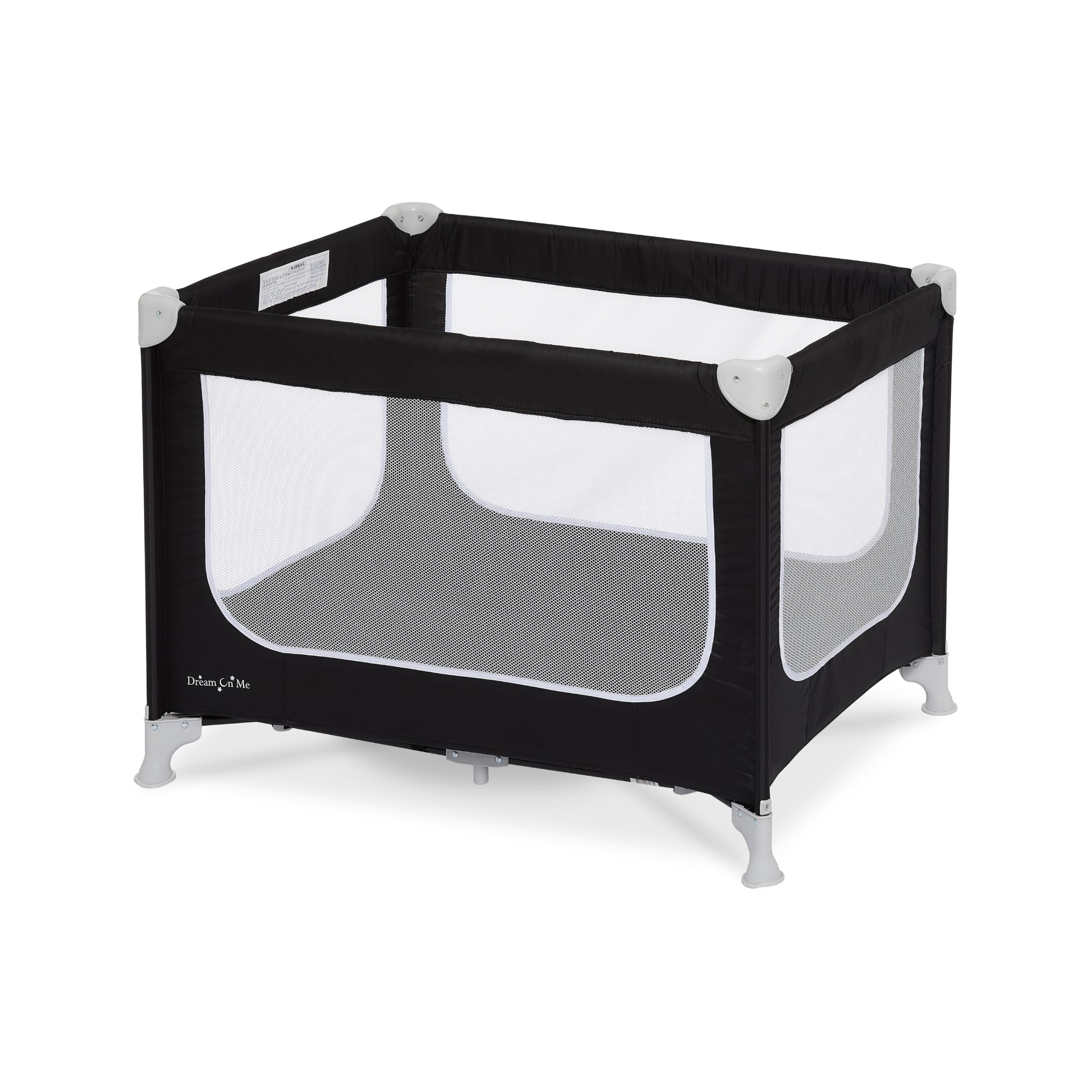
Dream On Me Zodiak Playard
Key Features
- Weight: 16.6 lb
- Dimensions: 40 x 28.5 x 29 inches
- Folded size: 7 x 7 x 25.4 inches
- Weight capacity: 30 lb
- Price: Budget
The Zodiak is the playard we point to when the budget is tight and the bed will live at Grandma’s house, not in an airport. It sets up with a quick-fold frame, has mesh sides for airflow, and includes a removable mattress pad and carry bag. At 16.6 pounds, it is light enough to move from room to room, and the 40-inch footprint fits where a full-size playard does not.
We set it up in a small guest room and liked that the mesh panels let us see the baby from the doorway. The pad is removable and wipes clean, which helps for spit-up and spills.
The trade-off is durability. The mesh and locking parts are the areas to watch if the playard gets heavy use, and the frame can feel less solid than a Graco. We treat the Zodiak as an occasional-use playard for visits and travel, not the one we set up every day.
For the money, it is a sensible second playard for a grandparent or a small apartment. It gives a baby a contained place to sleep and play without the bulk of a full-size unit, and the low weight makes it easy to move. Just go in expecting a budget build.
Pros
- Compact 40-inch footprint
- Mesh sides for visibility
- Quick fold with carry bag
- 16.6 pounds
Cons
- 30-pound weight limit
- Thin mattress pad
The Zodiak is our budget playard for occasional visits: 16.6 pounds, a compact 40-inch footprint, and mesh sides, with a 30-pound limit and a thin pad to accept.
How We Tested Toddler Travel Beds
We started with a list of about 40 travel beds and cut it down by price, packed size, listed weight limits, and whether replacement valves, pumps, and washable covers were available. Twelve made the cut, spanning inflatables, folding cots, soft floor beds, and travel cribs, and we lived with each one for six months.
Testing happened where these beds actually live: two weeks of naps in a toddler’s own room, a weekend at grandma’s, a hotel with wall-to-wall carpet, a cabin with hardwood floors, and one camping trip on uneven ground. We timed inflation with a stopwatch and counted pump strokes, then left each inflatable overnight and pressed the mattress at 6 a.m. to see whether it had gone soft. Fold-out models got set up one-handed while holding a mug, because that is the actual departure scenario.
We weighed every bed packed in its bag and compared it against a carry-on, then repacked it with a 30-pound toddler clinging to our leg. Overnight monitor checks told us whether bumpers and rails really kept a kid in, and we watched whether the base slid across hardwood when a child climbed aboard. After a week of jumping, we went back over the seams, valves, and zippers, and we machine-washed every removable cover.
At the end we set each bed’s price against what it actually felt like to live with, since a cheap inflatable that deflates by Tuesday is nobody’s bargain.
How to Choose a Toddler Travel Bed
The right toddler travel bed is the one your child will actually sleep in after a long day, not the one with the longest feature list.
Start With the Sleep Format
Inflatable bumper beds are the most packable option, and the Hiccapop shows why: four walls, a standard crib-sheet surface, and an 8-pound package. Folding cots like the Regalo skip the pump entirely and set up in seconds, but the canvas surface is firm. Foam floor beds such as the liftoza trade packability for a familiar, non-bouncy surface. Playards, including the Graco Travel Dome LX, are the choice when you need containment, a bassinet, or a changing station.
We choose the format before the brand. If you are flying, an inflatable or a travel crib earns its space; if you are driving to Grandma’s, a folding cot or foam bed is simpler. If the bed will double as a play space or a changing station, a playard is worth the bulk.
Match Packed Size and Weight to the Trip
A bed that is compact in the sleep position can still be a beast in the bag. Check the folded dimensions and the product weight, not just the mattress size. The Regalo is 6.3 pounds and folds flat; the Hiccapop is 8 pounds; the Graco Travel Dome LX is 37 pounds. Those numbers describe three different trips.
For air travel, put the packed bed on your bathroom scale and compare it with your airline’s carry-on limit before you leave. For car travel, a heavier playard is less of a problem if it stays set up at your destination. We treat the carry bag as part of the product: a bag that is hard to repack makes a light bed feel heavy.
Look at the Enclosure and the Sleep Surface
A bumper or raised edge gives a toddler a clear boundary, but height and firmness matter more than the label. Four-sided bumpers contain a roller better than a three-sided design; a playard’s mesh walls contain more than either. Press down on the sleep surface with your hand. An air bed should feel firm when fully inflated, a foam bed should feel dense, and a folding cot will feel taut over its frame.
Use a tight-fitting crib sheet on inflatable and cot-style beds; a loose sheet can bunch up. For a child who rolls hard, choose the higher bumper or the playard side rather than adding a pillow or extra padding. We prefer to size up the enclosure rather than soften the surface.
Plan for Setup, Air Loss, and Cleaning
Every inflatable can lose a little air at a seam or valve, so inflate a new bed at home and leave it overnight before a trip. If it stays firm, pack the pump and a repair patch. If it softens, you have found the problem before you are away from home. Foam beds need 24 to 48 hours to expand after unboxing, so start that clock early.
Cleaning is part of the purchase. Vinyl and flocked surfaces wipe down; foam covers usually zip off for the washing machine; playard fabrics spot-clean. We look for a removable cover or a wipeable surface because a travel bed will meet juice, crackers, and hotel-room floors. A bed that is hard to clean gets used less.
Frequently Asked Questions
Can a toddler travel bed replace a crib at home?
For most families, no. A travel bed is designed for short stays, and the inflatable and folding models here have age, weight, and setup limits that make them a poor full-time crib substitute. Use one for trips, sleepovers, and transitions, and keep a firm, flat crib or bed at home. If your child is climbing out of a crib, choose a bed that meets their height and weight limits rather than stretching a travel bed.
How do I get a toddler to sleep in a travel bed?
Practice at home before the trip. Inflate or unfold the bed in the afternoon, let your child help set it up, and put it in the same room where you will sleep. Bring the familiar crib sheet and lovey, keep the bedtime routine the same, and give the first night extra time. A bed that feels like a known part of the trip is easier than one that appears at bedtime.
Are inflatable toddler travel beds safe for babies under one?
No. Inflatable bumper beds are toddler beds, not newborn sleep surfaces. For a baby under one, use a bassinet or playard labeled for infant sleep, with a firm, flat mattress and no added padding or loose bedding. Wait until your child meets the bed’s stated age and weight limits before switching to an inflatable.
Final Verdict
After testing, the Hiccapop is the toddler travel bed we recommend first for most families. Its four-sided bumpers, standard crib-sheet fit, and 8-pound pack solve the three things that matter on a trip: containment, a familiar bed, and easy carrying. For a firm floor bed, choose the liftoza; for a bassinet-and-changer setup at a longer stay, choose the Graco Travel Dome LX. The Regalo stays our quick, budget-friendly cot for sleepovers.
