This post contains affiliate links. We may earn a small commission when you buy through our links — at no extra cost to you.
The corner of my sister’s coffee table sat at exactly eyebrow height for a baby who had just learned to pull up, and it took one wobble before we were taping a dish towel to it. Edge guards aren’t really about the furniture. They buy a few seconds of grace while a toddler works out gravity, and the wrong one peels loose in a week, leaves a gummy stripe on a walnut finish, or looks so institutional that you start apologizing for your living room. The right one holds firm, covers a whole edge rather than a token corner, and disappears into the room.
We’ve spent four months living with 14 of them, pressed onto coffee tables, a fireplace hearth, and a kitchen island while a determined cruiser tested our handiwork. What separated the good from the bad wasn’t foam thickness, which is what the packaging shouts about; it was the tape, and whether it still held on week six. The picks below are the ones I’d put on my own furniture.
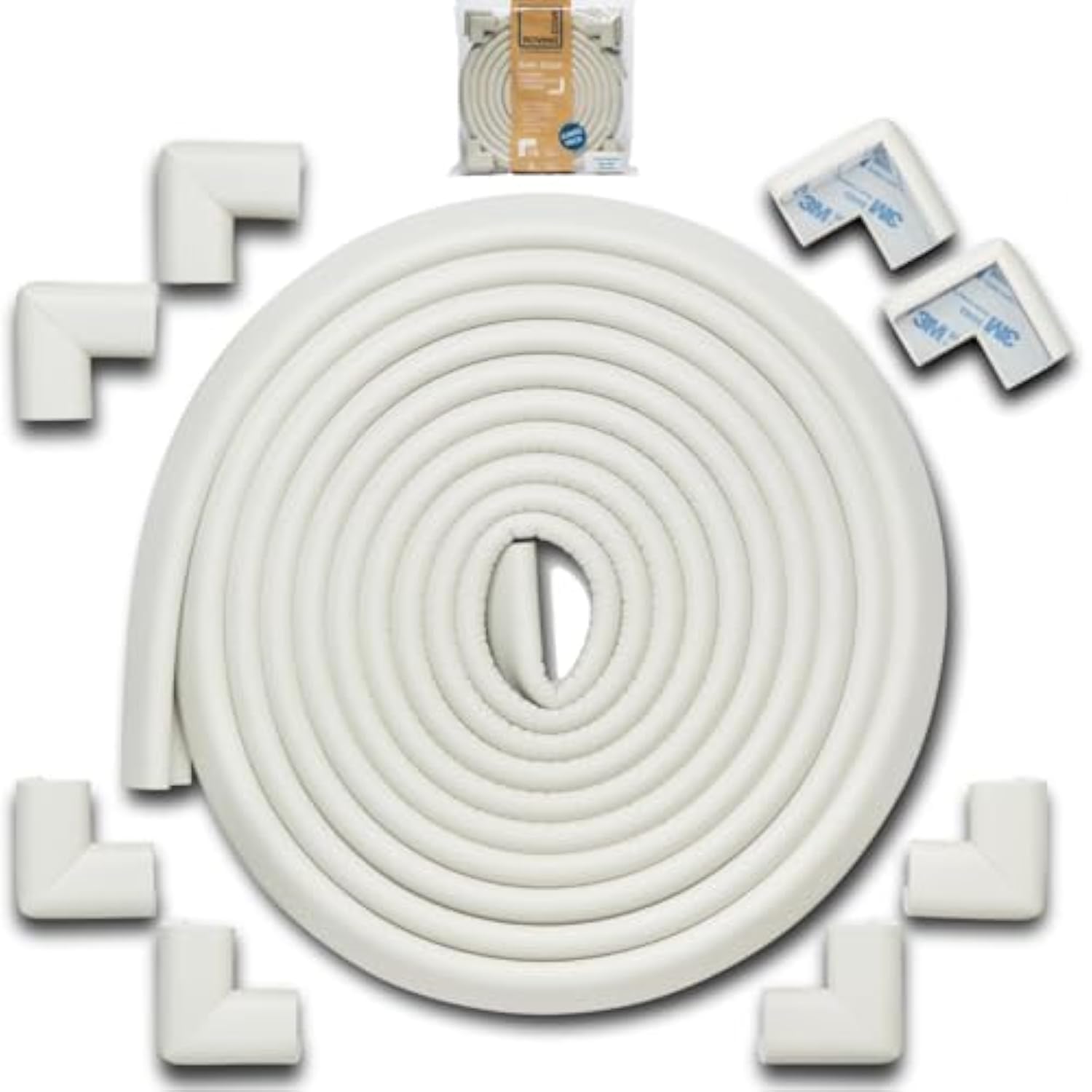


Best for Fireplaces and Tables
Roving Cove Edge & Corner Set
Key Features
- Foam: 0.4 in thick, 20-N density
- Color: Oyster white
- Adhesive: 3M tape, 36 ft included
- Coverage: 18 ft edge + 8 corners
- Price: Premium
Thirty-six feet of double-sided tape for eighteen feet of foam looks like a shipping error, and it is the first thing that made us take this set seriously. Tape is where edge guards fail: an end curls, a corner lifts, the strip you cut a little short lets go. The surplus here lets you run the last few inches of every stretch twice and press a second layer under anything that curves. We think that spare tape is worth more than the extra fraction of an inch of foam the cheaper set offers.
The foam is 0.4 inch thick at a stated 20-N density, dense enough that a head bounces rather than sinks and soft enough that a shin does not bruise. Eighteen feet plus eight pre-taped corners is a genuine room’s worth: a coffee table, a TV stand, and most of a hearth, with pieces left over. A round table 69 inches across takes the whole roll on its own, since that perimeter alone is roughly 18 feet, so measure before you assume it covers everything.
Oyster white is an off-white, which is why it sits quietly on pale wood, cream trim, and white skirting, and why it looks faintly beige on walnut. Two practical notes: the long strips arrive untaped and the corners do not, so budget an evening of peeling and pressing, and clean the surface properly first. This is the set we put on the table the baby actually uses, and the one we have gone back to when a strip needed replacing.
Pros
- 36 feet of 3M tape to double up the ends
- Thick 0.4-inch, 20-N foam
- 18 feet of edge plus eight corners
- Off-white that blends with pale furniture
Cons
- The most expensive set of the four here
- Oyster white reads beige on dark wood
Our pick for most homes: thick 20-N foam, 18 feet of edge, eight corners, and the spare 3M tape that keeps the ends stuck.
Best for Budget Room Coverage
BESTORE Edge & Corner Set
Key Features
- Foam: 0.42 in thick, 22-N density
- Color: Brown
- Adhesive: 3M, pre-applied
- Coverage: 18.1 ft edge + 8 corners
- Price: Budget
The most annoying half hour of any edge-guard job is the taping, and this set skips it: the 3M adhesive is already on the foam, so the install is peel, press, move on, and the eight L-shaped corners come ready to stick too. Where our top pick hands you a roll and expects an evening, this one is finished before the baby wakes up from a nap.
The foam underneath is the thickest and densest of the four on paper, 0.42 inch at a stated 22-N density, and it is the least expensive full-size set here with the same 18.1 feet of strip and eight corners. We think that makes it the better buy of the two big sets if the color suits your room. The cushioning is at least as good, and what you give up is spare tape rather than protection.
Color is the catch. The brown lands much closer to plum than to walnut, and the pale option is not quite white either, so do not order this one to match a finish you care about. Put it on a dark table, a dark shelf, or a corner nobody photographs and the mismatch stops mattering. Check the ends after the first week regardless, since that is where any of these lifts first.
Pros
- Adhesive applied at the factory
- Thickest, densest foam listed here
- Full 18.1 feet and eight corners at the lowest price of the big sets
Cons
- Brown reads plum, and the pale option is not white
If you want the taping done before the box arrives and the thickest foam here, this pre-taped set covers a full room for less than the rest.
Best for Dark Wood Furniture
Komfortology Edge Guard Set
Key Features
- Color: Black
- Adhesive: 3M furniture-safe tape
- Coverage: 18 ft edge + 8 corners
- Material: Rubber foam
- Price: Midrange
Dark furniture is where most of these sets look wrong, since an off-white bumper on an espresso coffee table reads as a bandage. Black foam fixes that in one move. It sits there as a shadow line, and after a day you stop seeing it at all. In a dark living room that is the entire case for this set, and it is a good one.
Otherwise the package is the familiar one: 18 feet of strip, eight L-shaped corners, and a roll of 3M furniture-safe tape you fit yourself. We found the foam dense rather than spongy, which is what you want at a table edge, because spongy foam bottoms out and passes the knock straight through. It cuts cleanly with scissors, so a fireplace surround and an odd drawer front are easy to do in one sitting.
The catch is the money. It sits at roughly what our top pick costs, without the generous tape roll that set includes, so you are paying for the color rather than for more material. On oak, walnut, or black furniture that is a fair trade. On a pale pine table it is simply the wrong set, and the oyster white of the Roving Cove will look far better.
Pros
- Black foam disappears against dark wood
- 18 feet of strip plus eight corners
- Dense foam that does not bottom out
Cons
- Priced with the premium sets, without the extra tape
Choose this one for dark wood: black foam vanishes against espresso and walnut, and the 18-foot pack matches the bigger sets piece for piece.
Best for Glass and Marble
Angloria Silicone Edge Guard
Key Features
- Color: Clear
- Profile: 0.12 in thick, 0.6 in wide
- Coverage: 3 ft strip
- Material: 100% silicone
- Price: Budget
Three feet is the entire roll: one long table edge, a counter lip, or the front of a desk. That is the trade, and it is the first thing to get straight before ordering. Once you have measured a coffee table’s perimeter, the arithmetic tells you whether you want one strip or a foam set.
What it does, it does well. At 0.12 inch thick and 0.6 inch wide, the silicone takes the sharpness off a glass tabletop, a marble counter, or a pale wood desk without announcing itself, and it flexes around a curve in a way thick foam cannot. The adhesive is pre-applied, so a counter lip takes a couple of minutes rather than an evening.
We like it best in a room that is already finished: the standing desk, the glass dining table, the console a toddler cruises past. What it is not is a substitute for foam at a hearth. Twelve hundredths of an inch of silicone softens a knuckle-level knock, and what you want under a falling head is 0.4 inch of dense foam.
Two details to plan around. It reads faintly milky rather than truly clear, so do not expect it to vanish on a dark surface. And it comes off cleanest with a minute of hairdryer heat before you peel, which is exactly why it is the pick for furniture you care about: the strip is meant to come away without taking the finish with it.
Pros
- Nearly invisible on glass and stone
- Flexes around curved edges
- Pre-taped, so it fits in minutes
- Comes off cleanly with a little heat
Cons
- Only 3 feet on the roll
- Thin: a knock buffer, not a fall cushion
For glass, marble, and wood you do not want to wrap in foam, this clear silicone strip is the one that belongs on the table.
How We Tested Edge Guards on Real Furniture
We started by pulling every edge guard that ships with tape already applied, the peel-and-stick kind, since the ones that need separate adhesive rarely get installed properly. The shortlist weighted long L-profile strips over corner-only packs because strips cover more edge per box, but we kept both: 14 units in all, from brands we already trusted plus a couple of budget multipacks. Testing ran four months, which is longer than it sounds with a baby using the furniture as a jungle gym.
Installs happened where the furniture lives: a coffee table with a 10-month-old cruiser circling it, a painted kitchen island at shin height, a stone hearth, a metal bed rail, and my mother’s antique side table, where I cared most about what came off later. I timed each solo install with a kitchen timer and noted whether the tape grabbed on first press or slid while I lined up the corner.
Once a week I pushed each strip sideways with a thumb, wiped it with a damp rag the way you’d clean, and bumped it with the vacuum to see if the ends lifted. A knuckle rap told me how much of a knock the foam actually absorbed, and I checked whether the cut ends had opened a gap a fingernail, or a tooth, could catch. Clear strips went against dark wood and white trim so I could judge visibility, and I noted which ones had yellowed by week eight.
At the one-month mark I peeled one guard off each surface, including polyurethane, latex paint, laminate, and stone, and looked for residue and lifted finish. I also measured how much linear edge a pack covered after cutting around two corners, since two boxes that look alike on the shelf can protect very different amounts of table.
How to Choose Edge Guards for a Baby-Proofed Home
The foam is the easy part; what decides whether an edge guard is still there next month is the surface you stick it to and how much tape you were given to do it with.
Adhesion starts with the surface, not the strip
When one of these lets go, it is almost never the foam that failed. It is the adhesive at an end lifting away from glossy paint, waxed wood, dusty skirting, or textured brick, and a guard that lifts at one end soon becomes a handle for a toddler. Wipe the surface with rubbing alcohol, let it dry completely, and press each run down hard for a good thirty seconds before moving to the next piece.
Smooth, sealed surfaces hold; anything powdery, freshly painted, or deeply textured is where these sets come unstuck. If your fireplace surround is rough stone or brick, treat adhesion there as the least reliable part of the job and check it every week or so.
Foam or silicone: match the cushion to the edge
The foam sets here run about 0.4 inch thick; the clear silicone strip is 0.12 inch. That is the real fork in the road. At a fireplace hearth, a glass table edge, or a brick surround, where a head can land, you want the thick foam, because that is what turns a corner into a soft surface. Along a desk, a counter lip, or a drawer front, where the risk is a shin or a hip, thin silicone does the job and stays out of the way.
Density figures such as 20-N and 22-N sit close together across these sets, so thickness and coverage are the more useful things to compare. The difference between the two foam picks is smaller than the difference between either of them and the silicone.
Do the perimeter math before you order
Eighteen feet sounds enormous until you walk the room. A round table 69 inches across uses roughly 18 feet of strip on its own, and a rectangular coffee table plus a TV stand plus a hearth will eat a full set with only a few corners to spare. Measure each edge you plan to cover, count the corners, and buy for the room rather than for the worst table in it.
If you only need one edge, such as a counter lip or the top of a low bookshelf, buy the short strip and skip the jumbo pack. If two tables and a fireplace are in scope, start with the 18-foot sets.
Pre-taped or tape-it-yourself
Factory-applied adhesive saves the tedious part: cutting tape to length, peeling a liner, and keeping the strip straight along a curve. A separate roll gives you more control, and more importantly it gives you spare tape for the ends and the corners, which is where every one of these lifts first.
Our advice is to buy pre-taped if the project would otherwise sit in its box for a month, and take the roll if you are covering a long run and want to double up at the ends. What you should not do is buy a roll and use it sparingly.
Color is part of the decision
Off-white foam disappears against pale wood and painted trim; black foam disappears against espresso and walnut; clear silicone is the only sensible choice on a glass table or a marble counter. Match the guard to the furniture it sits on rather than to the wall behind it.
Two warnings. Clear silicone reads faintly milky up close, and listing colors drift: the brown set here lands closer to plum than to walnut in a lit room. Do not order a color to match a finish you have only seen on a screen.
Frequently Asked Questions
Will edge guards damage the furniture when I take them off?
They can, and the risk is to the finish rather than to the guard. Warm the strip with a hairdryer for a minute, then peel it back slowly and at a low angle instead of pulling straight out; the clear silicone strip here is designed to come away that way with no residue.
Painted and veneered surfaces are the ones that lift, so start with a single corner piece somewhere hidden and give it a day before you commit the whole table.
Can I put edge guards on a crib?
Not inside it. Keep padding on furniture outside the sleep space, such as a dresser, a bedside table, or a bed frame, and leave the crib itself bare with a firm, flat mattress and nothing soft added to the interior. Edge guards cushion a knock; they are not part of a safe sleep setup, and the set here that lists a crib bumper among its uses is one to skip for that job.
Do edge guards actually prevent injuries?
They change what happens when a head meets a table edge, spreading an impact that a sharp corner would concentrate. What they do not do is stop the fall.
So use them where an edge sits at the height of a cruising or toddling child, and pair them with the basics: anchor tall dressers and bookshelves to the wall, keep chairs away from counters, and stay within arm’s reach at the fireplace.
Final Verdict
The Roving Cove set is the one we buy again: 18 feet and eight corners of thick, dense foam, plus enough 3M tape to reinforce the ends that lift on every set in this category. It costs more than the rest, and the spare tape is most of what that buys.
Change one requirement and the answer changes. A glass table or a finished desk calls for the Angloria silicone; a dark living room calls for the black Komfortology; and if you want the taping done for you, the pre-taped BESTORE is the better deal, provided you can live with the brown.
