This post contains affiliate links. We may earn a small commission when you buy through our links — at no extra cost to you.
A window screen is there to keep bugs out, not a toddler in. That thought tends to arrive the first time a child drags a chair over to an open second-floor window. A proper window guard changes the math: it creates a physical barrier or limits how far the sash can travel, so a curious kid can’t push through a gap that was never meant to hold their weight. The best ones also leave an adult able to release the guard or open the window fully in a hurry.
We spent five months testing 12 window guards in real homes, on older double-hung windows and newer sliders where the frame gave us less to work with. I installed most of them myself, sometimes with a toddler helping, and we checked whether the hardware felt solid, whether the screws bit cleanly into the frame, and whether any kit arrived missing pieces. What mattered most was a snug fit and a guard that stayed put when a child leaned on it, not the price on the box.
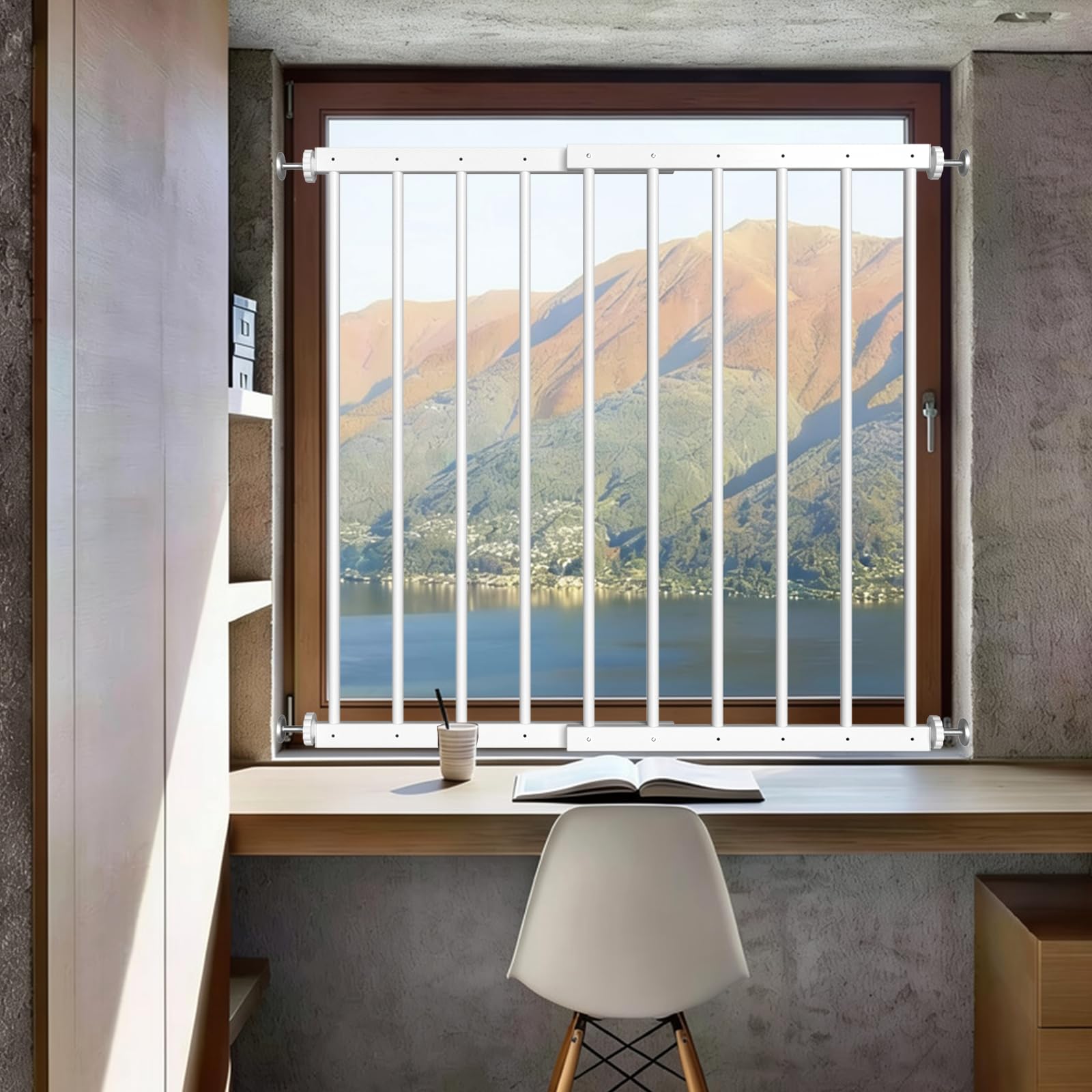

Best for Standard Windows
WAOWAO Window Guard
Key Features
- Panels: 2 pieces
- Mounting: Pressure mount, no drilling
- Bar spacing: 2.68 in
- Fits window width: 19.49 to 33.60 in
- Price: Midrange
The WAOWAO guard is the one we reach for when a parent wants a bedroom window protected without drilling. It is a two-piece pressure-mounted barrier sized for 19.49- to 33.60-inch windows, with threaded silicone bolts that tighten against the frame. The 2.68-inch bar gap is among the narrowest in this group, and the white plastic panels keep the whole thing visually quiet against typical trim.
What sells us is the combination of a no-drill install and a narrow gap. A pressure mount is the practical choice for renters, and it also makes the guard removable for cleaning the glass or taking it down when the grandkids go home. The two panels meet in the middle, so the barrier stays continuous across the opening instead of leaving a gap at the latch. We also appreciate that the adjustment happens at the sides, where you can reach it without leaning over the sill.
The current size is the limitation. If your window is wider than 33.60 inches, this exact guard is not the answer; you need the next size in the line or a different pick. For a standard single window, the WAOWAO gets the balance right: sturdy enough to trust, simple enough to install without a drill, and unobtrusive enough that you do not have to stare at a cage.
Pros
- No-drill pressure mount
- Narrow 2.68-inch bar gap
- Two panels cover standard windows
- Removable for cleaning
Cons
- Pressure fit needs a sound frame
We recommend the WAOWAO for most standard single windows because its no-drill pressure mount and 2.68-inch gap make a bedroom safer without permanent hardware.
Best for Wider Single Windows
SHYUJAJIE Window Guard
Key Features
- Height: 29.92 in
- Mounting: Pressure mount, no drilling
- Bar spacing: 2.68 in
- Fits window width: 35 in
- Price: Budget
The SHYUJAJIE guard covers a slightly wider single opening than our top pick—35 inches—without giving up the no-drill install. It is a pressure-mounted panel with a 2.68-inch gap, and the knobs are the part you notice first: they are easy to grip and tighten by hand, which matters when you are adjusting a guard with a toddler underfoot.
That hand-friendly adjustment is why this one earns a place for a wider single window. The 35-inch span handles openings that leave the WAOWAO short, and the painted steel frame gives it a more substantial feel than the plastic panels of some pressure guards. We also like that it can be mounted horizontally or vertically, so a tall casement or a low sill does not automatically rule it out. The pressure knobs are the difference in daily use: you can snug the guard without hunting for a screwdriver, and you can check the tension without taking the whole thing down.
The trade-off is coverage, not quality. One panel covers one 35-inch opening, so a wall of windows needs more than one guard. We also noted the smooth painted finish, which is easy to wipe and less likely to snag a curtain than raw metal. It is not the guard for a very wide slider—that is a different job—but it fills the gap between a standard pressure panel and a custom-sized barrier.
Pros
- Covers a 35-inch single window
- Hand-tightened pressure knobs
- Painted steel frame
Cons
- Pressure fit needs a secure frame
We prefer the SHYUJAJIE for a single window that is a little wider than standard, where its 35-inch span and hand-tightened knobs make the no-drill install work.
Best for Wide Openings
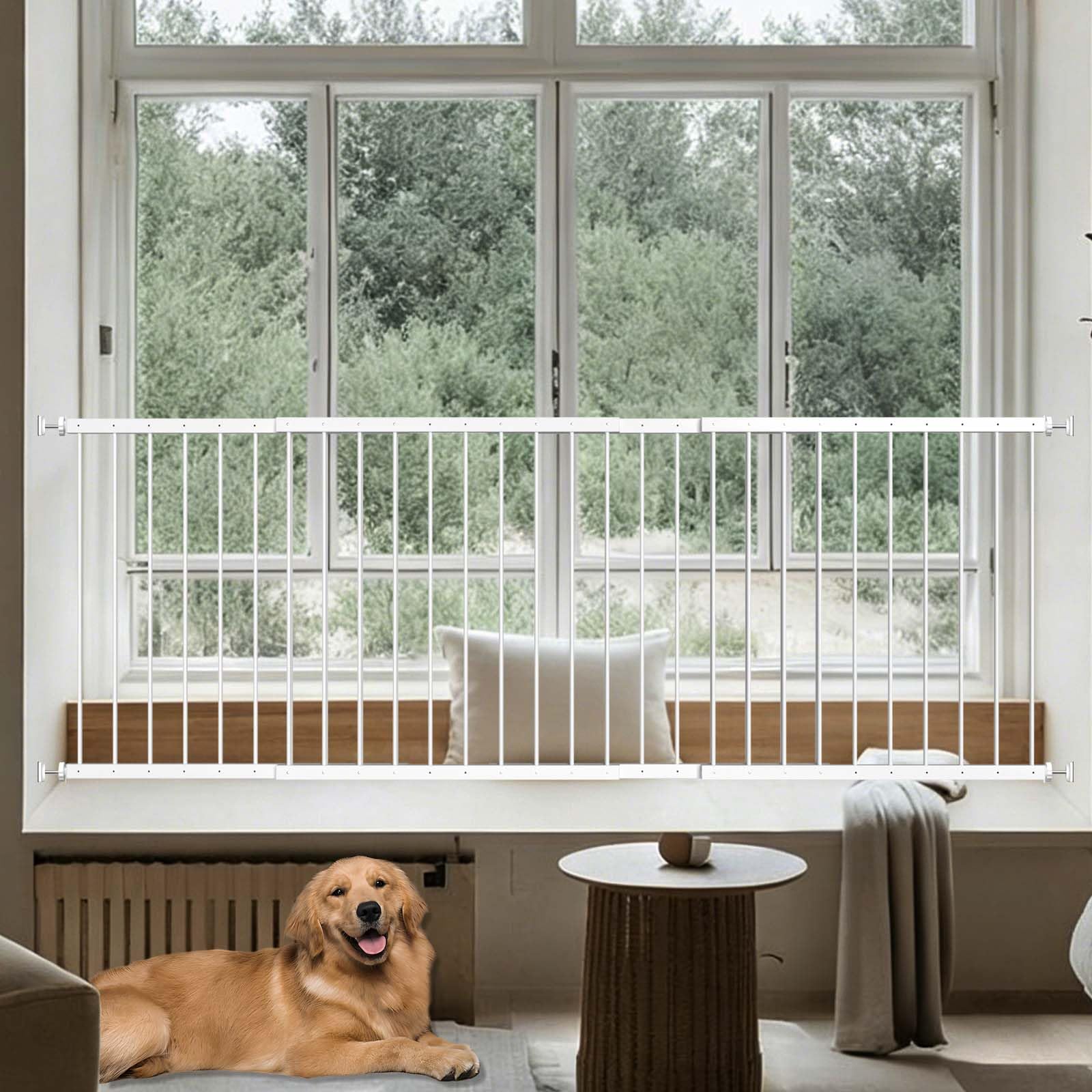
Fairy Baby Window Guard
Key Features
- Panels: 4 panels
- Mounting: Pressure mount, no drilling
- Bar spacing: 2.6 in
- Fits window width: 87.4 to 111.8 in
- Price: Premium
The Fairy Baby guard is for the window that makes every other guard look small. Its four panels span 87.4 to 111.8 inches, the kind of opening you find in a big slider, a loft, or a wall of fixed glass. The bar gap is listed at 2.6 inches, and the pressure mount means you do not have to drill a row of holes across a wide frame. The white finish is neutral enough to disappear against most trim, which matters when the guard covers a whole wall of glass.
The four-panel design is the point. Instead of a single small barrier that leaves half the opening exposed, the panels lock together into a continuous screen, and the pressure mount lets you place it horizontally or vertically. The listing rates the guard to withstand 150 pounds, which is more about the frame and tension than the panels themselves; treat that as a reassuring engineering claim, not an invitation to hang on it. The panels are bulky to store, but they are meant to stay put; this is not a guard you will move from room to room.
What makes it the wide-window pick is the coverage. It is the only guard here that can handle a nine-foot opening without piecing together several smaller units, and the 2.6-inch gap is the tightest in this set. For a wide slider or a loft window, it solves a problem the others do not.
Pros
- Spans 87.4 to 111.8 inches
- 2.6-inch bar gap
- No-drill pressure mount
Cons
- Only useful for very wide openings
- Pressure mount needs a solid frame
We keep the Fairy Baby for very wide sliders and loft windows, where its four panels cover an opening no other guard here can span without piecing units together.
Best for Permanent Installs
Grisham AWG Window Bars

Key Features
- Height: 14 3/4 to 15 3/4 in
- Mounting: Screwed, tamper-proof
- Bar spacing: 2.9 in
- Fits window width: 22 3/4 to 38 1/2 in
- Price: Budget
The Grisham AWG is a fixed three-bar steel guard with 2.9-inch spacing, adjustable from 22 3/4 to 38 1/2 inches wide. It mounts with tamper-proof one-way screws, inside or outside the window, and the tubular steel has a rust-resistant finish. This is the most permanent-looking guard in the group, closer to a security bar than to a pressure gate.
The installation is straightforward if you are comfortable with a drill and a one-way screw. The bars sit close together and the frame adjusts to the window width, so you can fit it to a basement hopper or a living-room sash without ordering a custom unit. The one-way screws are included and are meant to stay put.
What we like is the permanence. This is the guard for a living area, basement, or rental common space where you want a barrier that does not shift when a toddler leans on it. Measure the width and the mounting surface before ordering; the adjustment range is generous, but the guard still needs a flat frame to sit against.
Pros
- Narrow 2.9-inch bar spacing
- Adjustable 22 3/4 to 38 1/2 inch width
- Tubular steel with rust-resistant finish
Cons
- Not for sole-exit bedrooms
- One-way screws make removal hard
We recommend the Grisham AWG as a fixed steel barrier for living areas and basements, not for a sole-exit bedroom where its non-egress design is off limits.
Best for Two-Window Setups
Delmoar Window Guard 2-Pack

Key Features
- Height: 14 in
- Pack count: 2 guards
- Bar spacing: 3.8 in
- Fits window width: 21 to 38 in
- Price: Midrange
The Delmoar package is the one we like when two windows need the same treatment. You get two fixed guards in the box, each adjustable from 21 to 38 inches wide, with a 3.8-inch bar gap and tamper-resistant screws. They mount over the interior casing of vertical windows, and the white finish blends into standard trim. The guards arrive as a pair, so you can treat a double window as one project instead of two.
The two-pack is the appeal, but the installation is what makes it useful. Because these are fixed guards, you are not relying on pressure against a sill; you screw them into the casing and they stay put. We like that for a basement or a pair of living-room windows where you want the barrier to feel permanent. The 3.8-inch spacing is the widest in this group, so it is the one we measure most carefully against a small toddler’s head and shoulders.
The limits are built in. These are for vertical windows, not horizontal sliders, and the non-egress label means they are not for a bedroom or sleeping area without another exit. Within those boundaries, the Delmoar is a sensible way to cover two windows in one purchase.
Pros
- Two guards in one pack
- Adjustable 21 to 38 inch width
- Tamper-resistant screw mount
Cons
- Requires drilling into the casing
We like the Delmoar two-pack for covering two vertical windows with fixed guards, provided neither one is a sole-exit bedroom.
Best for Swing-Open Access
Knape & Vogt 1133 Guard

Key Features
- Mounting: Hardware mount
- Max height: 10 3/8 in
- Weight rating: 150 lb
- Fits window width: 24 to 42 in
- Price: Budget
The Knape & Vogt 1133 is the guard with a hinge, which is either the reason to buy it or the reason to pass. It is a three-bar steel guard for windows 24 to 42 inches wide, with a 10 3/8-inch maximum height and a 150-pound load rating. The three bars are spaced to cover the opening, and the frame can be mounted horizontally or vertically. The swing-open design lets you get to the window for cleaning or an emergency without unscrewing the whole frame.
We like the access, but this is the guard in the group we trust least for a toddler bedroom. The installation is fussier than a pressure mount, and the hinge adds a mechanism to check every time you open the window. The 150-pound rating is reassuring, but it depends on a solid frame and a careful install. We also noted that the swing-open feature is only useful if the latch stays tight; that is the part to check before you trust it with a child.
That makes it a reasonable choice for a secondary window or a basement where you want occasional access and a visual deterrent, not the first guard we recommend for a nursery. If you already own one, check the hinge and latch before you rely on it; if you are buying new, the pressure-mounted picks are easier to live with. For a window that needs to open for cleaning and stays out of a child’s main play area, that trade can make sense.
Pros
- Swing-open access for cleaning
- 150-pound load rating
- Three-bar steel frame
Cons
- Included screws are a weak point
We treat the Knape & Vogt as a secondary barrier for a basement or utility window, not the guard we trust first in a nursery.
How We Tested the Best Window Guards for Toddlers
We started by reading instructions and spec sheets for more than 40 guards, then narrowed the list to 12 that covered the window types people actually have: double-hung, slider, and casement, plus a few no-drill tension models. Price wasn’t a filter on its own, but we noted what came in the box, because a cheap guard that needs a trip to the hardware store is not a good deal.
Each guard lived on a window for five months. I installed them solo, timing how long it took from opening the box to a finished, shaken-tight fit. Before installing, I counted every screw, bracket, and anchor against the parts list and flagged any kit that arrived short. I paid attention to screw quality, too: whether the included screws bit cleanly into wood or stripped halfway in, and whether the anchors held in drywall or window casing without spinning.
Then came the daily-use checks. I opened and closed each window as I normally would, noted whether the guard blocked the sash, and practiced releasing it the way an adult would in a hurry. To judge sturdiness and stability, I pulled and shook each unit from the center and corners, then hung a 25-pound weight from the top bar and looked for flex, sag, or loosened screws. My sister’s 2-year-old provided the real test: he pushed, rattled, and leaned on the ones within reach while I watched for movement. We also weighed each guard, since a heavy bar can be awkward to install overhead and a too-light one can feel flimsy.
How to Choose Window Guards for Toddlers
The right guard has to do two jobs at once: stop a toddler from getting through the opening, and still let an adult reach the window for air, cleaning, or an emergency.
Measure the opening, not the window frame
A guard’s listed range is the opening it spans, not the glass size, so measure the clear width and height between the stops before you shop. The same model can have several sizes, and the current variant is the one that ships. A 28-inch window is common, but a 35-inch opening pushes you into a different panel, while an 87-inch slider is a different category altogether. Write the measurement down and match it to the guard’s stated range, not the photo.
Pressure mount or screwed-in?
Pressure-mounted guards are the rental-friendly choice: no holes, and you can take them down for cleaning or a move. They rely on a square, sound frame and a firm sill, so check for loose trim and crumbling paint before you tighten anything. Screwed-in guards are more permanent and generally feel more rigid, but they leave holes and some are non-egress. We prefer pressure mounts for bedrooms and fixed guards for living areas or basements where a drill is acceptable.
Bar spacing is the safety number
The gap between bars is what keeps a small body from passing through. The guards here range from 2.6 to 3.8 inches, and narrower is the safer default; 3.8 inches is the widest in this set and the one we measure most carefully against a toddler’s head and shoulders. Bar count matters less than the actual clear gap, so check the spec rather than counting bars in a product photo.
Bedrooms need an escape route
A window guard can save a child from a fall and still be the wrong choice if it blocks the only way out. Non-egress guards are explicitly not for bedrooms or sleeping quarters without another exit. Pressure-mounted guards are easier to remove, but that does not make them a fire escape unless an adult can take them down quickly. Check local codes, keep the release path clear, and choose a different window or a different guard if the room has no secondary exit.
Look at the hardware and the finish
The bars get the attention, but the screws, bolts, and hinge decide how pleasant the guard is to live with. One-way screws are secure and slow to remove; pressure knobs are easier to adjust but need checking after a child leans on them. A smooth painted finish wipes clean and is less likely to snag a curtain. If the guard will be in a main room, buy for looks as well as fit; a barrier you resent is one you are less likely to keep correctly adjusted.
Frequently Asked Questions
Do I still need a window lock with a guard?
Yes, if the window’s sash can be raised or slid open. A guard covers the opening; it does not stop the window from being unlocked or worked loose. Use the window’s own latch or a separate opening limiter, and check that the guard does not block access to the lock. The two jobs are different: the guard is the fall barrier, the lock controls the sash.
Can a toddler climb over or around a window guard?
A guard is a barrier, not a climbing frame, and a determined toddler can defeat one if there is furniture to climb on. Keep beds, chairs, and toy bins away from the window, and check that the guard covers the full opening rather than just the lower sash. If the child can reach the top bar, the guard is too low or the room layout needs changing. Recheck the fit as the child grows.
How do I clean the glass with a guard in place?
Pressure-mounted guards are the easier ones to live with: loosen the tension, lift the panel out, clean the glass, and put it back. Fixed guards stay put, so use a microfiber pad or a brush that fits between the bars, and clean the frame before installation so grit does not get trapped. If easy glass access matters, choose a removable pressure mount over a screwed-in guard.
Will a window guard fit a sliding window?
Some do, some do not. The Delmoar fixed guard is for vertical windows only, while the Fairy Baby pressure guard lists sliders among the windows it fits. Measure the opening and confirm the window type in the guard’s own range before ordering; a guard that spans the width but mounts to the wrong frame is still the wrong guard.
Final Verdict
For most families, we recommend the WAOWAO guard first. It fits the standard single window, installs without drilling, and keeps the bar gap at 2.68 inches—three things a bedroom guard has to get right. The fit range is the catch: if your opening is wider than 33.6 inches, step up to the SHYUJAJIE for a 35-inch single window, or to the Fairy Baby if you are covering a very wide slider. Fixed steel has its place in a living area or basement, but for a child’s room we keep coming back to the no-drill pressure mount that an adult can remove.
