This post contains affiliate links. We may earn a small commission when you buy through our links — at no extra cost to you.
The first sign is usually a patch that looks like yellow candle wax on the crown or behind the ears—and every bath-time attempt to pick it off makes you wince. A good cradle cap treatment softens those scales so they lift away without scraping, and it does it gently enough for skin that’s already dry or prone to eczema. We’ve spent four months with 14 treatments, from oils and creams to shampoos, and the differences were not subtle.
The labels all promise gentle, but the details matter: a fragrance that lingers on a baby’s scalp, a formula too thin to stay put, a bottle that lasts three weeks instead of three months. I’ve learned that cradle cap isn’t a hygiene problem—it’s common and usually harmless—so the treatment that works is the one you can use consistently without irritating tender skin. Below are the ones that loosened flakes, kept them gone, and felt worth repurchasing.


Best for First-Line Removal
Frida FlakeFixer 3-Step System
Key Features
- Bristles: Soft bristle brush and fine comb
- Prep step: Oil 30 minutes before bath
- Kit contents: Sponge, brush, comb and stand
- Treatment type: Mechanical, no formula included
- Price: Budget
Cradle cap is scale, and scale comes off in stages: softened, loosened, lifted. The FlakeFixer is built around that order, which is the main reason we put it first. The foam sponge works oil or shampoo into the scalp, the bristle brush loosens flakes in small circles, and the fine comb lifts them out of the hair. None of the three is clever on its own; together they replace the thing most of us try first, which is picking at dry flakes with a fingernail.
The other half of the argument is what the kit leaves out. There is no shampoo, which sounds like a gap and turns out to be the point: you use whatever baby wash is already in the bath, so a newborn’s skin meets one new thing at a time. The instructions suggest massaging a little gentle oil in about half an hour before bath time, and that prep does real work — softened scale slides off the comb, where dry scale just gets pushed around. We ended up fonder of the stand than expected, too, since it keeps three wet tools off the edge of the tub.
Set against the Safety 1st brush and comb, the extra spend buys the sponge and the stand. The sponge is the piece that matters on a baby with sparse hair, because it spreads lather across the whole scalp instead of one stripe and lets you work oil in without scrubbing. If you already own a soft baby brush and a fine comb, you own most of this kit; if you don’t, buying the three together saves a hunt.
Where it stops is a scalp that is red, oozing or badly irritated — that is a pediatrician question rather than a combing one, and the packaging makes the same point. For ordinary yellow scale on an otherwise cheerful baby, this is the least fuss we have found: a couple of minutes at the end of a bath and nothing new to rinse out.
Pros
- Three tools cover lather, loosen and lift
- Works with any shampoo or oil you own
- Stand keeps the wet set together
- Gentle enough for routine baths
Cons
- Sponge can detach from its holder
Our default pick for a flaky newborn scalp: three soft tools and no new formula, so the routine fits the bath you already run.
Best for Stubborn Scale
Ladibugs Cradle Cap Remedy Kit
Key Features
- Free from: Sulfates, parabens, phthalates, gluten
- Kit contents: Serum and comb
- Leave-on time: 10 minutes
- Price: Midrange
Dry hair, ten minutes, then a comb: Ladibugs asks for a different order of operations from the rest of this group, and the difference is the point. You massage the serum into the scalp, let it sit, comb the loosened scales out, and wash afterwards. Softening happens before anything pulls, which is why it works on scale that brushes skate over.
The practical cost is grease. The serum is oil-like, so hair comes out of the session looking wet, and a bath has to follow straight away rather than the next morning. The comb is the part we rate highest: fine teeth that slide instead of drag, which matters on a baby with a decent amount of hair. The scent is a light mint that rinses away with the serum.
Two things make this our pick for stubborn scale rather than the first thing we buy. The serum softens thick yellow patches that a soft brush only polishes, and the ten-minute sit means one patient session instead of a week of hopeful baths. On a light dusting of flakes it is more product and more waiting than the job needs; on crusted scale, it does the most of anything here in a single go.
Pros
- Serum softens crust before the comb touches it
- Comb lifts scale without tugging
- Rinses out with a normal wash
Cons
- Ten-minute wait before you can comb
For thick, crusted scale that has shrugged off brushes and baby wash, this serum-and-comb pair is the next thing we try.
Best for Persistent Flaking
Happy Cappy Medicated Shampoo
Key Features
- Use: Hair and body
- Size: 16 fluid ounces
- Fragrance: Fragrance-free
- Active ingredient: Pyrithione zinc
- Price: Midrange
Happy Cappy is the only medicated formula here. The active is pyrithione zinc, the ingredient that turns up in adult dandruff shampoos, and that is the honest way to think about this one: a dandruff treatment scaled for children rather than a baby wash with a cradle cap claim on the label.
It is formulated for hair and body, fragrance-free, and free of dyes, parabens and phthalates. The pack holds two eight-ounce bottles, which matters because the instructions call for repeated washing rather than a single go. It is thin, lathers modestly, and rinses clean — we never felt we were fighting product out of a hairline.
Two things to know before you commit. This is a step up in strength, and for a newborn with a light dusting of flakes a soft brush and a plain wash are gentler places to start. The flaking can also return once you stop, so it is worth keeping the second bottle for occasional maintenance washes rather than passing it on.
What settles it for us is coverage. Cradle cap that has crept down to the eyebrows or behind the ears is easier to treat with something you can use head to toe than with a targeted oil, and a wash you can put on the whole child gets used more often than one you have to aim. If gentle has already failed and the flakes are winning, this is where we start.
Pros
- Pyrithione zinc targets persistent flaking
- Fragrance-, dye- and paraben-free
- One wash for hair and body
Cons
- Can leave hair dry and rough
- Two bottles is more than a short course needs
When flakes keep coming back past the newborn months, this medicated wash is the strongest formula here, and the two-bottle pack lets you wash often enough to matter.
Best for Newborn Maintenance
Mustela Foam Shampoo for Newborns
Key Features
- Form: Pump foam
- Size: 5.07 fl. oz
- Fragrance: Fragrance-free
- Natural origin: 99% of ingredients
- Price: Midrange
Mustela’s foam arrives as a pump, which we appreciate more with a wet, wriggling baby than any bottle you have to open one-handed. It is fragrance-free, 99% ingredients of natural origin by the brand’s count, and it is meant to be massaged in and rinsed rather than left on.
The claim is minimization rather than removal: it exfoliates flakes gently and helps stop them settling back in, and it does that best alongside a comb rather than on its own. The foam rinses out easily without leaving hair squeaky, which is more than we can say for the medicated wash in this group.
Where this earns its place is a newborn’s first flakes and the maintenance washing afterwards. We liked it most as the wash in a routine that already includes a soft brush: put this on a scalp that is not badly affected and it keeps the skin calm and the flakes light. It is the option we reach for when the goal is not to make anything worse.
Pros
- Fragrance-free foam built for newborn scalps
- Pump bottle works one-handed
- Helps prevent flakes returning
Cons
- Some scalps show little change
The gentlest wash here: a fragrance-free foam that suits a newborn’s first flakes and slips into the bath routine you already have.
Best for Low-Cost Start
Safety 1st Cradle Cap Brush and Comb
Key Features
- Grip: Slides onto adult’s hand
- Design: 2-in-1 brush and comb
- Bristles: Soft rubber
- Price: Budget
Two tools, one handle, and a design detail that makes the whole thing work: the brush slides onto your fingers, so the hand holding a slippery baby is the hand doing the brushing. The bristles are soft rubber and the comb on the other end has fine teeth. We have handled fancier kits and come back to this shape — in a bath, one-handed beats feature-rich.
What the low price buys is fewer extras: no sponge, no stand, nothing to store it in beyond the edge of the tub. That is fine by us, since the two tools are the durable part of any routine and they rinse clean and dry fast. For a first attempt on a mild case, this and a bottle of baby oil will get you most of the way.
Pros
- Slides onto your hand for a steady grip
- Soft rubber bristles plus fine-tooth comb
- The cheapest pick in this roundup
Cons
- Bristles are so soft the comb does the work
The least expensive way into cradle cap care here, and still a good one: a brush and fine comb that strap to your hand.
Best for Between-Bath Care
Frida Baby Cradle Cap Treatment Kit

Key Features
- Size: 5 Fl Oz (Pack of 2)
- Scent: Aloe vera
- Free from: Sulfates, parabens, dyes
- Kit contents: Pre-wash mask and scalp spray
- Price: Midrange
Cradle cap has a habit of coming back a day or two after a good combing, and that gap is what this kit is built for. It is two liquids — a pre-wash mask and a scalp spray — free of sulfates, parabens, dyes and synthetic fragrance, and scented with aloe.
The spray is the reason we keep it in the cupboard. On a baby whose scalp re-flakes within days, a leave-on step between baths buys time and spares the scalp another round of combing. It pairs naturally with Frida’s three-step kit, though it works with any soft brush you already own.
The caution is skin. This is the pick here where redness and irritation come up most, and while plenty of babies use it without trouble, a first go on a small patch before you treat the whole scalp is the sensible way in. Do not introduce a second new product in the same week.
Pros
- Leave-on step treats between baths
- Fits the FlakeFixer routine
- Free of sulfates, parabens and dyes
Cons
- Aloe scent is more noticeable than the fragrance-free picks
The kit for a scalp that re-flakes within days of a good combing: a pre-wash mask and a leave-on spray that keep working after the bath.
Best for Bath-Time Massage
S&T Cradle Cap Brush 2-Pack

Key Features
- Size: 2 x 2.5 inches
- Storage: Suction cup base
- Material: Silicone
- Pack size: 2 scrubbers
- Price: Budget
Two palm-sized silicone scrubbers with a suction cup on the back. The pad is soft and flexible, the bristles are short, and it lathers shampoo into a thick foam faster than fingers do. The suction base means it lives on the tile within reach instead of sinking to the bottom of the bath.
We rate it as the pleasant part of the routine rather than the effective one. On mild flaking it lifts what is already loose, and the head massage is the reason a lot of babies put up with the rest of it. On thick crust a pad this soft mostly slides over the top — you still need a fine comb and a softener to do the real work. Two in the pack means one can live in the bath and one in the changing bag.
Pros
- Suction cup keeps it on the tile
- Soft silicone lathers and rinses clean
- Two per pack for bath and bag
Cons
- Smaller than they look in the photos
A bath-time scrubber rather than a cure: two soft silicone pads that lather well, stick to the tile, and make hair washing easier to take.
Best for Eczema-Prone Scalps
Era Organics Superbalm
Key Features
- Use: Head to toe
- Size: 4 oz
- Certification: USDA Organic
- Key ingredients: Chamomile, calendula, colloidal oats, castor oil
- Price: Midrange
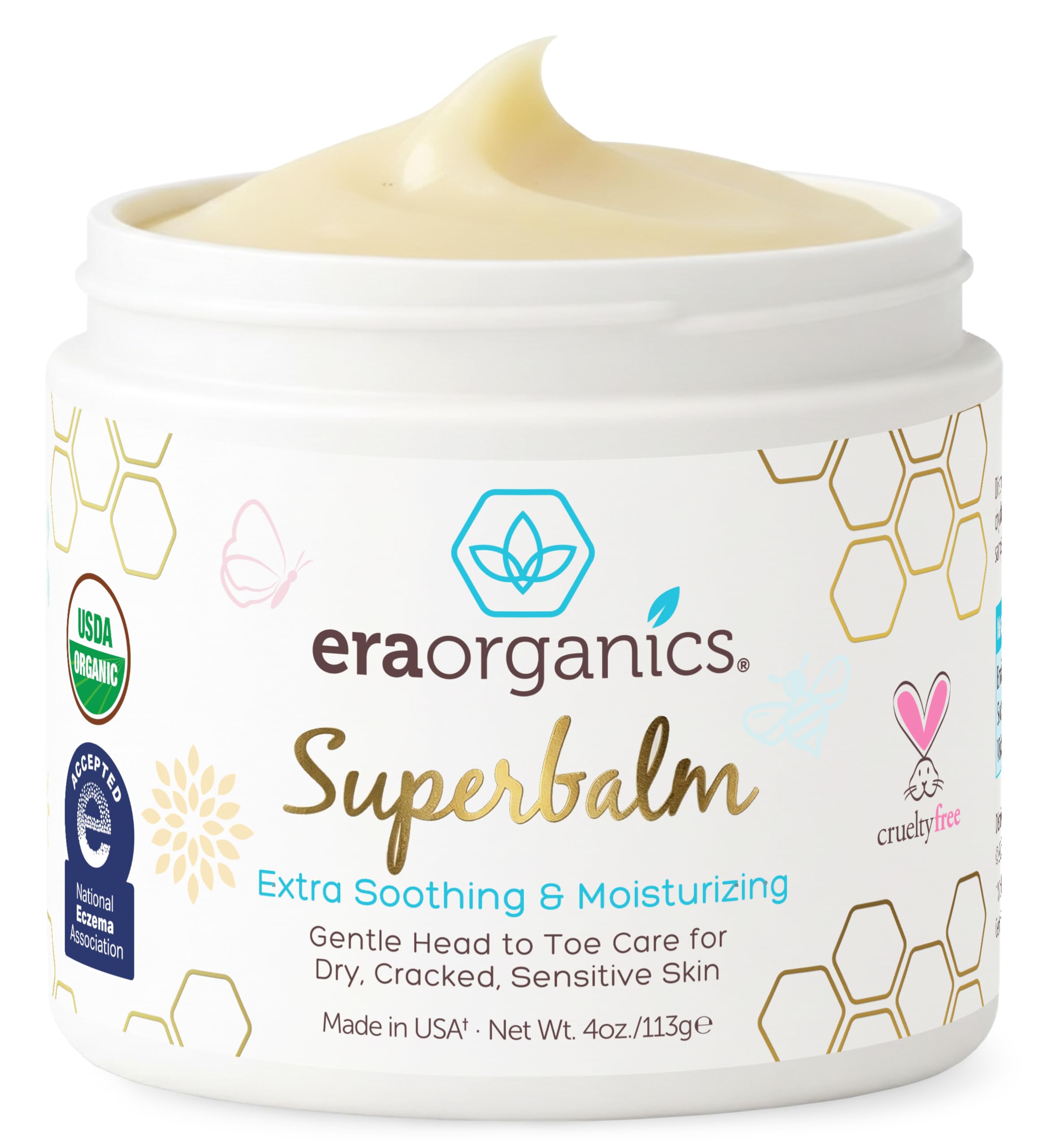
Superbalm is an ointment, not a shampoo or a serum, and that changes the job it does. It is a thick, waxy balm — chamomile, calendula, colloidal oats and castor oil in a USDA organic base — meant for dry, rough, irritated skin anywhere on a baby, scalp included.
For cradle cap it works as a softener: a thin layer on the scalp before a bath and a comb, much the way a plain baby oil would, except we found it easier to control because it stays where you put it instead of running. Where it goes further is coverage. The same jar handles dry cheeks, the dribble rash under a chin and the crusty bits behind the ears that cradle cap often spreads to, so you are not layering three products on one small person.
It is thick enough that a little goes a long way, which is just as well, because a full-body application every day gets through a four-ounce jar fast. Keeping it to the scalp and the rough patches makes it last; treating the whole baby every night does not.
If your baby has one small patch and nothing else going on, a cheap comb and a bottle of baby oil do the same first job. If the scalp is one front in a wider skin situation — eczema, dryness, patches that come and go — this is the jar we reach for, because it treats the whole baby instead of the square inch with flakes on it.
Pros
- One jar covers scalp and body
- Softens scale before combing
- Useful when eczema comes with the flakes
Cons
- Strong herbal, beeswax scent
- Mixed results on very sensitive skin
The one to buy when cradle cap arrives with eczema and dry patches: a thick organic balm that softens scale and earns its keep head to toe.
How We Chose and Tested Cradle Cap Treatments
We started with a shortlist of infant cradle cap treatments—oils, creams, balms, and shampoos—then read every ingredient list and instruction card before buying. We filtered for formulas explicitly labeled for babies and sensitive skin, and we set aside anything with a strong added fragrance or an applicator that looked impossible to clean. From that group, we tested 14 treatments over four months, following each label’s directions rather than inventing our own routine.
Each product went into our regular bath-time rotation. We applied it to a damp scalp, let it sit while a baby squirmed on a towel, combed gently with a soft brush, then rinsed and checked the scalp again the next morning. We logged whether scales lifted in one session or took several washes, whether flakes crept back by the following bath, and whether the formula left a greasy film, a lingering scent, or a dry, tight look.
We also paid attention to the skin around the treatment area. Since several testers had dry patches behind the ears or on cheeks, we noted whether the formula could be used nearby without redness, stinging, or extra fussiness, and we tracked any irritation at the hairline or in existing eczema. Containers stayed in rotation until they were empty, which let us see whether pumps clogged, caps leaked, or the product thickened, and roughly how many applications each one actually delivered. A handful of treatments did nothing after three washes—or left the scalp angrier than before—and those did not make the cut.
How to Choose a Cradle Cap Treatment
Nearly every cradle cap routine comes down to two moves — soften the scale, then lift it — so the real choice is whether to buy tools, a formula, or both.
Soften first, then lift
Dry scale does not come off cleanly. It tears at the hair and leaves the scalp angry, which is why every product here that works has a softening step built in — a little baby oil half an hour before the bath, an oil-based serum left for ten minutes, or a balm worked into the patch. Then a soft brush in small circles, then a fine comb.
We put the most weight on this sequence, because it is the part people skip. If you comb a scalp that has not been softened, you get a baby who protests and flakes that stay put, and it is easy to conclude that nothing works. Try the order before you try another product.
Tools or a formula, or both
Tools handle the flakes; formulas handle whatever keeps producing them. A mechanical kit works with the shampoo you already own and does not put a new ingredient on a newborn’s skin, which is why we suggest starting there. A medicated wash with pyrithione zinc is the step up for flaking that keeps coming back after the newborn months.
A leave-on serum or spray is for a scalp that re-flakes within a day or two of a good combing. You rarely need all three at once. Start with a softener and a comb, add a medicated wash if the flakes keep returning, and add a leave-on product only if the cleared scalp does not stay clear.
What to check on the brush and comb
Bristles should be soft enough for a newborn and firm enough to move a flake — rubber or silicone over anything with a scratchy tip. The comb matters more than the brush: teeth should be fine and closely spaced, because a wide-toothed comb skips straight over scale.
Grip is the underrated spec. A handle that slides onto your hand, like the Safety 1st set, keeps your other hand free for a wet baby, and a suction base or stand keeps the tool off the bottom of the tub. If you have a baby with a full head of hair, look for fine teeth that slide rather than drag.
Fragrance and sensitive skin
Fragrance is the ingredient most likely to cause trouble on a newborn scalp, and several picks here are fragrance-free for exactly that reason. If your baby has eczema or has reacted to a wash before, choose the unscented option, patch-test a small area, and give the product a couple of days before you judge it.
One product at a time is the other rule worth keeping. Introduce a mask and a spray in the same week and you cannot tell which one helped, or which one left the scalp red.
How much you actually need
Most kits contain far more than one course of treatment. A five-ounce shampoo used two or three times a week lasts months, and a serum used on a few patches goes further than the bottle suggests. Where product disappears fast is a balm you start using head to toe on eczema as well as scalp.
Buy the smallest size that covers a few weeks of treatment and put the difference into a decent fine-toothed comb. The tools outlast every bottle in this group, and they are the part of the routine you will still be using long after the flakes are gone.
Frequently Asked Questions
Can I brush over the soft spot?
Yes, with a soft brush and light pressure. You are brushing skin, not the gap beneath it — the soft spot is covered by a tough membrane, and gentle circular brushing is how these kits are designed to be used. Keep fingernails, hard combs and any scraping at dry flakes away from it.
If the scalp over the soft spot looks red, swollen or different from the rest of the head, stop and call your pediatrician rather than working at it.
Will cradle cap come back after it clears?
It often does, in patches, over the first year. A scalp that looks clear can flake again a few weeks later, which is normal rather than a sign the treatment failed.
The practical answer is a maintenance habit: keep a fine comb in the bath caddy, soften the scalp with oil once a week, and comb through. Catching a new patch while it is still loose takes one session instead of a week.
How long should it take to clear?
Mild flaking often looks dramatically better after one or two sessions with a softener and a comb. Thicker scale usually takes a couple of weeks of regular washing rather than a single go, so give any routine two to three weeks before deciding it does not work.
If there is no improvement by then, or the scalp is red, oozing or itchy enough to disturb sleep, that is a pediatrician question rather than a product question.
Final Verdict
For most families we point at the Frida three-step kit. It works with the shampoo already in the bath, it costs less than the bottles in this group, and it does the part of the job that actually clears scale: soften, loosen, lift.
Two situations change the answer. If the scale is thick and crusted, go to the Ladibugs serum and comb, which softens before it pulls. If the flaking keeps returning after the newborn months, Happy Cappy’s medicated wash is the stronger formula, and it is the one worth keeping on the shelf.
