This post contains affiliate links. We may earn a small commission when you buy through our links — at no extra cost to you.
The first time you try to sunscreen a squirming baby, you learn fast that the formula matters as much as the SPF. A thick, chalky cream turns a two-minute job into a wrestling match, and anything that stings or smells strong can leave a baby’s sensitive skin red and fussy. What you want is a sunscreen that rubs in clear, stays put through a stroller nap, and doesn’t leave a ghostly cast on tiny cheeks. Over the past four months, my team and I tested 16 baby sunscreens for sensitive skin, from mineral-only lotions to fragrance-free sticks.
We focused on what makes or breaks daily use: whether a formula irritates delicate skin, how easily it spreads, whether it feels greasy, and what you get for the price. A few surprised us—some sensitive formulas still left a noticeable cast, while a couple of thinner lotions rubbed in clear. If your baby has eczema or reacts to everything, the picks below held up through repeated use, not just one sunny afternoon.




Best for Full-Body Everyday Use
Thinkbaby SPF 50+ Sunscreen
Key Features
- SPF: 50+
- Size: 6 oz
- Age range: 6 months to 5 years
- Water resistance: Highest FDA rating
- Price: Midrange
Six ounces sounds like a lot until you are spreading it over a squirming one-year-old twice a day at the beach. That math is why Thinkbaby is the one here we are happy to use in bulk: it is a mineral SPF 50+ that rubs in faster than the thickest creams in this group, and a single tube covers a whole baby for weeks rather than a weekend. If you want one bottle by the door that works on arms, legs, ears, and the back of a neck, this is the one.
The label backs up the beach use: the highest FDA water-resistance rating, broad-spectrum UVA and UVB coverage, and a formula free of PABA, parabens, and phthalates. It is not fragrance-free, though. There is a mild coconut-ish scent that plenty of parents love, and it is the reason this is not automatically the right pick for a baby whose skin has already reacted to a scented lotion. If that is your situation, start with the fragrance-free options below rather than testing this one on a beach day.
Texture is where the compromises show. Thinkbaby is thick enough that you work it in rather than swipe it on, so thin layers beat one heavy smear, and thin layers are also how you keep the white cast down. Expect a little more time at bath time too. It holds on, which is the same tenacity that gets a baby through a swim in the first place.
Where it clearly beats the sticks here is coverage per squeeze, and that is the trade you are making: a lotion for the body, a stick for the face. Buy this one for the body and add a stick for faces; nothing in this group covers a whole baby faster for the money.
Pros
- Spreads faster than the thick mineral creams here
- Mineral formula with no PABA, parabens, or phthalates
- Highest FDA water-resistance rating
- Generous six-ounce tube for full-body use
Cons
- Not fragrance-free; a mild coconut scent
- Thick formula needs careful rubbing in
Our pick for the whole body: a mineral SPF 50+ that spreads fast, holds up in water, and goes far enough per tube to use generously, unless your baby reacts to scent.
Best for Faces and Touch-Ups
Blue Lizard Baby Stick SPF 50
Key Features
- SPF: 50
- Size: 0.5 oz
- Active filter: Zinc oxide
- Water resistance: 80 minutes
- Price: Budget
Half an ounce does not sound like much, and it is not. This stick is for faces, ears, noses, and the backs of necks, not for coating a toddler’s legs. What it buys in return is speed: a few swipes across a forehead take seconds, and it is the format that still works when a baby has decided the beach is a wrestling match.
For faces and touch-ups, it sits at the top of this set. The formula is zinc oxide only, fragrance-free, and rated for 80 minutes of water resistance, all in a tube that disappears into a diaper bag pocket. It also goes on drier than a lotion, which matters more than it sounds, because a dry swipe stays where you put it instead of running down a nose.
The catch is the finish. On pale skin the white layer rubs down to a faint sheen, but on deeper skin tones it can sit visibly, and you get better results warming the stick on the back of your hand before it goes near a cheek. It is also the one we hand to a babysitter without instructions: hard to over-apply, easy to see.
Pros
- Fastest format for a wriggling face
- Zinc oxide only and fragrance-free
- 80 minutes of water resistance
- Fits in a pocket or diaper bag
Cons
- White film can linger on deeper skin tones
The best face-and-touch-up sunscreen in this set: zinc-only, fragrance-free, and fast enough for a baby who treats a diaper change like a wrestling match.
Best for Fragrance-Free Body Coverage
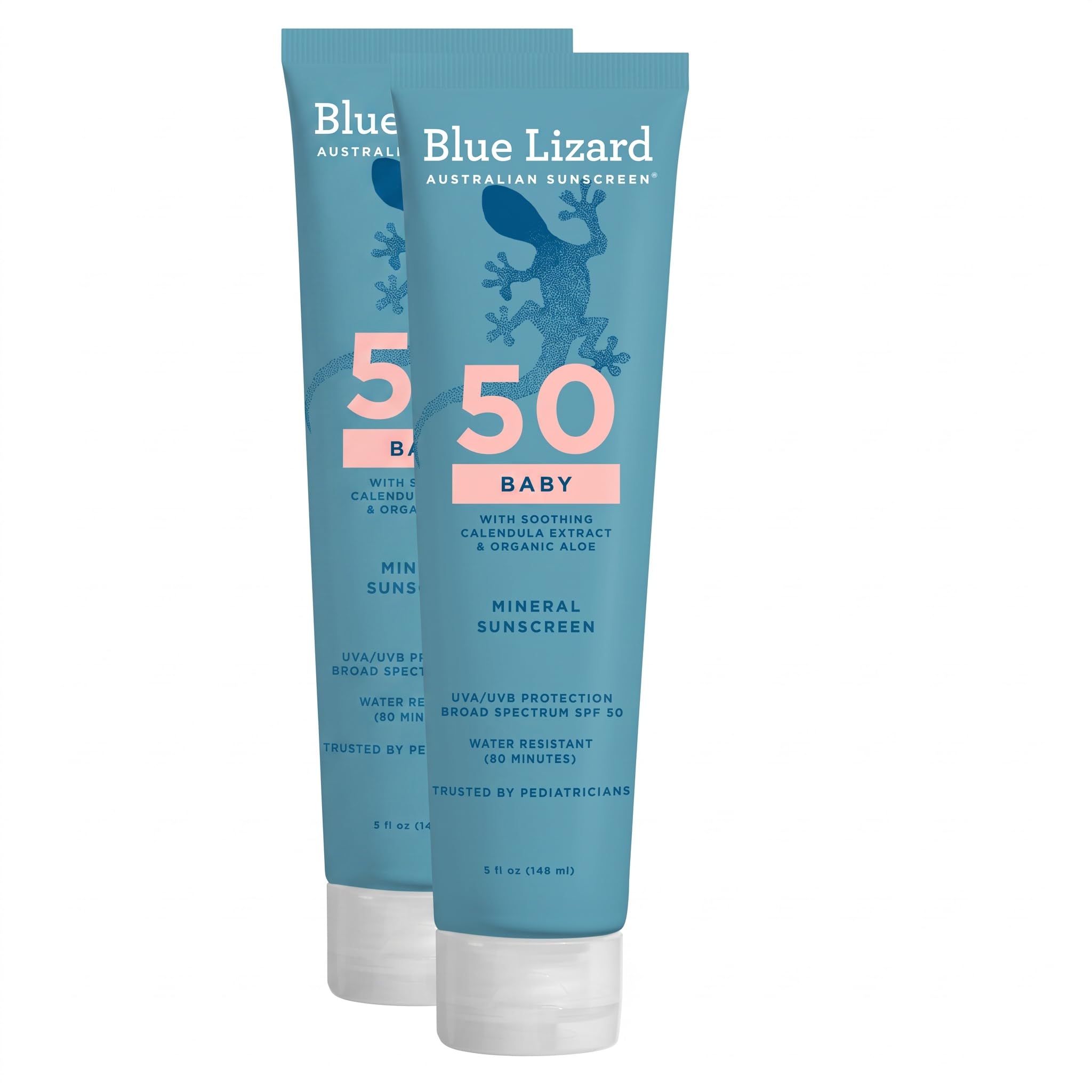
Blue Lizard Baby Tube SPF 50+
Key Features
- SPF: 50+
- Size: 5 oz, 2-pack
- Scent: Fragrance-free
- Extras: Smart Cap UV indicator
- Price: Premium
The cap changes color as UV strength rises. That sounds like a gimmick until you are the one deciding whether to reapply on a hazy afternoon, and then it is the small nudge that actually gets it done. That cap sits on a five-ounce tube of zinc oxide sunscreen, and this listing sells two of them.
The formula is the point: mineral, SPF 50+, water resistant, vegan, and free of parabens and fragrance, with calendula and organic aloe in the base. It is the full-body counterpart to the Blue Lizard stick above, same brand and same fragrance-free approach, but a lotion you can spread over a whole baby in under a minute instead of swiping at a face.
Of everything here, this is the pair that earns a permanent spot in the beach bag and the bathroom cabinet. If your baby’s skin has already objected to a scented sunscreen, start here: it has the least to object to in the ingredient list of any full-body option in this group, and two tubes suit us fine, with one staying packed and one living next to the bath.
Pros
- Fragrance-free zinc formula for the whole body
- Two five-ounce tubes for home and bag
- Smart Cap flags strong UV
- Water resistant with SPF 50+
Cons
- Sold only as a two-pack
The fragrance-free full-body lotion we stock up on: two five-ounce tubes of zinc sunscreen with a UV-sensing cap, for households that go through sunscreen fast.
Best for Eczema-Prone Skin
Aveeno Baby Mineral Stick SPF 50
Key Features
- SPF: 50
- Size: 0.47 oz
- Scent: Fragrance-free
- Water resistance: 80 minutes
- Price: Midrange
The National Eczema Association seal is why this stick made the cut over the other face options here. That seal is not a guarantee for your baby in particular, but for a parent whose last sunscreen ended in a rash, it is a more useful starting point than another marketing claim on a label.
Everything else about it is competent rather than exciting: zinc oxide at SPF 50, fragrance-, paraben-, and phthalate-free, 80 minutes of sweat and water resistance, and a glide-on stick a toddler can help with. It is small enough to live in a purse or a carry-on, and the no-mess application is the reason it gets used instead of argued about.
Two things to know. The stick holds 0.47 ounces, so a face-and-hands habit burns through it faster than a lotion does, and it costs more per stick than the Blue Lizard option while holding slightly less. Neither is a dealbreaker when an eczema history is the deciding factor, which is the trade you are making for the seal.
Pros
- National Eczema Association seal
- Fragrance-, paraben-, and phthalate-free
- Glides on with no mess
- 80 minutes sweat and water resistance
Cons
- Small stick, priced above the Blue Lizard stick
The stick we reach for when a baby’s skin has already reacted to something: fragrance-free, zinc-based, and the only one here carrying the National Eczema Association seal.
Best for Minimal-Ingredient Routines
Badger Baby Mineral Sunscreen SPF 40
Key Features
- SPF: 40
- Size: 2.9 fl oz
- Formula: 7 ingredients, 98% organic
- Water resistance: 40 minutes
- Price: Midrange
Seven ingredients, and you can pronounce all of them: non-nano zinc oxide, organic sunflower oil, chamomile, and not much else. If the reason you are shopping is that you do not want unfamiliar chemistry on a baby’s skin, this is the shortest list in the group by a wide margin, and the 98% organic claim is on the label rather than implied.
We choose it for daycare drop-off, stroller walks, and the daily grind where you apply a small amount and wash it off that night. It is SPF 40 with 40 minutes of water resistance, half the water time of the Blue Lizard tube and the Coppertone bottle, so a long swim morning is simply not its job.
The cream itself is thick, and thick is the price of a seven-ingredient formula. It wants warming between your palms and dotting on rather than smearing, which is Badger’s own instruction, and in exchange you get something that doubles as a baby lotion. Expect some stickiness on a hot day, and keep it away from pale stroller fabric.
Pros
- Seven ingredients, 98% organic
- Doubles as a moisturizing baby lotion
- Non-nano zinc oxide and reef safe
- Pediatrician tested and hypoallergenic
Cons
- Water resistance lasts 40 minutes, not 80
- Thick and sticky; can mark stroller fabric
For families who read every ingredient: seven of them, 98% organic, and a thicker cream that suits daily walks far better than a long pool day.
Best for Lightweight Daily Lotion
Baby Bum Mineral Lotion SPF 50

Key Features
- SPF: 50
- Size: 3 fl oz
- Scent: Fragrance-free
- Water resistance: 80 minutes
- Price: Midrange
Three ounces, fragrance-free, and thin enough to spread without a fight. That combination makes this the tube that lives in the diaper bag rather than the one on the bathroom shelf: it is the size you can restock without wincing, and the format that gets used on a weekend away.
The formula is mineral zinc with coconut oil, shea, and cocoa butter, 80 minutes of water resistance, and no octinoxate or oxybenzone, which is the short version of what a sensitive-skin shopper wants to see. It spreads more like a body lotion than a paste, and that is not nothing when the alternative is holding down a baby who has spotted the ocean.
What keeps it out of the top tier is consistency of experience. Some babies do fine and some come up in a rash, and a mineral filter offers no protection against that. Patch-test on the inner arm a day before you commit to a beach weekend. If it agrees with your baby, we think the texture and the travel size are genuinely pleasant to live with.
Pros
- Fragrance-free mineral formula
- Thin and quick to spread
- 80 minutes of water resistance
- Three-ounce tube suits a diaper bag
Cons
- Some babies react, so patch-test first
- Small bottle for daily full-body use
A thin, fragrance-free mineral lotion in a three-ounce tube that fits a diaper bag, worth trying if your baby tolerates it and worth patch-testing first if not.
Best for Ewg-Minded Shoppers
Babo Botanicals Baby Lotion SPF 50

Key Features
- SPF: 50
- Scent: Fragrance-free
- Active filter: Zinc oxide
- Certification: EWG Verified
- Price: Premium
EWG Verified is a stricter label than most. It reflects a third-party review of the whole ingredient list rather than a marketing adjective, and paired with a fragrance-free, zinc-only formula it makes this lotion look excellent on the back of the tube.
It also behaves better than most zinc lotions. It is thinner, it rubs in without the paste-and-drag routine, and the listing claims a non-whitening finish. Treat that last claim as optimistic: a formula this gentle still leaves some cast, and thin layers are how you keep it down.
The caveats are real but specific. Some babies still react to it, so the badge says nothing about your individual child. The base formula has a smell of its own despite being fragrance-free, the kind of thing you either do not notice or cannot get past, and the price sits at the premium end for what arrives.
Buy it if third-party verification is what you are after and your baby’s skin has already shown it can handle zinc formulas; the texture is the bonus. We found the Blue Lizard tube the easier call at a lower price per ounce, with the same fragrance-free approach and more volume.
Pros
- EWG Verified ingredient screening
- Fragrance-free, zinc-based formula
- Thinner than most mineral lotions
- Rubs in with less dragging
Cons
- Premium price compared with the other lotions here
- Base formula has a noticeable smell
The EWG Verified option: a fragrance-free zinc lotion with a thinner texture than most mineral formulas, for shoppers who want third-party screening and will pay for it.
Best for Budget and Big Bottles
Coppertone WaterBabies SPF 50

Key Features
- Age: 3 months and up
- SPF: 50
- Size: 8 fl oz
- Water resistance: 80 minutes
- Price: Budget
Eight ounces, which is more than twice what most of the tubes here hold, plus 80 minutes of water resistance and a hypoallergenic formula free of PABA, dyes, octinoxate, and oxybenzone. On volume and staying power, we have not found anything else in this group that comes close for a family that goes through a bottle a month.
What it is not is the sensitive-skin formula this article is about. The label leans on hypoallergenic testing and on the chemical filters it leaves out rather than on zinc or titanium, and it is scented with a baby-powder fragrance that some parents find strong. If a mineral filter and a fragrance-free list are the whole reason you are shopping, this is not your bottle.
If those are not your reasons, it is a good sunscreen. It spreads like hand lotion, absorbs quickly, and stays on through water play, and the eight-ounce squeeze bottle is easy to handle one-handed with a baby on your hip. It can sting if it gets in the eyes, which is the usual fate of any lotion on a wet face.
Buy it for daycare, the grandparents’ house, and the car. The eight-ounce bottle lasts a full season of drop-offs, and that is its own kind of strategy: the sunscreen that actually gets reapplied is worth more than the elegant one that stays in the cupboard.
Pros
- Eight ounces, the biggest bottle here
- 80 minutes of water resistance
- Spreads and absorbs like a body lotion
- Hypoallergenic and free of PABA and dyes
Cons
- Chemical filters rather than mineral
- Scented with a noticeable baby-powder fragrance
- Can sting if it gets in the eyes
The big-bottle budget option: eight ounces, 80 minutes of water resistance, and a scent, a fine daycare sunscreen and a poor choice if you are here because of a rash.
How We Tested Baby Sunscreens for Sensitive Skin
We started by pulling together more than 40 formulas marketed for babies and sensitive skin, then narrowed the list by reading ingredient panels for common irritants, checking whether each was fragrance-free and clearly labeled for reactive skin, and comparing cost per ounce. We ended up with 16 that represented a range of formats—lotions, sticks, and creams—and put each one through four months of real use.
Testing happened where sunscreen actually gets used: morning stroller walks, afternoons at the playground, a few sweaty trips to the zoo, and bath time afterward. With each formula, we applied a nickel-sized amount to a baby’s cheek and a quarter-sized amount to an arm, then watched how it spread, whether it left a white cast immediately and 20 minutes later, and whether it felt tacky or slick after it dried. We squeezed a pea-sized dollop onto a paper towel to see if it held its shape or ran, pressed a tissue against a greasy forearm to see how much stuck, and at the playground checked whether sand clung to legs after application.
For skin compatibility, we used each formula on the same two babies for several consecutive days and noted any redness, bumps, or fussiness around application, paying extra attention to cheeks and behind the knees. We also capped each bottle and smelled it a minute later to see whether fragrance lingered, and we tracked how many pumps it took to cover a toddler’s arms and legs to get a sense of cost per use. Sun protection was judged on reapplication: we noted whether the formula stayed put through sweat, water play, and a long nap in the stroller, and whether it was easy to reapply without crusting.
How to Choose a Baby Sunscreen for Sensitive Skin
For a baby with reactive skin, the SPF number is the least interesting thing on the bottle; the filter and the rest of the ingredient list decide whether you are dealing with a rash by dinner.
Read the filter before the SPF number
Zinc oxide and titanium dioxide sit on the skin and scatter UV; chemical filters absorb it. Neither is automatically a problem, but for a baby with a history of reactions, a mineral formula with no added fragrance is the version with the fewest variables. Fragrance is the ingredient most often behind a reaction, and it turns up in products that smell natural.
The trap is that fragrance-free does not mean odorless. Thinkbaby’s mild coconut scent is exactly why it is not our pick for a baby with a scent history, and even Babo’s fragrance-free lotion has a base smell of its own. Shopping after a rash? Start with the Blue Lizard tube or stick.
Match the format to the job
One lotion plus one stick covers almost every family. Lotion is for arms, legs, and the back of the neck, where you need volume and speed; a stick is for faces, ears, and touch-ups, where you need control. A half-ounce stick looks like good value until you try to cover a whole body with it.
Sprays are the weakest option for a baby: coverage is patchy, you still have to rub it in, and misting near a face is a bad idea. Buy the lotion for the body and keep the stick in the bag.
Treat water resistance as a timer
Eighty minutes is the ceiling, and several picks here hit it; Badger’s 40 minutes is the price of a seven-ingredient formula. Neither number survives a towel. Water resistant is not waterproof, and drying off after a swim takes off more than the label’s clock suggests, so reapply after every exit from the water and roughly every two hours otherwise.
If your summer is mostly backyard sprinkler rather than open water, 40 minutes is fine and you can choose on the ingredient list instead.
Expect some white cast, and plan the wash-off
Zinc leaves a visible layer, and on deeper skin tones it can sit noticeably. Thin lotions blend down further than thick creams, and warming a stick on the back of your hand before it goes near a cheek helps. The same thickness that resists water also resists a bath, so budget for a washcloth and a second pass on heavy-cream days.
There is an upside to the cast: on a wriggling baby it is the fastest way to spot the patch you missed.
Check the age label and what a certification means
Stated minimum ages differ, with Coppertone at 3 months and Thinkbaby at 6 months, and for a very young baby, shade, clothing, and a pediatrician’s advice come first. Certifications are worth paying for when they match your worry: the National Eczema Association seal on the Aveeno stick, EWG Verified on the Babo lotion, pediatrician-tested claims on several others.
None of them is a guarantee for your individual baby. Patch-test any new sunscreen on the inner arm the day before you need it.
Frequently Asked Questions
How much sunscreen should I use on a baby?
More than most of us do. A workable guide is half a teaspoon for the face and neck, and about an ounce for a toddler’s whole body, roughly a shot glass. Under-application is the most common way a good sunscreen lets a baby down: a thin smear over the shoulders is not a full dose, and a stick needs several passes to get there.
What should I do if a sunscreen makes my baby’s skin red?
Wash it off with lukewarm water and a mild soap, then stop using that bottle. Note whether it was scented and whether the filter was mineral or chemical, because that narrows what to try next. Patch-test the replacement on the inner arm and wait a day before a full application. A rash that spreads, blisters, or comes with swelling needs a doctor rather than another brand.
Do mineral sunscreens stain clothes and strollers?
They can. Zinc and titanium leave pale marks on fabric, and the thicker the cream, the more likely it is to transfer; Badger’s cream is the one here most likely to mark a stroller seat. Wash the item promptly in regular detergent and skip the dryer until the mark is gone, since heat sets it. A dark towel over the seat during application saves most of the trouble.
Final Verdict
Buy the Thinkbaby tube for the body and the Blue Lizard stick for the face, and most days are solved: mineral filters, SPF 50+ protection, and enough volume to apply it properly rather than rationing it.
If your baby’s skin has already reacted to a scented product, swap the Thinkbaby for the Blue Lizard two-pack, which is fragrance-free, zinc-only, and the easiest full-body option here to defend. Keep the Aveeno stick in mind if eczema is the specific worry.
