This post contains affiliate links. We may earn a small commission when you buy through our links — at no extra cost to you.
Many nursing pads promise thin profiles but skimp on absorbency — a trade-off that leaves heavy leakers soaked through within hours. Others shift around or itch after extended wear, turning a simple necessity into a constant annoyance. The right pad depends on your leak volume and skin sensitivity, not just the packaging claims.
Disposable pads offer grab-and-go convenience, but weak adhesive can ruin the experience. Reusable pads save money long-term but need frequent changes and may not handle overnight leaks. This guide cuts through the category noise by matching pads to real use cases — from heavy overnight protection to light daily wear — so you can stay dry and comfortable without second-guessing your choice.


Best for Heavy Leaks
Lansinoh Stay Dry Disposable
Key Features
- Absorbency Level: 20x weight, heavy
- Leak-Proof Design: Contoured, InvisiLock core
- Comfort & Softness: Soft, gentle on sore nipples
- Adhesion or Fit: Two adhesive strips, contoured
- Reusability vs Disposable: Disposable, individually wrapped
- Price: Mid-Range
Each pad absorbs 20 times its weight in fluid, making this the go-to choice for heavy leakers who need all-day and overnight protection. The contoured shape and InvisiLock core keep milk contained even during sleep, and the thin profile fits discreetly under clothing. Individually wrapped pads make travel and diaper bag storage simple.
Best for moms who deal with heavy letdown or overnight soaking and prefer the convenience of disposables. The adhesive backing can be hit-or-miss — some pads slide or peel away, so a snug bra helps keep them in place. Not for those seeking reusable alternatives or with skin that reacts to adhesive residue.
Pros
- Absorbs heavy leaks effectively
- Stays secure overnight, preventing leaks
- Soft on sore nipples
Cons
- Adhesive strips may peel or slide without a tight bra fit
Buy this if you need heavy-duty, all-day and overnight leak protection from a disposable pad. Skip it if you prefer reusable options or have extremely sensitive skin that reacts to adhesive residue.
Best for Eco-Conscious
KeaBabies Reusable Bamboo
Key Features
- Absorbency Level: Moderate, 4-layer
- Leak-Proof Design: Waterproof outer layer
- Comfort & Softness: 100% bamboo viscose, soft
- Adhesion or Fit: No adhesive, contoured
- Reusability vs Disposable: Reusable, machine wash
- Price: Budget
KeaBabies’ organic bamboo pads deliver a softness that cheaper polyester alternatives can’t match, making them a go-to for sensitive skin. The 4-layer construction handles moderate daytime leaks well, and the included wash bag and wet bag add practical value. But the absorbency falls short for heavy overnight use—you’ll need frequent changes for heavier flow. For eco-conscious moms with light to moderate leakage, these pads offer a comfortable, machine-washable solution that saves money over disposables.
Pros
- Ultra-soft organic bamboo surface ideal for sore nipples and sensitive skin.
- Good absorbency for moderate daily leaks with a 4-layer design.
- Durable construction that holds up well to repeated machine washing.
Cons
- Not fully leak-proof for heavy overnight leaks; requires frequent changes for high flow.
Buy this if you want a soft, eco-friendly reusable pad for light to moderate daily leakage, and value the included wash and wet bags.
Best for Budget Day/night
Nanobébé Day & Night Disposable
Key Features
- Absorbency Level: Day thin, night absorbent
- Leak-Proof Design: Day: ultra-thin, Night: thick
- Adhesion or Fit: Two adhesive strips
- Reusability vs Disposable: Disposable, individually wrapped
- Price: Budget
This set offers a practical split between 40 thin daytime pads and 20 thicker overnight pads in one affordable pack—a convenience you won’t find in the top pick. The overnight pads handle moderate leaks well, but the adhesion is hit-or-miss: reviewers report pads sliding or not sticking firmly to bras. Some also find the texture itchy after extended wear. For light-to-moderate leakage and a day/night variety, it’s a reasonable budget alternative; for heavy leakers or sensitive skin, the trade-offs become noticeable.
Pros
- Separate day and night pads with different absorbency levels
- Overnight pads absorb well for moderate leaks
- Individually wrapped for on-the-go use
Cons
- Adhesive strips may not hold securely against bras
- Some users experience itchiness during extended wear
Buy this if you want a budget-friendly disposable with separate day and night pads for light-to-moderate leaks. Skip it if you need strong adhesion for heavy leaks or have sensitive skin prone to itching.
Best for Budget Reusable
wegreeco Budget Reusable
Key Features
- Absorbency Level: Light to moderate
- Leak-Proof Design: TPU laminated outer
- Comfort & Softness: Polyester microfiber middle
- Adhesion or Fit: No adhesive, 4.7in diameter
- Reusability vs Disposable: Reusable, 14 pads
- Price: Budget
Compared to the bamboo reusable set, the wegreeco pads use polyester instead of natural fibers, reducing breathability and absorbency but significantly lowering the price. The 14-pad bundle plus laundry and travel bag delivers the lowest per-pad cost among reusables, ideal for budget shoppers. Users report the material is soft and comfortable for most, and cleaning is straightforward. However, heavy leakers may experience moisture breakthrough, and the polyester doesn’t breathe as well as cotton or bamboo – best for light to moderate daily leakage.
Pros
- Large 14-pad set with included laundry and travel bag at a budget-friendly price.
- Soft polyester material feels comfortable for most users.
- Easy to clean and maintain after use.
Cons
- Absorbency is limited; heavy leakers may experience moisture breakthrough.
Buy this if you want the lowest-cost reusable option for light to moderate daily leakage and are okay with polyester’s reduced breathability.
Best for Sensitive Skin
Kindred Bravely Organic Reusable
Key Features
- Absorbency Level: Moderate
- Leak-Proof Design: Contoured, sewn curve
- Comfort & Softness: Organic bamboo, ultra-soft
- Adhesion or Fit: No adhesive, contoured fit
- Reusability vs Disposable: Reusable, OEKO-TEX certified
- Price: Mid-Range
Certified organic bamboo viscose with OEKO-TEX Standard 100 puts these pads ahead for anyone with sensitive skin, but the contoured shape doesn’t always stay secure — some users report shifting or sliding. Their four-layer construction handles moderate leaks effectively and they wash well without losing shape. Still, the fit inconsistency means they’re best for light to moderate leakage rather than heavy overnight use. Compared to the top reusable in this set, the organic certification and ultra-soft texture are clear advantages, though the fit is less reliable.
Pros
- Ultra-soft organic bamboo surface comfortable for sensitive skin.
- Absorbs moderate leaks well without bulk.
- Washes repeatedly without losing shape or softness.
Cons
- Fit can be inconsistent; pads may shift or slide out of place.
Buy this if you prioritize organic materials and have sensitive skin with light to moderate leaks. Skip it if you need a secure fit for heavy leakage or larger bust sizes.
Best for Ultra-Soft
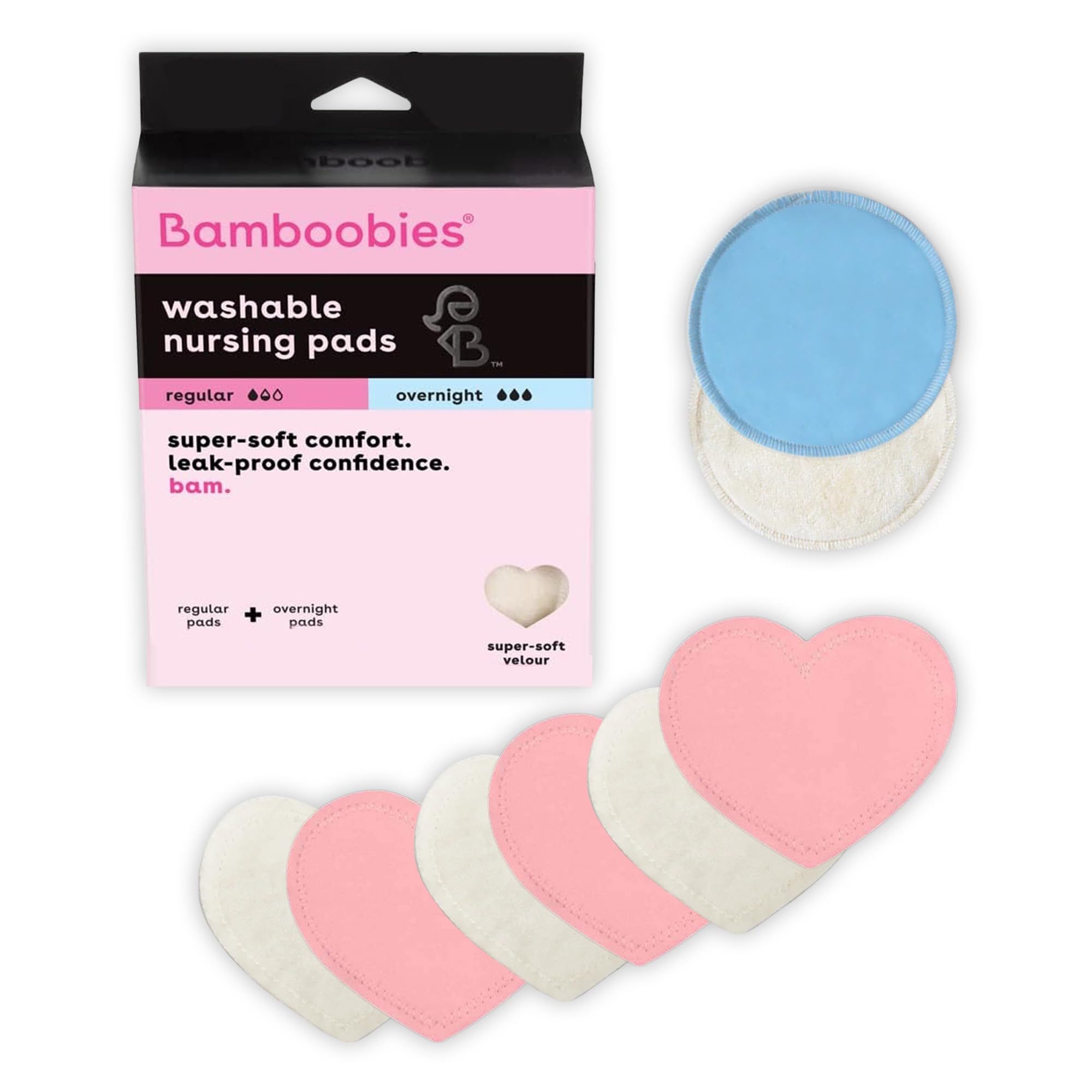
Bamboobies Ultra-Soft Reusable
Key Features
- Absorbency Level: Moderate
- Comfort & Softness: Velour surface
- Adhesion or Fit: No adhesive
- Reusability vs Disposable: Reusable, day/night pack
- Price: Mid-Range
The velour surface is genuinely soft against sensitive skin, and the separate day and night pads work well for moderate leaks. However, a pack contains only eight pads, so per-pad cost runs higher than many reusable competitors. Limited negative feedback makes it hard to gauge long-term durability, but for moms prioritizing a plush feel and a dedicated overnight option, it fills a specific niche.
Pros
- Exceptionally soft velour surface ideal for sensitive skin
- Dedicated day and night pads (6 heart-shaped + 2 round)
Cons
- Only 8 pads per pack; per-pad cost is higher than competitors
Worth considering if you want an ultra-soft velour feel and prefer separate day and night pads despite the higher per-pad cost.
Best for Thin Pads
Philips AVENT Disposable

Key Features
- Absorbency Level: Light to moderate
- Leak-Proof Design: Contoured, honeycomb texture
- Comfort & Softness: Honeycomb texture
- Adhesion or Fit: Two adhesive strips
- Reusability vs Disposable: Disposable, 100 count
- Price: Mid-Range
The ultra-thin honeycomb design makes these pads nearly invisible under fitted tops, and they handle light to moderate leaks well. However, the adhesive strips often fail to keep pads in place, and some users find the material rough against sensitive skin. Only choose these if you prioritize invisibility over stay-put reliability.
Pros
- Nearly invisible under thin or tight shirts
- Decent absorbency for light to moderate leaks
Cons
- Adhesive strips often fail to keep pads in place; shifting is common
- Material can feel rough or itchy for some users
Worth considering if you need a thin, discreet pad for light leaks under tight clothing and can tolerate weaker adhesion.
Best for Budget Light
PINOWU Budget Reusable

Key Features
- Absorbency Level: Light to moderate
- Leak-Proof Design: TPU laminated
- Comfort & Softness: Viscose/cotton blend
- Adhesion or Fit: No adhesive
- Reusability vs Disposable: Reusable, 10 pads
- Price: Budget
The PINOWU pads deliver the lowest price among reusable nursing pads, with decent light-to-moderate absorbency and durability through washes. However, many users report significant itchiness and a bulky fit that shows under clothing, making them best suited as a backup or occasional option rather than daily wear.
Pros
- Extremely affordable for a 10-pack with laundry bag
- Washable and holds up well through repeated machine cycles
Cons
- Fabric feels rough or itchy against sensitive skin
- Pads are large and may be visible under fitted tops
Worth considering if you need a low-cost backup set for occasional light leaks and don’t mind less comfortable fabric.
How to Choose
The biggest mistake is choosing a pad based on thinness alone—absorbency level determines whether you stay dry or leak through.
Absorbency Level
Light leakers can get away with thin pads, but moderate to heavy flow requires pads that hold 15–20x their weight. Overnight use demands thicker, dedicated night pads—standard thin pads will soak through within a few hours.
Leak-Proof Design
Look for a waterproof backing (common in reusables) or a multi-layer core (disposables). Contoured shapes help seal against the body, while flat pads can gap and leak. Thicker pads offer more security but may show under tight tops.
Comfort and Softness
Sore nipples need smooth, natural fibers like bamboo viscose or organic cotton. Avoid rough textures or scratchy adhesives. Reusables soften over time, while disposables vary widely—check for fragrance-free and hypoallergenic labels.
Adhesion or Fit
Disposable pads rely on adhesive strips—but many fail to stick, especially in active use or with certain bra fabrics. Reusable pads stay in place through friction and bra compression; contoured shapes help. For disposables, a snug bra improves retention.
Reusable vs Disposable
Disposables are convenient for travel and heavy leaks but generate waste and cost more per use. Reusables save money after a few months and are gentler on skin, but require washing every 2–4 hours and may not handle overnight flow.
FAQ
Why do my disposable nursing pads keep shifting around?
Weak adhesive strips are the most common cause. They lose grip with movement or in contact with bra fabric that doesn’t provide enough friction. To improve hold, try wearing a snug, non-stretchy bra or switch to pads with contoured edges that stay put without relying solely on adhesive.
Can reusable nursing pads be used overnight for heavy leaks?
Most reusable pads are not designed for heavy overnight use. Their absorbency tops out after a few hours, and moisture can breakthrough even with a waterproof backing. For heavy overnight leaks, a thick disposable night pad is a more reliable choice.
How often should I change reusable nursing pads?
Every 2 to 4 hours is the safe window to avoid moisture buildup and skin irritation. Keep at least two sets in rotation so you always have a clean, dry pair ready. If you feel dampness, change sooner regardless of time.
Are bamboo nursing pads better than cotton for sensitive skin?
Bamboo viscose pads tend to be softer and more absorbent than standard cotton, making them a good choice for sore nipples. However, the biggest factor is whether the pad is free of synthetic additives and fragrances. OEKO-TEX certified bamboo pads offer a verified safe option for sensitive skin.