This post contains affiliate links. We may earn a small commission when you buy through our links — at no extra cost to you.
There’s a stretch of potty training nobody really warns you about — the weeks when your kid is perfectly happy on the little floor potty and flat-out refuses the actual toilet. What closes that gap is usually a seat insert: something that shrinks a full-size bowl down to toddler proportions and gives a small, wobbly person somewhere solid to sit. Get the wrong one and it slides, pinches, or splashes, and you’re back in diapers for another month. Get the right one and the big toilet stops being scary overnight.
Over the past four months, my team and I put 14 different inserts through daily use with my own 2-year-old and two other toddlers in our test circle, from flimsy folding travel seats to rigid padded models with suction cups. One thing that surprised me: fit and stability matter far more than bells and whistles, and the inserts that win are the ones a half-asleep kid can climb onto at 2 a.m. without a shift or a wobble. The picks below earned a permanent spot beside our toilet — and a couple earned a spot in the diaper bag.



Best for Home Toilet Training
BabyBjörn Toilet Trainer
Key Features
- Fit: Adjustable dial, set once
- Weight: 16 oz
- Splash guard: Inward-sloping front guard
- Price: Premium
Most inserts are a compromise between a round bowl and an elongated one, so they sit wherever the porcelain lets them. The BabyBjörn takes the other route: a dial underneath sets the seat to your bowl once, and after that it drops into the same spot every time. It is a small piece of engineering, and it is the reason this seat feels planted rather than perched.
The opening matters as much as the fit. It is broad and contoured, with a front edge that slopes inward, so a boy who is still learning where to point sends most of it into the bowl instead of over the rim. The surface is one piece of smooth BPA-free plastic with no hinge, no crevice and no padding to crack, which is why a wipe does the whole job.
Children can lift it off and put it back themselves, and that changes the mood of the whole exercise: a child who can set up their own seat stops treating the toilet as your project. What it doesn’t do is travel. At 16 ounces and about 11.5 inches long, it is a seat that lives on one toilet, so if you want something for the diaper bag, one of the folding seats here is the better answer.
What it gives up is handles. There are none, so a child who likes to grip something will hold the rim or your hand instead. Nothing on it loosens, slides or needs re-seating, though, and after a few weeks it stopped being something we thought about at all.
Pros
- Dial fit, adjusted once to the bowl
- Broad contoured opening with inward-sloping guard
- One-piece shell, no hinge or padding
- Child can lift it on and off unaided
Cons
- Priciest seat in this group
This is the one we recommend if training happens at home: set the dial to your bowl once, and the seat sits flat and stays flat from then on.
Best for Public Restrooms
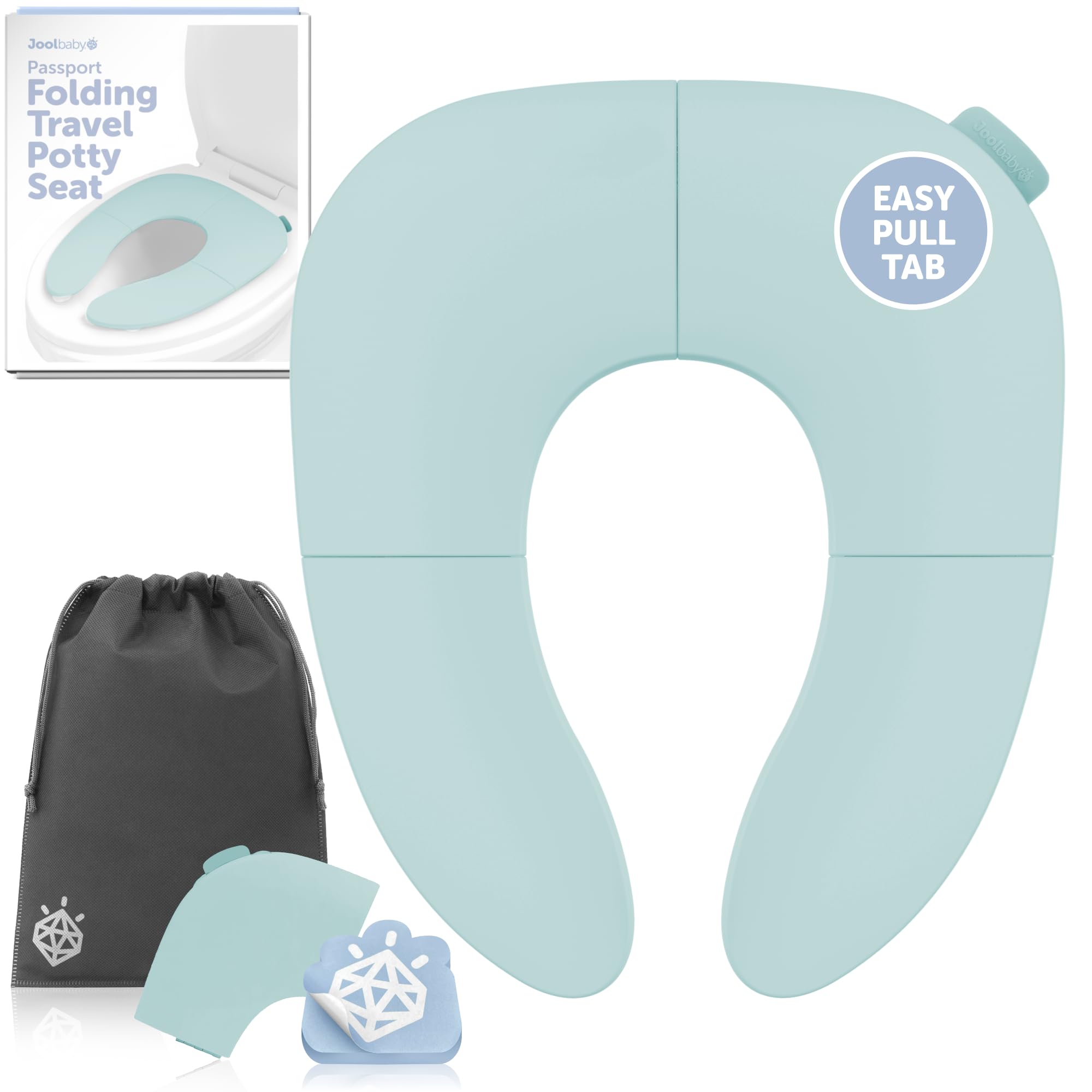
Jool Baby Folding Travel Seat
Key Features
- Extras: Auto-flush sensor blockers
- Weight: 9.5 oz
- Carry bag: Included, machine washable
- Dimensions: 10"L x 7.2"W
- Price: Midrange
The test of a travel seat isn’t how it looks on your own toilet. It is whether you can get it out, open it and get a toddler onto it in a narrow stall with the door already swinging. This one folds flat into a bag that fits a purse or a diaper bag, weighs under ten ounces, and opens in a single motion.
We like it most for the pull tab, which is the detail that separates it from other folding seats. Instead of prising a seat off a wet rim with your fingertips, you hook the tab and lift. The suction cups do the rest of the work on a smooth bowl, holding the seat steady while a child climbs on, though on a domed or textured public toilet they can lose their grip and let the seat creep. That is the one thing we check before sitting a child down.
Two features we didn’t expect to use as much as we did: the washable bag, which keeps the wet side away from everything else you are carrying, and the auto-flush blockers, which stop a sensor from firing mid-sit and frightening everybody. Wipe it down, fold it, and it is ready for the next stop. A seat fixed to one toilet is steadier, and we know that, and it is still the one that leaves the house with us.
Pros
- Folds flat into a washable travel bag
- Pull tab lifts it off without touching porcelain
- Under 10 ounces, auto-flush blockers included
Cons
- Suction cups can lose grip on domed bowls
The one we keep in the diaper bag: it folds flat, comes with a washable bag, and the pull tab means you never touch a strange bathroom’s seat.
Best for Boys at Home
Jool Baby Splash Guard Seat
Key Features
- Weight: 8.96 oz
- Included: Storage hook
- Dimensions: 15"L x 3"W
- Toilet fit: Round and elongated
- Price: Midrange
A flat insert has one obvious flaw where boys are concerned: there is nothing at the front, so a child who isn’t pointing down sends a stream straight over the rim. The guard on this Jool Baby seat closes that gap, and it is the reason this is the seat we hand to families training a boy.
The guard sits fairly low, and a taller boy who leans back can still clear it, which is worth knowing if you are buying for a four-year-old rather than a two-year-old. Around the bottom, a rubberized ring does the steadying rather than suction cups, so the seat grips a dry surface without anyone having to press cups down before every sit.
The hook is the part we ended up valuing most. It sticks above the toilet, the seat hangs from it, and the bathroom stops being a room with a training seat somewhere on the floor. At 15 inches long it covers an elongated bowl well and overhangs a small round one, so it is worth a quick look at your bowl before you commit.
Pros
- Front splash guard for boys
- Storage hook keeps it off the floor
- Non-slip ring holds the seat steady
Cons
- Guard sits low for taller boys
- Overhangs a small round bowl
We recommend it for a boy training at home: the front guard catches what a flat seat misses, and the wall hook keeps the wet side off the floor.
Best for Shared Family Toilet
Frida Drop Down Potty Seat
Key Features
- Mounting: Strap and suction cups
- Age range: 18 months to 3 years
- Dimensions: 13"L x 11"W
- Toilet fit: Round and elongated
- Price: Midrange
With an ordinary insert, every adult trip to the bathroom starts with moving a wet seat onto the floor or the counter. The Drop Down takes that out of the day: it straps to the toilet lid, folds down when your toddler needs it and flips back up when you do.
Setup needs no tools at all, just an adjustable strap around the lid and suction cups holding it steady, and the seat pops off completely when it needs more than a wipe. It is aimed at roughly 18 months to three years, which is exactly the stretch where a child has outgrown a floor potty but still disappears into a full-size opening.
We like the idea most in a house with one bathroom, which is also where it asks the most: your lid has to close flat with the seat attached, and anyone who likes the lid down for looks will have to live with a small white ring on it. In a house with several bathrooms, a plain insert that moves between them makes more sense.
Pros
- Flips up out of the way for adults
- Nothing to carry or store between uses
- Strapped to the lid, so it can’t wander
Cons
- Made for roughly 18 months to three years
Best for the one bathroom everyone shares: it stays strapped to the lid, flips down for your toddler and back up again for you.
Best for Second Bathroom
Dreambaby Non-Slip Potty Seat
Key Features
- Base: Non-slip grip
- Weight: 4.8 oz
- Dimensions: 14.5 x 11 x 1.75 inches
- Toilet fit: Round and elongated
- Price: Budget
At 4.8 ounces this is the lightest seat in this group, and that changes how you use it. It is the one that goes in a bag flat rather than folded, gets carried up to the second bathroom, and gets handed to a grandparent without a conversation about installation. Light doesn’t mean flimsy here: the base is a soft non-slip grip that holds a glossy porcelain seat well, and the top is smooth.
The surface is solid rather than padded, which we count as a plus. Padded rims are the first thing to split, and there is nothing on this seat to peel, crack or hold a smell. At 14.5 inches long it spans both round and elongated bowls, and a wipe or a rinse is all the cleaning it asks for.
Pros
- 4.8 ounces, the lightest here
- Soft non-slip base grips the bowl
- Solid surface with nothing to peel or split
Cons
- Doesn’t fold, so it lies flat in a bag
A light, simple second seat: at 4.8 ounces it is the one we move between bathrooms, and the grippy base means it stays where it lands.
Best for Budget with Handles
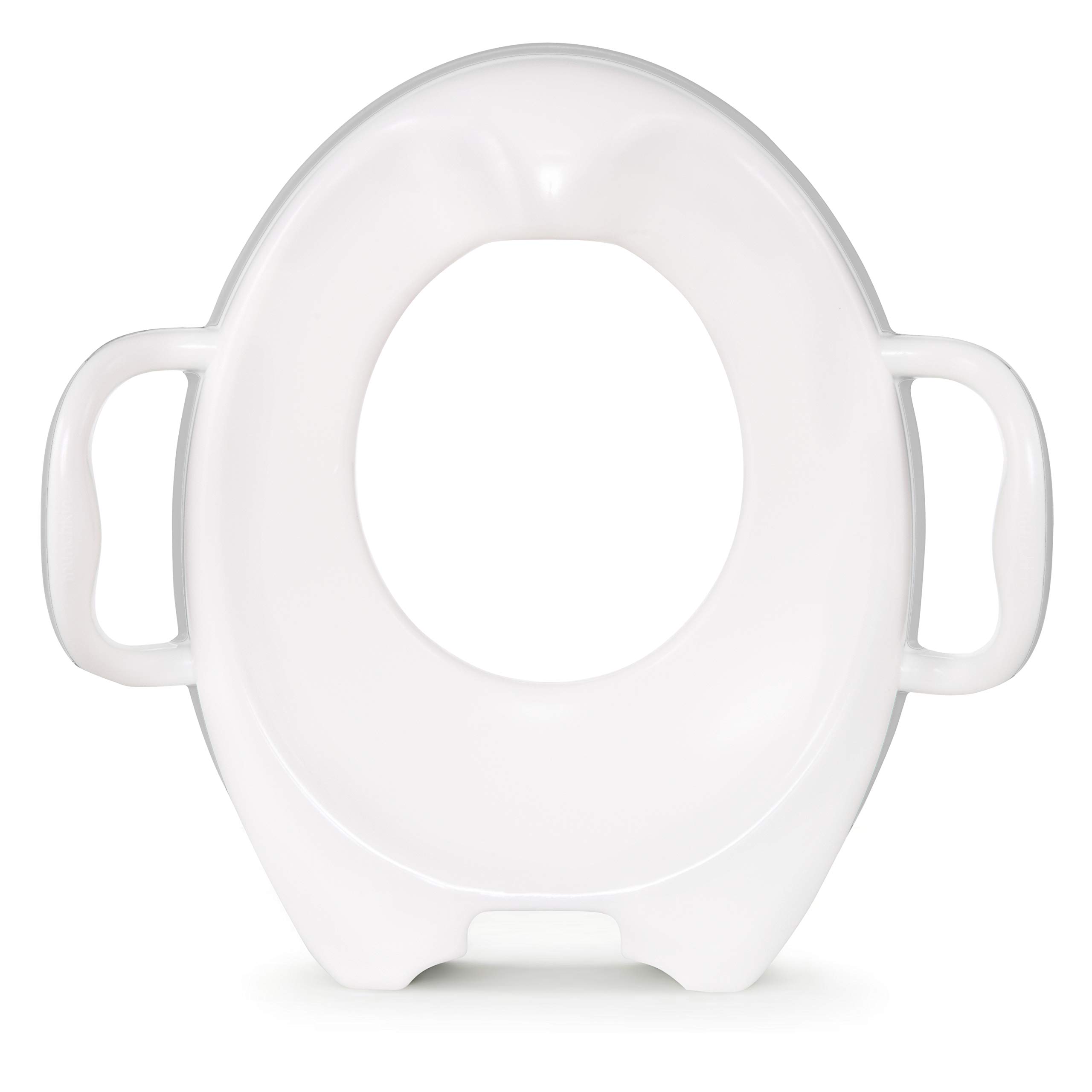
Munchkin Sturdy Potty Seat
Key Features
- Weight: 9.44 oz
- Handles: Built-in side handles
- Storage: Stands on its own feet
- Dimensions: 16"L x 3.75"W
- Price: Budget
Cheapest doesn’t usually come with a feature worth having, and this one does: two built-in handles that a wobbling toddler can grab with both hands. For a child who tenses up on the big toilet, that grip is worth more than most of the refinements the pricier seats add.
It is also the seat that stands on its own feet between uses, a small thing that keeps the wet side off your floor in a shared bathroom. The catch is the fit. Round bowls are where it runs into trouble, sitting proud and rocking when a child shifts, which leaves you holding the seat steady with one hand while you help with the other.
In practice that means checking the shape before you buy: a bowl close to the seat’s 16-inch length is where this one works best. If yours is a small round toilet, one of the rubber-ringed seats here is the safer choice, even though it costs more.
Pros
- Built-in handles for a wobbly sitter
- Stands on its own feet between uses
- Lowest price in this group
Cons
- Fit is hit or miss on round bowls
The budget buy we point to when a child wants something to hold: side handles and a low price, as long as your bowl is the shape it likes.
Best for Independent Climbers
Rabb 1st 2-in-1 Potty Seat

Key Features
- Weight: 3.8 lb
- Step size: 15.7" x 5.2"
- Height settings: 6, up to 3 inches
- Standing height: 15.94 inches
- Price: Premium
This isn’t an insert you carry. It is a small staircase with a seat on top, standing on the floor beside the toilet, and a child climbs the steps, turns, and sits at a height you set once. If you are picturing something that slips into a diaper bag, this is the wrong shelf entirely.
What it buys is independence. Six settings give you up to three inches of height adjustment, so the seat lines up with the bowl instead of hovering above or dropping below it, and the steps are wide enough at 15.7 by 5.2 inches that a two-year-old can plant a whole foot. The seat itself is cushioned in waterproof PVC, which is the difference between a child who sits and a child who perches. Assembly takes a coin rather than a toolbox.
The costs are real. At 3.8 pounds and roughly 16 inches tall it has to be moved out of the way whenever an adult needs the toilet, and it needs floor space beside it. We tightened the height locks twice before we trusted it, and that is the routine: a seat that isn’t locked down will wobble under a child who leans.
For the right household — one bathroom, room beside the toilet, a child who wants to do the climbing — it is the most independent setup in this group. For everyone else it is furniture with a seat on top, and the folding seats here do the job with far less to move.
Pros
- Wide steps a toddler can climb alone
- Six height settings, up to 3 inches
- Waterproof cushioned seat
Cons
- Takes floor space and must be moved for adults
- Wobbles if the height locks aren’t tight
For the child who insists on climbing up alone: a ladder seat with six height settings and wide steps, in a bathroom with floor to spare.
Best for Seat Plus Stool
Maliton Potty Seat and Stool

Key Features
- Fit: Adjustable snaps
- Storage: Hanging hook
- Includes: Potty seat and step stool
- Dimensions: 12.99"L x 14.17"W
- Price: Premium
Two pieces arrive in this box, and that is the point: a child-sized seat for the toilet and a separate step stool that goes wherever it is needed. Unlike the ladder seats here, nothing is bolted together, so the stool isn’t stranded in the bathroom.
The seat adjusts at the back, where snaps set it to the width of your bowl, with a non-slip border and a front splash guard doing the rest. A backrest curves where a small spine curves, and a hook lets the whole thing hang out of the way when the bathroom goes back to being an adult’s.
The stool is the piece we didn’t expect to care about. It is built light and has handles, so a child can shift it between the toilet and the sink, and it turns handwashing from something you lift them for into something they do themselves. In a training bathroom that is a dozen small wins a day.
Neither piece travels — the seat is around 13 inches across and the stool is a stool — so this is a set for a home bathroom rather than a diaper bag. If you want one purchase to cover both the climb and the seat, and it is staying in the house, this is the set we point you to.
Pros
- Seat and separate stool in one purchase
- Adjustable snaps fit the bowl width
- Stool moves to the sink for handwashing
Cons
- Adjustable snaps need re-setting on a different toilet
A seat and a separate stool in one purchase: the seat lives on the toilet, the stool lives at the sink, and both get used every day.
How We Tested the Best Potty Seat Inserts
We started by gathering every insert with a strong review record plus a few from baby-gear brands we’ve used for years, then cut anything that wouldn’t sit on both a round and an elongated bowl or that drew repeated complaints about sliding. That left 14 inserts, which we rotated through four months of actual training: the morning rush before daycare, the post-nap sit, the pre-bedtime attempt, and weekend outings where a folding seat had to survive a diaper bag, a rest-stop bathroom, and a grandmother’s toilet. We kept a round bowl at home and borrowed an elongated one so no insert got a free pass on fit.
Stability was tested the way it actually fails. I set each insert on the rim, sat my son down, and nudged him side to side while he squirmed, watching whether the suction cups gripped or popped loose, and whether the whole thing crept forward when he climbed on and scooted off. I measured each opening front to back and across, then compared it against his thighs to see where a leg could get pinched.
For portability, the folding models got opened and closed until the hinges stopped feeling stiff, then weighed and stuffed into a diaper bag pocket to see how much room they stole. Functionality came down to the messy details: after every accident we wiped the insert down and noted whether urine pooled in the seams or the padding soaked it up, and we checked splash-guard height for boys. At the four-month mark we inspected hinges for hairline cracks, suction cups for stiffening, and padding for tears — the inserts that held up still felt solid, while a few cheap ones had already started to give.
How to Choose a Potty Training Seat Insert
The insert that works is the one that doesn’t move, so start with your bowl and your child’s feet rather than with the feature list.
Fit starts with your bowl, not the listing
Almost every insert claims to fit round and elongated toilets, and that claim is usually a straddle: the seat is shaped to span both, which means a seat long enough for an elongated bowl overhangs a small round one, and an overhang is what tips when a child leans sideways. Measure your bowl from the hinge to the front rim and compare it with the seat’s stated length; within an inch or so, and it will sit flat.
The alternative is a seat that adjusts rather than compromises. The BabyBjörn’s dial is turned once to your toilet, and after that the seat repeats the same position every time, which is the closest thing in this group to a fitted seat rather than a universal one.
What actually stops a seat from sliding
Four things hold an insert steady and they behave differently. A rubberized ring grips a dry seat by friction and needs no pressing down. Suction cups hold harder on smooth porcelain but let go on domed or textured bowls, which is exactly what you meet in public restrooms. A dial or a strap creates a mechanical fit. Legs, on the ladder-style seats, take the weight off the toilet entirely.
Whatever the design, run the same test after setup: press the front edge down and try to rock the seat side to side before a child sits on it. If it moves under your hand, it will move more with a toddler aboard.
Splash guards, handles, and the boy question
A splash guard is the difference between training a boy and cleaning up after one, but the height cuts both ways: too low and it catches nothing, too high and a child can’t sit back. Most of the guards here sit fairly low, so if your son is tall for his age, expect to coach the angle for a while yet.
Handles are the other half of confidence, because a child with something to grip sits stiller and leans less. They matter most in the first weeks, when a toddler is still deciding whether the big toilet is safe; a child who is already steady won’t use them.
Seats that travel and seats that stay put
Decide where the seat will spend most of its life. A folding seat lives in a bag, weighs under ten ounces, and gets you through a restaurant bathroom without a negotiation. It also has hinges, and hinges are where mess collects, so wipe the fold as well as the top. A seat that stays on one toilet can be a single smooth shell with nowhere for anything to hide, and the flip-down designs go further by never leaving the lid at all.
Buying one of each is not extravagant. Most families end up with a seat on the home toilet and a folded one in the diaper bag, and the two jobs really are that different.
Frequently Asked Questions
When can my toddler switch from a floor potty to a seat insert?
When they can sit steady without you holding them and can get on and off with a step or a hand. The seats here that state an age range aim at roughly 18 months to three years, the stretch where a child has outgrown a floor potty but still drops through a full-size opening. Try a week of short sits before you put the floor potty away for good.
Do we need a step stool as well?
Sit your child on the insert and look at their feet. If the heels don’t rest on something solid, add a stool — braced feet are what let a child push and relax instead of gripping the rim to stay upright. A separate stool that also reaches the sink is the most useful version, which is why we like the two-piece sets here.
Will an insert work on a cushioned or soft-close toilet seat?
A cushioned vinyl seat is the one surface an insert can’t grip: it compresses under the ring and the seat rocks. Soft-close lids are fine for a free-standing insert, but a design that straps to the lid, like the Frida Drop Down, needs a lid that closes flat against the tank. If your lid sits proud, choose a seat that rests on the bowl instead.
Final Verdict
If most of your training happens at home, the BabyBjörn is the seat we recommend: the dial fits it to your bowl rather than splitting the difference between shapes, the opening is wide enough for a wriggling child, and one wipe cleans it. If the seat has to leave the house, the Jool Baby folding seat is the one that lives in the diaper bag.
Buy one of each and you have covered the whole training year — a fitted seat on the bathroom toilet and a folded one in the bag for everywhere else.
