This post contains affiliate links. We may earn a small commission when you buy through our links — at no extra cost to you.
A rattle is a baby’s first instrument—and the first toy many parents learn to regret. The wrong one is too heavy for tiny fingers, too big to bring to their mouth, or loud enough to make you dread the car ride home. The right one gets picked up again and again, survives being dropped on the sidewalk, and makes that little wrist turn feel like a triumph. I looked for rattles that babies actually wanted to hold, not just ones that looked cute in a basket.
Over four months, we tested 16 rattles in stroller walks, tummy time, and diaper-bag duty. We watched which ones got grabbed first and which inspired that all-important second shake. The best weren’t the loudest or the cutest; they were the ones small hands could grip comfortably, with a sound that didn’t make us wince and colors that caught a baby’s eye. This list covers wood, plastic, and fabric—because the right pick depends on your baby’s grip and your tolerance for noise.



Best for Everyday All-Rounder
Manhattan Toy Winkel
Key Features
- Care: Surface wash only
- Weight: 3 oz
- Material: BPA-free polyurethane
- Dimensions: 5.02 x 4.04 x 3.54 inches
- Price: Premium
A rattle has to survive a hand that has not learned to open on purpose. The Winkel’s answer is a nest of soft tubes with no wrong end: fingers close around a loop wherever they land, the whole toy comes up with the hand, and there is no handle to line up first. That is why it works at three months, earlier than most of the shapes here.
The open shape is what makes it our overall pick. At 3 ounces it is light enough for a young baby to swing, and the tubes are soft enough to chew, so the toy that gets shaken at four months is still useful during teething at seven. We kept it in the stroller pocket for months precisely because it covers both jobs without asking anything of the baby — the fist wraps a loop and the toy is already working.
Upkeep is the trade. Manhattan Toy says surface wash only, and the gaps between the loops hold drool, so cleaning means working a damp cloth into the maze rather than a quick rinse under the tap. It is not a dealbreaker — the same shape that traps the mess is the one a baby can grab — but it is the one thing we wish were different.
Pros
- Grabbable from any angle, even at three months
- Soft BPA-free tubes work as a teether
- Three ounces, light enough for a young baby
Cons
- Costs more than most single rattles here
We recommend the Winkel to almost everyone: the one shape here that works from a newborn’s first grab through teething, and worth the extra over a basic plastic rattle.
Best for First Rattle
Bright Starts Oball Rattle
Key Features
- Care: Wipe clean only
- Weight: 1.44 oz
- Age range: Newborn and up
- Dimensions: 4 x 4 x 4 inches
- Price: Budget
Three months is when a hand starts closing on purpose, and a ball full of holes is a better first target than a handle: there is nothing to line up, so the toy works whenever the fingers happen to land. At 4 inches across and 1.44 ounces, this is the one we hand a young baby first — light enough to swing, flexible enough to give a little on the way down, and affordable enough that losing it under the couch is a non-event.
It is a rattle second. The beads are quiet, the shell is firm, and there is not much to chew, so it stops at grasping and rolling; for gum relief, the Winkel’s tubes or a silicone teether do more. That is a fair trade at this price, and it is why the Oball is the toy we hand over first while the Winkel is the one we keep.
Pros
- Holes give small hands a grip anywhere
- 1.44 ounces, light enough to swing
- Quiet beads suit car rides and shared rooms
Cons
- Wipe clean only; cannot be submerged
For a baby’s very first rattle, we point to this one: a light, holed ball that a three-month-old can catch and keep hold of.
Best for Tight Budgets
Bright Starts Rattle & Shake Barbell
Key Features
- Care: Hand wash only
- Weight: 1.41 oz
- Age range: 3 months and up
- Dimensions: 2.4 x 5.1 x 1.2 inches
- Price: Budget
Two narrow rails joined by a clear barrel: that is the shape, and the narrow part is the whole point. A baby’s first grip closes on whatever is thinnest, and the bars at either end are much easier to catch than the fat rings and balls that dominate this category. It also rattles properly — beads in a clear tube, loud enough to register without being the thing you hear in your sleep.
Nothing here pretends to be a teether. There is a textured strip on the handle, but the toy’s job is shaking and grabbing, and that is what it does. We liked it as the second rattle in the bag: the one that is always there, that you do not mind losing, and that a baby can hold before they can manage anything rounder. If you are buying one toy and want it to last into teething, put the money toward the Winkel instead.
Pros
- Thin bars suit the earliest grips
- Clear barrel shows the beads moving
- One of the cheapest rattles here
Cons
- Little here for sore gums
- Hand wash only
We keep this on the list as the best cheap rattle: thin bars for early grips, a clear bead barrel, and nothing you will mourn when it disappears under the couch.
Best for Toy Stash
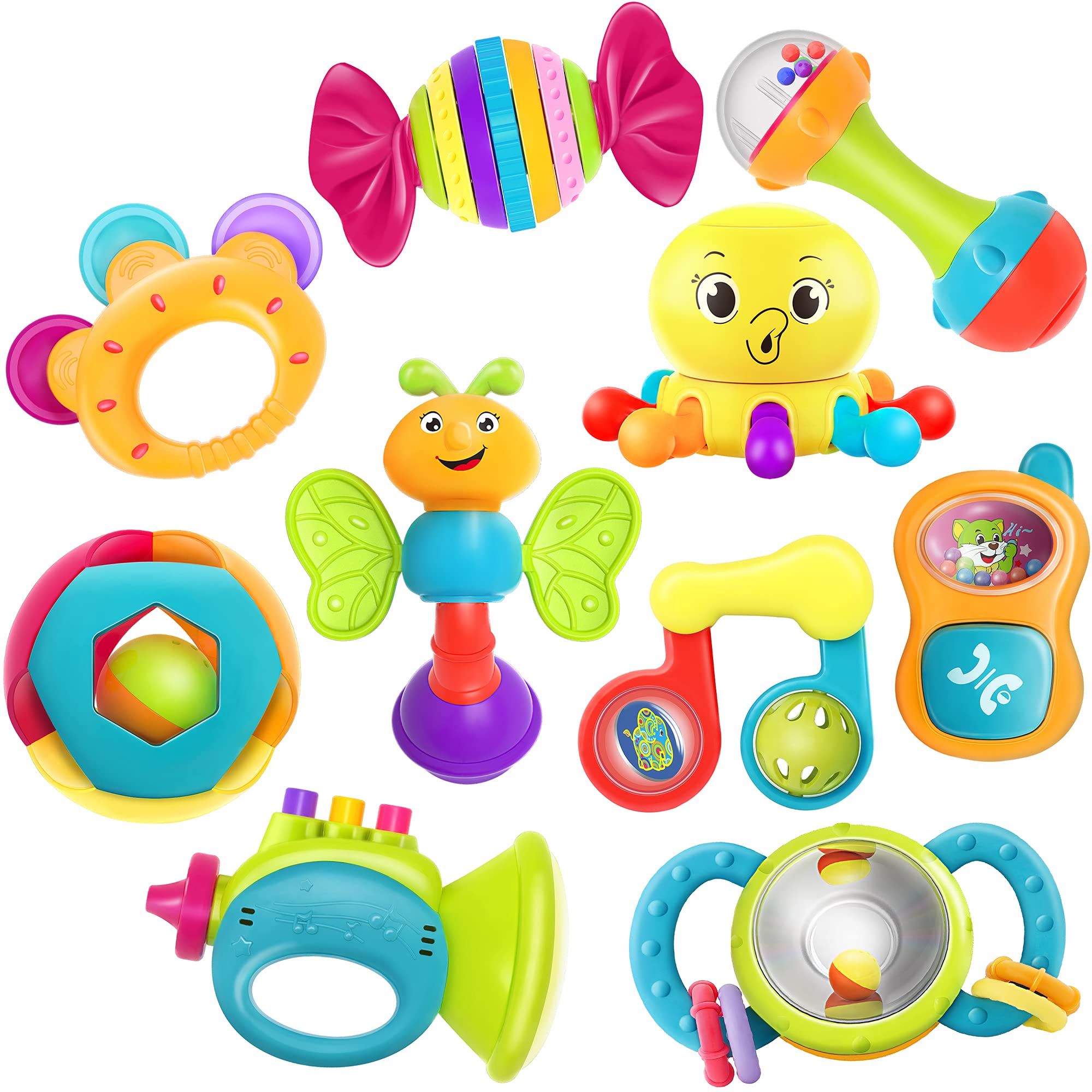
iPlay, iLearn 10-Piece Rattle Set
Key Features
- Care: Wipe with vinegar and water
- Pieces: 10 rattles
- Weight: 1.5 lb
- Age range: 0 to 12 months
- Price: Premium
Ten rattles in one box, each with a different grip, a different sound and a different set of moving parts. The pitch is obvious — you buy options and find out what your baby reaches for — and it is a better pitch than we expected, because the toys really do differ: some click, some squeak, some are a rattle on a ring and nothing more.
The material is the catch. These are hard ABS rather than soft silicone, and a four-month-old swings a toy with no idea where it is going, so an edge can land on a forehead. That is manageable — start with the rounder, lighter ones and bring out the busy ones once grabbing gets deliberate — but it is why this set is not our first choice for a newborn.
Where it wins is range. For the grandparents’ house, the diaper bag, or a baby who is bored of everything by Tuesday, ten different shapes beat one premium rattle, and the cost per toy is the lowest in this group. What it will not give you is a favorite: the toy you are still reaching for at eight months is likelier to be something soft.
Pros
- Ten different shapes, sounds and grips
- Lowest cost per toy in this group
- Bright colors and varied sounds
Cons
- Wipe-clean only; no steaming or soaking
Ten different shapes beat one if you are still learning what your baby reaches for, and no other pick here covers that much ground for the money.
Best for Car Seat Distraction
VTech Rattle and Sing Puppy
Key Features
- Weight: 4.64 oz
- Age range: 3 months to 2 years
- Batteries: 3 LR44 (included)
- Dimensions: 2 x 5.3 x 7 inches
- Price: Midrange
This is the only toy in the group that does something on its own. Shake it and the beads rattle; press the button and the puppy plays songs and phrases while its cheeks light up; the ears crinkle under a thumb. For pulling a baby out of a fuss on a car ride, that self-starting quality is worth more than any shape, and it is the one we reach for when a plain rattle has stopped working.
Everything else is a negotiation. At 4.64 ounces it is the heaviest toy here — fine for a six-month-old, a real handful for a three-month-old, which is why the grip is such a dividing line. The sound is tuned for a living room rather than a car, and the crinkle ears are the part babies go back to long after the songs have worn thin.
Pros
- Songs, phrases and light-up cheeks
- Crinkle ears and textured rings to handle
- Self-starting distraction for car or changing table
Cons
- Three LR44 batteries to keep stocked
- Hand wash only, so it cannot be rinsed
Buy it for the baby who needs distracting, not for the newborn: the songs and light-up cheeks do work no passive rattle can.
Best for Sensory Play
TOHIBEE Sensory Teether Ball

Key Features
- Care: Hand wash only
- Weight: 3.95 oz
- Material: Silicone and ABS
- Dimensions: 4.72 x 3.15 x 2.36 inches
- Price: Midrange
Silicone balls with different textures, a twisting clicker, a rattle ring and a bright set of colors: this is the busiest small toy in the group, and the one that gives a curious baby the most to do with a single hand. Everything turns, clicks or rattles, so the same toy changes as the grip does.
The size is the surprise: about 4.7 inches across and 112 grams, smaller than the photos suggest. A small, light toy a baby can hold in one hand gets used more than a big one they drop, so the compact build works in its favor here rather than against it.
The timing matters too. From about four months, when grabbing gets deliberate and a baby wants something to turn over and inspect, this earns its place; before that it is a lot of texture to take in, and the Winkel or the Oball is the easier start. After that, it is the thing in the diaper bag that buys you ten quiet minutes at a restaurant table.
Pros
- Textured silicone balls are worth chewing
- Rattle, clicker and twisting parts in one toy
- 112 grams and compact for a diaper bag
Cons
- Hand wash only; no sterilizing
For a baby who wants to turn things over and chew on everything, this is the busiest handful here: several textures, a clicker and a rattle in one.
Best for Curious Babies
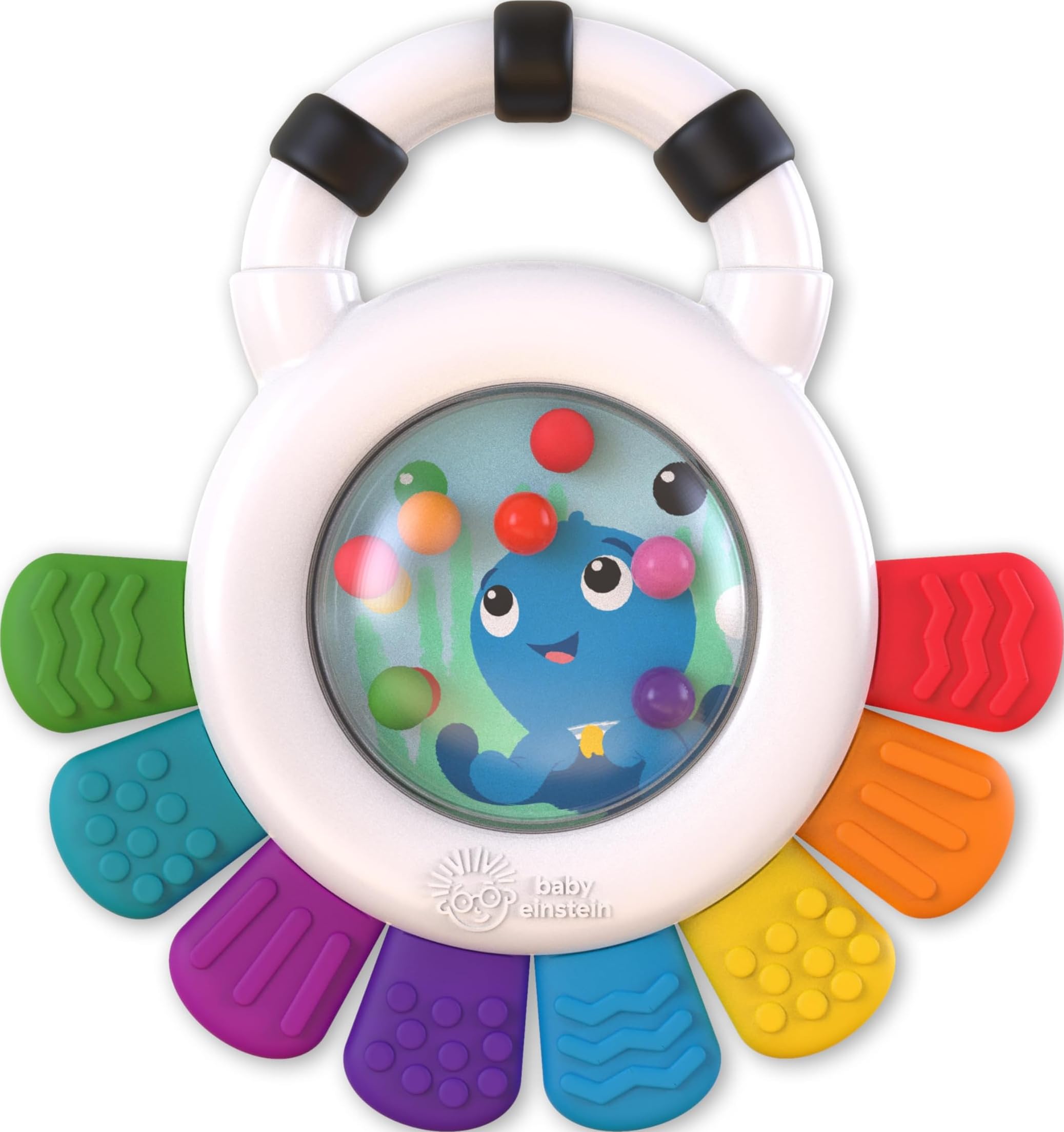
Baby Einstein Opus Rattle
Key Features
- Care: Wipe clean
- Weight: 3.53 oz
- Age range: 3 to 36 months
- Dimensions: 1.1 x 5.2 x 5.3 inches
- Price: Budget
A mirror, a bubble-popper over a smiling octopus, eight textures and a set of rattle beads: this is less a rattle than a small activity panel with a handle. Babies who like to study things get a lot from it — pressing the popper is a first cause-and-effect lesson, and the mirror is the part they come back to.
We like the black-and-white handle for young eyes, and the teether arms are soft enough to be worth chewing, which is more than most multi-feature toys manage. It is rated from three months, and the shape is compact enough to live in a diaper bag.
Weight is what holds it back. At 0.1 kg it is heavier than the plain rattles here, and a four-month-old still learning to hang on will drop it and then complain. From about five months, once they can hold and pass, that stops mattering and the mirror starts earning its place.
So this suits a five- or six-month-old better than a three-month-old, and a baby who prefers inspecting to shaking. For a newborn, the Oball gets picked up more easily and gets used for longer.
Pros
- Mirror and bubble popper add real play
- Soft teether arms to chew on
- Easy-grip black-and-white handle
Cons
- Wipe clean only
Best for the baby who prefers inspecting to shaking — a mirror, a popper and a rattle in one, once they can carry its weight.
Best for Gym-Themed Gifts
Fred Buff Baby Dumbbell

Key Features
- Care: Hand wash only
- Weight: 2.47 oz
- Material: ABS plastic
- Dimensions: 5.71 x 2.17 x 1.97 inches
- Price: Midrange
It is a dumbbell. That is the whole proposition, and as a shower gift for a household that posts workout photos, it lands better than another pastel ring. It is also the pick here that gets a laugh before the baby even touches it.
Under the joke is a decent rattle. The bar is 5.7 inches and slim enough for a small hand, it weighs 0.07 kg, and the beads give a soft sound rather than a clatter — pleasant in a room where someone else is trying to nap.
It is smaller than the product photos suggest — closer to a doll’s hand weight than the desk object the pictures imply — and that pushes it later than the newborn stage. It is a toy for a baby with some arm control, not a first grabber.
So: a gift pick, not a workhorse. If you want one rattle that covers grasping, teething and cleanup, this is not it. If you want the toy that gets a photo and a laugh at the shower and still rattles properly afterward, nothing else in this group does that job.
Pros
- The dumbbell joke lands as a gift
- Slim 5.7-inch bar is easy to hold
- Light at 0.07 kg with a soft rattle
Cons
- Hard ABS plastic with no give
Buy it as a gift rather than a first rattle: the dumbbell joke is the entire point, and the rattle underneath is perfectly decent.
How We Tested the Best Baby Rattles
We started by rounding up rattles sold for babies in that early grab-and-shake stage, then narrowed the field by size, material, washability, and price. We set aside anything with a seam that felt pry-able, a battery compartment, or a shape that looked too wide for a small mouth. That left 16 rattles, which we lived with for four months in diaper bags, strollers, play mats, high chairs, and the car.
During tummy time and stroller rides, we watched how each rattle sat in a baby’s palm, whether it could be held with three fingers, and whether it stayed put after a vigorous shake. We listened for volume in a quiet room and on car rides, and noted whether a rattle was too big to bring to the mouth or too small to feel secure. Color got checked in daylight and under indoor lights—some muted palettes disappeared. We also kept a running tally of which ones got picked up again after being tossed aside, and which survived drops onto pavement and tile without cracking.
At the end, we compared what each rattle cost against how often it got used, how easily it wiped clean, and how well it held up. The strongest performers weren’t always the most expensive; they were the ones that earned a spot in the diaper bag and still sounded and looked the same after four months. We’ll keep using them, and we’ll update this list if a rattle stops earning its keep.
How to Choose a Baby Rattle
A rattle is bought for one moment — a hand closing around something and shaking it — and nearly every decision after that comes down to grip, sound and how the thing gets clean.
Grip comes before everything else
A three-month-old’s hand closes on whatever presses into the palm; a six-month-old can aim. That is why shape matters more than anything printed on the box: open loops and holed balls can be caught anywhere, while a handle has to be lined up first. Weight follows the same curve — the toys in this group run from about 1.4 ounces to 4.6 ounces, and the light ones get held far longer. Buying for a newborn? Choose the lightest open shape you can find and save bars and handles for the deliberate grabbing that arrives a few months later.
Sound: how much noise, and who makes it
Beads in a chamber, a chime ball and a battery-powered song are three different products. Beads are the classic for a reason — the baby’s own hand makes the sound, which is the lesson. Quieter rattles are easier to live with and easier to use in a restaurant; louder ones pull attention across a room. Watch for the toy that makes its own noise: an electronic rattle plays whether or not the baby does anything, which is entertainment rather than cause and effect. One of each covers both jobs.
Teething makes cleaning a buying decision
If a rattle is going into a mouth, how it gets clean matters as much as what it is made of. Rattle chambers, battery compartments and water-filled rings cannot be submerged, so a toy that is surface-wash only never gets a proper rinse, however often you wipe it. Soft silicone and chillable teethers are the ones babies chew longest; water-filled rings go in the fridge, never the freezer. Read the care line before you pay, because it decides how useful a teether really is.
One good rattle, or a box of ten?
A single well-shaped rattle is enough for most babies. The argument for a set is discovery: nobody can predict which grip a baby takes to, and ten different shapes answer that question faster than one. Sets tend to be hard plastic and wipe-clean, which suits a baby with some arm control and a household that wants toys for the bag, the car and the grandparents’ house. Our advice is to buy one soft, grabbable rattle for the newborn stage, then add variety at four or five months, when preferences show up.
Frequently Asked Questions
When can a baby start using a rattle?
From the first weeks, a rattle is something you shake for them — newborns turn toward the sound long before they can hold anything. Most babies close a hand around a light toy at around three months and start shaking it on purpose soon after. Start with the lightest open shape you own, and keep heavier or battery-powered rattles for the second half of the year.
How should I clean a new rattle before the first use?
Wipe it with a damp cloth and mild soap, then wipe again with a clean damp cloth. That is what most makers here specify, and it is enough for a new toy. Skip boiling, steam and the dishwasher: heat warps thin rattle chambers, and anything with batteries stays out of water. One set in this group asks for a fifty-fifty vinegar and water wipe, so read the care line on the box.
Is it safe to leave a rattle in the crib?
No. A crib holds a firm mattress and a fitted sheet, and rattles, teethers and soft toys stay out of it, at naps and at night alike. A rattle is a supervised toy, for a stroller you are pushing or a floor you are sitting on. If your baby likes the sound to settle, shake it during the wind-down and take it with you when you leave the room.
Final Verdict
The Winkel is the rattle we hand over first, and the one still in the bag at seven months. Loops catch any grip, the soft tubes are worth chewing on, and three ounces is light enough for a baby who can barely hold anything.
Buying at three months with a smaller budget? The Oball is the better pure grasping toy — light, holed and cheap — but it stops there, while the Winkel keeps working through teething.
