This post contains affiliate links. We may earn a small commission when you buy through our links — at no extra cost to you.
A snack can survive the lunchbox, or it can be something kids actually ask for again. The best ones do both—and that’s a harder combination than the snack aisle suggests. A bar that snaps in half on the bus, a pouch that leaks, a snack-size bag that leaves a 7-year-old hungry: these small failures turn morning pack-up into a daily negotiation. The right snack fixes that by being sturdy enough to survive a backpack, portioned so it satisfies without spoiling dinner, and tasty enough that it doesn’t come home untouched.
I’ve packed snacks for my own kids long enough to know a big bag is only a value if it gets eaten. Over the past three months, my team and I tested 18 snacks in lunchboxes, after school, and on weekend outings. We looked for ones that tasted good to kids and adults, held their texture without turning to crumbs or paste, and came in portions that made sense for small appetites. The picks below are the ones that earned repeat requests—and survived the bottom of a backpack.





Best for Lunchbox Variety
Nabisco Team Favorites Variety Pack
Four flavors in one box is the reason this is our default. Thirty one-ounce packs split across Barnum’s Animal Crackers, Teddy Grahams and two more cookie flavors, so the kid who is bored of Wednesday’s snack still has something new on Friday. The packs are genuinely small, the sort a four-year-old finishes without help, and that sizing does more for this box than any single flavor in it.
The split isn’t even — seven packs of animal crackers and seven of Teddy Grahams, with the rest divided between the other two — and that turns out to suit families with mixed ages. The animal crackers go to the toddler, the chocolate ones to the older kid, and nobody has to open a full-size sleeve of anything. Animal crackers that are a good source of calcium and certified kosher cookies are a nice bonus; neither is why we buy it.
The limitation is sweetness: all four flavors are cookies, so this box covers the treat end of the lunchbox and nothing else. Pair it with a savory one and the week is handled. Freshness is the other variable, because a bulk box can sit in a warehouse before it reaches you — check the best-by date when it lands and keep the oldest packs at the front of the shelf.
Pros
- Four flavors in one box beat lunchbox boredom
- One-ounce packs sized for small appetites
- Individually wrapped and lunchbox-ready
- Strong value across 30 single-serve packs
Cons
- All four flavors are sweet cookies
Four flavors, 30 small packs, and a portion young kids actually finish — this is the box we tell friends to buy first.
Best for Classroom Treats
Rice Krispies Treats, 40 Bars
Key Features
- Box weight: 31.2 oz
- Bars per box: 40
- Calories per bar: 90
- Price: Midrange
Forty individually wrapped squares in one box, and that is the point of it: this is the snack you buy when you have volunteered for the class party, the team snack roster or the Halloween table. Each bar is 90 calories, small enough for a child to finish, and sealed so you can hand it out without touching anyone’s food.
Kids finish these, which is the only metric that matters for a snack bought by the case. The toasted-rice-and-marshmallow flavor is a known quantity in most houses, the bars don’t shatter in a lunchbox the way crackers do, and the price per bar is easy to live with. We keep a box for the days a lunchbox needs a guaranteed win rather than an experiment.
The catch is condition on arrival. Marshmallow bars are the first thing in a bulk order to show their age: a fresh one is soft and slightly sticky, an old one is hard enough that a small kid gives up on it. Buy from a listing that moves stock quickly and check the date on the box when it comes in — a hard bar isn’t worth packing.
Pros
- Forty individually wrapped bars, ready to hand out
- 90-calorie squares that suit small hands
- A flavor kids reliably finish
- Low cost per bar for a treat
Cons
- A treat slot, not a filling snack
The bulk treat box we buy for classrooms and teams: 40 wrapped 90-calorie bars kids finish, as long as the box arrives fresh.
Best for Mild Savory Snacks
Goldfish Big Smiles Variety Pack
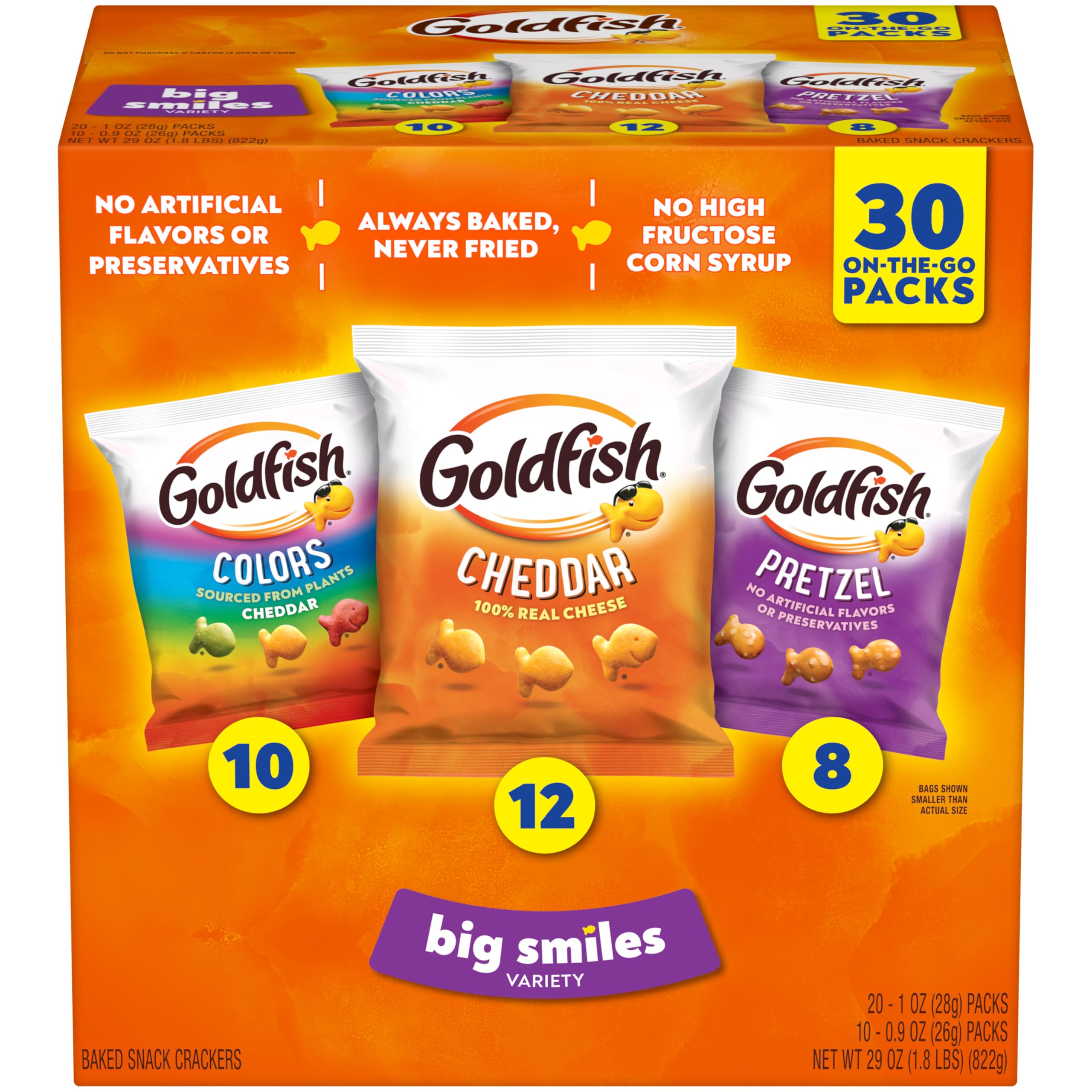
Set this box beside the Cheez-It one and the difference is obvious: Goldfish are the milder cracker, always baked rather than fried, with less salt on the surface and a cheese flavor even a suspicious three-year-old will take. That mildness is the recommendation, not a compromise.
The counts are worth knowing before you buy. Thirty packs break down as twelve cheddar, ten colors and eight pretzels, so the box never runs even — you finish on a run of pretzels, which is either the best or the worst week of the month depending on your household. If your kid only tolerates one flavor, plan for the tail end of the box rather than the middle.
Baked with no artificial flavors or preservatives is what earns this box a regular slot, and the single-serve bags go into a lunchbox without a fight. Freshness is the thing to watch: a Goldfish that bends instead of snapping has been around too long, so buy from a fast-moving listing and look at the date. For the savory slot with younger kids, this is the one we pick.
Pros
- Baked, with no artificial flavors or preservatives
- Three flavors in one 30-pack box
- Mild and not overly salty
- Single-serve bags that fit a lunchbox
Cons
- Uneven flavor counts — only 8 pretzel packs
Mild, baked and free of artificial flavors — the savory box we hand to younger kids, in 30 single-serve packs.
Best for Fruit Snack Staple
Welch’s Fruit Snacks, 40 Pouches
Key Features
- Pouches: 40
- Vitamins: 25% DV of A, C & E
- Pouch size: 0.8 oz
- Price: Budget
‘Made with whole fruit’ is the claim on the front, and it’s worth knowing what it buys you. Whole fruit is the main ingredient and there are no artificial dyes, which is a cleaner recipe than a lot of gummy snacks carry. What it doesn’t buy you is a serving of fruit — a small pouch of fruit snacks is a sweet, and we treat it as one.
Texture is where these win with younger kids. They’re soft and gummy and break down quickly rather than fighting back, which is exactly the property that makes a chewy snack usable for a four-year-old with a full lunchbox in front of them. Adults tend to find them sweet; kids don’t.
Forty pouches at 0.8 ounces each, individually wrapped, gluten free and carrying 25% of the daily value of vitamins A, C and E. They take up almost no room in a lunchbox, and the box lasts long enough to be a pantry staple rather than a one-week splurge.
This is the fruit snack we hand to the under-eight crowd: dye-free, soft, and the one here least likely to come home half-chewed. Older kids finish a pouch in three bites and ask for a second, so budget two per lunch or add a cracker alongside — that’s the only argument we have with the box.
Pros
- Soft texture younger kids chew easily
- No artificial dyes; whole fruit is the main ingredient
- Vitamins A, C and E in every pouch
- Forty pouches sized for lunchboxes
Cons
- Small 0.8-ounce pouches; older kids want two
Soft, dye-free and easy to chew: the fruit snack we pack when the lunchbox needs something sweet that won’t come home untouched.
Best for Bigger Appetites
Cheez-It Original, 40 Packs
Key Features
- Packs: 40
- Made with: 100% real cheese
- Pack size: 1 oz
- Price: Premium
It’s the priciest box in this group, and we still keep it on the list, because a one-ounce bag of Cheez-Its is a real snack rather than a taste. Forty of them in a box, each bag sealed, made with real cheese and finished with salt on top.
The flavor sits at the sharp end of the savory picks here — more salt and more cheese than the Goldfish box, which is exactly why some kids ask for these by name and others hand them straight back. If your kid likes a strong cheddar hit, this beats the milder crackers; if not, it won’t get eaten, whatever the portion size.
Freshness is the usual bulk-box risk. The individually wrapped bags protect the rest once the box is open, but a stale bag tastes flat instead of cheesy, so check the date when it arrives and buy where stock turns over. The bags themselves are sturdy enough to survive a backpack.
Where it earns its place is appetite: an ounce is a proper handful, which makes this the better box for the nine-year-old who says crackers don’t fill them up. You pay more per box than for the Goldfish or the Ritz, and for a household that goes through savory snacks quickly the 40 bags justify it.
Pros
- One-ounce bags that count as a real snack
- Sharp real-cheese flavor kids ask for
- Forty individually wrapped bags
- Sealed bags keep the rest of the box crisp
Cons
- The priciest box in this group
- Saltier and sharper than the other savory picks
We pick this one for the savory kid with a bigger appetite: sharper, saltier crackers in 40 one-ounce bags, and the priciest box here.
Best for Backpack-Safe Chips
Pringles Snack Cups, 27 Count
Key Features
- Cups: 27
- Flavors: Original, Sour Cream & Onion, Cheddar
- Total weight: 19.5 oz
- Price: Midrange
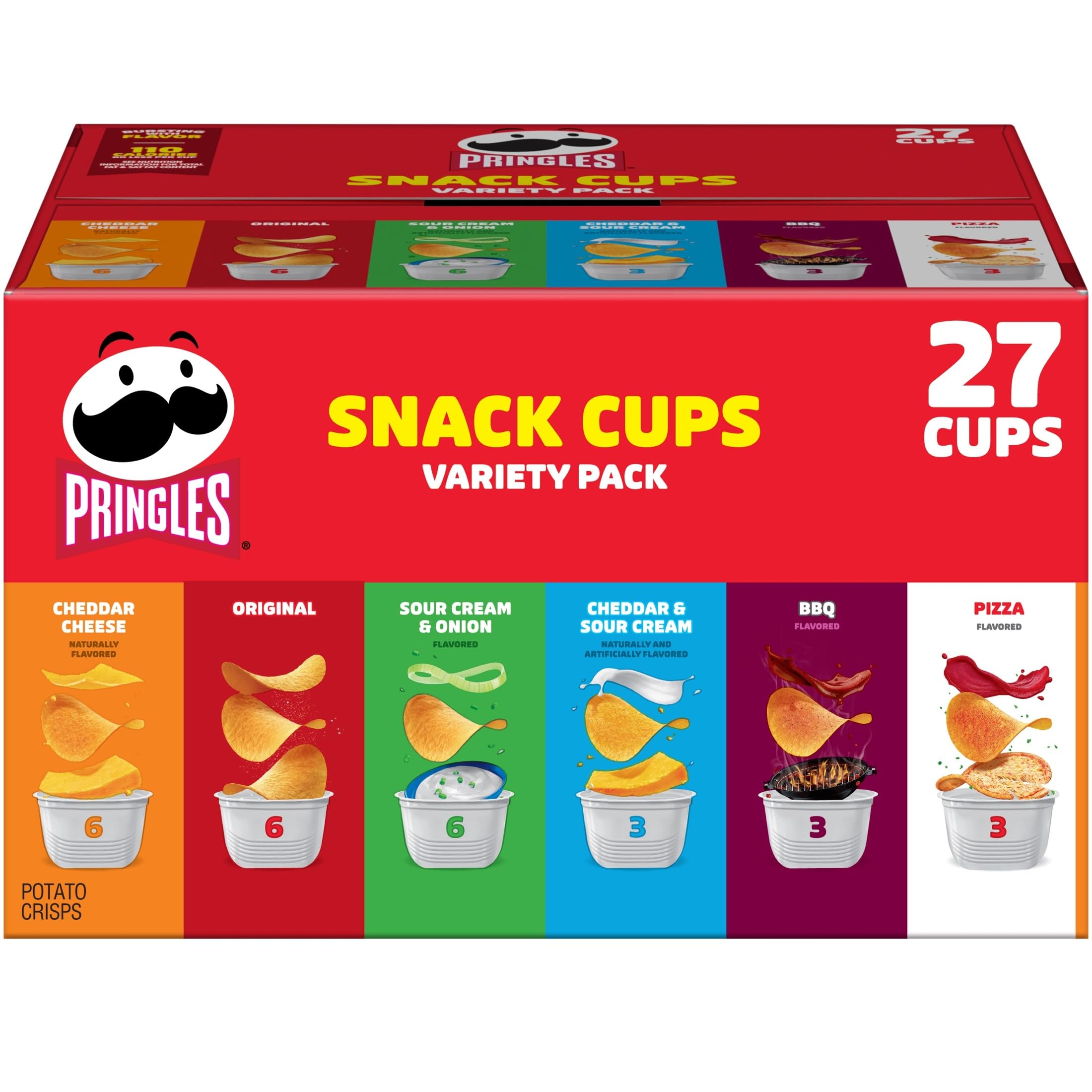
The cup is the whole reason these are on the list. A foil bag of chips goes into a backpack and comes out as crumbs; a Pringles cup keeps the crisps stacked and whole, and the crisps themselves are too big to shatter the way thin chips do. For a packed lunch, that’s worth more than a flavor upgrade.
The box mixes Original, Sour Cream & Onion and Cheddar Cheese across 27 cups, which covers most kids’ preferences in one purchase. Flavor is where this box is softest among the savory picks here — the seasoning is assertive, and a kid who likes plain crackers may not go for the sour cream cups.
Portions are modest: 27 cups out of a 19.5-ounce box tells you each one holds a small handful, so treat it as a side rather than the main event. That’s fine for a lunchbox and thin for an after-school hunger, which is why we pair a cup with a sandwich rather than handing one over on its own.
Pros
- Rigid cups keep crisps unbroken in a bag
- 27 single-serve portions in one box
- Three classic flavors in one purchase
Cons
- Modest portion per cup
- Assertive seasoning some kids reject
A bag of chips comes back as crumbs; these cups don’t, which is why they’re our lunchbox chip — 27 small portions with assertive seasoning.
Best for Shelf-Stable Dessert
Snack Pack Pudding Cups, 12 Count
Key Features
- Cups: 12
- Flavors: 6 chocolate, 6 vanilla
- Cup size: 3.25 oz
- Price: Budget
Pudding in a lunchbox has one obvious friction: the spoon. Pack one deliberately, or the cup comes home unopened. Everything else about these cups is convenience — they don’t need refrigeration before opening, so they live in the pantry and go into a bag without an ice pack.
Twelve cups, six chocolate and six vanilla at 3.25 ounces each, made with real nonfat milk and without preservatives or high-fructose corn syrup. The chocolate is the one that gets finished; vanilla is the compromise cup. The shelf life is long enough that a family pack never becomes a race against the date.
Consistency is the catch. Pudding cups vary — some are properly set and creamy, others run thinner than the picture on the lid, and you can’t tell from the outside. Ordering by the case also risks crushed cups in transit, so open the box and check before you stack it in the pantry. For a lunchbox dessert that never needs a cooler, we still think it’s worth remembering the spoon.
Pros
- No refrigeration needed before opening
- Real milk, no preservatives or high-fructose corn syrup
- Six chocolate and six vanilla cups in one pack
- Long pantry life for a dessert
Cons
- Cups can arrive crushed in shipping
- Consistency can run thin in some cups
The dessert we reach for when a lunchbox has no cooler: chocolate and vanilla cups, no refrigeration needed, spoon required.
Best for Build-Your-Own Snacks
Ritz Fresh Stacks, 16 Packs

Key Features
- Stacks: 16
- Box weight: 23.7 oz
- Crackers per stack: 13
- Price: Budget
Thirteen crackers in a sleeve is the detail that matters here. For a five-year-old that’s two sittings or a share; for an adult it’s a proper lunch accompaniment. The Fresh Stacks box isn’t a replacement for a bag of crackers, it’s a portioned one, and the portion is bigger than most single-serve packs here.
Sixteen sleeves, each sealed, means the rest of the box stays crisp while you work through it — more than you can say for a bulk sleeve that goes soft after the first week. Ritz also take toppings better than anything else on this list: cheese, peanut butter, tuna salad, soup. They’re just as good plain, which is why they end up at desks and in classroom snack bins.
On price this is one of the cheapest boxes in the group, and that’s a strange thing to bury. A sleeve of 13 buttery crackers is a substantial snack for very little, which is why it’s the box we restock most often rather than the one we save for a treat.
Our reservation is that it’s a vehicle, not a finished snack. A kid who wants something to open and eat will take the Goldfish or the cookies first, and a plain cracker can be a hard sell on its own. Where the box earns its keep is in households that assemble snacks anyway and in anyone who wants a cracker that tastes of butter rather than cheese powder.
Pros
- 13-cracker sleeves, enough for a lunch
- Pairs with cheese, peanut butter or soup
- Individually wrapped so the box stays crisp
- One of the cheapest boxes here
Cons
- Crackers often arrive cracked or crumbled
If your kids build snacks instead of opening them, this is the box we restock: 16 sealed sleeves of 13 buttery crackers that carry cheese, peanut butter or soup.
How We Chose and Tested Kids’ Snacks
We started with a shortlist of snacks available in grocery stores and big-box retailers, then narrowed it by portion size, packaging format, and whether the snack could realistically go into a school lunch without a fight. We ended up with 18 snacks and tested them for three months. Each one went into weekday lunchboxes, after-school car rides, and weekend park trips—the places where snacks actually get eaten, crushed, and traded.
At lunch, we watched which snacks got opened first and which came home untouched. We tasted each one ourselves, noting whether it was too sweet, too salty, or bland, and asked the kids for repeat requests. Texture mattered as much as flavor: we checked whether crackers arrived unbroken after a backpack commute, whether fruit snacks were chewy or stuck to teeth, and whether puffed snacks dissolved cleanly or turned to paste.
For freshness, we opened a bag, left it in the pantry for a week, and tasted again to see if it stayed crisp or went stale. We also opened multiple bags of the same snack to check consistency—same seasoning, same crunch, same piece size. Value came down to cost per serving versus how much actually got eaten, and we compared package size with real portion size, watching whether one bag was enough for a 6-year-old or too much for a 4-year-old. The snacks that scored best were the ones kids asked for again, parents didn’t mind paying for, and that still looked and tasted right at the bottom of a bag.
How to Choose Snacks for Kids
The snack that works is the one your kid actually eats, in a portion that fits the lunchbox — everything else on the box is marketing.
Start With the Portion, Not the Box
A 40-count box looks like value until half of every pack comes home. Match the pack to the eater: 0.8-ounce fruit pouches and 1-ounce cracker bags suit most kids under eight, while a third grader usually wants closer to an ounce and a half or a second item alongside. Pudding cups at 3.25 ounces are a dessert, not a snack on their own.
The trap is buying the biggest box of the smallest pack, which is the combination that leaves you packing two of everything. Count a week’s worth of snacks before you pick a size.
Buy the Box You’ll Finish
Individually wrapped snacks hold up well, but a bulk box still sits in the pantry for weeks, and crackers and marshmallow bars are the first to show their age — a cracker that bends instead of snapping, or a bar that’s hard to bite, has been around too long. Buy the size your household finishes in about six weeks rather than the best price per pack.
A 16- or 30-count box you actually get through beats a 56-count one that outlives its own freshness.
Build a Rotation, Not a Stockpile
Lunchboxes go better with one savory and one sweet option than with six of either. Variety packs solve this in a single purchase: four cookie flavors or three cracker flavors means a kid who’s bored by Wednesday still has a choice on Friday, and a picky eater can hand back the pretzels without rejecting the whole box. A single-flavor 40-count is the box that goes stale in the cupboard.
If you’re not sure what your kid will eat, buy one small pack first and let them choose before you commit to the case.
Texture and Packaging Decide What Survives
Two things ruin a packed snack: a texture the kid can’t manage and packaging that doesn’t protect the food. Younger kids do better with soft, quick-to-chew fruit snacks and small, thin crackers; hard bars and sticky chews get rejected or end up in a napkin. In a backpack, rigid Pringles cups and boxed pudding cups arrive intact, while foil sleeves of crackers and cookies are the ones that come back as crumbs.
If the snack has to travel, favor the rigid pack, and keep the foil sleeves for days the lunchbox stays upright.
Frequently Asked Questions
Are fruit snacks a healthy snack for kids?
Treat them as a sweet, not a fruit serving. ‘Made with real fruit’ and ‘whole fruit as the main ingredient’ describe the recipe, not a portion of produce. What you can check on the label is the dye and vitamin line — Welch’s, for example, uses no artificial dyes and adds vitamins A, C and E. One pouch fills the sweet slot in a lunchbox; two is dessert.
Can kids take these snacks to school?
That depends on the school’s snack policy, not the packaging. Many classrooms restrict cookies, chips and candy, and plenty are nut-free, so read the allergen line before you pack for a class. Baked crackers and dye-free fruit snacks clear more school lists than cookie packs do. If your school sends home a snack list, match the box to it before buying a 40-count.
How long do these snacks stay fresh?
None of them need refrigeration before opening, but the clock differs by type. Pudding cups are the most forgiving in the pantry, crackers and cookies go soft first, and fruit snacks firm up as they age. Write the best-by date on the shelf where the box sits and pack the oldest pouches first. If a box arrives past its date, ask for a replacement instead of working through it.
Final Verdict
For one box that does the most lunchbox work, make it the Nabisco Team Favorites: four flavors, 30 packs, portions small enough for young kids, and the most consistent feedback of anything here. If your kid won’t touch sweet snacks, the Goldfish Big Smiles box covers the savory slot with baked crackers in three flavors.
For a dessert that survives a warm backpack, add the Snack Pack pudding cups and a spoon.
