This post contains affiliate links. We may earn a small commission when you buy through our links — at no extra cost to you.
The nursery looked perfect in the photos—until the first 5 a.m. wake-up, when the blackout curtains glowed like a nightlight and the rug slid across the floor every time I stepped in. Nursery decor is supposed to make the room feel calm and finished, but it also has to do real work: darken the room for naps, soften the floor for crawling, and hold up to a baby who grabs everything. Over the past nine months, we’ve tested 14 nursery decor pieces—curtains, rugs, wall art, and mobiles—in actual nurseries, not showrooms.
The pieces that looked best online weren’t always the ones that survived a baby. Color can shift dramatically between a screen and a nursery wall, and soft means little until you’ve felt it under bare knees during a 3 a.m. feed. A nursery doesn’t need a theme; it needs a few hardworking pieces—light blocking that actually blocks light, a rug that stays put, and quality that doesn’t fray after the first wash. We compared appearance, color, softness, and value, and the picks below are the ones that earned their place.


Best for Blackout Nursery Windows
MIULEE Blackout Linen Curtains
Key Features
- Care: Spot clean; do not machine wash
- Pack: 2 panels
- Panel size: 52"W x 84"L each
- Light control: 100% blackout, lined
- Price: Budget
Most nursery windows force a choice: something that kills the light and looks like a hotel room, or something pretty that does nothing at two in the afternoon. These do both. The face is a textured linen-look weave in a soft beige, the back is a coated blackout liner, and the set arrives as two 52-by-84-inch panels — the detail that settles it against the single-panel curtains here.
Weight is what makes them hang properly. At 4.1 pounds for the pair they fall in a straight fold instead of drifting, and the 1.6-inch grommet openings slide over a standard rod, so the rod you already own probably works. We like that kind of thrift in a nursery, where the list of things to buy never seems to end. Hanging the rod wider than the frame and closer to the ceiling than feels natural closes most of the light gap at the edges.
The panels arrive folded and creased, so borrow a hand steamer before hanging day; a warm iron or a low tumble does the same job. Eight sizes are offered, and the 84-inch length is the one that lets you mount high and pull the gap at the top down to almost nothing. In a room that gets repainted for a toddler in two years, this beige is a safe thing to build around.
Pros
- Two panels per pack, not one
- Blocks light without the hotel look
- Grommets fit a standard rod
Cons
- Not machine washable — spot clean and steam
Two lined panels that darken a nursery for naps and still look like soft, textured linen — that combination is why we point window shoppers here first.
Best for Bare Rented Walls
decalmile Jungle Wall Decals
Key Features
- Material: Waterproof vinyl
- Mounting: Peel and stick, removable
- Sheet size: 11.8" x 35.4", 2 sheets
- Finished size: 40" x 30.3"
- Price: Budget
A nursery wall can sit bare for months because every fix sounds expensive: paint, a mural, a gallery of framed prints. Two sheets of vinyl and a free hour solves it. The set builds a jungle tree with an elephant, giraffe and lion among leaves and vines, and you decide the spacing yourself.
What makes it pleasant rather than fiddly is the numbering. Every piece has a number matched to a printed guide, so you’re assembling a layout instead of guessing at composition. We were pleasantly surprised by how much that helps on a wall you can only see from the floor. The vinyl also sticks to lightly textured walls, which is the usual failure point for peel-and-stick decor, and lifts back off if a piece lands crooked.
It’s an accent, not a mural. Plan a dresser-width of wall, above a dresser or beside the crib, and keep the animals low — at the height a baby actually looks from a changing table. Spread the pieces wider than the guide suggests if your wall has the room, and when the jungle loses its charm it peels away without a patch of spackle.
Pros
- Numbered pieces make placement simple
- No holes and no paint
- Sticks to lightly textured walls
- Lifts off when the theme changes
Cons
- Finished scene is about 40 by 30 inches
If you’re renting or not ready to commit to paint, this is the fastest way to give a nursery a theme — two sheets, numbered pieces, and no holes to patch.
Best for Soft Play Zone
RELEANY Floral Area Rug
Key Features
- Care: Machine wash cold
- Pile: Low pile, 0.2 in
- Size: 5′ x 7′
- Backing: TPR non-slip
- Price: Midrange
Five by seven feet — 60 by 84 inches of floor — is the size that turns a nursery into a room with a zone in it: big enough to sit on with a baby, small enough to leave bare floor around the crib and the dresser. The printed floral brings pinks and greens that stay saturated rather than fading to pastel, and the surface feels like velvet underfoot.
What sold us is the pairing of a low 0.2-inch pile with a rubbery TPR back. Thin is a feature here: it’s why the rug can go in the washing machine, why a robot vacuum doesn’t choke on it, and why the edges lie flat instead of curling up at the corners. It is the opposite of a deep shag, and in a room that will host spilled milk and a crawling baby we think that’s the right trade.
It ships folded in a box rather than rolled, so give it a few days to relax before deciding it looks wrong; the creases work themselves out. The surface is water repellent, which buys you time on a spill — blot rather than scrub. And the floral is busy enough to set the room’s palette, so choose it before you choose the art.
Pros
- Washable five-by-seven fills a real nursery floor
- Velvet-soft surface in strong colors
- Lies flat and grips with a TPR back
Cons
- Low pile — soft, but thin underfoot
The floor layer we reach for when a nursery needs warmth and color: a washable five-by-seven that feels like velvet underfoot and lies flat without curling.
Best for Patterned Farmhouse Look
Grainger Buffalo Check Panel
Key Features
- Pack: 1 panel
- Fabric: 90% polyester, 10% linen
- Panel size: 52"W x 84"L
- Light control: Lined blackout, sewn-in liner
- Price: Premium
A three-inch buffalo check is a big, confident pattern, and on an 84-inch panel it reads as the room’s theme rather than a detail. We think that’s the right move when the walls are plain and the bedding is solid: one bold textile does more for a nursery than five small ones. It’s the loudest thing on this list, and it knows it.
Two things decided it for us. The slub weave carries real linen flecks, so the check reads woven rather than printed, and the sewn-in off-white liner gives the panel enough body to hang in a clean column — 2.8 pounds of curtain, not a sheet of fabric. Then there’s care: it goes in the machine on a delicate cycle, which is rare for a lined blackout panel and matters in a room where everything gets wiped.
The catch is light. The liner filters and softens rather than sealing the window, so this suits a baby who sleeps through a bright afternoon and not the toddler who wakes at first light. If total darkness is the goal, the MIULEE pair is the better buy. The check is a scale decision too: at three inches it’s bold from across the room, and in a small nursery it will dominate whatever hangs beside it.
Pros
- Buffalo check with a woven linen look
- Machine washable despite the blackout liner
- Back tab or rod pocket hanging
Cons
- One panel per pack — a window needs two
For a farmhouse nursery where the window should carry the pattern, this lined buffalo check is the pick — order two panels and don’t expect pitch black.
Best for Small Corner Softening
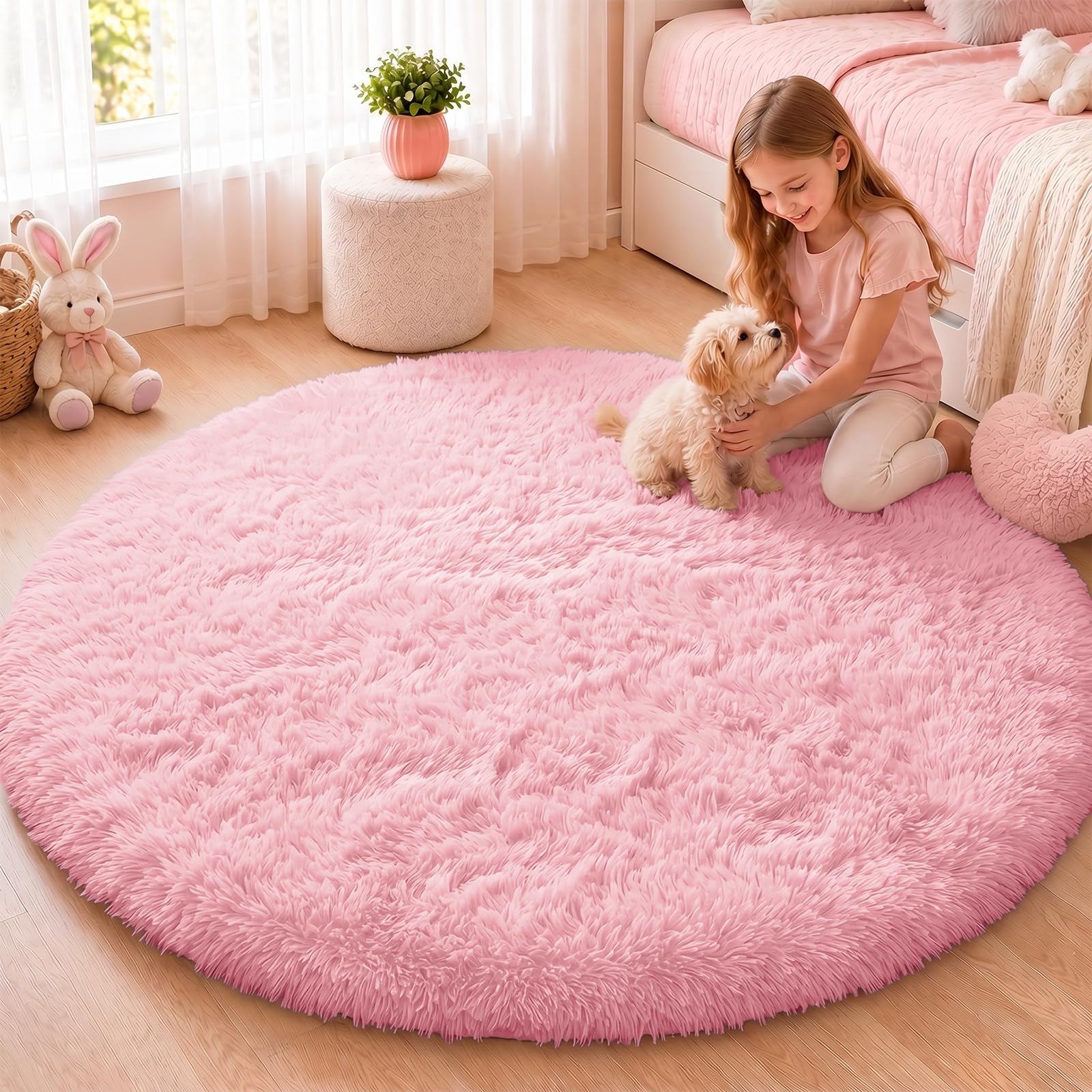
OLANLY Round Nursery Rug
Key Features
- Care: Machine wash
- Pile: High pile, 0.4 in
- Size: 4 ft round
- Backing: PVC non-slip dots
- Price: Budget
Round rugs solve something rectangular ones can’t: they finish a corner without squaring off the room. At four feet across this one tucks beside a glider or under a small play arch without crowding the crib, and the pink is a proper saturated pink rather than a washed-out pastel, which is easier to build a room around than it sounds.
It arrives vacuum-compressed in a bag, so the first hour is unflattering: flat and creased. Two or three days laid out and it recovers most of its fluff. That’s a shipping method rather than a fault, but it’s worth knowing before you conclude you’ve been sent the wrong rug.
Where it earns its place is underfoot. The pile is soft enough that a baby will happily lie on it for tummy time, and it goes in the washing machine, which is the single most useful thing a nursery rug can do. On carpet the dotted backing holds well; on smooth sealed wood it slides, so plan on a gripper pad. In our view the modest size is the whole point — it’s the decor piece you can move when the furniture does.
Pros
- Soft enough for tummy time
- Machine washable
- Round shape finishes a corner
Cons
- Pile is shallower than the plush photos imply
Our pick for a corner that needs softening: a four-foot round that’s genuinely soft underfoot, goes in the washing machine, and asks very little of a small room.
Best for Narrow Wall Filler
GIAUMA Eucalyptus Wall Decor

Key Features
- Size: 19.5"W x 16.5"D
- Weight: 4.8 oz
- Assembly: Pre-assembled hanging loop
- Material: Faux eucalyptus, wood branch
- Price: Midrange
Every nursery has one awkward wall — too narrow for art, too visible to leave empty. A hanging branch fills it without a shelf, a frame or a plant to water. This one pairs a natural wood branch with faux eucalyptus, wooden beads and a cotton tassel, in sage and oatmeal tones that sit easily next to linen curtains and a floral rug.
What we noticed on arrival is how little it asks of the wall. It comes fully assembled with a loop at the top, so it hangs from a single nail or picture hook, and at under five ounces it needs no anchor and no drilling. Both of those matter in a rental, or in a room where you’ve already made more holes than you planned.
Hang it away from the crib. The beads and tassel are exactly what a standing baby reaches for, and the wooden elements are the fragile part of the design — the branch and the round wooden accents can arrive cracked, so check them before they go up. The faux stems need an occasional dusting and nothing else, which is the point of fake greenery in a room that already has plenty to look after.
Pros
- Ready to hang from one nail
- Fills a narrow wall without a shelf
Cons
- Wooden branch and beads can arrive cracked
For the narrow wall that needs something living and can’t take a shelf, this pre-assembled eucalyptus branch hangs from one nail and never needs water.
How We Tested Nursery Decor
We started by scanning nursery registries, parent forums, and retailer reviews, then narrowed the list by size, material, and price—no point testing a rug that only came in one dimension or a curtain panel that couldn’t cover a standard window. We ended up with 14 pieces: blackout curtains, area rugs, a mobile, and wall art. Each lived in a real nursery for nine months, through nap schedules, bedtime routines, and the occasional 2 a.m. diaper change.
For curtains, I hung each panel on the same window and checked light blocking at 6 a.m., noon, and 8 p.m., noting whether light crept around the edges or through the fabric. I also measured drop and width against the window frame and washed each panel according to the care label to see if the fabric shrank, faded, or lost its backing.
For rugs, I laid each one on both hardwood and carpet, then tugged the corners and walked across it in socks to judge grip. I measured thickness with a ruler, pressed a knee into the pile to check softness, and vacuumed weekly to see how the edges held up. Wall art and mobiles got a simpler test: I hung them at crib height, watched how the colors read in daylight and at night, and checked for sharp corners, loose threads, and hardware that felt flimsy.
At the end, I compared what each piece cost against how it looked and performed after nine months—a cheap rug that shed or a curtain that let in a stripe of light didn’t feel like a bargain. The ones that made the list are the pieces I’d put in my own nursery again.
How to Choose Nursery Decor
Nursery decor earns its keep when it does a second job — darkening the room, softening the floor, or covering a wall you cannot paint.
Start With the Window
You get more change per dollar at the window than anywhere else, and curtains are the one decorative piece that also does work. Hang the rod wider than the frame and closer to the ceiling than feels natural; the light that leaks around the edges is where most blackout disappointment comes from, not the fabric itself. Decide first whether you want true blackout or a lined decorative panel. The buffalo check we recommend filters and softens light, which suits a flexible sleeper but not a toddler who wakes with the sun. Panels come singly or in pairs, so count before you order.
Choose a Floor Layer You Can Wash
Pile height is a cleaning decision as much as a comfort one. Low pile, around a fifth of an inch, washes, lies flat and doesn’t fight a vacuum; high pile feels better under a knee but flattens where the glider sits. Match the size to the zone — a five-by-seven anchors a crib-and-chair arrangement, while a four-foot round finishes a corner without eating the floor. Check the backing against your floor too: the same dotted base that grips carpet can slide across sealed wood, where a gripper pad solves it.
Wall Decor Without Holes
Decals, a leaning frame and hanging greenery all skip the drill, but they suit different walls. Decals are the only one of the three that covers a large area for very little and comes back off again. Sheet size is not finished size — a set sold as two long sheets may build a scene barely wider than a dresser, so read the recommended layout before you plan a mural. Whatever you hang, keep it off the wall directly above the crib and out of a standing baby’s reach.
Pick One Loud Thing
A nursery feels calm when a single element is doing the talking: a three-inch check, a printed floral, a jungle wall. Everything else — curtains, walls, even the border of the rug — should be quiet enough to let it work. Pattern reads bigger in a small room than it does on a screen, so judge the repeat, not just the panel size. If you’re unsure, buy the neutral pieces first and add the patterned one last, once you can see the room together.
Buy for the Toddler Too
Everything here will eventually be tested by a two-year-old. Machine-washable rugs, removable decals and curtains that spot clean survive the juice-and-finger-paint years better than anything needing specialist care. Before you buy, ask which piece you’ll be cleaning most and choose that one for maintenance rather than looks. It’s also why separate, movable pieces beat fitted or glued decor: when the theme moves from jungle to dinosaurs, the room can move with it.
Frequently Asked Questions
How much nursery decor do I actually need?
Three pieces do most of the work: something on the window, something on the floor, and one thing on the wall. Add a lamp and somewhere to sit and the room reads finished. Everything beyond that tends to arrive as a gift or accumulate slowly, so buy the three anchors first — the extras are easier to choose once the big surfaces are settled.
How long does shipped decor take to settle?
Longer than the tracking suggests. Folded curtain panels hold their creases until they’re steamed, and vacuum-compressed rugs look flat and creased for two or three days before the pile recovers. Unpack and lay everything out as soon as it arrives rather than the night before a shower, and give textiles a warm, dry room to relax in.
Will peel-and-stick decor damage the paint?
On sound, fully cured paint it usually lifts cleanly, and the decals here peel back up if a piece lands crooked. Fresh paint is the risk — it stays soft for a couple of weeks and can come away with the vinyl, so wait until it has cured. Test one small piece low on the wall before you commit to the full layout.
Final Verdict
Start with the window. The MIULEE pair is the purchase that changes both how the nursery looks and how well it sleeps, and because two panels come in the pack it covers the whole window rather than half of it. If the window is already handled, the decalmile decals are the next best use of an afternoon: no holes, no paint, and a jungle you can peel off when the room grows up. The rugs come after that, and only when the floor still feels unfinished.
