This post contains affiliate links. We may earn a small commission when you buy through our links — at no extra cost to you.
A kids winter coat has to pull off a small miracle: keep a child warm at the bus stop and loose enough to play once they get there. Too puffy and they waddle; too thin and they shiver. My own kids have tested that tradeoff in every coat I’ve bought them, and the ones they keep wearing are the ones they forget about. Over the past six months, our team put 12 kids winter coats through a full winter — from October frost through March mud — to see which handled warmth, fit, and the daily abuse of childhood.
Sizing surprised me most: a 5T from one brand can fit like a 4 from another. So we sized up, layered hoodies underneath, and watched how each coat held up after recess, sledding, and the washing machine. The coats that made the list kept kids warm without turning them into the Michelin man, and still looked decent enough that my daughter didn’t fight me at the door. The picks below cover different budgets, body types, and winter climates.


Best for All-Winter Versatility
Children’s Place 3-in-1 Jacket
Key Features
- Liner: Removable fleece
- Shell: Wind- and water-resistant
- Department: Baby boys
- Construction: 3-in-1 with fleece liner
- Price: Midrange
A three-in-one only earns its place if each piece works as a coat on its own, and this is the one here where both do. The outer shell is wind- and water-resistant with a proper hood, the fleece liner zips out and wears alone, and together they make a coat for the coldest mornings. That is the best versatility in this set, and it is why we point most families here first.
What settled it for us is how little ceremony the conversion takes. The liner comes out and goes back in without a fight, so switching from a mild afternoon to a raw evening is not a project. As a single coat it is warm enough for the walk to school rather than just the dash to the car, and the shell turns away wet snow instead of soaking it up.
The fit is true to size, with room for a sweater underneath without swimming in it, and the zip runs cleanly enough that plenty of kids manage it themselves. That sounds like a small thing until you are getting two children out the door at once and one of them can dress herself.
The honest limit of any 3-in-1 is that the liner alone is a cool-day layer and the shell alone is a wind-and-rain jacket, so the winter work is done with both zipped together. Ours has been through the wash without the loft collapsing, which is more than we can say for some cheaper systems.
Pros
- Three ways to wear it, shell to deep winter
- Wind- and water-resistant hooded shell
- True to size with room to layer
- Zip a child can work alone
Cons
- True-to-size cut leaves little room to grow
We recommend this one first: the removable fleece liner and weather-resistant shell make it the most versatile coat here, and a coat that covers fall, deep winter and spring in one purchase.
Best for Rough-Play Durability
Carhartt Hooded Jacket
Key Features
- Model: CP8552
- Style: Hooded jacket
- Department: Baby boys
- Price: Premium
Order this one carefully. Sizing is the first decision you make with the Carhartt: it runs big, generously so, and a jacket that swallows a toddler is a jacket with cold air moving around inside it. Get it right and you have a coat that outlasts the winter it was bought for.
What you get for the trouble is the most solidly built coat in this group. It is thick and heavy in the hand, with cuffed sleeves, a full hood, a substantial zip and enough length to cover the seat, which is why it reads as workwear rather than playground padding. That build is what makes it our pick for a coat that gets handed down.
It is stiff for the first few wears and softens after a wash, and the weight is the price of the warmth. This is a heavier coat than any puffer here and a small kid will feel that on. The payoff is a coat that shrugs off dry cold wind without needing layers underneath.
For cold, dry northern winters and children who wreck clothes, it is the one we reach for. It is also the coat most likely to come back out of the closet for a younger sibling, which is the only way a premium coat makes sense.
Pros
- Heaviest, sturdiest build here
- Cuffed sleeves and full hood seal drafts
- Warm without needing extra layers
- Built to be handed down
Cons
- Heavier and stiffer than a puffer when new
If you want one coat that survives a rough kid and a younger sibling, this is the one we point you to, so long as you size it carefully because it runs big.
Best for Everyday Cold-Weather Wear
Amazon Essentials Heavyweight Puffer
Key Features
- Hood: Attached
- Department: Boys
- Insulation: Heavyweight puffer
- Price: Midrange
Heavyweight loft, a hood, a back that drops below the waist and a price that sits in the middle of this group: this is a lot of winter coat for the money, and it is what we hand a kid who needs to be properly warm without being bundled into a snowsuit.
The details are aimed at cold air rather than at the listing photo. There are thumbholes in the cuffs, an inner waist snap that stops the hem riding up, and pockets deep enough for gloves. Those are the things that decide whether a coat gets worn zipped or flapping open on the way to school, and we noticed them more than anything else here.
It fits roomy and true to size, so there is space to grow and space for a hoodie underneath, and the loft is light enough that a child can run in it. Warmth is not the compromise at this price.
Durability is. The side seams and the underarm are where these coats give out first, and hard playground use will find them. If your child is rough on clothes, the Carhartt is the safer spend. If you want the most warmth for the middle of the range, this is the better everyday coat.
Pros
- Serious loft without the weight
- Thumbholes and waist snap block drafts
- Longer back and deep glove pockets
- Roomy, true-to-size fit to grow into
Cons
- Side seams and underarms can tear with rough play
For everyday cold-weather wear at a sensible price, this is our pick: warm, roomy and light enough that kids keep it on instead of unzipping it the moment you turn away.
Best for Wet Snow Days
GEMYSE Boys Ski Jacket
Key Features
- Shell: Waterproof and windproof
- Style: Ski and snow jacket
- Lining: Fleece
- Department: Boys
- Price: Premium
Wet snow is where most kids’ coats give up, and it is where this one earns its place. The shell is waterproof rather than merely water-resistant, with a fleece lining and a hood, so for skiing, sledding and the kind of slush that soaks through a puffer in minutes, this is the coat we reach for.
It is built to move in. There is room through the shoulders for a mid-layer without the coat pulling, the sleeves come down over the thumb, and snow slides off the fabric instead of clinging to it. On a cold, dry day it is more coat than most kids need, which is the honest trade for a shell this weatherproof.
Sizing is the thing to get right, because it runs big for some kids. Do not size up out of habit. A slightly loose ski jacket is fine on the hill, but a neckline that gapes sends cold air straight down the front on the ordinary walk to school.
The other consideration is cost. This is the priciest coat here, and it makes sense if your winter includes lift lines or a sledding hill. If it does not, a heavyweight puffer covers ordinary cold mornings and costs less.
Pros
- Waterproof shell, not just water-resistant
- Fleece lining and windproof build
- Roomy through the shoulders for layering
Cons
- Runs big for some kids; don’t size up by habit
Our pick for skiing, sledding and wet snow: the waterproof shell is the difference between a dry kid and a soaked one on the hill.
Best for Mild Winters
Children’s Place Girls Puffer
Key Features
- Shell: Wind- and water-resistant
- Style: Hooded puffer
- Weight: Medium weight
- Department: Baby girls
- Price: Budget
Not every winter needs the three-in-one. If your cold season is more slush and frost than blizzard, this medium-weight puffer from the same maker as our top pick does the job with far less coat to carry around.
The shell is wind- and water-resistant, the hood is cut so it stays over the head instead of sliding back, and the fill is soft rather than stiff. It sits close to the body without being tight, and there is just enough room for a fleece underneath when the temperature drops.
That combination is why it is our pick for mild winters: true to size, warm on a frosty bus-stop morning, and light enough that overheating never becomes the argument. It is also the easier coat for the car, where a heavyweight ends up off anyway.
Its limit is real. This is a medium-weight coat, and a deep cold snap wants the 3-in-1 or the Carhartt instead. Layer a fleece under it and it stretches further into the season, which is how most families will actually wear it.
Pros
- Wind- and water-resistant shell with a hood that stays put
- Warm without bulk or overheating
- True to size with room for a fleece
- Soft lining kids don’t fight
Cons
When January means frost rather than blizzard, this is the coat we choose: warm, soft and light enough that kids keep it on all the way to school.
Best for Backpack and Travel
Amazon Essentials Packable Puffer

Key Features
- Shell: Water-resistant
- Style: Packable hooded puffer
- Weight: Lightweight
- Department: Girls
- Price: Budget
This is not the coat for a January cold snap, and it does not pretend to be. It is a lightweight, water-resistant puffer that packs down into its own little pouch, the one that lives in a backpack for the walk home, a fall soccer game, or a weekend where you do not want to haul a parka.
For that job it is very good. It weighs almost nothing, the elastic-edged hood stays put in wind, and the bright lining is easy to spot across a playground. Kids who complain about bulk do not complain about this one, which is most of the battle.
We treat it as a layer rather than a coat: warm on a cool morning and through a mild winter, thin enough to go under a shell when the weather turns. That flexibility earns more wear than extra insulation a child refuses to put on.
Two things to know before ordering. It runs a size small, so go up one. And the thinness that makes it packable is the same thinness that leaves it short on a genuinely cold day, so pair it with a heavier coat rather than replacing one.
Pros
- Packs into its own pouch
- Water-resistant with an elastic-edged hood
- Light enough that kids keep it on
- Bright lining is easy to spot
Cons
- Runs a size small; order up
Buy it as the coat that lives in the backpack for cool days and travel, not as your child’s only winter coat.
Best for Style-First Big Kids
OshKosh Colorblocked Jacket
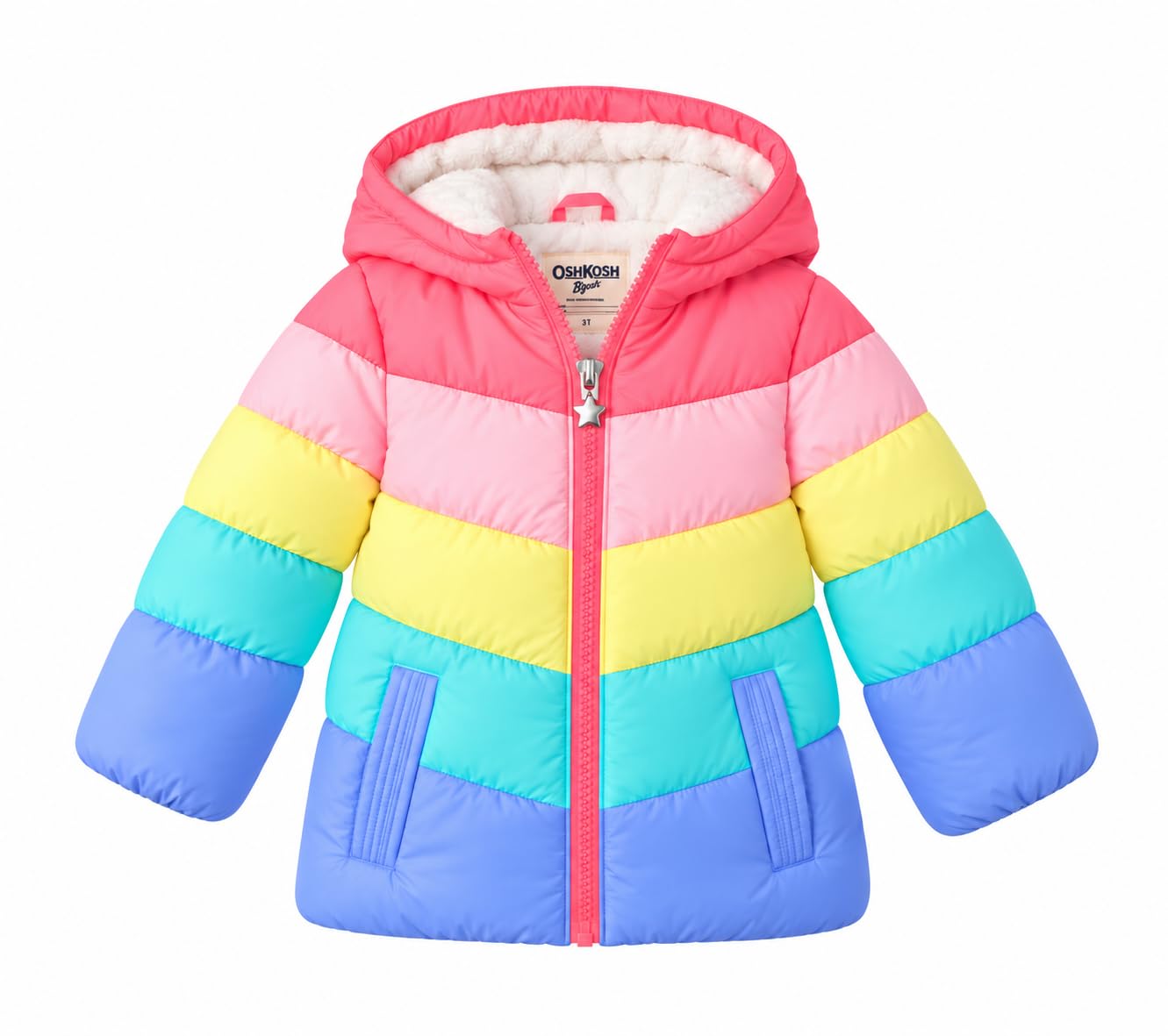
Key Features
- Model: B218771
- Pattern: Colorblocked
- Department: Girls
- Insulation: Heavyweight
- Price: Premium
The colorblock is the first thing anyone notices, and on a dark morning at the bus stop that is not a small thing. Bright stripes do actual work: this is a coat you can pick out of a crowd of kids from the far side of the playground.
Underneath the looks it is a serious heavyweight. It stays warm through a proper northern winter, thick without going rigid, and the zip runs easily enough that a child can manage it herself. There is room for a sweater and for a growth spurt, which matters in a coat at the top of this price range.
That room to grow is the argument for spending more here. It is a coat built to be worn for two seasons by a child who cares what she looks like, and it holds its shape through repeated washing.
It is also a lot of coat for a mild winter. Where January means rain, the medium-weight puffer from the same maker is the better buy, and this one will hang in the closet being admired.
Pros
- Bright colorblock that is easy to spot
- Heavyweight warmth without stiffness
- Room to layer and grow
- Zip a child can work herself
Cons
- Foil-look trim can peel and flake
- Pale panels show dirt quickly
Bright enough to spot across a playground and warm enough for a real northern winter, this is our style-led pick for big kids with opinions.
Best for Babies and Crawlers
Fumdonnie Baby Snowsuit

Key Features
- Type: One-piece snowsuit
- Sizes: Newborn to toddler
- Department: Baby boys
- Price: Budget
Dressing a baby for snow is a wrestling match, and a one-piece wins it: one zip, one suit, done. No gap at the waist where a jacket rides up, and no snow down the back the first time they faceplant into a drift.
Warmth is the point and it delivers, a soft puffy suit that holds heat without going rigid, with enough room for a base layer and a fleece underneath when it is properly cold. It also gets more comments than anything else in the hall, in the way that babies in puffy hoods do.
On and off is quick, which matters when you are doing it four times a day, and the zip runs smoothly enough that you are not fighting it with cold hands. Like any snowsuit, it comes off before the car seat. That is not negotiable.
For a baby, a crawler or a new walker, this beats a jacket-and-snow-pants combination, because there is nothing to come untucked while they are being carried or falling over every few steps. Once a child is running properly, separate coat and pants give more freedom.
Pros
- One piece, so no gap at the waist
- Warm without going stiff
- Room for layers underneath
- Quick on and off
Cons
- Leg snaps can break if pulled open quickly
A baby or early walker is better served by this one-piece than by any jacket here: warm, quick to get on and impossible to ride up.
How We Chose and Tested Kids Winter Coats
We built the shortlist by pulling together 30 coats that parents in our own circles and in customer reviews kept mentioning, then narrowing by available sizes (2T through youth XL), fill type, and price. We looked for a mix of down and synthetic, hooded and hoodless, and styles that could work for a daily school commute as well as a weekend sledding hill. From that group, we tested 12 coats over six months, from October through March.
Each coat went home with a family on our team and lived a normal winter: school drop-off in 20-degree mornings, recess, the walk to the car, and at least one snow day. We checked warmth by feeling the child’s neck and back after 20 minutes outside, and we asked whether they shivered or complained. Fit was judged over a hoodie and a sweater, with a backpack on, and we watched whether the sleeves covered wrists when arms were raised and whether the hem stayed put during a squat. For sizing, we compared the brand’s size chart against actual measurements and noted how much room a child had to grow.
Durability got the hardest test: knees, cuffs, and zipper pulls after a full season of playgrounds and three wash cycles. We noted loose seams, pilling, and whether the water resistance faded. Lightweight coats were judged by whether kids could move freely and carry their own backpack without overheating, while thicker coats were checked for bulk in the car seat. Appearance mattered too — we watched which coats kids actually wanted to wear and whether colors held up after washing. Finally, value came down to whether a coat looked ready to hand down to a younger sibling, not just survive one season.
How to Choose a Kids Winter Coat
Start with the coldest morning your child will realistically stand at a bus stop in, not the warmest word on the hangtag, because most coat regret comes from buying for the wrong winter.
Match the coat’s weight to your winter
Kids’ coats come in four practical weights, and ‘winter’ covers all of them. A lightweight packable is a fall and mild-winter layer. A medium-weight puffer handles a frosty morning and the car ride. A heavyweight or 3-in-1 is the deep-cold coat. A waterproof ski shell is for wet snow and the hill.
The trap is buying a packable for a real winter because it is inexpensive and folds small. It is an excellent second coat and a poor only coat. We would buy for the two or three worst weeks you actually get, and add a lighter jacket later if the budget allows.
Fit: room to layer, without gaps
A coat should fit with a sweater underneath and no more. Sizing up sounds thrifty, but two sizes too big leaves a gap at the neck and cuffs where cold air walks straight in, and a hem hanging past the wrists gets in the way of hands.
If your child is between sizes, take the larger one for a season of growth. If you want two winters out of the coat, size up once, not twice. Check the cuffs and hem before anything else, because those are what keep the warmth in.
Water-resistant or waterproof?
The two words are not interchangeable. Water-resistant fabric shrugs off light snow and drizzle and wets through once a child sits in a snowbank. Waterproof shells, usually with taped seams, are built for sustained wet snow and sledding.
Ask what your winters actually deliver. In a wet, slushy climate a waterproof shell over a fleece earns its higher price. In a cold, dry one you are paying for protection you never use, and a heavyweight puffer keeps a child warmer for less.
Check the zipper first
The closure is the first thing to fail on a kids’ coat, and it fails in a parking lot in the cold with a child who now cannot be zipped in. Look for a chunky metal or molded plastic zip with a pull big enough for small hands, a flap behind it to block wind, and a chin guard at the top.
On a snowsuit, check the snaps at the legs as well. A coat with a good zip and ordinary fill will outlast a beautifully insulated one with a bad closure every time.
One good coat or a system?
Two lighter coats often beat one heavy one: a packable for cool days, travel and the backpack, plus a heavyweight or 3-in-1 for the real cold. A 3-in-1 does that in a single purchase, which is why we think it is usually the better value for a growing child, since you are buying a fall jacket, a winter coat and a spring jacket at once.
An insulated ski shell only makes sense if your family actually gets to the snow. Otherwise the money is better spent on loft you will wear every day.
Frequently Asked Questions
How do I keep my child warm in the car without a bulky coat?
Buckle the harness without the coat first, then look at how much slack the coat adds. If you have to loosen the straps to close the buckle, the coat is too bulky to wear in the seat. Take it off, strap the child in snug, and put the coat on backwards over the harness or use it as a blanket.
How do I wash a puffer coat without flattening it?
Zip it up, wash cold on a gentle cycle with a little detergent and no fabric softener, then tumble on low with two or three clean dryer balls to break up clumps of fill. Zip-out fleece liners do better air-dried. A coat that stays flattened has lost the loft that does the insulating, so take the hour.
Are hand-me-down winter coats worth it?
Usually yes. Check three things before you accept one: the zipper teeth and pull, the loft (pinch the fill, which should spring back rather than stay compressed), and the cuffs and hem, which wear through first. A worn coat with a working zip and full loft beats a cheap new one.
Do I need a snowsuit or a winter coat for a baby?
Before a child is walking much, a one-piece is easier: no gap at the waist when they are carried or crawling, and one zip instead of three. Once they are running around, a coat and snow pants give more freedom and let the coat do ordinary-day duty too. Either way, the suit comes off for the car seat.
Final Verdict
Most families should buy the Children’s Place 3-in-1. It is the coat here that changes with the weather instead of being one fixed weight, and the shell-plus-fleece combination covered more mornings for us than any single-layer puffer.
If your child destroys clothes, the Carhartt is the tougher spend and the better hand-me-down. If your winter means lift lines and wet snow, the GEMYSE shell is the one worth the premium. Everyone else can stop reading and order the 3-in-1.
