This post contains affiliate links. We may earn a small commission when you buy through our links — at no extra cost to you.
A baby hat that slides over the eyes, leaves a red mark across the forehead, or ends up on the sidewalk before you reach the corner isn’t doing anyone any favors. Over four months, we’ve put 16 baby hats on babies — newborns through first-year walkers — during stroller walks, carrier naps, and daycare drop-off. The ones that worked got the basics right: soft seams, a size range that matches head circumferences, and enough adjustability to stay put without squeezing. A good hat keeps a baby warm or shaded, stays on through a stroller ride, and doesn’t turn mornings into a wrestling match.
Here’s what first-time buyers learn quickly: the age on the label is a rough guide — head circumference and a secure brim or tie matter more. Appearance matters, because you’ll reach for the cute hat, but warmth and sun protection are not interchangeable; a thick knit beanie on a July afternoon is a mistake. The right pick depends on season and how often your baby will wear it, and the 16 we tested split into chilly-morning, sunny-day, and everyday options.


Best for Everyday Winter Wear
Carhartt Knit Cuff Beanie
Key Features
- Type: Knit cuff beanie
- Stretch: Generous knit stretch
- Department: Unisex child
- Price: Midrange
A folded cuff does more work on a baby beanie than it looks like it does. It takes up the slack when a hat is a size too big, it rolls down over the ears when the wind picks up, and it shows how much room is left before you need the next size. On this Carhartt the cuff is deep enough to do all three, and the knit behind it gives generously — the hat that sits low on a nine-month-old still covers a two-year-old’s ears.
That stretch is why this is the one we hand to anyone buying a single hat for the cold half of the year. Warmth is where it earns its place: the hat comes down over the ears and stays there, and it holds heat on a windy walk without needing a lining. It also looks right — a shrunken version of the adult beanie with the small logo patch, not a baby-fied novelty. It costs roughly what the other single hats here cost, so the decision is about design rather than budget.
The size labels are the weak point. A 2-5T can arrive closer to infant sizing, so ignore the age range on the listing and buy against head circumference; if the baby is between two numbers, take the larger one and let the cuff make up the difference.
What it won’t do is cover a summer. From about April the sun hats below take over, and a knit beanie in July is just a sweaty head. What it does do is survive: it comes out of the wash the size it went in, the cuff still folds flat, and the shape holds wash after wash.
Pros
- Covers the ears and holds heat
- Stretch and deep cuff fit for years
- Looks like the adult Carhartt beanie
Cons
- No chin strap to stop a determined puller
Our pick for most babies: a stretchy cuffed beanie that covers the ears, fits from baby through toddler, and looks like the adult Carhartt rather than a novelty.
Best for Sunny Days Out
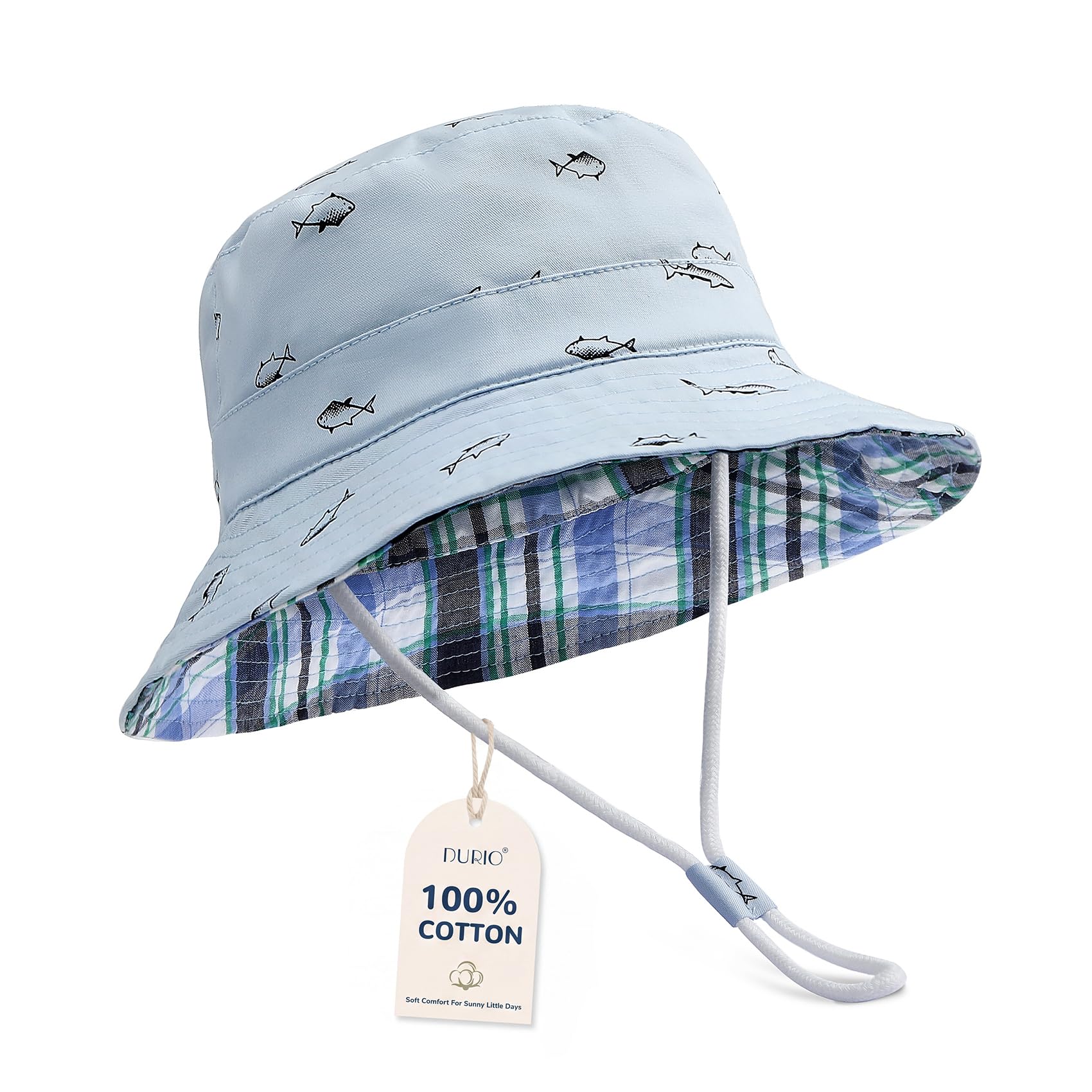
Durio UPF 50+ Sun Hat
Key Features
- Brim: Wide brim
- Adjustment: Crown band and chin strap
- Size range: 0-8 Years
- Sun protection: UPF 50+
- Price: Budget
Two adjusters sounds like a small thing until you have chased a hat across a beach. The Durio tightens around the crown with a band and under the chin with a strap, so a hat bought for a four-month-old can be snugged down today and let out by August. At the lowest price in this guide, it is the sun hat we hand to anyone buying their first.
The brim is wide and holds its shape instead of flopping into the eyes, which is the line between a sun hat and a decorative one. The back shades the neck, but it is a positioning job: pull the hat forward and the front covers the face while the neck is exposed; push it back and you trade one for the other. On a stroller with a canopy, or in a carrier, that is fine. On an open beach, add sunscreen to the neck.
UPF 50+ is the headline claim, and we treat it as fabric coverage rather than a license to skip cream. In use the hat is light enough that it does not become a sweat trap, the chin strap holds through the tenth removal attempt, and the whole thing folds into a diaper bag. It is a shade hat, though — nothing about it keeps a head warm, and it is the wrong purchase for a winter baby.
Pros
- Adjusts at both the crown and the chin
- Wide brim holds its shape and shades the face
- Light enough for hot afternoons
- Least expensive hat in this guide
Cons
- Size labels do not track age cleanly
Two adjusters and a wide brim for the least money here — this is the sun hat most babies end up wearing all summer.
Best for Deep Winter
Moon Kitty Fleece Beanie
Key Features
- Type: Fleece-lined winter beanie
- Lining: Fleece
- Coverage: Full ear coverage
- Price: Midrange
The ears are the whole point of a winter hat, and this one comes down over them and a little onto the cheek. Inside it is lined in soft fleece rather than a scratchy knit, which is the difference between a hat a toddler forgets about and one that comes off at the first tug.
It is a thick hat — thick enough that it stands up on the shelf instead of collapsing — and the pom pom on top gives it enough personality that it does not read as pure utility. The knit stretches, so a hat that is slightly big today sits right in a month, and the lining stops it sliding up over the ears when they move.
For a cold climate, this is the one we pick over the Carhartt for a toddler who spends the day outdoors: the fleece and the ear coverage make it feel like outerwear rather than an accessory. The trade-off is a hat that is too much for a mild day — on a February thaw it ends up in the bag — so it is a second hat rather than the only one.
Pros
- Fleece lining is soft against the head
- Covers the ears and part of the cheek
- Thick and genuinely warm
Cons
- Runs big on petite toddlers
The warmest hat here for a real winter: fleece-lined, thick, and cut low over the ears, so it works for a toddler who is outside every day.
Best for Daycare Rotation
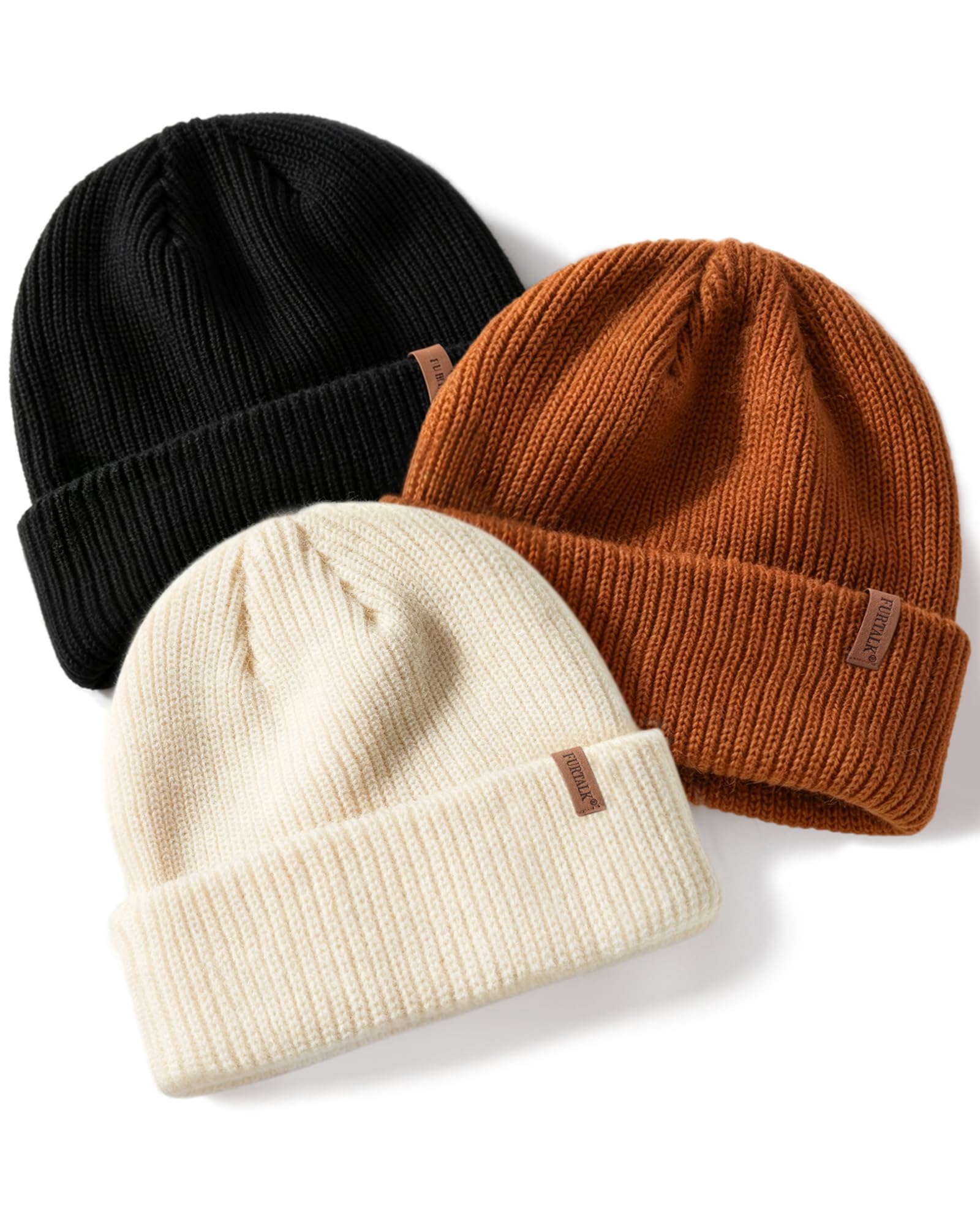
FURTALK 3-Pack Beanies
Key Features
- Cuff: Fold-up cuff
- Pack: 3 beanies
- Type: Knit beanie
- Price: Midrange
Three hats sounds like overkill until you count where a baby hat actually goes: one in the diaper bag, one in the wash, one on the head, and none of them where you need them at seven in the morning. The FURTALK set solves that arithmetic for roughly the price of a single hat elsewhere in this guide.
We think it is the right buy for daycare and for the car. The knits are soft and stretchy rather than stiff, the fold-up cuff adjusts the fit as they grow, and the colors are solid enough to go with whatever else is clean. Losing one stops being a small disaster, which at this age is the real argument.
The knit is properly soft, the kind that does not leave a red line across the forehead after an hour, and the stretch means one set covers a whole winter of growth. Solids also mean the set never looks mismatched, even when all three are in rotation.
Pros
- Three hats for roughly single-hat money
- Soft, high-stretch knit
- Fold-up cuff adjusts the fit
Cons
- Long crown sits low on small babies
Three stretchy knit beanies for about the price of one elsewhere here — the practical answer to daycare, the wash, and the hat nobody can find.
Best for Toddlers on the Go
Carhartt Canvas Baseball Cap

Key Features
- Type: Canvas baseball cap
- Material: Canvas
- Department: Baby boys
- Price: Midrange
A baby baseball cap is a costume unless it is cut like the real thing, and this one is: same canvas, same stitched logo, same curved brim as the grown-up Carhartt, just scaled down. It reads as workwear rather than baby pastel, which is either the reason you are buying it or the reason you are not.
The structure is what earns it a place. A canvas crown holds its shape, so the brim stays facing forward instead of twisting sideways the way a soft bucket hat will, and it shades the eyes properly when the sun drops low. It also goes on in one motion — no cuff to fold, no tie to thread — which is worth something with a toddler who treats getting dressed as a negotiation.
The fit is where it needs a caveat. It runs big, and an infant size can still float on a four-month-old, so in practice this is a toddler’s cap: from about the first birthday, on a head that has filled out, it sits down properly and stays through a playground session.
That is the judgement, then: the best-looking hat here for a toddler, and the one we reach for between March and October, when a knit is too much and a sun bucket is more fabric than the job needs. At about the same money as the knit hats, it is an easy yes once the head fits.
Pros
- Canvas brim stays facing forward
- Looks like the adult Carhartt cap
- Goes on in one motion
Cons
- Elastic back, no adjustable strap
A scaled-down version of the adult cap, with a brim that stays forward and shades the eyes — the right hat for a walking toddler, not a newborn.
Best for Beach and Pool
MaxNova Smile Face Sun Hat

Key Features
- Brim: Wide brim
- Size range: 0-7 Years
- Sun protection: UPF 50+
- Price: Midrange
If the Durio is the sun hat you buy first, this is the one you buy after a summer has taken its toll. The brim is stiffer, so it does not flop into the eyes after a dozen trips in a bag, and the chin drawstring is easy enough to work one-handed while you are holding the baby. That combination is why it is the one that stays in our stroller.
It is a light hat — light enough that a baby in a carrier does not end up with a sweaty head, because the air moves through it rather than sitting in it. The smile face is the part people comment on, and it holds up: the shape survives the wash and the brim keeps its curve.
What we do not get is a cold-weather hat — this is shade through and through, and the knits above take over from October. For the four or five months it is the right hat, it is the one we grab.
Pros
- Stiff brim keeps its shape
- Light and breathable in heat
- Chin drawstring adjusts one-handed
Cons
The sun hat we take when the bag is already full: light, quick to adjust, and stiff enough in the brim to keep shade where you put it.
Best for Cold-Weather Photos
Duoyeree Earflap Pom Pom Hat

Key Features
- Type: Earflap knit beanie
- Detail: Double pom poms
- Fastening: Tie strings
- Size range: 0-36M
- Price: Budget
Earflaps and ties are the two features that keep a hat on a baby who has decided hats are a personal insult. This one has both: soft flaps over the ears, strings under the chin to knot, and double pom poms for good measure. It is the least subtle hat in this guide, and the one people ask about.
Under the decoration it is a proper winter hat. The knit is tight and warm, the flaps do real work on a cold walk rather than sitting there looking cute, and the inside is lined and soft against the head — we were struck by how comfortable it feels for something that reads as a novelty on the shelf.
Where we land: this is the hat for a first birthday, a holiday card, and the cold snap in between, and it earns its place because it is genuinely warm as well as cute. It is a going-out hat rather than the one that lives in the diaper bag, and that is a fine thing for a hat to be.
Pros
- Earflaps cover the ears properly
- Ties keep it on
- Warm knit with a soft lining
Cons
- Runs small for the stated months
- Tie strings run short
The one with earflaps, ties, and double pom poms: a winter hat that stays where you put it and photographs better than anything else here.
How We Chose and Tested Baby Hats
We started with a long list of hats from brands we’d used and ones that kept surfacing in parent reviews, then filtered by fabric, size range, and whether the adjustment system looked sturdy enough for a wiggly baby. We landed on 16 and tested them over four months.
Each hat went on at least three stroller walks, two carrier naps, and one daycare drop-off. We measured each baby’s head circumference before fitting, checked whether the hat stayed put when they turned their head or grabbed the brim, and looked for red marks or pressure points after 20 minutes. On chilly mornings, we felt the back of the baby’s neck for sweat or chill; on sunny afternoons, we checked whether the brim actually shaded the eyes and whether the fabric carried a UPF rating. For adjustability, we fastened and unfastened ties, snaps, and elastic toggles one-handed while holding a baby, then checked whether the fit held after a nap.
We turned every hat inside out to inspect seams and lining, washed each one twice, and noted pilling, fading, or stretched-out brims. Size and age-appropriate labels got a reality check: we tried hats on babies at the low and high end of each size range and compared the fit to the head circumference chart. Appearance came down to whether the shape survived the wash and looked intentional with a plain onesie. The hats that made the list are the ones that stayed on without fuss and kept babies comfortable.
How to Choose a Baby Hat
The hat that works is the one that fits the head in front of you and stays on it, so start with the adjusters and a tape measure rather than the age printed on the label.
Size by the Head, Not the Birthday
Age ranges are the least reliable number on a baby hat listing. The same six-to-twelve-months can be snug from one maker and a swimming helmet from another, and the labels inside the hat do not always match the range on the page. Measure around the widest part of the head, just above the ears and eyebrows, and buy against that number.
Between sizes, take the larger hat when it has a deep cuff you can fold, and the smaller one when it does not. A hat that slides down over the eyes is a sizing problem, not a strap problem, and no amount of tightening fixes it.
What Actually Keeps a Hat On
A sun hat needs at least one adjuster and ideally two: a band around the crown to take up slack and a strap under the chin so it cannot be flung into the stroller wheels. A knit beanie needs the opposite approach, since there is nothing to fasten — generous stretch and a deep fold-up cuff are what hold it on and let it fit for more than one season.
If your baby has already learned that pulling hats off is a game, buy the tied or strapped version rather than the pull-on. The fastening is the difference between a hat that is worn and a hat that lives in your pocket.
Warmth, Shade, and Why You Need Both
One hat cannot cover the year. For cold weather, look for ear coverage and a lining: a hat that stops at the top of the ears is a hat for a mild day, whatever the label says. For sun, UPF 50+ fabric and a brim wide enough to shade the face matter far more than the print.
Most families end up with two hats per size, one knit and one brimmed, which is cheaper than replacing a summer hat in November because it was the only one you owned.
Lining and What Sits Against the Skin
A scratchy hat comes off. Fleece or a soft jersey lining is what lets a hat stay on for a whole walk, so check the inside as carefully as the outside — seams, tags, and the texture of the knit against a forehead.
Lining also does the work in cold weather. A fleece-lined beanie holds heat with a thinner shell, which means less bulk on a head that is still small, while a plain acrylic knit needs more thickness for the same warmth.
One Good Hat or a Handful
Single hats and multipacks cost roughly the same here, so the question is how you lose things. A three-pack makes sense for daycare, the car, and the diaper bag, where hats vanish at a rate no laundry schedule keeps up with. A single good hat makes sense if you will actually keep track of it.
Our rule: buy the multipack for the hat that gets lost, and spend the money on the one that gets worn.
Frequently Asked Questions
Can my baby sleep in a hat?
No. Hats come off for naps and nighttime. A hat with ties or a chin strap is the bigger concern, since a loose cord can catch in a crib, and a hat also holds heat a sleeping baby does not need. Keep hats for stroller walks and outdoor naps where you are watching.
If you are unsure whether a baby is warm enough, feel the back of the neck rather than the hands or forehead — that is the reading that matters.
Does UPF 50+ mean I can skip sunscreen?
No. UPF describes how much UV gets through the fabric, not what happens to skin the hat does not cover. The neck, ears, shoulders, and hands are still exposed below the brim and still need sunscreen.
Treat the hat as your first layer of shade, apply cream to everything it does not cover, and keep a young baby in the shade where you can.
How should I wash a baby hat?
Wash it before the first wear — new knit arrives with sizing and dye on it, and it sits right against the forehead. A cold machine wash is fine for most knit beanies and cotton sun hats; skip fabric softener, which coats the fibers and can dull the stretch.
Lay knits flat to dry so the cuff does not stretch out of shape, and reshape a damp brim by hand before it dries.
Final Verdict
Buy the Carhartt cuff beanie first. It covers the ears, it stretches through a couple of winters, and it costs about what the other single hats here do, which makes it the safest hat purchase in this guide.
What changes the answer is the season. For warm weather the Durio is the better buy, with two adjusters and a wide brim for the least money here. And if the hat is going to live at daycare, take the FURTALK three-pack and stop keeping score.
